

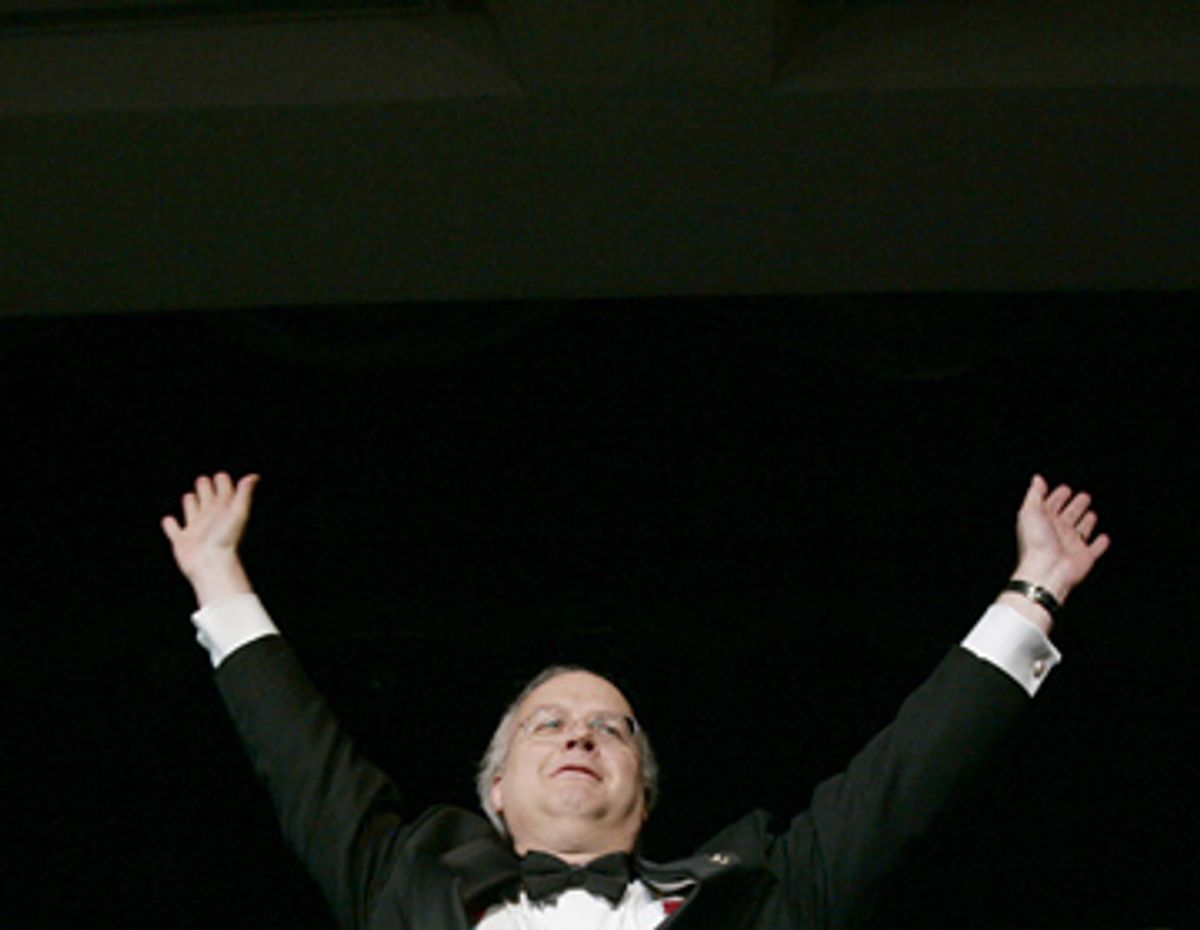
With the departure of Karl Rove the Bush administration now enters its last throes. As a legacy for his patron, Rove has designed the public relations offensive for the fall presidential campaign to attempt to corner congressional Democrats through a combination of Gen. David Petraeus' forthcoming report on the "surge" in Iraq and presidential budget vetoes; but once those tactics are played the political string runs out. President Bush will be left with the unalloyed counsel of Vice President Dick Cheney, whose endgame transcends Rove's machinations. "I don't worry about the polls," Cheney said on CNN's "Larry King Live" on July 31. One more hypothetical restraint on Cheney has been removed.
Rove's resignation marks a tacit recognition of the failure of his theory of political realignment, though hardly of its consequences. Trailing him out of the West Wing is the cloud of a subpoena from the Senate Judiciary Committee that seeks his testimony about his primary role in purging U.S. attorneys for partisan purposes. But even when Rove leaves government service at the end of August, Bush will extend the protective cover of executive privilege.
Rove's merger of politics and policy was an effort to forge a total one-party state. While he is acclaimed as a political strategist, his true innovation was in governing. He sought to subordinate the entire federal government to his goal of creating a permanent Republican majority. Every department and agency has been subject to an intense and thorough politicization. Indeed, Rove's ambitious plan was tantamount to a proto-Sovietization. Even science has been suppressed in the name of the party line, recalling the Lysenko episode. Cheney and Rove acted as the pincers of the unitary executive. While Cheney sought to concentrate unaccountable power in the presidency, Rove brought down the anvil of politics on the professional career staff.
Rove's radicalization of government was early described by the first member of the administration to quit in disgust, John DiIulio, a University of Pennsylvania professor and the first director of the White House Office of Faith-Based and Community Initiatives. He discovered that "compassionate conservatism," Rove's slogan for Bush's 2000 campaign, was little more than a sham. "What you've got is everything -- and I mean everything -- being run by the political arm. It's the reign of the Mayberry Machiavellis," said DiIulio.
Rove's saga is a rags-to-riches success story of a political serial killer. His first involvement in a political campaign was to conduct a dirty trick against a candidate running for Illinois state treasurer. After Rove dropped out of the University of Utah, his promise was recognized and he was appointed executive director of the College Republicans. Donald Segretti, ringmaster for the Committee to Reelect the President of a gang of dirty tricksters engaged in what he called "ratfucking," recruited Rove. Rove conducted one session training young Republicans to sift through the garbage of opponents. In the Watergate scandal, Segretti was sentenced to prison for forging campaign literature. The FBI questioned Rove, but dropped its investigation of the small fry. Yet he would become the greatest rat fucker of them all. The new chairman of the Republican National Committee, George H.W. Bush, named Rove chairman of the College Republicans and, even more fortuitously, appointed him as a handler of his obstreperous older son. It was love at first sight, at least from the nerdy Rove's point of view. "Huge amounts of charisma, swagger, cowboy boots, flight jacket, wonderful smile, just charisma -- you know, wow," he said later.
Rove weathered rough storms, including being fired in 1992 from the Bush for President campaign by the candidate himself for leaking damaging information to conservative columnist Robert Novak about the elder Bush's close friend and top fundraiser Robert Mosbacher.
In 1981, Rove established a direct-mail firm, Karl Rove & Co., in Austin, Texas, which became his cockpit for the destruction of the state Democratic Party. Over more than the next decade, he was involved in dozens of campaigns marked by dirty tricks, sexual innuendo and the use of friendly FBI agents and prosecutors to harass Democrats. In Texas and elsewhere, he laid the groundwork for his later efforts. The whispering campaign in 1994 against Gov. Ann Richards claiming that she was a lesbian and the rumor-mongering that an esteemed Alabama state judge was really a secret pedophile were harbingers of the smear campaign against Sen. John McCain in the South Carolina primary in 2000. Rove's exploitation of prosecutors pioneered his later politicization of U.S. attorneys.
Rove promoted the Bush campaign for president in 2000 as a national extension of his realignment of Texas politics. He cast Bush as William McKinley and by inference himself as the political boss Mark Hanna. Rove's historical analogy was either the autodidact's self-inflated misreading of history or a shrewd manipulation of a gullible and careerist press corps, or both. Whatever Rove's pretension, Bush lost the 2000 election, unlike McKinley in 1896, which was a major victory of the Republican Party. There was no parallel except in the name of the party: One election marked a genuine realignment of Republican support, firmly consolidating its uncertain majority since the Civil War. The other was a gift handed to the loser of the popular majority in a decision not so contrived since Dred Scott. George W. Bush is less William McKinley than Rutherford B. Hayes.
Nonetheless, Bush began governing as if he had a mandate for the most radical presidency ever. The story is told that before the inauguration Bush pollster Matthew Dowd (now another disillusioned and lost soul) wrote a memo to Rove explaining that there was no middle in American politics and that only those who turned out their maximum base through polarization would win. Yet, Dowd memo or not, Bush, Cheney and Rove were prepared to govern as radicals. The theory helped justify what had been decided already.
Only the attacks of Sept. 11 gave Rove, Bush and Cheney an atmosphere in which such theories could thrive through the exploitation of fear. Rove became the public exponent of using terror as a political instrument to demonize the Democrats as unreliably soft. Just before the 2002 midterm elections swept by Republicans, Rove held forth on the coming realignment. "Something is going on out there," Rove said. "Something else more fundamental ... But we will only know it retrospectively. In two years or four years or six years, [we may] look back and say the dam began to break in 2002."
After the Republican victories in 2002, an enraptured press corps celebrated Rove. "Let me disclose my own bias in this matter. I like Karl Rove," wrote David Broder, the lead political columnist for the Washington Post, on May 18, 2003. "In the days when he was operating from Austin, we had many long and rewarding conversations. I have eaten quail at his table and admired the splendid Hill Country landscape from the porch of the historic cabin Karl and his wife Darby found miles away and had carted to its present site on their land."
The 2004 election should have been a foregone conclusion, and perhaps it was, based on the momentum from 9/11. Rejecting Bush at that early point, a year after the invasion of Iraq, would have been an extraordinary repudiation not only of him but of the public's recent and continuing support before it had come to the conclusion that his policies had been given a full chance and were not working. The 2004 election also took place before the further radicalization of policy and politics that was to occur in its immediate aftermath -- the Terri Schiavo case, "the last throes" in Iraq and Hurricane Katrina. Bush and Rove also faced a flawed Democratic candidate and campaign that steadfastly refused to respond to the early smears of Sen. John Kerry's heroic war record, declined to offer any critique of the administration at the Democratic National Convention, and was tentative and inarticulate on issues concerning the Iraq war. And yet Bush still barely eked out a victory, dependent ultimately on slim margins in swing states reinforced by initiatives against gay marriage.
At the St. Regis Hotel, just blocks from the White House, a week after the election, the panjandrums of the Washington press corps hailed Rove at a lunch held by the Christian Science Monitor. "When Rove entered the room, everyone stood up to congratulate him and shake his hand," reports Joshua Green in the September issue of the Atlantic.
Once again, Bush and Rove plunged forward. "I earned capital in the campaign, political capital, and now I intend to spend it," Bush proclaimed. "It is my style." Bush's first proposal of the second term, politically devised by Rove, was to privatize the great achievement of the New Deal -- Social Security. But it never even reached a single congressional hearing room. Soon the winds and water of Katrina washed away the façade. Bush named Rove reconstruction czar for New Orleans. He did little except for the permanent removal of about a quarter million black voters who held the political balance of power in Louisiana.
As the aftereffects of fear from 9/11 receded, Rove's strategy of using terror as the main political weapon against Democrats dulled. Rove himself was engulfed in the investigation into the White House's outing of a covert CIA operative, Valerie Plame Wilson, in order to damage her husband, ambassador Joseph Wilson, for having revealed that the rationale for the invasion of Iraq was based on bogus claims about Saddam Hussein. Rove escaped indictment for perjury and obstruction of justice only by the skin of his teeth, amending his grand jury testimony at the last minute after a helpful journalist at Time magazine told his lawyer that Matthew Cooper, a correspondent there, had evidence of Rove's involvement.
On the eve of the 2006 midterm elections, the press corps continued to salute Rove's genius. "The emphasis, for those who want to understand the world, should be on 'genius' and not 'evil' (as in Rove is an 'evil genius')," wrote Mark Halperin, then political editor of ABC News, in Slate. He went on: "People who live in Bethesda, Chevy Chase, and Manhattan should understand that in much of red America, Rove is beloved and respected, and they should ask themselves why that is."
After the Republicans lost Congress, Rove blamed the disaster on one wayward homosexual Republican member, Rep. Mark Foley of Florida, not on the administration's policies. Still treated as an oracle, Rove was invited to the Aspen Institute's Idea Festival two years in a row. On July 9, he told the assembled eminences, intellectuals and corporate executives that conditions were fine in the Guantánamo prison camp for detainees. "Our principal health problem down there is gain of weight, we feed them so well," he said. Next, he predicted that the Iraq war would not be a defining issue in the 2008 presidential campaign. "I think it's likely not to be the dominant issue because I think, because of my assumptions about where it is -- where it is likely to be."
Perhaps Rove quit because he wishes to cash out, securing corporate contracts, lecture fees and a book advance, as the sun begins to set on the Republican White House. Perhaps he will act as an unofficial go-between for Bush and advisor to the Republican candidate in 2008. Whatever his gambits, he will remain protected by executive privilege for the duration and beyond. "We've been friends for a long time, and we're still going to be friends," Bush said as he hugged Rove. "I would call Karl Rove a dear friend."
We now take leave of the "Architect," "Turdblossom," and the "Mayberry Machiavelli," his grand experiment in political realignment collapsed, and remember him as he wants to be remembered, rapping onstage as MC Rove at the 2007 Radio and Television Correspondents Association dinner as members of the Washington press corps bopped and shimmied as his backup dancers.
Shares