

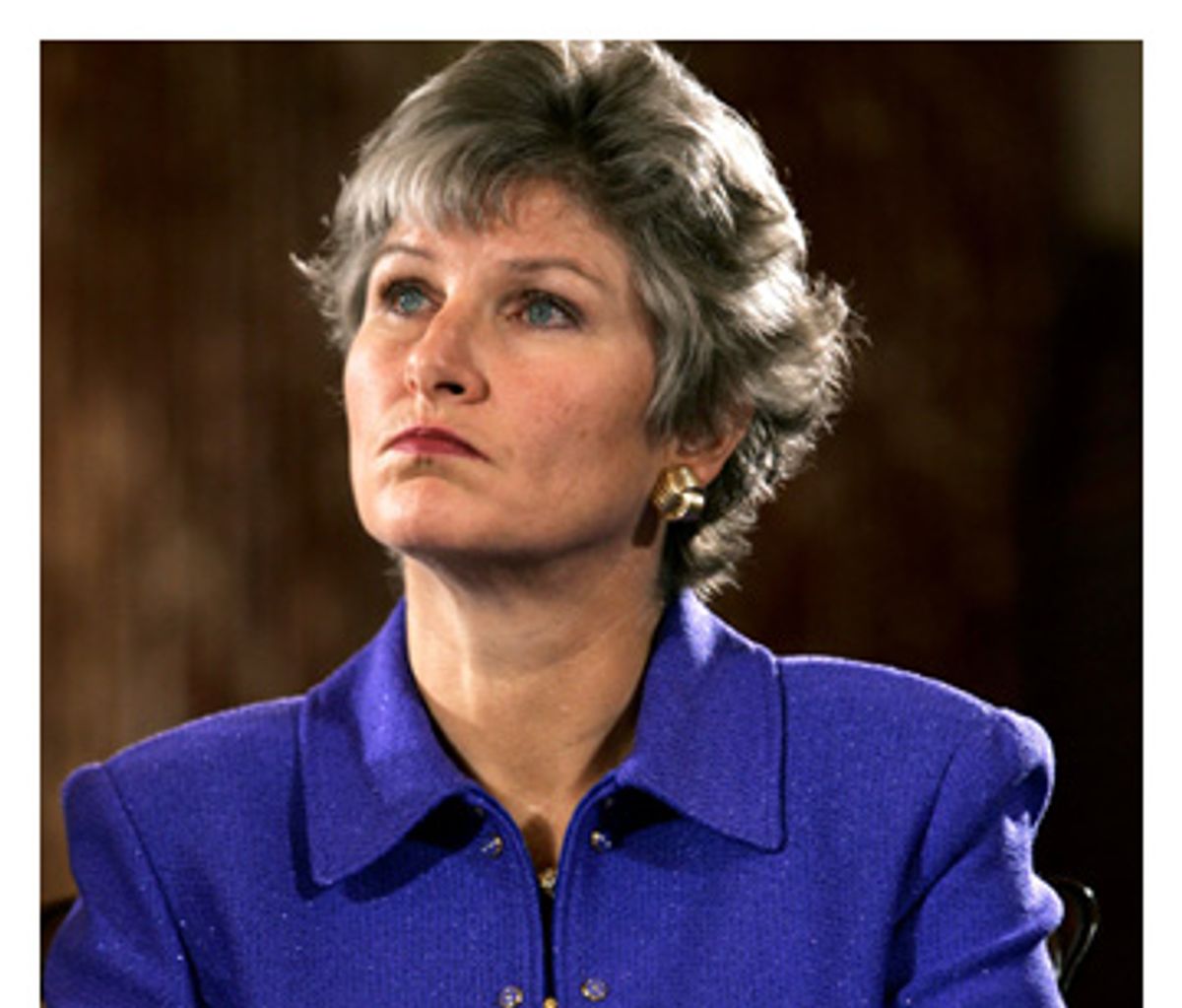
Karen Hughes
Undersecretary of State for Public Diplomacy and Public Affairs
U.S. Department of State
2201 C St. NW
Washington, DC 20520
Dear Karen Hughes:
You may recall that we met briefly in January 2001, during the transition to the Bush administration, when you dropped by my office in the White House. You were filled with enthusiasm and I wished you good luck. Now I am writing you as the executive producer of a documentary, "Taxi to the Dark Side" (directed by Alex Gibney), to invite you to a private preview in Washington on Oct. 18. The film has been described by the New York Times as "a meticulous examination of American policy on the interrogation of prisoners. It traces the scandals at Abu Ghraib and elsewhere to official changes of policy originating in the vice president's office and approved by the secretary of defense. We see documents listing approved methods of interrogation, including waterboarding, which simulates drowning."
The film includes interviews with military interrogators, victims and families of those tortured, and with members of the Bush administration who opposed the policy, such as former general counsel of the Navy Alberto Mora and Lawrence Wilkerson, former chief of staff to Secretary of State Colin Powell.
"Taxi to the Dark Side" has won the prizes for best documentary at the Tribeca, Newport and Ojai film festivals, will be aired this month on major television channels throughout Europe, is being shown next week by special request at the European Union's annual ministerial meeting, and will be distributed commercially by Think Films in theaters throughout the U.S. and Europe in January 2008, after which it will be broadcast on the Discovery Channel. The Times calls "Taxi" devastating." The Guardian of London says its documentation is "irrefutable."
One Defense Department official, believing the administration policy on detainees and torture to be illegal and counterproductive, told me that in his and others' efforts to reverse it they approached you as a last hope. After all, you have virtually unrestricted access to the president. But he recounted that you rebuffed them, and described your attitude as dismissive.
Your complicity in the torture policy is one reason that I am writing you. Despite the futility of those inside the administration in bringing the problem to you, you still remain in place to redress it. As the undersecretary of state for public diplomacy, responsible for defending America's reputation in the world, you must engage the issue that has most seriously damaged our image. Your obligation will continue so long as you hold your post. Those who care about the good name of the United States will not cease viewing you as a last resort, even if you disdain or ignore them, because they cling to the desperate hope that a nagging conscience or its sudden awakening will compel you actually to do your job.
If you were to start performing your mission in earnest, you would have to persuade the president and his spokespeople to acknowledge the truth of their policy. On Oct. 4, the New York Times reported that in 2005 the Justice Department under former Attorney General Alberto Gonzales issued a secret opinion justifying torture despite President Bush's repeated claim, "We do not torture." According to the Times, "The new opinion, the officials said, for the first time provided explicit authorization to barrage terror suspects with a combination of painful physical and psychological tactics, including head-slapping, simulated drowning and frigid temperatures." Then Deputy Attorney General James Comey opposed the policy and "told colleagues at the department that they would all be 'ashamed' when the world eventually learned of it." When the Times' story broke, White House press secretary Dana Perino responded with a familiar refrain: "We do not torture."
Yet the revelations in the Times fit with those disclosed by the former head of the Justice Department's Office of Legal Counsel, Jack Goldsmith, in his new book, "The Terror Presidency." Goldsmith was appointed to this highly sensitive position because he was trusted politically as a conservative, a member in good standing of the Federalist Society and an ardent believer in President Bush's policies. Upon assuming office in October 2003, Goldsmith began a review of existing opinions, including those on torture. As White House counsel, Gonzales had called the Geneva Convention against torture "quaint," and the president had affirmed two opinions abrogating the convention. In a now notorious opinion, written on Aug. 1, 2002, deputy assistant OLC counsel John Yoo declared that torture consisted of pain "associated with a sufficiently serious physical condition or injury such as death, organ failure, or serious impairment of body functions." In other words, torture was whatever the president said it was. Goldsmith writes that the message of the OLC opinion was clear: "The torture law doesn't apply if you act under color of presidential authority."
In his review, Goldsmith found that the legal analysis behind these opinions on torture displayed an "unusual lack of care and sobriety" and was "deeply flawed." The stakes, moreover, put at risk the United States' "decades-long global campaign to end torture, relations with the Muslim world and the nation's moral reputation and honor." Goldsmith decided that the opinions underpinning the administration's interrogation regime could not be legally defended, and he withdrew them. While Comey supported him, "important people inside the administration had come to question my fortitude for the job, and my reliability." Goldsmith resigned on principle after serving less than a year.
You are the last member of the so-called Iron Triangle of the president's Texas political team still in government. The others have departed. In an article in the Washington Post on Oct. 7, former members of the administration gave interviews presenting themselves as increasingly embittered, disenchanted and alienated. The newspaper reports, "The long-term ideals that many of them came to the White House to pursue appear jeopardized, even discredited to many. They tell themselves that they have acted on principle, that the decisions they helped make will be vindicated. But they cannot be sure." You alone remain to alter the course of events that might somehow change the historical perception of the Bush presidency and those who served him, a legacy already deeply engraved.
The genius of your appointment is that the president and his advisors understood ahead of time that they would need your services to repair the nation's reputation. After all, this position has never existed before; and it has never been so drastically needed. While it is true that there have been organizations within the government, such as U.S. Information Agency, under directors such as Edward R. Murrow and John Chancellor, that built libraries and conducted international educational exchanges, the idea of a public diplomacy czar is novel. Having someone to paper over the country's mistakes by telling people what they should think despite the reality would in the past have been considered undemocratic. Form and content, it would have been said, needed to complement each other. But your position is one in which form and content (words and deeds) stand in opposition to each other. Ironically, therefore, your job has never been more important than now.
So far, to be honest, you have earned a reputation for being out of touch, for spouting platitudes without understanding the underlying issues. You are seen as oblivious to the concerns and sensibilities of groups of foreigners with whom you have met. However noble the abstractions of your rhetoric, your speeches are uniformly received as irrelevant propaganda. Even after objective observers have called attention to this pattern, you have done little to adjust. While it would be unfair to put the entire burden of transforming the image of the United States on you, it is a sad fact that your actions have deepened cynicism about American motives. And your inability to change has been consistent with the administration's unwillingness to shift course in the face of demonstrable failure.
If you still wish to succeed, you must finally come to terms with how you and the administration are perceived. Self-awareness is the first step to recovery. Denial has been more than this administration's pervasive state of mind; it has become its prevailing strategy. When other rationales have been shown to be false, hollow or self-undermining, denial has invariably become the last defense. Even when presented with irrefutable facts -- there were no WMD, there were no links between Saddam Hussein and Osama bin Laden, and torture has indeed been the official policy -- the administration resorts to transparent gestures of denial: "We do not torture." But repeating a falsehood does not make it true. As one American president who was a keen student of public opinion put it: "You cannot fool all of the people all of the time." But this truism does not seem to have come to the attention of the White House or of your office. I hope it is not a shock to you that the strategy of denial is not working. It is your job, after all, not only to take into account the considered views of others but to assess objectively what works and what does not. Acknowledging that this persistent reaction is not achieving its goal is essential to learning from failure.
The issue of torture is a special case. Torture is state-sanctioned deviant behavior. It is degrading, arbitrary, cruel and illegal. As all responsible intelligence officers know, torture is the least productive technique of all, and torture yields inherently tainted information. Torture destroys the humanity of more than those tortured. It destroys the souls of those performing the torture. When Americans torture, Americans are shattered. Torture feeds secrecy. It undermines democracy. And it is shameful. Even the Gestapo and the KGB tried to hide their torture. Torture is considered uncivilized by most of the world's nations. At the Nuremberg war crimes tribunals, the U.S. tried, convicted and executed Nazi leaders for engaging in torture. Those that do not adhere to international treaties against torture are rightly branded rogue nations. Torture is the mark of tyrannies.
Moral authority is an impalpable but measurable quality in U.S. foreign policy. From our founding, the idea that the nation should be an example to the world has been central to our identity and leadership. When we have fallen short of our ideals, our willingness to engage in self-examination and self-reform has been critical to our reputation as a special nation. Our credentials for leadership have depended upon our capacity for change.
Nations may blunder and presidents may miscalculate. But nations that commit crimes against humanity and presidents who authorize torture have been deemed pariahs, subject to international quarantine and opprobrium. After World War II, the U.S. was widely admired for its leadership in establishing the Geneva Conventions and the United Nations Charter for Universal Human Rights. The American conduct at the Nuremberg tribunals set the highest standards and respect for human rights, justice and the rule of law. When U.S. officials such as yourself ask foreign peoples to embrace the ideals and values that they clearly see being violated by the administration's behavior, you succeed only in fostering cognitive dissonance at best and contempt for hypocrisy at worst.
Since the Revolutionary War, at the order of George Washington, Americans have consistently opposed torture as a policy. Only one president, George W. Bush, has adopted torture as a policy. This administration stands outside more than the international treaties we have signed and previous presidents have upheld. This administration stands beyond the American tradition and values.
The terrorist attacks of Sept. 11 were heinous and barbarous. But they and subsequent threats are no reason for abandoning our commitment to the rule of law. Other nations that have been subjected to terrorist attacks since Sept. 11 -- Spain and Britain -- have not succumbed to torture. Even in the dark hours after Pearl Harbor torture was not adopted as a policy. During the Cold War, when the U.S. faced the potential existential threat of nuclear annihilation, torture was never adopted as a policy. Goldsmith writes, "The Bush administration's go-it-alone approach to many terrorism-related legal policy issues is the antithesis of Roosevelt's approach in 1940-1941 ... The Bush administration has operated on an entirely different concept of power that relies on minimal deliberation, unilateral action, and legalistic defense."
Not a week goes by without President Bush citing Saddam Hussein's cruelty and butchery as a justification. The tragic irony of pursuing his torture policy while denouncing Saddam's appears to be lost on him and on you. But it is not lost on the rest of the world.
Of course, as someone who has spent years in politics, you must be aware of the polls. According to the most recent Pew poll of global public opinion, taken this June, the downward trend since 2002 of the image of the United States has continued "in most parts of the world. Favorable ratings of America are lower in 26 of 33 countries for which trends are available. The U.S. image remains abysmal in most Muslim countries in the Middle East and Asia, and continues to decline among the publics of many of America's oldest allies. Favorable views of the U.S. are in single digits in Turkey (9 percent) and have declined to 15 percent in Pakistan. Currently, just 30 percent of Germans have a positive view of the U.S. -- down from 42 percent as recently as two years ago -- and favorable ratings inch ever lower in Great Britain and Canada."
Perhaps if you look closely at the problem, the solution to your dilemma may appear. Your words are not forging a new reality. Lying about the war in Iraq, or torture, is not building the bridges of understanding you are so fond of talking about in your speeches. Instead, empty words only fritter away at your ability to influence. There is power in truth.
You might also use your acquired skills in diplomacy among your colleagues in the inner circle of the White House. Perhaps you could talk to them about the dangers of politicizing and militarizing fear. They are a group, as Goldsmith has pointed out, consumed with "fear bordering on obsession." When he informed the White House that one of its counterterrorism programs was illegal, Vice President Cheney's then counsel, David Addington, angrily lashed out, "If you rule that way, the blood of the hundred thousand people who died in the next attack will be on your hands." As Addington demonstrated, when legal artifice falls, bullying takes its place. Fear has become a license for quelling not only political criticism but also the rule of law.
As you know only too well, fear-mongering, though it has worked well politically at home, has backfired abroad, breeding hatred throughout Muslim and Arab lands. Public diplomacy should assuage fear, not fan its flames; enable understanding, not hostility. Perhaps, while you're talking to your colleagues, you might explain that the opinion of the world matters, and that while it might be "soft power," not "hard power" like a piece of military equipment, it directly impinges on global stability. You might tell them that persisting in a policy of torture has threatened our national security.
While you are rethinking how to calm fears and rebuild America's image as a global leader perhaps you ought to begin to think of yourself not as a tool of the Bush administration but as a citizen of the world, not as a propagandist, constantly trying to formulate a hollow ideological phrase or distraction, but as someone who can admit mistakes and correct them.
If you receive this letter as simply a partisan broadside and can't envision your transformation into a true diplomat at large, an envoy of healing, perhaps you should just resign. Nothing will be served by continuing on your current course. Nothing different will happen. You might as well return to Texas now. To date, your diplomacy has consisted of excuses for leaving the damage to the next president to remedy.
Soon you will be reminiscing about the Bush presidency. Will you be agitated and depressed like your former colleagues described in the recent Washington Post report? Will you persist in fantasies of denial? Or you will be, as Comey suggested you should be, "ashamed"?
If you can attend the screening of "Taxi to the Dark Side," please let me know. Otherwise, I can send you a DVD and you can share it with the president.
Shares