

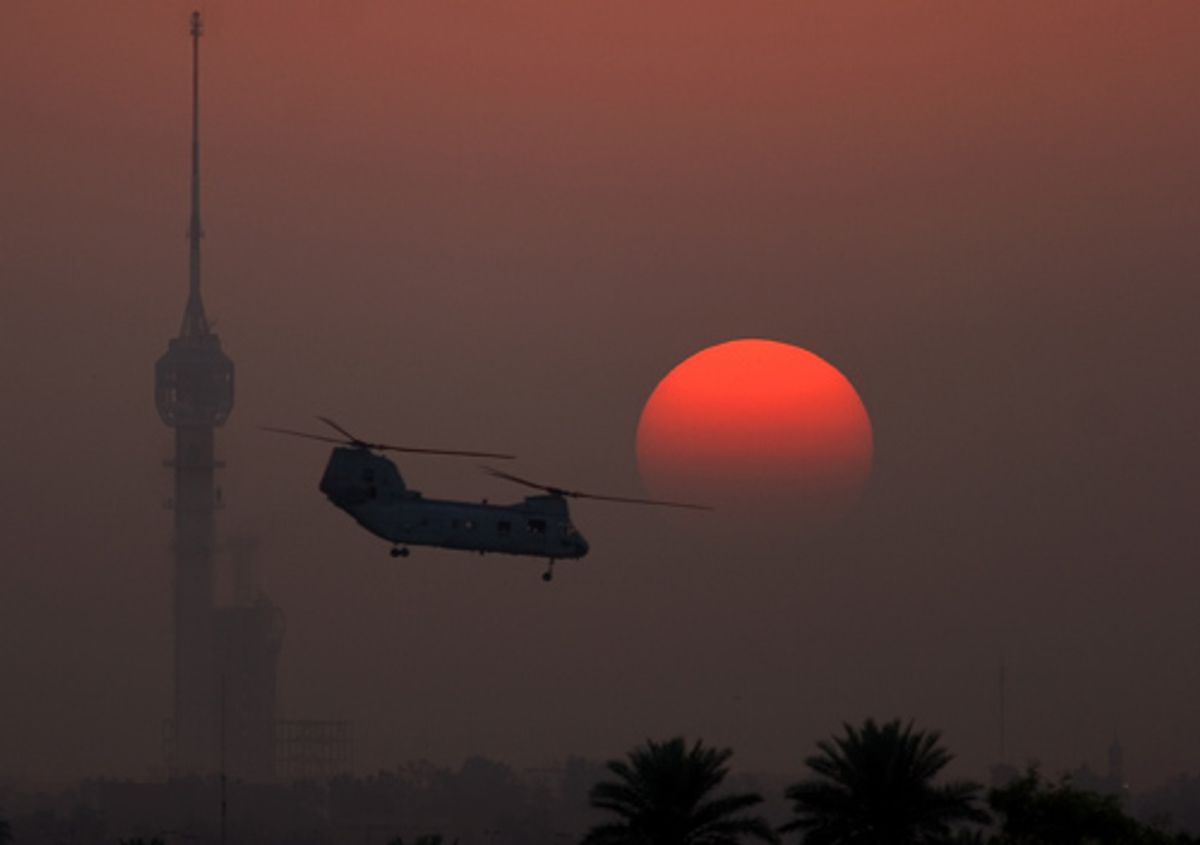
We're in a new period in the war in Iraq -- one that brings to mind the Nixonian era of "Vietnamization": A president presiding over an increasingly unpopular war that won't end; an election bearing down; the need to placate a restive American public; and an army under so much strain that it seems to be running off the rails. So it's not surprising that the media is now reporting on administration plans for, or "speculation" about, or "signs of," or "hints" of "major drawdowns" or withdrawals of American troops. The figure regularly cited these days is less than 100,000 troops in Iraq by the end of 2006. With about 136,000 American troops there now, that figure would represent just over one-quarter of all in-country U.S. forces, which means, of course, that the term "major" certainly rests in the eye of the beholder.
In addition, these withdrawals are -- we know this thanks to a Seymour Hersh piece, "Up in the Air," in the Dec. 5 New Yorker -- to be accompanied, as in South Vietnam in the Nixon era, by an unleashing of the U.S. Air Force. The added air power is meant to compensate for any lost punch on the ground (and will undoubtedly lead to more "collateral damage" -- that is, Iraqi deaths).
It is important to note that all promises of drawdowns or withdrawals are invariably linked to the dubious proposition that the Bush administration can "stand up" an effective Iraqi army and police force (think "Vietnamization" again), capable of circumscribing the Sunni insurgency and so allowing American troops to pull back to bases outside major urban areas, as well as to Kuwait and points as far west as the United States. Further, all administration or military withdrawal promises prove to be well hedged with caveats and obvious loopholes, phrases like "if all goes according to plan and security improves..." or "it also depends on the ability of the Iraqis to..."
Since guerrilla attacks have actually been on the rise and the delivery of the basic amenities of modern civilization (electrical power, potable water, gas for cars, functional sewage systems, working traffic lights, and so on) on the decline, since the very establishment of a government inside the heavily fortified Green Zone has proved immensely difficult, and since U.S. reconstruction funds (those that haven't already disappeared down one clogged drain or another) are drying up, such partial withdrawals may prove more complicated to pull off than imagined. It's clear, nonetheless, that "withdrawal" is on the propaganda agenda of an administration heading into midterm elections with an increasingly skittish Republican Party in tow and congressional candidates worried about defending the president's mission-unaccomplished war of choice. Under the circumstances, we can expect more hints of, followed by promises of, followed by announcements of "major" withdrawals, possibly including news in the fall election season of even more "massive" withdrawals slated for the end of 2006 or early 2007, all hedged with conditional clauses and "only ifs" -- withdrawal promises that, once the election is over, this administration would undoubtedly feel under no particular obligation to fulfill.
Assuming, then, a near year to come of withdrawal buzz, speculation and even a media blitz of withdrawal announcements, the question is: How can anybody tell if the Bush administration is actually withdrawing from Iraq? Sometimes, when trying to cut through a veritable fog of misinformation and disinformation, it helps to focus on something concrete. In the case of Iraq, nothing could be more concrete -- though less generally discussed in our media -- than the set of enormous bases the Pentagon has long been building in that country. Quite literally multibillions of dollars have gone into them. In a prestigious engineering magazine in late 2003, Lt. Col. David Holt, the Army engineer "tasked with facilities development" in Iraq, was already speaking proudly of several billion dollars being sunk into base construction ("the numbers are staggering"). Since then, the base building has been massive and ongoing.
In a country in such startling disarray, these bases, with some of the most expensive and advanced communications systems on the planet, are like vast spaceships that have landed from another solar system. Representing a staggering investment of resources, effort and geostrategic dreaming, they are the unlikeliest places for the Bush administration to hand over willingly to even the friendliest of Iraqi governments.
If, as just about every expert agrees, Bush-style reconstruction has failed dismally in Iraq, thanks to thievery, knavery, and sheer incompetence, and is now essentially ending, it has been a raging success in Iraq's "Little America." For the first time, we have actual descriptions of a couple of the "super-bases" built in Iraq in the last two and a half years and, despite being written by reporters under Pentagon information restrictions, they are sobering. Thomas Ricks of the Washington Post paid a visit to Balad Air Base, the largest American base in the country, 68 kilometers north of Baghdad and "smack in the middle of the most hostile part of Iraq." In a piece titled "Biggest Base in Iraq Has Small-Town Feel," Ricks paints a striking portrait:
The base is sizeable enough to have its own "neighborhoods" including "KBR-land" (in honor of the Halliburton subsidiary that has done most of the base-construction work in Iraq); "CJSOTF" ("home to a special operations unit," the Combined Joint Special Operations Task Force, surrounded by "especially high walls," and so secretive that even the base Army public affairs chief has never been inside); and a junkyard for bombed out Army Humvees. There is as well a Subway, a Pizza Hut, a Popeye's, "an ersatz Starbucks," a 24-hour Burger King, two post exchanges where TVs, iPods, and the like can be purchased, four mess halls, a hospital, a strictly enforced on-base speed limit of 10 MPH, a huge airstrip, 250 aircraft (helicopters and predator drones included), air-traffic pile-ups of a sort you would see over Chicago's O'Hare airport, and "a miniature golf course, which mimics a battlefield with its baby sandbags, little Jersey barriers, strands of concertina wire and, down at the end of the course, what appears to be a tiny detainee cage."
Ricks reports that the 20,000 troops stationed at Balad live in "air-conditioned containers" that will, in the future -- and yes, for those building these bases, there still is a future -- be wired "to bring the troops Internet, cable television and overseas telephone access." He points out as well that, of the troops at Balad, "only several hundred have jobs that take them off base. Most Americans posted here never interact with an Iraqi."
Recently, Oliver Poole, a British reporter, visited another of the American "super-bases," the still-under-construction al-Asad Airbase ("Football and pizza point to US staying for long haul"). He observes, of "the biggest Marine camp in western Anbar province," that "this stretch of desert increasingly resembles a slice of U.S. suburbia." In addition to the requisite Subway and pizza outlets, there is a football field, a Hertz rent-a-car office, a swimming pool, and a movie theater showing the latest flicks. Al-Asad is so large -- such bases may cover 15 to 20 square miles -- that it has two bus routes and, if not traffic lights, at least red stop signs at all intersections.
There are at least four such "super-bases" in Iraq, none of which have anything to do with "withdrawal" from that country. Quite the contrary, these bases are being constructed as little American islands of eternal order in an anarchic sea. Whatever top administration officials and military commanders say -- and they always deny that we seek "permanent" bases in Iraq -- facts on the ground speak with another voice entirely. These bases practically scream "permanency."
Unfortunately, there's a problem here. American reporters adhere to a simple rule: The words "permanent," "bases" and "Iraq" should never be placed in the same sentence, not even in the same paragraph; in fact, not even in the same news report. While a LexisNexis search of the last 90 days of press coverage of Iraq produced a number of examples of the use of those three words in the British press, the only U.S. examples that could be found occurred when 80 percent of Iraqis (obviously somewhat unhinged by their difficult lives) insisted in a poll that the United States might indeed desire to establish bases and remain permanently in their country; or when "no" or "not" was added to the mix via any American official denial. (It's strange, isn't it, that such bases, imposing as they are, generally only exist in our papers in the negative.) Three examples will do:
The secretary of defense: "During a visit with U.S. troops in Fallujah on Christmas Day, Defense Secretary Donald H. Rumsfeld said 'at the moment there are no plans for permanent bases' in Iraq. 'It is a subject that has not even been discussed with the Iraqi government.'"
Brig. Gen. Mark Kimmett, the Central Command deputy commander for planning and strategy in Iraq: "We already have handed over significant chunks of territory to the Iraqis. Those are not simply plans to do so; they are being executed right now. It is not only our plan but our policy that we do not intend to have any permanent bases in Iraq."
Karen Hughes on "The Charlie Rose Show": "CHARLIE ROSE: They think we are still there for the oil, or they think the United States wants permanent bases. Does the United States want permanent bases in Iraq? KAREN HUGHES: We want nothing more than to bring our men and women in uniform home. As soon as possible, but not before they finish the job. CHARLIE ROSE: And do we not want to keep bases there? KAREN HUGHES: No, we want to bring our people home as soon as possible."
Still, for a period, the Pentagon practiced something closer to truth in advertising than did our major papers. At least, they called the big bases in Iraq "enduring camps," a label that had a certain charm and reeked of permanency. (They were later relabeled, far less romantically, "contingency operating bases.")
One of the enduring mysteries of this war is that reporting on our bases in Iraq has been almost nonexistent these last years, especially given an administration so weighted toward military solutions to global problems; especially given the heft of some of the bases; especially given the fact that the Pentagon was mothballing our bases in Saudi Arabia and saw these as long-term substitutes; especially given the fact that the neocons and other top administration officials were so focused on controlling the so-called arc of instability (basically, the energy heartlands of the planet) at whose center was Iraq; and especially given the fact that Pentagon prewar planning for such "enduring camps" was, briefly, a front-page story in a major newspaper.
A little history may be in order here:
On April 19, 2003, soon after Baghdad fell to American troops, reporters Thom Shanker and Eric Schmitt wrote a front-page piece for the New York Times indicating that the Pentagon was planning to "maintain" four bases in Iraq for the long haul, though "there will probably never be an announcement of permanent stationing of troops." Rather than speak of "permanent bases," the military preferred then to speak coyly of "permanent access" to Iraq. The bases, however, fit snugly with other Pentagon plans, already on the drawing boards. For instance, Saddam's 400,000-man military was to be replaced by only a 40,000-man, lightly armed military without significant armor or an air force. (In an otherwise heavily armed region, this insured that any Iraqi government would be almost totally reliant on the American military and that the U.S. Air Force would, by default, be the Iraqi Air Force for years to come.) While much space in our papers has, of late, been devoted to the administration's lack of postwar planning, next to no interest has been shown in the planning that did take place.
At a press conference a few days after the Shanker and Schmitt piece appeared, Secretary of Defense Rumsfeld insisted that the U.S. was "unlikely to seek any permanent or 'long-term' bases in Iraq" -- and that was that. The Times piece was essentially sent down the memory hole. While scads of bases were being built -- including four huge ones whose geographic placement correlated fairly strikingly with the four mentioned in the Times article -- reports about U.S. bases in Iraq, or any Pentagon planning in relation to them, largely disappeared from the American media. (With rare exceptions, you could only find discussions of "permanent bases" in these last years at Internet sites like Tomdispatch or Global Security.org.)
In May 2005, however, Bradley Graham of the Washington Post reported that we had 106 bases, ranging from mega to micro, in Iraq. Most of these were to be given back to the Iraqi military, now being "stood up" as a far larger force than was originally imagined by Pentagon planners, leaving the U.S. with, Graham reported, just the number of bases -- four -- that the Times first mentioned over two years earlier, including Balad Air Base and the base Poole visited in western Anbar Province. This reduction was presented not as a fulfillment of original Pentagon thinking, but as a "withdrawal plan." (A modest number of these bases have since been turned over to the Iraqis, including one in Tikrit transferred to Iraqi military units, which, according to Poole, promptly stripped it to the bone.)
The future of a fifth base -- the enormous Camp Victory at Baghdad International Airport -- remains, as far as we know, "unresolved"; and there is a sixth possible "permanent super-base" being built in that country, though never presented as such. The Bush administration is sinking between $600 million and $1 billion in construction funds into a new U.S. embassy. It is to arise in Baghdad's Green Zone on a plot of land along the Tigris River that is reportedly two-thirds the area of the National Mall in Washington, D.C. The plans for this "embassy" are almost mythic in nature. A high-tech complex, it is to have "15ft blast walls and ground-to-air missiles" for protection as well as bunkers to guard against air attacks. It will, according to Chris Hughes, security correspondent for the British Daily Mirror, include "as many as 300 houses for consular and military officials" and a "large-scale barracks" for Marines. The "compound" will be a cluster of at least 21 buildings, assumedly nearly self-sufficient, including "a gym, swimming pool, barber and beauty shops, a food court and a commissary. Water, electricity and sewage treatment plants will all be independent from Baghdad's city utilities." It is being billed as "more secure than the Pentagon" (not, perhaps, the most reassuring tag line in the post-9/11 world). If not quite a city-state, on completion it will resemble an embassy-state. In essence, inside Baghdad's Green Zone, we will be building another more heavily fortified little Green Zone.
Even Tony Blair's Brits, part of our unraveling, ever-shrinking "coalition of the willing" in Iraq, are reported by Brian Brady of the Scotsman ("Revealed: secret plan to keep UK troops permanently in Iraq") to be bargaining for a tiny permanent base -- sorry, a base "for years to come" -- near Basra in southern Iraq, thus mimicking American "withdrawal" strategy on the micro-scale that befits a junior partner.
As Juan Cole has pointed out at his Informed Comment blog, the Pentagon can plan for "endurance" in Iraq forever and a day, while top Bush officials and neocons, some now in exile, can continue to dream of a permanent set of bases in the deserts of Iraq that would control the energy heartlands of the planet. None of that will, however, make such bases any more "permanent" than their enormous Vietnam-era predecessors at places like Danang and Cam Rahn Bay proved to be -- not certainly if the Shiites decide they want us gone or Ayatollah Sistani (as Cole points out) were to issue a fatwa against such bases.
Nonetheless, the thought of permanency matters. Since the invasion of Saddam's Iraq, those bases -- call them what you will -- have been at the heart of the Bush administration's "reconstruction" of the country. To this day, those Little Americas, with their KBR-lands, their Pizza Huts, their stop signs, and their miniature golf courses remain at the secret heart of Bush administration "reconstruction" policy. As long as KBR keeps building them, making their facilities ever more enduring (and ever more valuable), there can be no genuine "withdrawal" from Iraq, nor even an intention of doing so. Right now, despite the recent visits of a couple of reporters, those super-bases remain enswathed in a kind of policy silence. The Bush administration does not discuss them (other than to deny their permanency from time to time). No presidential speeches deal with them. No plans for them are debated in Congress. The opposition Democrats generally ignore them and the press -- with the exception of the odd columnist -- won't even put the words "base," "permanent" and "Iraq" in the same paragraph.
It may be hard to do, given the skimpy coverage, but keep your eyes directed at our "super-bases." Until the administration blinks on them, there will be no withdrawal from Iraq.
This article originally appeared on TomDispatch.com
- - - - - - - - - - - -
Tom Engelhardt, who runs the Nation Institute's Tomdispatch.com ("a regular antidote to the mainstream media"), is the co-founder of the American Empire Project and the author of "The End of Victory Culture, a History of American Triumphalism in the Cold War." His novel, "The Last Days of Publishing," has recently come out in paperback.
Shares