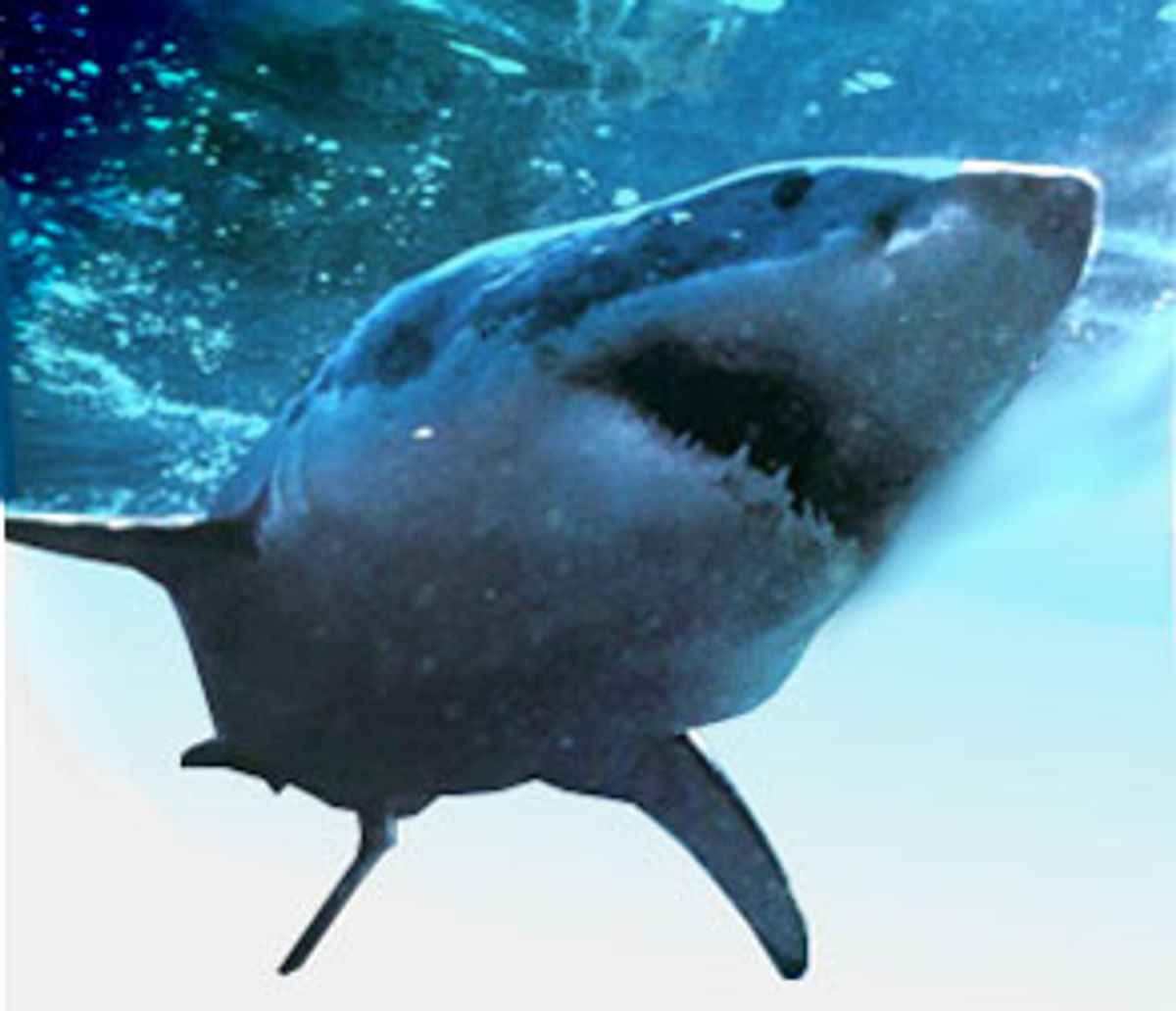
May 26, 2000
MONDAY
I have stopped telling my friends I'm going diving with sharks. Their reactions have been less than encouraging.
"Isn't that, ah, fairly dangerous?" asks one, a marketing VP. "You'll be inside a cage, right?" asks another, an editor. Lastly, from a left-brained attorney: "Sounds like a death wish to me."
My tack has been to smile inscrutably and explain that sharks are generally shy, that a cage won't be necessary -- and, indeed, I am more likely to be attacked and bitten by a domestic pig than a shark. "Jaws" did this to us, I remind them, portraying every sleek, dorsal-finned creature as a demonic eating machine with a pea-sized brain. In fact, I say, "Snouts" would be a far more realistic danger.
No one laughs.
To reassure myself, I call up a more reasonable and informed friend, Dr. John McCosker at the California Academy of Sciences. McCosker, a renowned ichthyologist, has co-authored a book, "Great White Shark," on the most dangerous of the breed. He sets me straight.
"Sharks have a lot more to fear from us than we do from them," explains McCosker. Worldwide, they are over-fished for fins, meat and sport. Out of 368 species, only four -- the great white, bull, tiger and oceanic whitetip -- have been involved in unprovoked attacks, and then only on the rarest of occasions.
Worldwide, says McCosker, there are an average of 100 attacks on humans yearly -- with about 30 fatal. But most of those are on swimmers or waders in shallow water, and most are cases of bite-and-run in which the human was mistaken for a more tasty seal or sea turtle.
McCosker also tells me it was probably a great white -- instead of a whale -- that swallowed Jonah. "The good news is, he was spit back up."
I lodge all this comforting information safely inside my brain.
Outside my brain, in that little place in my mammalian stomach that secretly replays the theme to "Jaws" every time I imagine a mouth full of sharp teeth coming at me, things are still a bit unsteady.
I admit it: I do have an underlying, visceral reaction to this whole idea. Maybe it comes from the prospect of entering the ocean and getting bumped a couple of notches down the food chain by another species that's faster, stronger and, on occasion, even more merciless than humans. Downsizing may be brutal, but it has nothing on a shark attack.
More to the point, I'm also a genetic victim of the fight-or-flight syndrome. We battle fear in great explosions of adrenaline, or we run. That was a useful reaction when we lived in caves or hid back in the tall grasses. But now that we are civilized, a more rational response is required. If I could deal with my most dramatic fear of all -- the prospect of being eaten -- I could learn to cope with most anything.
I pack my scuba diving gear, toss in some clothes and head for Fort Lauderdale, Fla. There I will hop aboard something called Island Express for a flight to the southernmost edge of the Bahamas and my rendezvous with aquatic, dorsal-finned destiny.
WEDNESDAY
The twin-propped Cessna 402 from Island Express Airlines taxis to a stop on the runway at the international airport at Long Island in the Bahamas. The off-white plane, apparently in the midst of re-painting, has been spot-sprayed in bursts of green, as if a kid with an aerosol can went on a rampage. It didn't fly yesterday because of mechanic problems.
The runway is a narrow, rutted strip of asphalt thick with black tire skid marks -- including a few that our own earring-studded pilot just left. The airport is a two-room wood and stucco hut split in half by a patio. A wind sock flies at the edge of the runway, not far from the turquoise sea. I'm clearly in a Jimmy Buffett song.
A large, black-skinned man comes out to greet me and picks up my gear as it's offloaded from the plane. Like other Bahamians, he speaks in a lilting patois, a blend of African and old English flavored by 300 years of island living. He piles my two bags onto a wood bench marked "Customs." I hand him my passport and he smiles, no mon. He is a taxi driver.
Off we go to a local German-run resort, my shark-diving base for the next few days. While there are over 150 such dives worldwide, this Long Island lodge is the granddaddy of them all -- and that is a big part of why I am here. If you're going to swim with the sharks, you might as well do it with someone who has experience.
The place exudes an efficiency not always found in the wider Caribbean -- must be the Germans. Over the 3,000-acre estate, there are enough rooms for only 120 people. It is a place of seclusion, a retreat the upwardly mobile use to emotionally decompress from hectic, fast-paced, mainland lives. It is uber Marqueritaville.
Here, everyone chills out in different ways. Some rent cars and drive around the 76-mile-long island, past the ruins of colonial cotton plantations and villages like "Burnt Ground" and "Glenton's," maybe dropping in at a native restaurant for a meal of fresh spiny lobster. Others learn to scuba dive. If so inclined, a few swim with the sharks.
Shark-wise, the results have been good: In over 1,000 dives in 20 years, there have been no skirmishes between sharks and divers. Shark attacks must be messy, emotional affairs; I figure the Germans simply have no time for them.
My room is one of four in a spacious, ranch-style stucco and wood house, perched on the edge of the limestone island next to the frothing green surf. A sign outside shows a cartoon dolphin leaping over the words "Haus Delphin." The air here is clean, flavored with the scent of tropical blossoms and the sea. The U.S. is not all that far from here, but it is light years away in ambience. There is no room key, no telephone or television. It is me and my regulator and the turquoise sea. It's hard to be buttoned-down in an environment like this.
I unpack my gear and reflect on tomorrow's dive. Going underwater is like visiting another planet, one where you have to carry your entire life support system on your back. I've found that the experience has the strange effect of sweeping the emotional slate clean, leaving you to pursue new challenges with a fresh perspective.
And if my diving adventures -- in the Caribbean, the Bahamas and on Australia's Great Barrier Reef -- have buoyed my psyche, they have also made me more attuned to the complex world beneath the waves. The sea, that great vast unknown, has become a lot less so for me.
Still, a piece of this puzzle is missing: Sharks, skittish and cautious in the wild, have eluded me. Underwater, I have only caught fleeting glimpses of them as they dashed away in a blur of tail and fin. With scant firsthand knowledge of them, my subliminal human fear grew out of proportion to the danger they represented.
Now, I would finally have the chance to meet the fear head-on, to look it right in the beady little eyeballs. The ones set back on either side of the head -- right above the mouth that seems ready to Cuisinart everything in its path.
THURSDAY
It is 9 a.m. sharp, and a flatbed truck with two benches full of smiling American and German tourists is beeping its horn at my door. It has come to take me to the sharks. I climb aboard with my gear, comforted that so many others have also chosen to overcome their shark anxieties with me today.
We drive down a dirt road paralleling the sea, past coconut palms and papayas, flowering bougainvillea and a rubber tree the size of a small house. When we reach the marina on the leeward shore of the island, everyone but me and a sturdy blonde German woman piles off the truck and onto an immense 65-foot boat. Off they go, headed for a series of deserted local beaches, giddy with their snorkeling gear and coolers of cold Kalik, the Bahamian beer.
The two of us climb aboard a smaller 31-foot inboard cruiser. I turn to the German woman, whose name is Helga. "Looks like just you and me and the sharks," I say, adding a casual, nonchalant smile.
"No," she corrects me. "Just you. I ride on the boat and look at them from where it is safe." Gulp.
Bahamians Omar Daley and Christopher Carroll Smith -- "Call me Smitty" -- are our boat captains and underwater guides. After sojourns in Nassau, both men have returned to their remote native island. Omar is a quiet man with an athletic build, and Smitty's lean and congenial, if a bit wired.
A dark rain cloud moves across the horizon and our boat tries to outrun it as we head for "Shark Reef." Smitty, in his Reebok cap and workout jacket and khaki shorts, is upbeat. "'Dis is my island, mon. I know the rain and the sunshine. We will have no problem."
Soon, we are over the shallow, 35-feet-deep site. "Here, you have the fish and the coral and the sponges," says Smitty. "Every-ting we need for the beau-tif-i-cation of the reef." Then, as an afterthought, "and here, especially, we have the sharks."
Smitty gives me the shark-wrangling history of Long Island. Years ago, a French documentary team arrived here to film sharks. But, since sharks are pelagic -- strong, streamlined swimmers who generally hunt in deeper, open waters with only brief forays into the shallows -- finding a subject willing to terrorize the picturesque coral reef wasn't easy. And, except for the rare unprovoked attacks, wild sharks generally avoid humans. Indeed, the exhalation of scuba bubbles may even spook them.
So, locals obliged the French filmmakers by spearing bloody fish on the reef -- a guaranteed Pavlovian dinner bell. Other photographers in search of dramatic images heard of the Long Island sharks and the shark-baiting continued. Adventurous divers later joined in on the action. And today there is a simple formula: Divers descend to the bottom, a chum bucket is dropped into the water overhead and the fun begins.
Candidly, the notion of baiting any wild animal to get it to do something it wouldn't ordinarily do generally doesn't sit well with me. I don't like to see animals encouraged to perform, just because we want them to. Alligators fed in Florida's urban lakes lose their fear of humans and learn to associate them with food -- swimmers, fishermen and poodles find a spot on the menu. But here, I figure the sharks have been at it long enough to have developed a routine. Whatever happened to get the ball rolling in these parts predates my appearance by a couple of decades.
Finally, Smitty finally says out loud what I have been thinking since I first packed my dive gear. "Yea, mon, it is a fear for most people. Seeing these big animals with teeth like they want to make dinner out of you. But it is not just about the sharks; it is about facing up to fear. You do it and later, when you see a shark, you don't have the fear." Surely, self-help authors have written entire books elaborating on Smitty's gunwale-side manner.
I slip into my wet suit, hoist on my scuba tank and weight belt and sit down on the stern of the boat. My feet dangle in the water as I put on my fins. I look into the clear sea below and immediately see great, brown-gray shapes moving in slow circles under me. They have been lured here by the sound of our motor and swash of our hull. It seems the show has already started.
Omar settles down beside me in his scuba gear. I can't help but notice he is carrying a large metal pole in his hand. "Ah, Omar," I ask, as casual as possible, "if this dive is so safe, why are you carrying that big stick ?"
"My CYA stick, mon," explains Omar. "Cover your ass." Then he puts his regulator into his mouth and slips under the sea, into the phalanx of circling fins.
Like a true believer, I wordlessly follow, ablaze with newfound trust. This will work, I tell myself, because Omar has done this many times before and he is not even mildly scared.
Then again, he has the stick.
Underwater, I count seven or eight Caribbean reef sharks circling me like giant, steel-gray torpedoes. I concentrate on trying to move slowly and deliberately, like I would ordinarily do if I were here on the reef without sharks. I check my air pressure gauge, neutralize my buoyancy and -- reminding myself this is perfectly natural -- settle down on the sandy bottom not far from a towering mound of Technicolor corals.
As soon as I'm on the bottom, a lone seven-foot shark swims straight towards me, his mouth in a perpetual grimace, looking like Peter Falk's Columbo on a bad hunch. For a split second, my senses freeze -- along with my sphincter muscle. I want to run but I can't, and for the most fleeting of moments, I have a sort of out-of-body experience, as if I am watching myself watch the shark.
Remembering the old adage of not showing fear to a mad dog, I stay my ground. At a distance of three feet, the shark turns abruptly, as if someone has pulled an invisible chain. This happens several more times, before the sharks tire of it and resume swimming in circles just above.
And then I figure if I am going to really swim with the sharks, I need to get off my butt and head up to their level. I do so, rising ever slowly upward. The circling sharks swim just a wee bit wider to avoid bumping me.
Some scientists suspect that sharks, with their heightened sense of smell, can even detect adrenaline. I think of the little twits with backward baseball caps who weave in and out of traffic back in Florida with NO FEAR decals on the back of their jacked-up pickups. A Caribbean reef tip shark would peel that decal in a nanosecond.
More than anything I've ever done, there is a be-here-now element to this experience that commands my senses. Whatever shards of anxiety remain from my top-side life -- career, mortgage, deadlines -- vanish.
Breathing, something I take for granted back on the surface, becomes a conscious, auditory event. In comes the good air in a long, relaxed suck; out goes the bad in a series of gently exploding exhaust bubbles. Around me, the bubbles become domes of mercury and drift up to the surface. To control myself, I control my breathing, turning it into a Zen-like exercise. As I do, the environment seems to absorb me. I become one with it.
And then something magical happens. I see the sharks more clearly. Gill slits, eyes and mouths come into focus. The grace of their swimming awes me. I watch how little they twist their body to make a turn, how small the energy investment is compared to my awkward surface-mammal gyrations. Instead of mindless eating machines, they become elegant, smooth-skinned beasts: giant, underwater panthers. I begin to admire them.
As I do, my fear dissolves with my exhaust bubbles. I settle back down to the bottom on my knees, next to Omar and his stick. He gives a signal to Smitty, who is watching the action from back on the boat.
Down into the water comes a PVC can full of fish heads and guts. New sharks I have not seen before dash to the bucket from somewhere just beyond my range of vision. There must be 30 of them in the water now, and they are fired up. The bucket is theirs.
The sharks attack the chum, slashing and biting at it. The bucket drops to the bottom in slow motion, sharks slamming into it from every which way. As it settles onto the sand, the commotion they kick up creates a storm of dust. The storm grows, spreading towards me, sharks veering in and out of it with fire in their eyes.
When the edge of the storm is only a couple of yards away, I back away gingerly, careful not to thrash about as I do.
As quickly as the frenzy started, it is over. The chum bucket, now scored with teeth marks, is empty, lying next to me on the sand.
My air is starting to run low. I carefully ascend, moving deliberately. Midway up, I pause and raise a tiny plastic underwater camera to snap photos of the remaining sharks.
As I do, I listen closely to my gut for sounds of alarm. But I hear none.
There is only the rhythm of my steady exhaust now, and it is more comforting than it has ever been.
Shares