

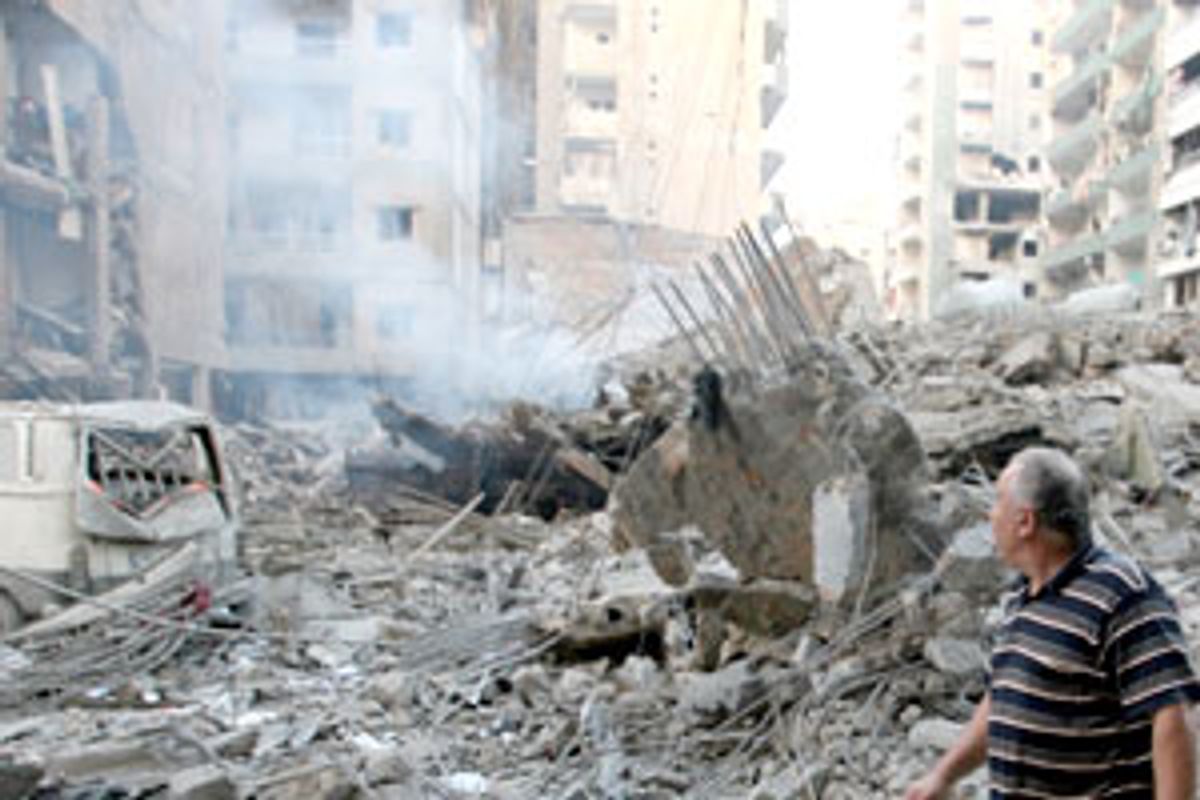
Haifa and Beirut, both usually bustling Mediterranean seaports whose terraced chalk apartment buildings and hotels rise abruptly from the aquamarine waves, are shadows of their usual selves this week, their streets empty, bars closed and shops locked up. Panicked tourists are fleeing or canceling their reservations, and the sanitation crews have to deal not with shawarma wrappers and beer bottles but with rubble and body parts. Everyone is wondering about the military objectives of the Israeli and Hezbollah leaderships, whose rash and immoral actions have brought their countries to this dangerous pass.
Beirut, of course, has taken the far heavier punishment, with dozens of buildings razed, massive bomb-produced potholes in the streets and frantic rescue crews carting away bloody bodies, mainly of civilians, including families and children. But Haifa is in greater shock, its inhabitants unused to taking direct enemy missile fire. Nor are they accustomed to seeing a bombed-out Israeli warship towed into the bay. The big international companies with offices not far from where the rockets landed include Microsoft, and the danger posed to Israel of capital flight in the billions dwarfs in magnitude the Lebanese losses of $100 million a day, mainly in forfeited tourism.
Haifa and Beirut resemble one another a good deal at the moment, but that could change dramatically. One option being entertained by the Israeli leaders would have the effect of turning the Lebanese capital into a fetid slum, swamped by hundreds of thousands of cowering peasants expelled north by a vast Israeli human engineering project. And if this project produces a civil war between Shiite Lebanese and the central government, as the Israeli high command and the Kadima Party who are considering this plan believe, then all the better.
The current Israeli plan for Lebanon appears to seek to repeat Israel's success in Jordan in 1970-71. Palestinian refugees in Jordan, their ranks swelled by those who fled in 1967, had turned to guerrilla actions against Israel under the Palestine Liberation Organization. By bombarding and menacing Jordan, Israel forced King Hussein and his Bedouin tank corps to attempt to curb the PLO. When it fought back, the struggle turned into a civil war with Palestinian Jordanians, in which the PLO was crushed and thousands of Palestinians were massacred.
Lebanon, however, is far more fragile than Jordan. It is a multicultural society, sometimes called a country of minorities. In East Beirut, Jounieh and points north, into Mount Lebanon, Maronite Catholics are the majority. Sunnis are important in the port cities -- Tripoli, West Beirut and Sidon -- as well as in the Bekaa Valley and in the far north. In the Shouf mountains live the Druze, hardy adherents of an esoteric offshoot of Ismaili Islam. The deep south down near the Israeli border is orthodox (or a "Twelver") Shiite territory, though they are also a majority in the Bekaa Valley to the east, with Baalbak a major center, and decades of immigration to the capital have created a southern ring of Shiite slums around Beirut. Poor Shiites are the constituency for the fundamentalist Hezbollah Party, though in opinion polls most of them do not report their main political commitment as Muslim fundamentalism.
On July 12, members of the Lebanese militant group (and political party) Hezbollah attacked Israeli soldiers, killing three and capturing two. In the following days, the Israeli air force launched a massive response, repeatedly bombing the Beirut airport and fuel storage facilities, bridges, roads, ports, power plants, a television station, and even Internet servers. The Israeli navy blockaded Lebanese ports from the sea. The Israeli attacks have so far killed at least 245 people in Lebanon, including 216 civilians and 23 Lebanese soldiers, and wounded more than 500. Hezbollah replied with hundreds of mostly ineffectual Katyusha rockets, but it did kill two and injure a handful of Israelis and inflict damage on a warship. Then early Sunday, Hezbollah fired a rocket that struck Haifa, killing eight rail workers at the train station garage and wounding 20. Hezbollah continues to rain rockets down on northern Israel. Twenty-five Israelis have been killed so far.
Hezbollah emerged as the militarily most important group in Lebanon when 14,000 Syrian troops withdrew from the country in spring 2005. The Syrians had played the role of peacekeeper, or at least referee, during the Lebanese Civil War. When the warring factions made peace from 1989 forward, all the Lebanese factions disarmed their paramilitaries except Hezbollah, which was struggling against the continued Israeli occupation of the south. In the 1990s and early zeroes, a reduced Syrian force provided some security in the rest of the country at a time when the Lebanese army was being rebuilt. Following the assassination of former Prime Minister Rafik Hariri, which a U.N. investigation linked to Syria, a popular movement, known in the West as the "Cedar Revolution," led to a Syrian withdrawal last year. Although the anti-Syrian reformers did well in the elections held late last spring, so too did the Shiite parties, including Hezbollah and Amal, who together won 29 seats in the 128-seat parliament. Hezbollah became part of the government for the first time, but resisted demands that it disarm its militia in the south, maintaining that the continued threat of Israeli violence and renewed occupation made it necessary. It pointed out that Israel continues to retain control of the Shebaa Farms, a small border area claimed by both Lebanon and Syria. (If the Israelis had negotiated the return of this land years ago, it would have been much more difficult for Hezbollah to have justified not disarming.)
The Cedar Revolution was hailed by the Bush administration as a great achievement of democratization, but in fact it pushed the fragile Lebanese political system into a state of dangerous instability, in which the Lebanese ethnic factions no longer had a referee. As members of the reformist bloc such as Druze leader Walid Jumblatt began pressing for disarming Hezbollah, they threatened its prime source of political legitimacy and power. Within the arena of Lebanese politics, escalation of tension with Israel benefited Hezbollah at a time it was under this pressure.
On Sunday, Hezbollah leader Sheik Hassan Nasrallah delivered a disturbing videotaped speech in which he gloated over his party's missile strikes on Israel. He said that the attack on Haifa had not been for revenge but for the purpose of deterring Israeli assaults on Lebanon. He contrasted his strikes, which he claimed deliberately avoided targeting civilians, with Israel's, which he claimed had targeted civilians. Since his missiles are inaccurate, this was a self-serving lie: Any Katyushas he launched could (and did) kill civilians. He sanctimoniously pointed out that he could have hit chemical plants and fuel plants and produced a much worse disaster for the city, but had refrained from doing so for the moment. He also promised further "surprises" for the Israelis. Nasrallah, soft-spoken behind his white-speckled soft black beard, exuded an adolescent nationalism, taking pride in this "Arab" achievement of striking back at last against the Israeli cities from which the Lebanese Shiites had taken decades of bombings. (In 1997, Nasrallah had lost his own son, Muhammad Hadi, in the fight against the Israeli occupation of Lebanese soil.)
Nasrallah's speech was full of delusions of grandeur. His goals appear to include giving aid to the beleaguered Palestinians in Gaza, claiming the mantle of the most important political and military leader in Lebanon now that the Syrians are gone, and forcing Israel to negotiate with him as an equal. None of these goals is realistic. He has raised Hezbollah's status with the Arab street, but has no way to translate that into actual power. His ability to help the Palestinians is nonexistent. His amateurish missile attacks, most of which have done no real damage, cannot possibly deter Israel from its military plans for the destruction of Lebanon's infrastructure. And after years of fighting the Israelis, he should have known enough about their psychology to know that nothing would guarantee a widening of the war more than menacing the descendants of victims of the Holocaust with poison gas.
What of Israel? There is no question that Israel has the right to defend itself against rocket attacks, and to respond appropriately to Hezbollah's illegal and immoral abduction of two soldiers and killing of others. A "proportional" response by Israel to Hezbollah's initial attack, of the sort demanded by international human rights lawyers, would have involved killing three Hezbollah fighters and capturing two down at the border between the two countries -- and a heavier response directly specifically at Hezbollah could also have been justified. Instead, Israel has bombed, blockaded, isolated and crippled the entire country. Why? In preparation for what?
The Israelis clearly do not intend to conduct a big land invasion of Beirut on the model of Ariel Sharon's assault of 1982 -- otherwise they would not have bombed the bridges and roads. They are preventing Syria and Iran from resupplying Hezbollah.
Israel has a range of options. It has already made one raid into the south. It could pull back at any point. But the maximal option would be to change the human geography and military posture of the Lebanese south. The next stage could be a calibrated Israeli incursion into the south, reminiscent of its Operation Litani in 1978. Israeli Maj. Gen. Uzi Adam told reporters at a news conference of his advice to Lebanese in the south: "We recommend that they leave their villages and homes and go to the north of the country ... We are going to heavily attack the south of Lebanon.'' Those Israelis who favor the maximalist option hope that turning the militarized south into central and northern Lebanon's problem will set the Maronite Christians, Sunnis and Druze leaders even more resolutely against Hezbollah and provoke them to use the Lebanese army to rein in or destroy the Shiite paramilitary.
Israeli Internal Security Minister Avi Dichter insisted that Hezbollah rocket launchers be cleaned out of the area between Israel's northern border and the Litani River, creating a sort of demilitarized Zone on the model of the Koreas. He added ominously that the Israeli army "should be instructed to operate without a time limit and without a limit of means to apply heavy pressure on the residents of southern Lebanon to evacuate northwards, thereby applying pressure on the center of the Lebanese government." Dichter's statement appears to envisage an Israeli attack on south Lebanon that will have as its goal the displacement of tens or hundreds of thousands of Lebanese Shiites into Beirut, burdening the city with a massive refugee problem. A military spokesman said that a ground invasion was not being planned; instead, Israel would attack with airstrikes and artillery fire.
Tens if not hundreds of thousands of Lebanese have already been displaced. UNICEF's representative in Lebanon told Agence France-Press that "The situation is both alarming and catastrophic. There are about 500,000 people displaced already."
If it comes about, the forced transfer of the Shiites of the south would have several advantages for the Israelis. The depopulated territory would make it easier to search for and destroy all the Katyusha emplacements and the heavier missiles of which Hezbollah boasted on Sunday. With Hezbollah's approximately 5,000 fighters deprived of civilian cover, it would be easier to kill them. The Israelis clearly anticipate that a refugee crisis in Beirut will put pressure on the Lebanese government to turn on Hezbollah decisively and to intervene against it militarily. Finally, they expect Prime Minister Fouad Siniora, in the aftermath, to send the Lebanese army south to take up positions along the border and so form a buffer between Hezbollah and Israel.
How good is the maximalist plan enunciated by Israeli military and government spokesmen? Ethically, it is monstrous, involving war crimes on a vast scale insofar as it targets a civilian population for forcible relocation. And practically, any such plan is doomed to abject failure.
The insistence of Prime Minister Ehud Olmert that Hezbollah withdraw to beyond the Litani River will raise Lebanese and Arab suspicions that Israel again wants to gain control of that river's waters, which Israeli leaders have coveted since the time of David Ben-Gurion, the Zionist state's first prime minister. It is a demand that inevitably will stiffen the spines of the Lebanese. Moreover, at a time when Hezbollah can easily get hold of rockets that reach Haifa, whether the movement has a presence north or south of the Litani is not militarily decisive.
Olmert's hope that the Lebanese government can be forced to confront and disarm Hezbollah is also likely to remain unfulfilled. The Lebanese were deeply scarred by their civil war of 1975-89, and most leaders would do almost anything to avoid risking repeating it. Pro-Syrian President Emile Lahoud, a former general from a Maronite Catholic background, thundered that "the Lebanese will not surrender." Member of Parliament Saad Hariri, a leader of the reform movement and son of the martyred former prime minister of Lebanon, said that his government and people were determined "not to allow Israel to incite this sedition." Even the Phalange Party's Karim Pakradouni, a longtime right-wing ally of Israel's, said he was supporting President Lahoud. Another prominent former general whose list did well in the late spring 2005 elections, Michel Aoun, has shown a willingness to ally with Hezbollah.
Even if Lebanon's famously fractured political elite could come to a consensus that Hezbollah had to be curbed, it is unclear how they could accomplish that task. The reconstituted Lebanese army formed after the civil war is 60,000 strong, but most of the troops are green and many of the infantrymen are Shiites. The 5,000 battle-hardened Hezbollah fighters defeated the Israeli occupation with suicide bombings and guerrilla tactics. Even if the Shiite troops in the regular Lebanese army would fight their own, it is not clear that they could do so successfully. The Lebanese political elite in 1975 risked civil war when then-President Elias Sarkis refused to commit the army, for fear that it would splinter and doom the state. Nothing has changed to alter that calculation.
The Israeli plan to pressure the Lebanese government to take on Hezbollah will therefore likely fail. The Jordan precedent has no analogies here. The Shiites of Lebanon have played a role in contemporary Lebanese nationalism very unlike that of the Palestinian refugees in Jordan. Neither President Emile Lahoud nor Prime Minister Siniora command the respect, or have the steel, of Jordan's King Hussein, and the Lebanese army lacks the cohesion and loyalty that had characterized his Bedouin troops.
Instead, if Israel follows through on threats to create a massive internal refugee problem in Lebanon, they will further radicalize the Shiites, many of whom now support Hezbollah because of the services it provides or because it looks out for their interests rather than because they really want an Islamic Republic. If the Israelis manage to disrupt the party structure, as they appear to hope, they will simply remove any discipline over rank-and-file members and encourage small-group terrorism of the sort that has recently plagued Madrid, Spain, and London. Radicalized Lebanese Shiites can expect ongoing aid not only from Iran but from the newly liberated radical Shiites of Iraq, such as the Mahdi Army of Muqtada al-Sadr.
Worse, the kind of large-scale injustice apparently being planned in Israel against tens or hundreds of thousands of Lebanese Shiites may profoundly affect the situation in Iraq. Many Iraqi Shiites entertain a profound hatred for the American and other coalition troops in Iraq, feeling humiliated by what they view as an infidel military occupation. Many have refrained so far from attacking the foreigners, however, because they have seen them as allies against Saddam Hussein and other Sunni Arab leaders, who persecuted the Shiites. Anger has grown in the Shiite south of Iraq against coalition troops, however, as witnessed by persistent attacks on the British in Basra and elsewhere. If the Iraqi Shiites decide that Britain and the United States are enabling Israel to crush the Lebanese Shiites, they may begin attacking the coalition in revenge. On Friday, Shiites demonstrated in the thousands in Baghdad against Israel's predations in Lebanon. The U.S. and Britain have already had difficulty dealing with a vigorous Sunni Arab guerrilla movement, and the opening of a second front, with enraged Iraqi Shiites, could doom their enterprise in Iraq.
Of course Israel has the right to defend its citizens against missile attacks and its soldiers against being attacked. But Israel's disproportionate response and its overreaching plan to cleanse the entire south of Lebanon of Shiites will at best buy a temporary respite. If Israel could not destroy Hezbollah during 20 years of actual Israeli military occupation of the south, it cannot do so with intensive bombing raids and some ground incursions.
There are two most likely outcomes of the war. One is the collapse of the Lebanese government and the creation of another failed state on Israel's border, where desperation will breed terrorism for decades. The other is a strengthened Hezbollah, which will become the leading force in Lebanese nationalism, weakening the reformists. The maximalist option would likely turn Beirut into a poor Shiite city, reinforcing Shiite political power at the center. Destroying a few Katyusha emplacements in the south will not affect either outcome, and in both cases Hezbollah will probably be able to rebuild its arsenal.
The Israelis' current blank check will begin to be canceled by the world community, as the full scale of the destruction of Lebanon becomes apparent and humanitarian crises ensue. At some point it will be forced to cease its attack. Israel will not get the Lebanese government of which it dreams. It may get a U.N. or Lebanese buffer for a while, but it will not be effective, and the southern Lebanese clans are famed for nothing if not long memories and determined feuding.
If, as Abba Eban once said, the Palestinians never missed an opportunity to miss an opportunity, it is equally true that the Israelis, with their reflexive instinct to shoot first and negotiate later, never miss an opportunity to make a bad situation worse. The Israelis have responded the same way to military threats for decades -- with overwhelming force. This is perhaps understandable, but each time they overreact they create future catastrophes for themselves. Just as their 1982 invasion of Lebanon and occupation of the south haunted them for a generation, they will be living with the blowback of their ill-considered war on hapless little Lebanon for decades to come. Tragically, the United States, as Israel's closest ally, will also have to suffer for its actions.
Shares