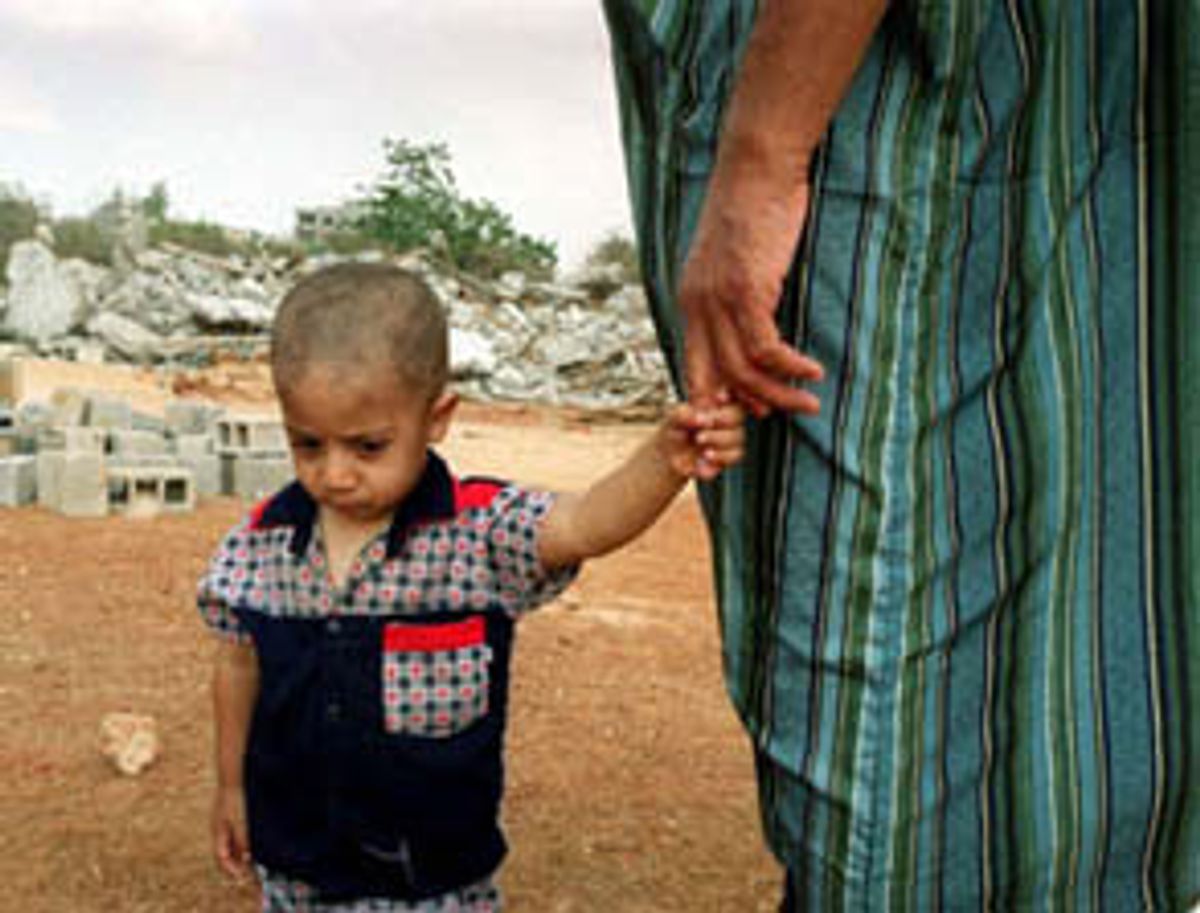
Adel Kaadan wants out. The main street in Kaadan's hometown 20 miles north of Tel Aviv is lined with neatly manicured flower beds and decorative palm trees. Off main street, however, the sidewalk ends, and the cracked asphalt and littered streets reveal the darker face of Arab life in Israel -- one of poverty, discrimination, neglect and violent distress.
For six years now, Kaadan has tried to move his family out of the run-down, overcrowded Arab town of Baqa to the greener pastures of Katzir, a small Jewish village built on state-owned land, where open spaces, whitewashed houses and impeccably paved streets form a picture of suburban bliss. But the Katzir municipal council has barred Kaadan from building a home there for a simple reason: He's an Arab.
Comprising roughly 18 percent of the country's population, Israeli Arabs like Kaadan pay taxes, vote in Israeli elections and speak Hebrew. Tired of being treated as a second-class citizen, Kaadan sued the state in 1995. On paper, he won. But in practice, Kaadan and many other Arabs are still waiting for Israel to uphold their basic human rights.
Israel has treated its Arab minority -- the descendants of the 150,000 Arabs who stayed put when Israel was established during the War of Independence in 1948 -- as the enemy within for decades, as a fifth column with links to the greater Arab world, bent on undermining the Jewish state. (Other Palestinians became refugees in the West Bank, Gaza and neighboring Arab countries.) Until 1966, Israeli Arabs were subjected to curfews, administrative detentions, land confiscations and employment restrictions under a military regime. Israel even required its Arabs to carry "movement licenses" whenever they left their villages. Recently, however, the idea that Arabs should be treated as equal citizens has begun to take root in Israeli society.
Indeed, small signs of positive change are everywhere. In 1998, Israelis appointed the first Arab justice to the Supreme Court. In 1999, for the first time in the contest's history, the country selected a long-lashed Arab beauty as Miss Israel. In March, the Supreme Court issued a landmark decision based on the Kaadan case, ruling that the government may not allocate state-owned land to communities like Katzir that bar Arab residents, and holding that "equality is among the fundamental principles of the state."
And last month, Israeli Prime Minister Ehud Barak announced a plan to spend $1 billion over the next four years to improve roads, schools, work opportunities and housing in the Arab sector. Barak had promised during his campaign last year to narrow the gap between Arabs and Jews. That pledge -- and Barak's eagerness to make peace with Israel's Arab neighbors -- won him the support of 95 percent of Israeli Arab voters and accounted for his landslide victory in the last election. But support for Barak has crumbled among Arabs in the past weeks, and the plan was greeted with skepticism from Israeli Arab politicians. "The Arab sector has been discriminated against for 52 years. We need a development program, but it's too little, too late," Aded Dahamshe, one of 12 Arab members of the Israeli parliament, said in a telephone interview.
The plan, drafted over the past year, was unveiled soon after the worst unrest in Israeli Arab history. In early October, Israeli Arabs let their pent-up anger against the Jewish state explode in demonstrations of support for the Palestinians who live in the West Bank and Gaza. The demonstrations quickly turned to riots pitting disgruntled Arab youths against Israeli police. Thirteen Israeli Arabs were killed by the police, and hundreds more were wounded.
In response to the recent riots, the Israeli army announced plans this week to fortify Jewish towns like Katzir that are near Arab population centers. The extra precautionary measures will include stockpiling weapons, radio communications systems, fences, electric gates and providing alternative access routes to ensure that Jewish populations will not be vulnerable to attacks from their Arab neighbors.
The riots and the heavy-handed police crackdown confirmed deep-seated fears on both sides. In a survey conducted Oct. 6 for an Israeli newspaper, 74 percent of the Israeli Jews polled said they considered the behavior of Israeli Arabs "treacherous." And 66 percent of Israeli Arabs said they would show allegiance to the Palestinians next door rather than to Israel in a conflict, adding substance to Israeli Jews' security concerns. At the same time, when police opened fire against Arab rioters armed with stones, Arabs became convinced that Israel will always treat them as disposable enemies rather than as valuable citizens.
"Israel doesn't realize it's forcing us to become more nationalistic, more Palestinian than we ever wanted to be," Kaadan says.
A 46-year-old staff nurse at an Israeli hospital and the father of four daughters, Kaadan considers himself a model citizen and a representative of "the moderate [Arab] stream that wants peace." He teaches his daughters how to use a computer at home and has hired a Russian Jewish music instructor to teach them piano. The girls' school in Baqa has neither a computer room nor music classes, and is lined with dangerous asbestos. One of the main reasons Kaadan would like to move to Katzir, the genteel Jewish village just a few miles from Baqa, is to improve his family's standard of living. After the Supreme Court ruled in his favor this spring, Kaadan declared, "We know today that [Israel] is a state of all its citizens. The meaning of this is enough discrimination, enough racism -- give coexistence a chance."
Eight months later, however, Kaadan is singing a different tune. The Supreme Court verdict has had little effect on the discriminatory policies of the Israel Lands Authority, Kaadan still lives in Baqa and the recent outburst of violence has radicalized even the most conciliatory minds.
"If the Supreme Court had given the order to destroy my house, it would have happened the very next day. But since the order was to build a house for me, I probably won't get it even if I wait another 20 years. That is racism," says Kaadan.
"I feel like a prostitute. Israel used me to mount a PR campaign for the outside world so that the world would think it is democratic. But, in fact, it's a racist, militaristic country that takes away people's rights." Later in the same interview, Kaadan refers to Israel as a "Nazi country" with an "apartheid system," and drifts into an anti-Semitic diatribe against Jews who plague the world "like a cancer."
But Kaadan says he would still like to live among the Jews in Katzir. "It's my right, and I'm demanding my right. If I can't [live there] my only outlet is religion, and we, as Arabs, have to declare jihad." Kaadan, who is secular, says he prefers "the challenge of peace."
In Katzir, Israeli Jews have also been more on edge lately. Dubbi Sandrov, the mayor of Katzir, believes the violence has vindicated his decision to exclude Kaadan from purchasing land in the village. "The places where there was tension were places that have a mixed community -- places like Jaffa, Acco, Nazareth. It strengthens the conclusion we had already made that, when you plan residential neighborhoods, you shouldn't plan conflict areas. You have to be smart and plan ahead. It would be ridiculous to now create new points of conflict," the mayor says.
Sandrov also says that the majority of Katzir's 2,200 Jewish residents aren't racist. Instead, he argues, barring Arabs from the town is "a question of social suitability."
In Sandrov's worldview, Arabs are apparently suitable enough to bus Katzir's children to school or fix leaks in Katzir's tony homes, but they don't share the same values as Israeli Jews. When asked to give examples of the culture clash, Sandrov accuses Israeli Arabs of lusting after Jewish women and disrespecting national holidays. "We work well with them. The problem is political. High walls make good neighbors," says Sandrov, mangling the Robert Frost verse. "It's the same in Bosnia, Serbia, the United States and Africa -- wherever there is mixing there are problems." But Kaadan finds great hypocrisy in the words of Sandrov and other Katzir residents. "It's ironic, because some of the people sitting on the Katzir council were treated by me in hospital. They were embarrassed, but they told me up front: 'We don't want Arabs here,'" Kaadan says. "I said: 'I took care of you through the night, but you can't accept me as your neighbor?' They had no answer."
The plot of land Kaadan wants to buy stands in front of Katzir's modern, landscaped school on a street that offers breathtaking views of the Mediterranean. Ayelet Sheiman, an English teacher at the school, pauses for a minute on her way home from work to explain her ambivalent feelings toward Arabs. She believes Kaadan should have the right to live wherever he wants "because Israel is a democratic country," she says. "But part of me doesn't want Arabs and Jews to mix. I want to preserve my religion. If [Kaadan] comes to live here, his daughter will marry his neighbor's son, their children won't be Jewish and their grandchildren won't be Jewish at all."
"We both live in this country," says Sheiman, 26. "We have to live together -- together, but separately."
The problem, as the United States discovered in the 1950s, is that separate is usually inherently unequal. Israeli Arabs and Jews live essentially segregated lives -- their paths crossing only briefly at university -- with vastly differing opportunities. According to the New Israel Fund, an organization that promotes social justice, only 3.7 percent of Israel's federal employees are Arabs; Arabs hold only 50 out of 5,000 university faculty positions; and of the country's 61 poorest towns, 48 are Arab.
But the most glaring discrimination is the way in which the Jews strictly limit the Arabs from purchasing land.
Although Israel's Arab population has grown from 150,000 in 1948 to almost 1 million today, Arab communities have been systematically denied the right to expand beyond their 1948 boundaries. At the same time, Israel has continued to confiscate private Arab land. Not surprisingly, the disproportionate amount of Arab land expropriated recently to build the Trans-Israel Highway was one of the major grievances that pushed Israeli Arabs to protest this month.
"It's a Zionist plan to choke Arabs from within," asserts Kaadan. In a scene typical of Arab overcrowding, Kaadan shares his narrow driveway with two other houses built seemingly without plan or permit. "They made us a part of their country, but Israel doesn't really want us to be here. They didn't develop Arab infrastructure or villages."
The issue of land distribution is a reflection of the fundamental contradiction between Israel, the country set up after the Holocaust as a shelter for displaced Jews, and Israel as a liberal democracy. (Israel's 1948 Declaration of Independence defined the country as a "Jewish state," but simultaneously promised "full social and political equality of all its citizens, without distinction of religion, race or sex.")
As with the hilltop around Katzir, most of Israel's land has been designated for Jewish settlement through the Jewish Agency, a powerful quasi-governmental body that works solely on behalf of Jews. This means government resources go toward building new housing for Jews -- even while Arabs continue to live in ghettoized pockets that suffer from gross neglect. This explains why Katzir, a village that has absorbed hundreds of new Jewish immigrants from the former Soviet Union in the past decade, felt it had the right to close its doors to Arabs. It also explains why the anger and bitterness among Israeli Arabs run so strong.
During the recent days of riots in Baqa, a town of 25,000 that has no pools, cinemas or shopping malls, "People looked for anything that represented Israel," says Kaadan. "A border police jeep came into the village and was attacked. When the jeep left, they hit the Israel National Bank and burned down the post office."
The attacks appalled Israeli Jews. Why should Israel improve the living conditions of Arabs if they burn Israeli flags and side with Israel's Palestinian enemies? Beeri Holtzman, head of the governmental team that drafted the $1 billion plan for the Arab sector, says he was amazed Barak's cabinet approved the package last week in such a climate of open hostility. "We are in the middle of a confrontation, and it's quite a miracle for me to see that Israelis can accept this kind of program at a time like this. I can be more than proud. It seems that everyone feels that it's time to improve the conditions of Arabs. It's time to take some courageous steps."
Shlomo Hasson, a professor of geography at Israel's Hebrew University, puts the issue in different terms. He draws a parallel between Israeli Arabs who have feelings of sympathy for embattled Palestinians, and American Jews who identify with Israel in times of war but remain loyal American citizens. "The majority of Arabs are angry and upset," Hasson says, "but they still regard themselves as Israeli citizens and should be treated that way."
In many respects, this month's Israeli Arab riots were a cry for attention, not a declaration of war. "The people are boiling here," said Kaadan, speaking of Baqa. "Fifty percent are unemployed. Educated people can't find suitable jobs. There are no activities after work. What do you want people to do? The government of Israel is responsible for this [outburst of violence]."
The Israeli government's new plan for the Arab sector could help calm tempers by allowing Arab communities to gradually expand and develop. But Dan Yakir -- a Jewish lawyer from the Israeli Association for Civil Rights who helped Kaadan win his suit and is now waiting, like Kaadan, for concrete results -- expressed caution. "There have been many promises before. The real test will be in the implementation."
Shares