

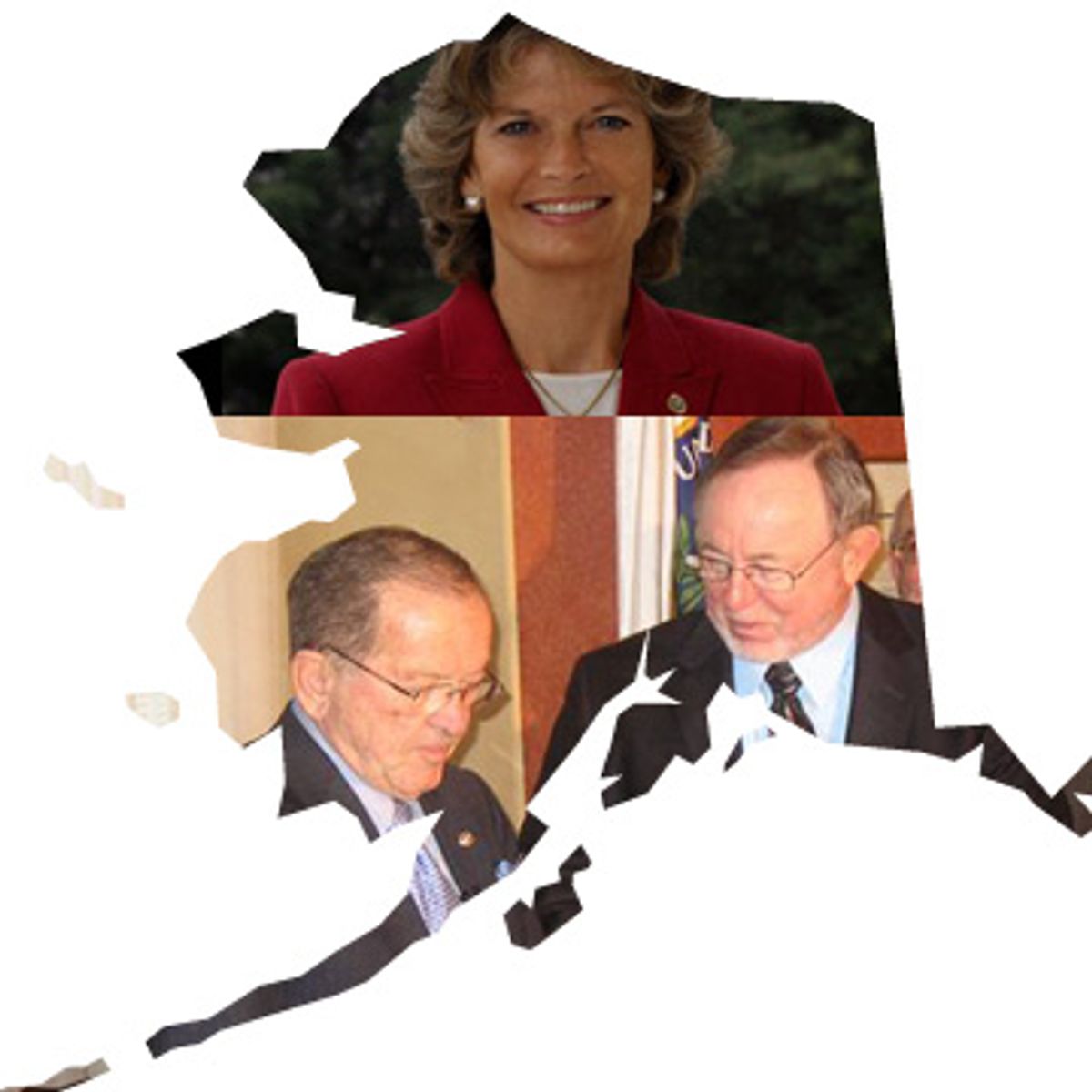
It is difficult now -- it has always been difficult -- to visit Alaska and not depart with the feeling that you have witnessed something experimental and anomalous. The state seems less an extension of America proper than a distilled counterfactual, a pioneer's idea of what the country could have become. There is the magnificent landscape, of course, the rough survivalist feel, the intimacy with the natural world and the disorienting, ever present gender imbalance. Where women outnumber men in the rest of the country, the proportion is reversed in Alaska, the most male of all 50 states. There is the state's unique transience, too, the notion that with more than 60 percent of Alaska's population born elsewhere, the state's very existence depends on hundreds of thousands of decisions to pick up stakes and leave the Lower 48, and on an equal number of individual commitments to live not only differently but apart. And then, perhaps even more vividly, there is the politics.
The political anomalies of the far Northwest are on view right now in a scandal that looks likely to bring down much of the state's Republican establishment, threatening the careers of oil executives, lobbyists and all three of Alaska's representatives in Washington. The alleged improprieties are as crass as they get -- lobbyists handing out bribes on the floor of the state Legislature, federal money directed by Alaska's U.S. senators to those companies, and lobbyists who granted politicians personal favors. The taint has spread so far that it has become a crisis not just for those politicians who have been directly implicated, and not just for the Republican Party, but for the state itself. The Associated Press was recently moved to call the few living statesmen who had signed the state's first constitution, in 1956, and ask them what had become of their creation. " Greed is rampant," one of them, Vic Fischer, told the AP. "I'm very disgusted. It's not a matter of betrayal. It's more a matter of sadness and concern. But most of all disgust."
What's wrong with Alaska? The state's politics can seem an accident of its own isolation, and dependence. There are few states that seem as ripe for scandal as this one, with its history of single-party rule and an economy, based on the extraction of wealth from public lands. But there may also be another, deeper truth: Alaska's strange, enticing political culture may equally be a legacy of the state's senior senator, Republican Ted Stevens.
It is perhaps unsurprising that such a scandal should have erupted in Alaska. The state's economy, more than any other in the nation, is based on making money from government land -- fishing, oil exploration and tourism are among the state's biggest industries -- which means that just about anyone in the state who wants to make a buck needs to get close to legislators, in Juneau and in Washington. The state's often outsized dependence on the federal government was highlighted in 2005, when its congressional delegation won $223 million to help build a bridge to Gravina Island, Alaska (pop. 50). When other senators tried to cut the appropriation, Stevens threatened to quit, and if the bill did not pass, he said, "they'll have to take me out of here on a stretcher."
But the relationship between pork and prosperity in Alaska has been long-lasting. Beginning in 1969, politicians in Juneau and Washington cut a series of deals that leased public lands to oil developers and built a pipeline to speed the product to market. In 1976, voters in Alaska passed a constitutional amendment requiring that a portion of the development revenues be paid into a state-run fund, which in turn cuts each Alaskan a check that has ranged as high as $1,963. By the time Stevens stepped down as chair of the Senate Appropriations Committee in 2005, Alaska was snaring federal pork at a rate 30 times the per capita national average. The New Republic's Franklin Foer, in a 2002 essay, called Alaska the archetypal conservative welfare state. "Stevens and his fellow Alaskans like to think of themselves as embodying a kind of rugged, frontier libertarianism," Foer noted. "If only it were all true."
Stevens, like most of the state's residents, wasn't born in Alaska but came when he spotted opportunity. Stevens had been a young, Harvard-trained environmental lawyer in Washington who helped staff the Eisenhower campaign; when a job in the administration didn't come through, he borrowed $600, piled his wife and belongings into a Buick, and got off the highway in Fairbanks in 1953. Alaska was not yet a state. The conservative establishment in Alaska in those days was tiny, and Stevens quickly became the province's U.S. attorney and a statehood advocate. By 1970, he'd worked his way up through the state's Republican establishment and got himself elected U.S. senator. At the time, vast wedges of the state, the Alaska political leader Willie Hensley has said, were still in "the twilight of the Stone Age."
Stevens' politics were for the most part those of a doctrinaire conservative, but at key moments they approached something more basic: an old-fashioned, ward-heeler-style grab for public cash and advantage, in which the constituency is served and ideology is irrelevant. In a state where the U.S. government still owned 60 percent of the land, and the population was settled too sparsely to develop viable creative industries, this dependence on federal assistance was of a certain grudging necessity. But under Stevens' powerful hand the relationship between the state, the Republican Party, and federal cash was formalized and extended. Early in his career, the senator helped push what had been a Democratic stronghold into Republican control. And when he won for Alaskan-native-owned firms a unique legal exception that allowed them to garner millions of dollars in federal contracting during the 1970s, he not only ensured prosperity for villages that still ran mostly on subsistence hunting, but he also moved some of the state's large native population into the Republican column, cutting into a key Democratic constituency and helping cement Alaska's status as a one-party state.
By 1997, he'd made himself into the head of the Senate Appropriations Committee, a perch he used to bring home an unprecedented amount of federal spending. "Almost every institution, region and segment of the population in the state has benefited from Stevens' efforts, from its schools and social programs to its transportation system, its urban areas and the far-flung villages of Alaska's Native peoples," the Los Angeles Times concluded in 2003. The most striking thing about Ted Stevens may not be his cartoonish grandeur, that when this 84-year-old pipsqueak swaggers down to the Senate floor for appropriations fights he wears an Incredible Hulk tie. The most striking thing may be that he has earned it.
But Stevens had also made Alaska into his own version of a political machine, one in which taxpayers from the Lower 48 were footing the bill. As his profile increased, so too did public scrutiny. A 2003 investigation by the Los Angeles Times found that Stevens had funneled millions of dollars in single-source contracts to clients of his brother-in-law, the lobbyist William Bittner. In 2006, investigators from the federal government started probing the senator's relationship with a former aide, Trevor McCabe, who represented companies that had won nearly $700,000 in contracts thanks to a project Stevens had written into legislation. The structure Stevens set up replicated itself in Juneau, Alaska's capital, where his son, the former state Sen. Ben Stevens, has been fingered as a recipient of political bribes. The Stevens machine in some ways mirrored the one run by Tom DeLay and Jack Abramoff in Washington, where ex-aides to powerful politicians set up shop as lobbyists and directed their clients to send campaign cash to their former bosses in exchange for federal contracts. But in Juneau, with public scrutiny far less intense, things had become far more brazen.
The mess that now threatens Stevens and the rest of the state's congressional delegation began, as is so often true in Alaska, with oil. On Aug. 30, 2006, teams of investigators from the FBI, IRS and Justice Department, probing allegations of bribes paid by an oil services and engineering company called Veco, raided the offices of six state legislators, shutting the blinds, picking through files with rubber gloves. They uncovered a practice that had never been terribly well hidden: State legislators were allegedly taking bribes from Veco and associated companies in return for sending government contracts their way -- for building state prisons, promoting state fish products, and servicing state-run oil fields.
Stevens himself was implicated when it emerged that Veco had helped manage the construction of an extension that doubled the size of his Alaska home; investigators are trying to determine if Stevens paid full value for the construction. The state's junior senator, Lisa Murkowski (who was appointed by her own father, Frank Murkowski, to replace him when he left the Senate to become governor in 2002), got in trouble for buying a lot of land from a real estate developer friend that a watchdog group charged had been sold to her below market value. She has since sold back the land. Alaska's lone representative in the U.S. House, Don Young, is in hot water for directing earmarks to two companies that contributed to his campaigns. To date, one state legislator has been convicted of taking bribes, and four lobbyists and executives have been indicted for giving them. Bribes were blatant, and floor votes in Juneau were being directed by lobbyists over the telephone. In the state Senate, lobbyists were caught handing voting instructions across the banister meant to separate legislators from the public.
When the details finally began to emerge this year, the Democrats, a meek and politically sidelined force in Juneau, started issuing a collective cri de coeur, urging the state's representatives to take back the Capitol from the lobbyists. "This is our floor. Our floor," the House's minority leader, Ethan Berkowitz, announced to the chamber last fall. "No telephone call's supposed to change what we're doing." (Some of the implicated Republicans, meanwhile, had hats printed up that read "CBC," for "Corrupt Bastards Club.") But reform hasn't arisen from partisan competition, as it did in Washington. In a neat symbolic fit, the agent responsible for Alaska's current moment of reform and modernization is a woman, a breed once nearly as rare in far Northwest politics as a Democrat. Sarah Palin, a libertarian and hockey mom from the fast-growing suburbs of Anchorage, began her political career -- as an appointed member of the state's Oil and Gas Commission -- by hacking into the computer of another commissioner, Randy Ruedrich, chairman of the Alaska Republican Party. Palin was seeking the evidence that she would eventually use to charge him with an improper relationship with lobbyists. (Ruedrich would later settle state ethics charges against him by paying a $12,000 fine.)
It is difficult not to see Palin's ascendance not just as a challenge to the state's establishment but also as presenting a crudely cut choice between the state's cronyist, resource-economy past and its future. She beat Frank Murkowski, the incumbent, in the GOP primary; voters began to sour on Murkowski as soon as he picked his daughter to replace him in the Senate, and then grew angrier over his grubbing for a private jet and other perceived ethical lapses. He left office the least popular governor in the country. Since her election as governor last November, Palin has made a public point of cutting down on Alaska's excesses, and challenging the easy habits of its past -- getting the state to put Murkowski's infamous jet up for sale on eBay, canceling pork projects and firing patronage appointees. By early this summer, with the scandals plaguing the rest of the Republican Party, Alaska Democrats had made some headway in the polls. But Palin's approval ratings are over 90 percent. Whether in the long term Alaska's economy can modernize and the state can wean itself from government welfare remains to be seen. But as Stevens hits back at the FBI through press releases, the senator's old legislative aides plead guilty, and his son endures a federal investigation, the moment is beginning to look like a pivotal point in Alaska's history. Perhaps the rough edges are being ushered out and something more modern and nationally acceptable has begun to move in.
What is happening in Alaska is not simply the collapse of one ancient Republican power and the rise of another, in Palin, that is more fragile and conditional. It is the assertion that for all of the country's divisions into red and blue, the national culture does exert a crude centrifugal tug, a tendency to iron out protruding regional discrepancies. The plaintive, humbled sounds coming from Alaska right now are those that always emerge when the exception succumbs to the rule.
Shares