

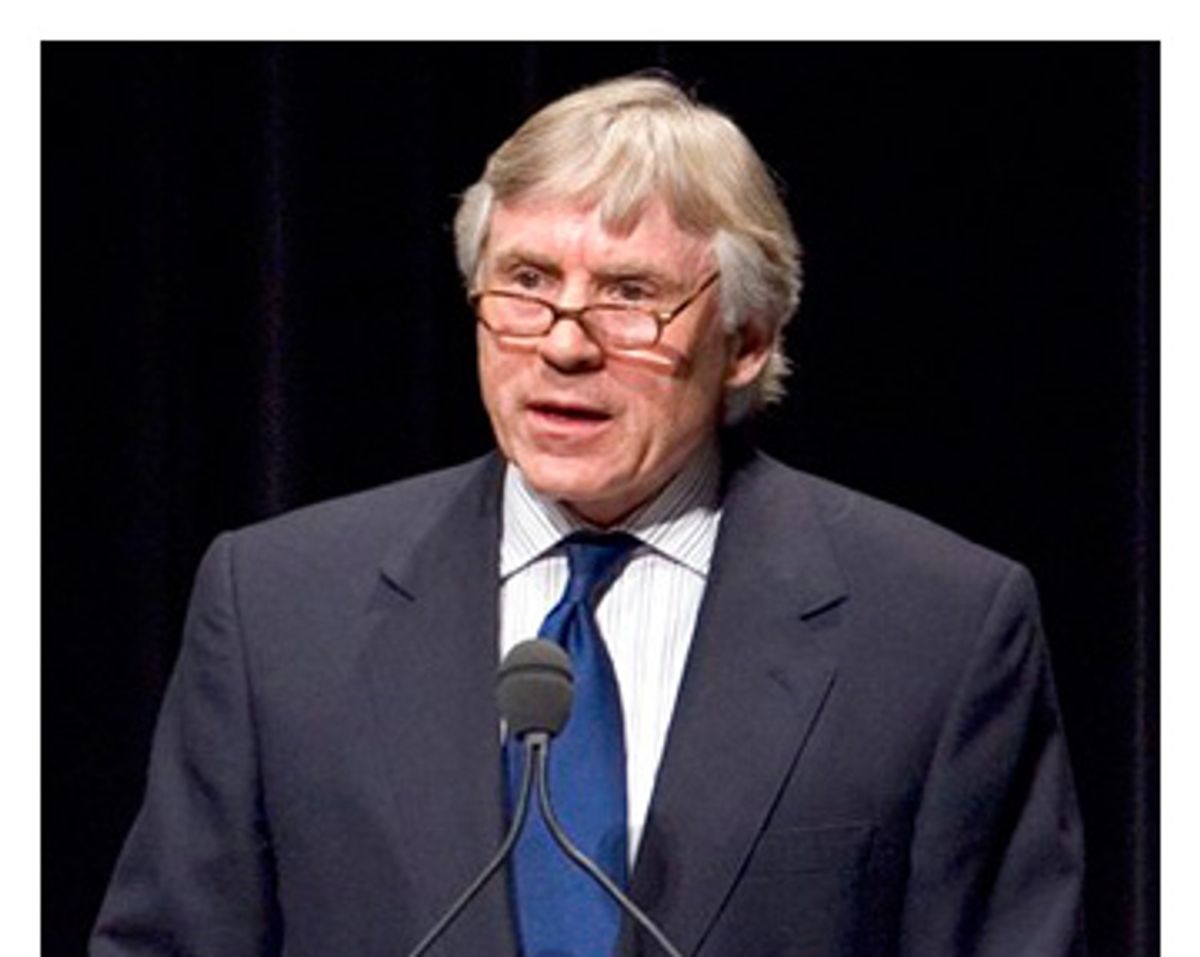
I would like to begin by thanking dean John Coatsworth and professor Richard Bulliet for their work in organizing this event and for their commitment to the role of the School of International and Public Affairs and its role in training future leaders in world affairs. If today proves anything it will be that there is an enormous amount of work ahead for all of us. This is just one of many events on Iran that will run throughout this academic year, all to help us better understand this critical and complex nation in today's geopolitics.
Before speaking directly to the current president of Iran, I have a few critically important points to emphasize.
First, since 2003, the World Leaders Forum has advanced Columbia's long-standing tradition of serving as a major forum for robust debate, especially on global issues. It should never be thought that merely to listen to ideas we deplore in any way implies our endorsement of those ideas, or the weakness of our resolve to resist those ideas or our naiveté about the very real dangers inherent in such ideas. It is a critical premise of freedom of speech that we do not honor the dishonorable when we open the public forum to their voices. To hold otherwise would make vigorous debate impossible.
Second, to those who believe that this event never should have happened, that it is inappropriate for the university to conduct such an event, I want to say that I understand your perspective and respect it as reasonable. The scope of free speech and academic freedom should itself always be open to further debate. As one of the more famous quotations about free speech goes, it is "an experiment, as all life is an experiment." I want to say, however, as forcefully as I can, that this is the right thing to do and, indeed, it is required by existing norms of free speech, the American university and Columbia itself.
Third, to those among us who experience hurt and pain as a result of this day, I say on behalf of all of us we are sorry and wish to do what we can to alleviate it.
Fourth, to be clear on another matter -- this event has nothing whatsoever to do with any "rights" of the speaker but only with our rights to listen and speak. We do it for ourselves.
We do it in the great tradition of openness that has defined this nation for many decades now. We need to understand the world we live in, neither neglecting its glories nor shrinking from its threats and dangers. It is consistent with the idea that one should know thine enemies, to have the intellectual and emotional courage to confront the mind of evil and to prepare ourselves to act with the right temperament. In the moment, the arguments for free speech will never seem to match the power of the arguments against, but what we must remember is that this is precisely because free speech asks us to exercise extraordinary self-restraint against the very natural but often counterproductive impulses that lead us to retreat from engagement with ideas we dislike and fear. In this lies the genius of the American idea of free speech.
Lastly, in universities, we have a deep and almost single-minded commitment to pursue the truth. We do not have access to the levers of power. We cannot make war or peace. We can only make minds. And to do this we must have the most full freedom of inquiry.
Let me now turn to Mr. Ahmadinejad.
THE BRUTAL CRACKDOWN ON SCHOLARS, JOURNALISTS AND HUMAN RIGHTS ADVOCATES
Over the last two weeks, your government has released Dr. Haleh Esfandiari and Parnaz Axima; and just two days ago Kian Tajbakhsh, a graduate of Columbia with a Ph.D. in urban planning. While our community is relieved to learn of his release on bail, Dr. Tajbakhsh remains in Teheran, under house arrest, and he still does not know whether he will be charged with a crime or allowed to leave the country. Let me say this for the record, I call on the president today to ensure that Kian Tajbaksh will be free to travel out of Iran as he wishes. Let me also report today that we are extending an offer to Dr. Tajbaksh to join our faculty as a visiting professor in urban planning here at his alma mater, in our Graduate School of Architecture, Planning and Preservation. And we hope he will be able to join us next semester.
The arrest and imprisonment of these Iranian Americans for no good reason is not only unjustified, it runs completely counter to the very values that allow today's speaker to even appear on this campus.
But at least they are alive.
According to Amnesty International, 210 people have been executed in Iran so far this year -- 21 of them on the morning of Sept. 5 alone. This annual total includes at least two children -- further proof, as Human Rights Watch puts it, that Iran leads the world in executing minors.
There is more.
Iran hanged up to 30 people this past July and August during a widely reported suppression of efforts to establish a more open, democratic society in Iran. Many of these executions were carried out in public view, a violation of the International Covenant on Civil and Political Rights, to which Iran is a party.
These executions and others have coincided with a wider crackdown on student activists and academics accused of trying to foment a so-called "soft revolution." This has included jailing and forced retirements of scholars. As Dr. Esfandiari said in a broadcast interview since her release, she was held in solitary confinement for 105 days because the government "believes that the United States ... is planning a Velvet Revolution" in Iran.
In this very room last year we learned something about Velvet Revolutions from Vaclav Havel. And we will likely hear the same from our World Leaders Forum speaker this evening -- President Michelle Bachelet Jeria of Chile. Both of their extraordinary stories remind us that there are not enough prisons to prevent an entire society that wants its freedom from achieving it.
We at this university have not been shy to protest and challenge the failures of our own government to live by these values; and we won't be shy in criticizing yours.
Let's, then, be clear at the beginning, Mr. President, you exhibit all the signs of a petty and cruel dictator.
And so I ask you:
Why have women, members of the Baha'i faith, homosexuals and so many of our academic colleagues become targets of persecution in your country?
Why in a letter last week to the secretary general of the U.N. did Akbar Gangi, Iran's leading political dissident, and over 300 public intellectuals, writers and Nobel Laureates express such grave concern that your inflamed dispute with the West is distracting the world's attention from the intolerable conditions your regime has created within Iran? In particular, the use of the Press Law to ban writers for criticizing the ruling system.
Why are you so afraid of Iranian citizens expressing their opinions for change?
In our country, you are interviewed by our press and asked to speak here today. And while my colleague at the Law School Michael Dorf spoke to Radio Free Europe [sic, Voice of America] viewers in Iran a short while ago on the tenets of freedom of speech in this country, I propose going further than that. Let me lead a delegation of students and faculty from Columbia to address your university about free speech, with the same freedom we afford you today? Will you do that?
THE DENIAL OF THE HOLOCAUST
In a December 2005 state television broadcast, you described the Holocaust as a "fabricated" "legend." One year later, you held a two-day conference of Holocaust deniers.
For the illiterate and ignorant, this is dangerous propaganda. When you come to a place like this, this makes you, quite simply, ridiculous. You are either brazenly provocative or astonishingly uneducated.
You should know that Columbia is a world center of Jewish studies and now, in partnership with the YIVO Institute, of Holocaust studies. Since the 1930s, we've provided an intellectual home for countless Holocaust refugees and survivors and their children and grandchildren. The truth is that the Holocaust is the most documented event in human history. Because of this, and for many other reasons, your absurd comments about the "debate" over the Holocaust both defy historical truth and make all of us who continue to fear humanity's capacity for evil shudder at this closure of memory, which is always virtue's first line of defense.
Will you cease this outrage?
THE DESTRUCTION OF ISRAEL
Twelve days ago, you said that the state of Israel "cannot continue its life." This echoed a number of inflammatory statements you have delivered in the last two years, including in October 2005 when you said that Israel should be "wiped off the map."
Columbia has over 800 alumni currently living in Israel. As an institution we have deep ties with our colleagues there. I personally have spoken out in the most forceful terms against proposals to boycott Israeli scholars and universities, saying that such boycotts might as well include Columbia. More than 400 college and university presidents in this country have joined in that statement. My question, then, is: Do you plan on wiping us off the map, too?
FUNDING TERRORISM
According to reports by the Council on Foreign Relations, it's well documented that Iran is a state sponsor of terror that funds such violent groups as the Lebanese Hezbollah, which Iran helped organize in the 1980s, the Palestinian Hamas, and Palestinian Islamic Jihad.
While your predecessor government was instrumental in providing the U.S. with intelligence and base support in its 2001 campaign against the Taliban in Afghanistan, your government is now undermining American troops in Iraq by funding, arming and providing safe transit to insurgent leaders like Muqtada al-Sadr and his forces.
There are a number of reports that also link your government with Syria's efforts to destabalize the fledgling Lebanese government through violence and political assassination.
My question is this: Why do you support well-documented terrorist organizations that continue to strike at peace and democracy in the Middle East, destroying lives and civil society in the region?
PROXY WAR AGAINST U.S. TROOPS IN IRAQ
In a briefing before the National Press Club earlier this month, General David Petraeus reported that arms supplies from Iran, including 240 mm rockets and explosively formed projectiles, are contributing to "a sophistication of attacks that would by no means be possible without Iranian support."
A number of Columbia graduates and current students are among the brave members of our military who are serving or have served in Iraq and Afghanistan. They, like other Americans with sons, daughters, fathers, husbands and wives serving in combat, rightly see your government as the enemy.
Can you tell them and us why Iran is fighting a proxy war in Iraq by arming Shi'a militia targeting and killing U.S. troops?
FINALLY, IRAN'S NUCLEAR PROGRAM AND INTERNATIONAL SANCTIONS
This week the United Nations Security Council is contemplating expanding sanctions for a third time because of your government's refusal to suspend its uranium-enrichment program. You continue to defy this world body by claiming a right to develop peaceful nuclear power, but this hardly withstands scrutiny when you continue to issue military threats to neighbors. Last week, French President Sarkozy made clear his lost patience with your stall tactics; and even Russia and China have shown concern.
Why does your country continue to refuse to adhere to international standards for nuclear weapons verification in defiance of agreements that you have made with the U.N. nuclear agency? And why have you chosen to make the people of your country vulnerable to the effects of international economic sanctions and threaten to engulf the world with nuclear annihilation?
Let me close with this comment. Frankly, and in all candor, Mr. President, I doubt that you will have the intellectual courage to answer these questions. But your avoiding them will in itself be meaningful to us. I do expect you to exhibit the fanatical mind-set that characterizes so much of what you say and do. Fortunately, I am told by experts on your country, that this only further undermines your position in Iran with all the many goodhearted, intelligent citizens there. A year ago, I am reliably told, your preposterous and belligerent statements in this country (as in your meeting at the Council on Foreign Relations) so embarrassed sensible Iranian citizens that this led to your party's defeat in the December mayoral elections. May this do that and more.
I am only a professor, who is also a university president, and today I feel all the weight of the modern civilized world yearning to express the revulsion at what you stand for. I only wish I could do better.
Shares