

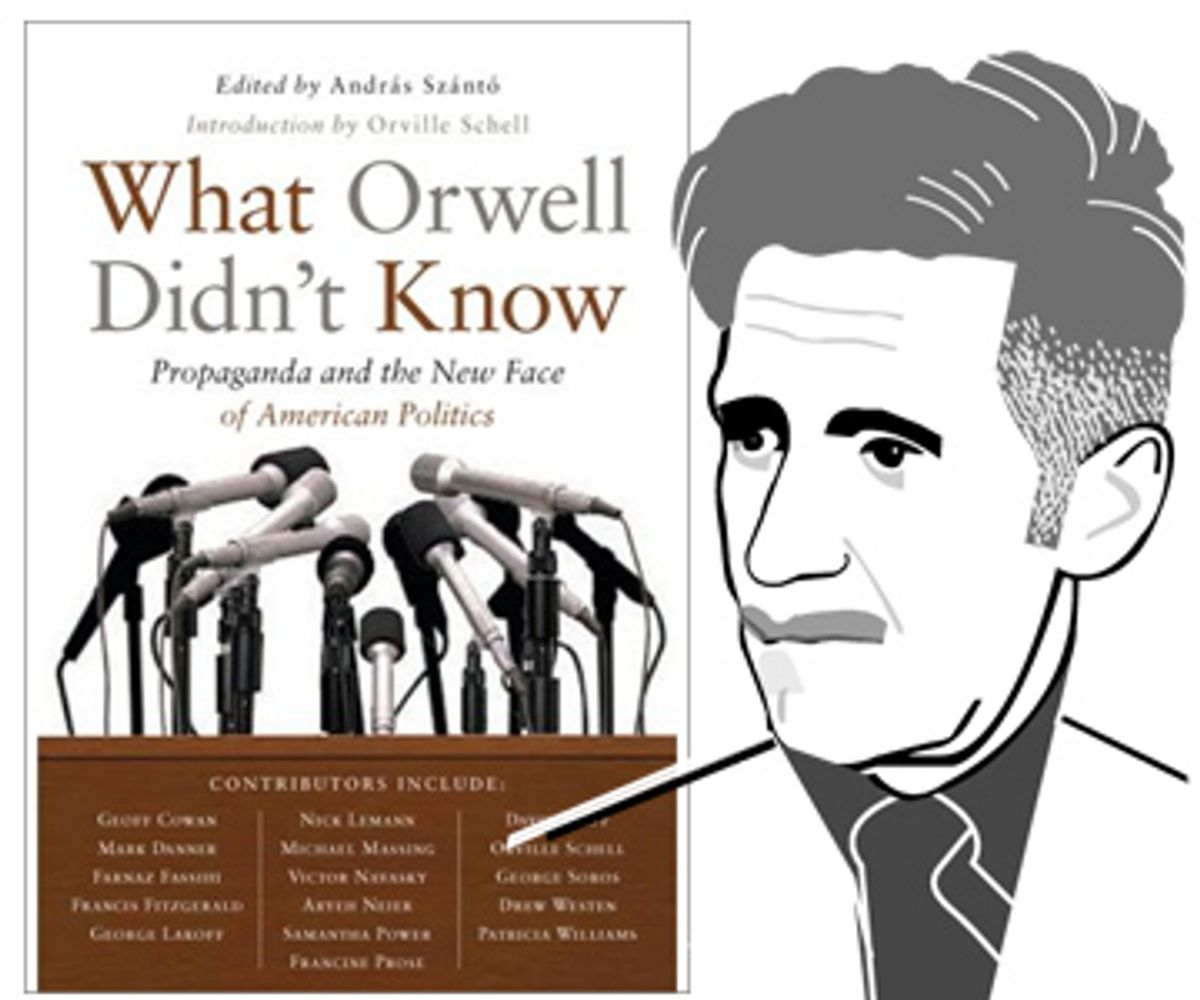
At first glance, the war in Iraq would seem to represent the realization of George Orwell's darkest fears. In "Politics and the English Language," he expressed alarm over how political speech and language, degraded by euphemism, vagueness, and cliché, was used to defend the indefensible, to make lies sound truthful and murder respectable. Three years later, in "1984," Orwell offered an even grimmer vision, one in which an all-powerful Party, working through an all-seeing Ministry of Truth, manipulates and intimidates the public by pelting it with an endless series of distorted and fabricated messages.
The Bush administration, in pushing for the war in Iraq, seems to have done much the same. It concocted lurid images to stir fear ("weapons of mass destruction," the prospect that the "smoking gun" could become a "mushroom cloud"). It asserted as fact information known to be false (the purported ties between Iraq and al Qaeda). It clipped and cropped intelligence data to fit its policy goals (dropping important qualifiers from the National Intelligence Estimate on Iraq). It worked up snippets and scraps of unsubstantiated evidence into a slick package of deception and misrepresentation (Colin Powell's speech at the United Nations). And it created a whole glossary of diversionary terms -- "preemptive war" for unprovoked aggression, "shock and awe" for a devastating bombing campaign, "coalition" for an invading force that was overwhelmingly American -- all of which helped win the White House broad domestic support for a war that most of the rest of the world had decisively rejected.
Yet in many key respects, the Iraq war has diverged from Orwell's dystopic vision. Orwell had expected advances in technology to allow the ruling elite to monopolize the flow of information and through it to control the minds of the masses. In reality, though, those advances have set off an explosion in the number and diversity of news sources, making efforts at control all the harder to achieve. The 24-hour cable news channels, the constantly updated news Web sites, news aggregators like Google News, post-it-yourself sites such as YouTube, ezines, blogs, and digital cameras have all helped feed an avalanche of information about world affairs. In Iraq, reporters embedded with troops have been able via the Internet to file copy directly from the field. Through "milblogs," soldiers have been able to share with the outside world their impressions about their experiences on the ground. Even as the war has dragged on, it has given rise to a shelf-full of revealing books, written by not only generals and journalists but also captains, lieutenants, privates, national guardsmen, and even deserters.
In short, no war has been more fully chronicled or minutely analyzed than this one. And, as a result, the Bush administration has been unable to spin it as it would like. The spreading insurgency, the surging violence, the descent into chaos -- all have been thoroughly documented by journalists and others, and public support for the war has steadily ebbed as a result.
Yet even amid this information glut, the public remains ill-informed about many key aspects of the war. This is due less to any restrictions imposed by the government, or to any official management of language or image, than to controls imposed by the public itself. Americans -- reluctant to confront certain raw realities of the war -- have placed strong filters and screens on the facts and images they receive. This is particularly true regarding the conduct of U.S. troops in the field. The U.S. military in Iraq is an occupation army, and like most such forces, it has engaged in many troubling acts. With American men and women putting their lives at risk in a very hostile environment, however, the American public has little appetite for news about such acts, and so it sets limits on what it is willing to hear about them. The Press -- ever attuned to public sensitivities -- will, on occasion, test those limits, but generally respects them. The result is an unstated, unconscious, but nonetheless potent co-conspiracy between the public and the press to muffle some important truths about the war. In a disturbing twist on the Orwellian nightmare, the American people have become their own thought police, purging the news of unwanted and unwelcome features with an efficiency that government censors and military flacks can only envy.
Sometimes the public defines its limits by expressing outrage. The running of a story that seems too unsettling, or the airing of an image that seems too graphic, can set off a storm of protest -- from Fox News and the Weekly Standard, bloggers and radio talk-show hosts, military families and enraged citizens -- all denouncing the messenger as unpatriotic, un-American, even treasonous. In this swirl of menace and hate, even the most determined journalist can feel cowed.
Kevin Sites can attest to this. A freelance cameraman, Sites in November 2004 covered the second battle of Fallujah for NBC News. On Nov. 13, he followed a squad of Marines into a mosque that had been the scene of intense fighting. On the ground lay several badly wounded Iraqis. Seeing one of them move, a Marine shouted, "He's fucking faking he's dead," then shot him, making sure that he was. Sites caught the moment on tape and sent it to NBC. The network aired the clip but halted it at the moment when the soldier actually began firing. "NBC has chosen not to air the most gruesome of the images," anchor Brian Williams explained. Other networks did the same. (On the Arab satellite networks, the clip was shown in full, and repeatedly.) Even with this editing, Sites received thousands of death threats and pieces of hate mail. "Dear Liberal Media Scumbag," went one, "I hope the next video clip out of Iraq I watch is an insurgent placing your severed head onto your back." Bloggers accused him of being a traitor and an antiwar activist.
Since then, the networks have aired very few clips that approach even the truncated version of Sites' report. Sites himself no longer works for the networks; rather, he's out on his own, posting video reports from around the world on Yahoo.com, where his audience is a fraction of what it once was. To find truly revealing footage about the war, it's necessary to seek out documentaries such as "The Ground Truth" and "The War Tapes," which play mainly before small elite audiences in art houses in the nation's largest cities.
In other cases, the public sets the limits of its tolerance through indifference and inattention, responding to reports of a shocking nature with a yawn and a sigh and thus causing these stories to wither and fade. The Haditha massacre is a good example. In March 2006, Time magazine reported that four months earlier, a group of Marines patrolling a remote village in western Iraq had lost one of its men to a roadside bomb. Furious, the soldiers had gone on a rampage, killing 15 unarmed men, women, and children. Initially, the Marines involved in the attack claimed that the civilians had died from the insurgent bomb, and the military accepted their report. But Time had obtained a copy of a videotape of the attack's aftermath and, based on it, and on interviews with eyewitnesses, concluded that a massacre might have occurred. "What happened in Haditha," correspondent Tim McGirk wrote, "is a reminder of the horrors faced by civilians caught in the middle of war -- and what war can do to the people who fight it."
All in all, it was an explosive report, presenting strong evidence of a Marine atrocity. Yet it stirred little public reaction, prompted no demands for an investigation, received scant follow-up from other news organizations. It was only two months later, when Rep. John Murtha denounced the slaughter at a press conference, declaring that the Marines had "killed innocent civilians in cold blood," that politicians began to pay attention to the episode, and that journalists began to write about it. Forced to investigate, the military determined that the Marines had killed not 15 but 24 civilians, and it initiated proceedings against eight of the soldiers.
From that point on, the massacre -- validated as newsworthy by a leading congressman -- received extensive coverage. Even so, it was framed as a rare exception, as an aberration from the otherwise commendable behavior of U.S. soldiers in Iraq. But, as William Langewiesche found in an investigation for Vanity Fair, the incident was not all that exceptional. The initial failure of the Marines to fully investigate the killings was due not to any conspiracy or cover-up but to the fact that the bloodshed was not regarded as anything out of the ordinary. "The killing of civilians," Langewiesche wrote, "has become so commonplace that the report of these particular ones barely aroused notice as it moved up the chain of command in Iraq." The debacle in Haditha grew out of the "normal operations in the war," he observed, operations that "make such carnage routine."
Few other publications, however, were willing to explore this. Doing so would require acknowledging that U.S. soldiers in Iraq are not necessarily paragons of virtue, that they do not always show respect for Iraqi civilians, that at times they harass, abuse, injure, and even kill them. It would require acknowledging that the Iraq war, like most wars, is a savage, pitiless affair in which American soldiers have been forced to do many un-American things. Most Americans prefer not to confront this. They want to be able to maintain their belief that Americans are an exceptionally virtuous, freedom-loving people and that their soldiers are a uniquely compassionate, well-meaning force. Any assertions to the contrary can rouse the beast, and the press, well aware of this, tends to tread warily around it.
Needless to say, many U.S. soldiers do behave in an upright fashion. Intent on doing good, they have distributed toys to children, cleaned up streets in poor neighborhoods, and arranged medical help for the injured and ailing. But these soldiers have been placed in an extraordinarily perilous environment with minimal preparation, and as the security situation has deteriorated and the population has grown increasingly belligerent, they have responded in ways that do not always conform to the standards taught in Army field manuals.
For a truly unsanitized look at the nature of the occupation, one must consult the many books that have been written about it. Just as the most graphic footage from Iraq has been tucked away in documentaries, so has the rawest reporting been relegated to books that only the most motivated will seek out. Especially revealing are the many firsthand accounts produced by ordinary soldiers. Among them are "My War: Killing Time in Iraq," by Colby Buzzell, a pot-smoking admirer of Charles Bukowski, Ralph Nader, and George Orwell and the operator of one of the most widely read milblogs (until it was shut down by the military); "Love My Rifle More Than You: Young and Female in the U.S. Army," by Kayla Williams, a freewheeling, foulmouthed military intelligence specialist; "The Deserter's Tale," by Joshua Key, a private from Oklahoma who, appalled by the brutality and cruelty of his fellow soldiers, left his unit and fled to Canada; and "Operation Homecoming," a collection of eyewitness accounts, private journals, and short stories by U.S. soldiers sponsored by the National Endowment for the Arts. In these books are recorded not only many acts of courage, self-sacrifice, and benevolence but also many deeply disturbing aspects of the U.S. presence in Iraq -- realities that tend to get airbrushed out of news accounts. Among them:
In contrast to the deaths from car bombs and suicide attacks of the insurgents, most of the civilian deaths caused by Americans are unintentional. That does not, however, make them any less wrenching for the victims and their families. In the Arab news media, this ongoing slaughter receives constant coverage. In the American media, it receives very little. One can watch the evening news shows for nights on end, one can scour U.S. papers week after week, and not find any acknowledgment of the many civilians who have been killed by GIs. Writing in the Washington Post in July 2006, Andrew J. Bacevich, a professor of international relations at Boston University and the author of two highly regarded studies of U.S. foreign policy, expressed dismay at the indifference shown by both the military and the American public toward the ongoing slaughter of Iraqi noncombatants by U.S. soldiers. Observing that nobody has even bothered to keep a tally of the victims, Bacevich surmised from his own readings that the number "almost certainly runs in the tens of thousands." Aside from the obvious moral questions this raises, he went on, the violence against civilians has undermined America's policies in Iraq and the Mideast generally by "suggesting to Iraqis and Americans alike that Iraqi civilians -- and perhaps Arabs and Muslims more generally -- are expendable."
How can such a critical feature of the U.S. occupation remain so hidden from view? Because most Americans don't want to know about it. The books by Iraqi vets are filled with expressions of disbelief and rage at the lack of interest ordinary Americans show for what they've had to endure on the battlefield. In "Operation Homecoming," one returning Marine, who takes to drinking heavily in an effort to cope with the crushing guilt and revulsion he feels over how many people he's seen killed, fumes about how "you can't talk to them [ordinary Americans] about the horror of a dead child's lifeless mutilated body staring back at you from the void, knowing you took part in that end." Writing of her return home, Kayla Williams notes that the things most people seemed interested in were "beyond my comprehension. Who cared about Jennifer Lopez? How was it that I was watching CNN one morning and there was a story about freaking ducklings being fished out of a damn sewer drain -- while the story of soldiers getting killed in Iraq got relegated to this little banner across the bottom of the screen?" In "Generation Kill," by the journalist Evan Wright, a Marine corporal confides his anguish and anger over all the killings he has seen: "I think it's bullshit how these fucking civilians are dying! They're worse off than the guys that are shooting at us. They don't even have a chance. Do you think people at home are going to see this -- all these women and children we're killing? Fuck no. Back home they're glorifying this motherfucker, I guarantee you."
"Generation Kill" recounts Wright's experiences traveling with a Marine platoon during the initial invasion. The platoon was at the very tip of the spear of the invasion force, and Wright got a uniquely close-up view of the fighting. In most U.S. news accounts, the invasion was portrayed as a relatively bloodless affair, with few American casualties and not many more civilian ones. Wright offers a starkly different tale. While expressing admiration for the Marines' many acts of valor and displays of compassion, he marvels at the U.S. military's ferocious fire-power and shudders at the startling number of civilians who fell victim to it. He writes of neighborhoods being leveled by mortar rounds, of villages being flattened by air strikes, of innocent men, women, and children being mowed down in free-fire zones. At first, Wright notes, the Marines found it easy, even exciting, to kill, but as the invasion progressed and the civilian toll mounted, many began to recoil, and some even broke down. "Do you realize the shit we've done here, the people we've killed?" one Marine agonizes. "Back home in the civilian world, if we did this, we would go to prison."
In an interview he gave soon after the publication of his book, Wright said that his main aim in writing it was to deglamorize the war -- and war in general. The problem with American society, he said, "is we don't really understand what war is. Our understanding of it is too sanitized." For the past decade, he explained, "we've been steeped in the lore of The Greatest Generation" -- Tom Brokaw's book about the men who fought in World War II -- "and a lot of people have developed this romanticism about that war. They tend to remember it from the Life magazine images of the sailor coming home and kissing his fiancée. They've forgotten that war is about killing." In "Generation Kill," he noted, he wanted to show how soldiers kill and wound civilians. In some cases, he said, the U.S. military justified such killings by the presence of Iraqi fedayeen fighters among the civilian population, but, he added, "when you see a little girl in pretty clothes that someone dressed her in, and she's smushed on the road with her legs cut off, you don't think, 'Well, you know, there were Fedayeen nearby and this is collateral damage. They're just civilians.'" The "real rule of war that you learn -- and this was true in World War II -- is that people who suffer the most are civilians," Wright said. "You're safest if you're a soldier. I'm haunted by the images of people that I saw killed by my country."
As Wright suggests, the sanitizing of news in wartime is nothing new. In most wars, nations that send their men and women off to fight in distant lands don't want to learn too much about the violence being committed in their name. Facing up to this would cause too much shame, would deal too great a blow to national self-esteem. If people were to become too aware of the butchery wars entail, they would become much less willing to fight them. And so the illusion must be maintained that war is a noble enterprise, that the soldiers who wage it are full of valor and heroism, that in the end their intentions are good and their actions benign.
In his reflections on politics and language, Orwell operated on the assumption that people want to know the truth. Often, though, they don't. In the case of Iraq, the many instruments Orwell felt would be needed to keep people passive and uninformed -- the nonstop propaganda messages, the memory holes, the rewriting of history, Room 101 -- have proved unnecessary. The public has become its own collective Ministry of Truth -- a reality that, in many ways, is even more chilling than the one Orwell envisioned.
Shares