

When Joseph Smith Jr., who would become the founder of the Church of Jesus Christ of Latter-day Saints, was a 14-year-old boy in 1820, he went into the woods near his home in Palmyra, N.Y., to pray for spiritual guidance. All over the rural United States people were being swept up in a religious upheaval that historians would later call the Second Great Awakening. Western New York state, Smith's home region, was so prone to "catching fire" with religious fervor that it became known as the Burned-Over District.
Young Joseph was suffused with religious feeling from an early age; both of his grandfathers and both of his parents apparently experienced prophetic visions. Joseph had attended Methodist camp meetings around Palmyra, and had very likely heard traveling Presbyterian and Baptist preachers spreading their versions of the gospel too. But when he retired to that now-legendary grove of trees to ask God "which of all the sects was right, that I might know which to join," he was met with a startling response. By Smith's own account of Mormonism's First Vision, "a pillar of light" descended on him, containing two "Personages," who turned out to be Almighty God and his son Jesus Christ.
"I was answered [evidently by Jesus] that I must join none of them, for they were all wrong; and the Personage who addressed me said that all their creeds were an abomination in his sight; that those professors were all corrupt; that: 'they draw near to me with their lips, but their hearts are far from me, they teach for doctrines the commandments of men, having a form of godliness, but they deny the power thereof.'"
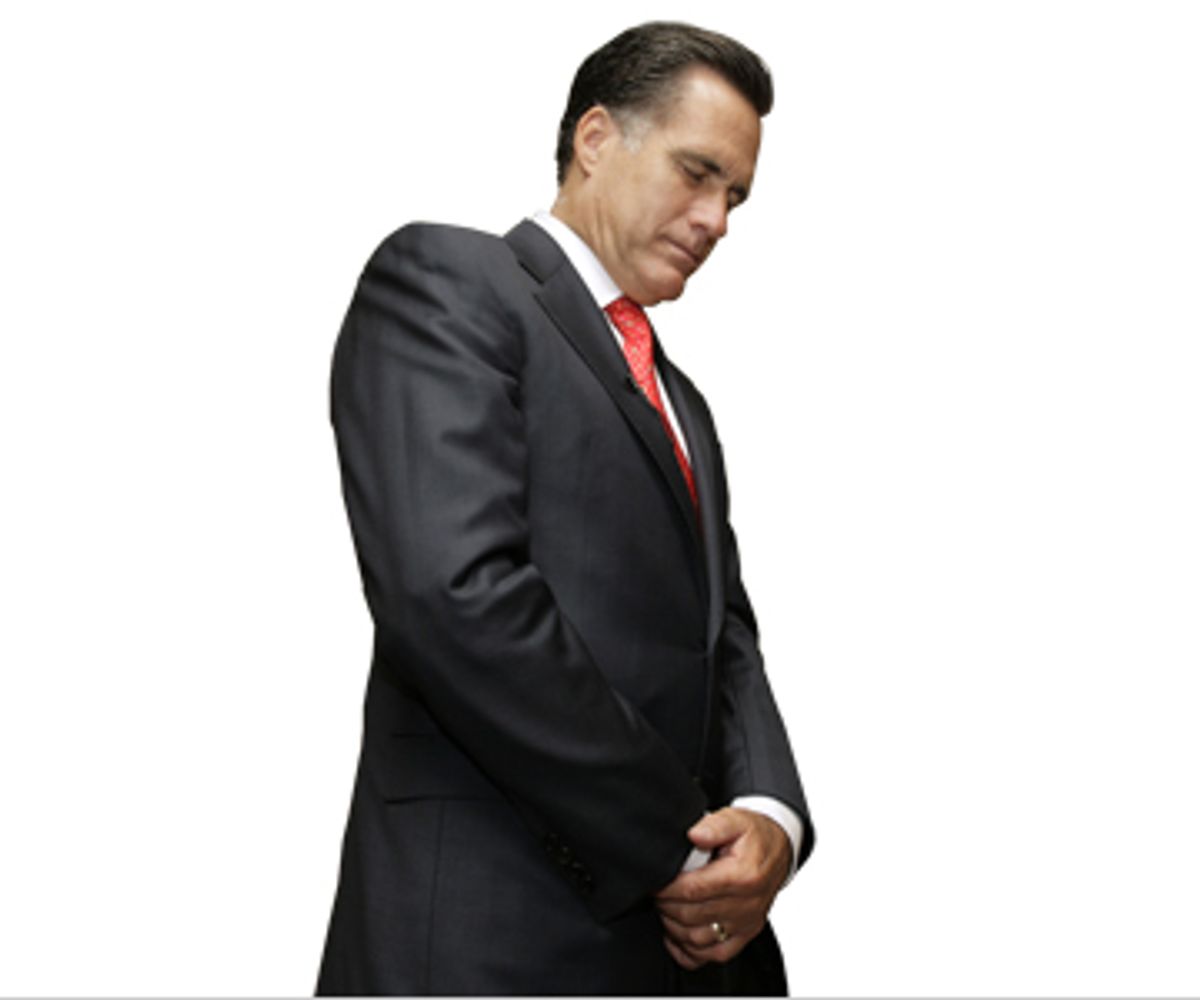
When former Massachusetts governor Mitt Romney faces the cameras on Thursday at the George H.W. Bush Presidential Library in College Station, Texas, where he has promised to deliver a major speech "about the role of religion, faith, in America and in a free society," he carries the legacy of Joseph Smith's First Vision with him, whether he likes it or not. Romney is unlikely to tell the Protestants and Catholics in his audience that their creeds are an abomination, or that they are participants in a Great Apostasy that began shortly after Jesus ascended to heaven and continued, in all forms of Christianity, till Smith founded the Mormon church on a new set of scriptures in 1830. But he cannot quite evade those beliefs either, for they are fundamental tenets of his faith.
As the most prominent Mormon presidential candidate since his father, George, 40 years ago, or since Smith himself ran on a platform of "Theodemocracy" in 1844, Romney must negotiate between two opposing forces. The theology and tangled history of Mormonism is at odds with the quasi-theocratic nature of the contemporary Republican Party, which seems to have decreed that only Bible-believing Christians or their close allies may run for high office. Neither of these two forces is of Romney's own making, but it was the candidate, and his decisions about how to run his campaign, who ensured that they would collide.
As Christopher Hitchens recently complained in Slate, political reporters have generally treated the details of Romney's faith as a no-go zone. If the question were simply whether his beliefs (or anyone else's) should qualify or disqualify him from public office, I would agree that there was nothing to discuss. Moreover, only Mitt Romney can know how much of Mormon doctrine he accepts without question and how much he takes with a grain of salt. Even in the most dogmatic of believers and the most dictatorial of denominations, faith is fundamentally a private process of negotiation.
But you don't have to descend to Hitchens' level of anti-Mormon vitriol to recognize that Romney's religion, and how he characterizes and explains it, has now become the central issue of his campaign. It may even be the issue that ends his candidacy -- and some of that is no one's fault but Mitt Romney's. In transforming himself from a moderate, pro-choice Republican into an avid pro-life conservative, and in pandering to the party's white Southern evangelical base -- essentially presenting himself as a Christian fellow traveler with a few eccentric updates -- Romney himself helped make an evangelical vetting of his faith inevitable.
Romney has explicitly resisted comparing his upcoming College Station speech to John F. Kennedy's September 1960 address to the Greater Houston Ministerial Association, and for good reason. Most famously, Kennedy declared in that speech that he was "not the Catholic candidate for president," but rather "the Democratic Party's candidate for president who happens also to be a Catholic." Earlier in the address, he said things that were arguably more important, and that Romney is singularly unlikely to repeat, unless his steadily sinking poll numbers in Iowa and New Hampshire have convinced him to reverse fields yet again and run as a liberal Republican after all.
"I believe in an America where the separation of church and state is absolute," Kennedy told the Houston ministers, "where no Catholic prelate would tell the President -- should he be Catholic -- how to act, and no Protestant minister would tell his parishioners for whom to vote; where no church or church school is granted any public funds or political preference ... I believe in an America that is officially neither Catholic, Protestant nor Jewish; where no public official either requests or accepts instructions on public policy from the Pope, the National Council of Churches or any other ecclesiastical source; where no religious body seeks to impose its will directly or indirectly upon the general populace or the public acts of its officials."
Kennedy was seeking to take his then-controversial faith off the table by embracing the constitutional and secular nature of the American republic, and by asking voters to judge him on his own words and deeds rather than as a representative of his church. If Romney were trying to accomplish something similar, one could only commend him. But his task is more perplexing and difficult than that.
Romney needs to appease a constituency that conspicuously does not believe in the absolute separation of church and state, that favors public funding of religious education (or at least certain varieties of it) and has frequently sought to impose theological ideas or religious structures in the public sphere. He's not trying to convince right-wing evangelical Christians that he would govern as a secular president; he's trying to convince them that his ideas about religion are close enough to theirs, in some general way, that they should overlook the differences.
In aiming his candidacy at a born-again audience, Romney has made his faith into a campaign issue, much as George W. Bush did in 2000. But while Bush's version of repentant-sinner spirituality made him appealing to a wide swath of Americans, both devout and less so, Romney is now facing the fact that his religion makes many of the same people uncomfortable. After 187 years, Mormonism has become a recognizable skein of the American religious tapestry, but that doesn't change the fact that it was founded on a rejection of mainstream Christianity and embodies many beliefs that no other Christians are likely to accept.
During his speech, Romney certainly won't be bringing up the more peculiar aspects of Mormon theology, the ones drawn from Smith's later prophetic career that sound pretty close to polytheism. Smith moved from a "restorationist" version of Christianity toward an intriguing mishmash of post-Christian theology drawn in part from Swedenborgian mysticism, Masonic ritual and Hinduism. Smith's pronouncement that God, angels and human beings are all members of the same eternal, coexistent species is entirely incompatible with any normative Christian doctrine. God did not create man, Smith proclaimed, or at least not in the usual biblical meaning of that phrase. In fact, the God of the Abrahamic faiths used to be a man, in the distant past, and far in the future the most diligent and virtuous men may become gods.
In fairness, the Mormon church has tried to have it both ways on the question of whether it is or isn't Christian for a long time, and Romney is simply inheriting many generations of waffling. Since at least the late 19th century, Mormons have proclaimed that they belong to a larger Christian fellowship whenever it was socially or politically expedient to do so, all while hewing to a set of prophetic teachings most Christians find outrageous and following a visionary founder who insisted they were the only true Christians.
The Mormon church is trying to rehearse the history of other successful American religions by assimilating. In every new sect, as in an immigrant family, each generation becomes progressively more integrated into the majority culture. It's hard to remember that a mainline Protestant denomination like Methodism, now settled and bourgeois, was considered a fanatic faith when it began in the 18th century.
Mormon assimilation began early, and under duress. After a rising tide of anti-Mormon persecution led to Joseph Smith's murder, the more pragmatic Brigham Young stemmed the tide of constant revelation and circled the wagons, both literally and figuratively. He sought to ensure Mormon survival by creating a separatist but recognizably Christian state on the shores of the Great Salt Lake. After Young died in 1877, the end of polygamy soon followed, and the end of polygamy meant statehood for Utah. By the beginning of the 20th century, Mormons -- like any number of denominations and ethnic groups before them -- had set a course toward the American mainstream.
There is no question that the cultural differences between Mormons and evangelical Protestants have narrowed in recent decades, and this fact may have presented a pitfall the Romney campaign could not avoid. Mormons and white evangelicals, who once engaged in open warfare, have cohabited peaceably in the exurban West and Southwest for many years. They vote similarly (i.e., for conservative Republicans, from the local school board to the presidency) and are likely to hold similar views on a wide array of issues, from abortion to gay rights to the corrupting influence of popular culture to the war in Iraq.
One could argue that their religious doctrines have grown closer as well. Many more Protestants these days (and even some Catholics) talk about having a personal, dialogic relationship with the deity -- you talk, and God answers -- than in years gone by. Some Mormons believe that's because the gospel of Joseph Smith, with its promise of direct revelation for all, is doing its work. On the other hand, while nothing in official Mormon doctrine requires a rejection of evolutionary theory, and Smith was in no sense a biblical fundamentalist, there is ample evidence that creationist belief has become widespread among Mormons.
But what Mitt Romney and his campaign handlers failed to grasp is that assimilation only goes so far when you're talking about a prophetic and eccentric religion that's still less than 200 years old -- and about the intolerant, borderline-paranoid atmosphere of contemporary Republican politics. Even an obviously secular Republican candidate like the thrice-married Rudy Giuliani is obliged to profess, these days, that he often reads the Bible. While some evangelicals may remain uncomfortable with Giuliani's Catholicism, at least his church wasn't founded by a kid from upstate New York who pronounced himself the one true heir to the traditions of Abraham, Moses and Jesus.
There's no reason to doubt the sincerity of Romney's faith, or to doubt that he accepts his church's current self-definition as an exotic blossom on the golden bush of Christian America. But like all other Mormons he's stuck with the religion's history and contradictions; he doesn't get to pick and choose among Joseph Smith's free-associating pronouncements any more than a Muslim gets to ignore the edicts of Mohammed. Either Smith was a prophet of God or he wasn't. If he was, then all other forms of Christianity are corrupt and a tiny handful of us may grow up to be gods in other universes. In the meantime, Mitt Romney will probably spend Thursday morning trying to spin all that for the Republican base. If, instead, he says, "I have no idea whether I'm a Christian or not. It depends what the question means," then I'm voting for him, no matter what.
Shares