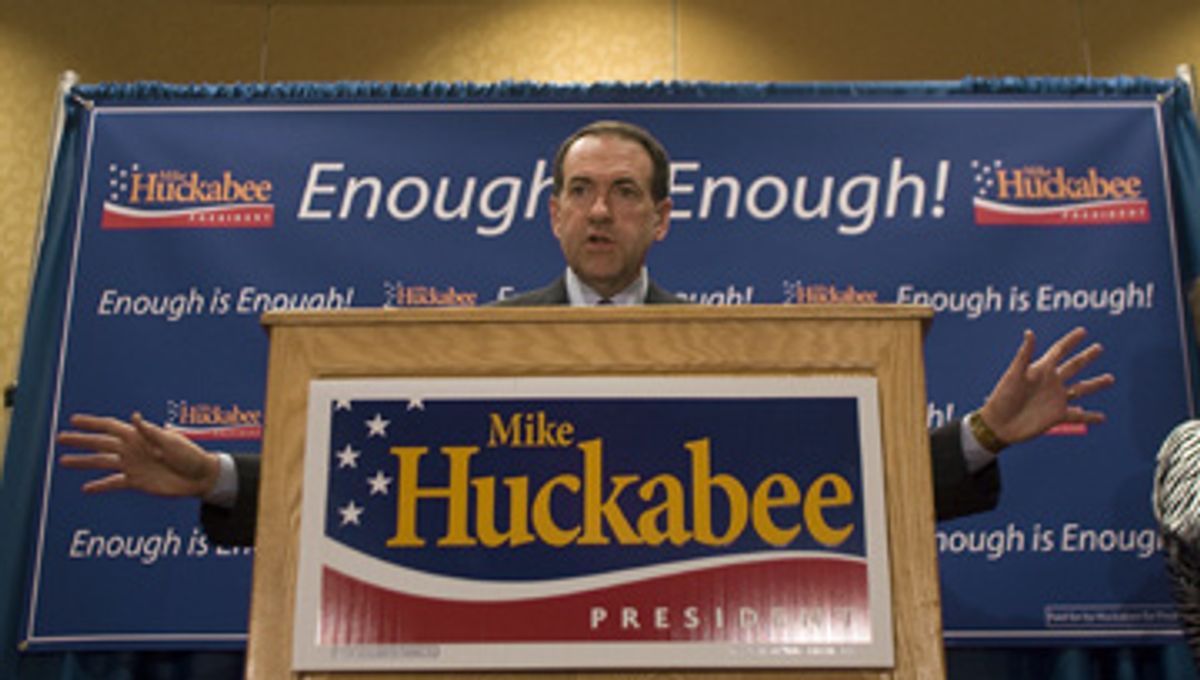
For a generation Republicans have won elections by promising to do something new -- and usually strange -- to America's tax system, and by making wild and improbable claims about how great what they propose will turn out to be. This was how Ronald Reagan rode to victory in 1980 with his tax cut plan -- a plan that his own vice president and successor to be, George H.W. Bush, dismissed as "voodoo economics." This was what George W. Bush did back in 2000 when he claimed that faster economic growth would be guaranteed by yet another tax cut for the rich. And this is what Republican presidential front-runner Mike Huckabee is doing today with the "FairTax": a plan to replace the income tax and the Internal Revenue Service with a nationwide federal sales tax.
From one perspective, you have to wish Huckabee, and the other FairTax backers in the Republican field, well. All of the GOP's second-tier candidates -- Alan Keyes, Duncan Hunter and Ron Paul -- are FairTax proponents, as was the recently departed Tom Tancredo. The other major Republican candidates, including John McCain and Mitt Romney, are all singing the same old song. They are promising a) income tax cuts and b) expanded government services because c) they are willing to claim that cutting income tax rates will trigger so much extra economic growth that revenues will not suffer but will instead expand. One way or another, all the GOP front-runners except Huckabee are lying. They are either a) lying to their supporters who want tax cuts or b) lying to their supporters who want expanded government or c) lying to everybody, perhaps themselves included.
Huckabee, to his credit, doesn't think this is a good game to play.
This view, however, leaves Huckabee and company at a disadvantage. They need to distinguish themselves somehow from the establishment candidates with better organizations and more media visibility. But they don't want to find themselves in the future in the place where George H.W. Bush found himself in 1990. Two years after running for president on a promise that he would block any tax increase by telling congressional Democrats, "Read my lips, no new taxes," he was forced to raised taxes. Huckabee et al. need a new game to play.
Enter the FairTax. It promises to be a game changer. It would abolish the IRS and all current federal taxes, including Medicare, Social Security, and personal and corporate income taxes, and replace them with a national, across-the-board, 23 percent point-of-purchase retail sales tax. It would also give each household a multi-thousand-dollar "prebate" every year on their expected annual taxes and exempt people living below the poverty line from taxes altogether.
The FairTax asks: Don't we all hate the IRS? Don't we wish it would just die? And once Huckabee has made the don't-we-all-hate-the-IRS move, his establishment competitors are suddenly thrown on the defensive. They are the defenders of the hated IRS. They are the people who applaud when the IRS audits you. Cynical on the part of Huckabee? Surely. Dishonest? Somewhat. But remember that this move of Huckabee's is less cynical and dishonest than the standard Republican line on how tax cuts raise revenue, which the other front-running GOP candidates are still mouthing.
From another perspective, however, you have to scorn Huckabee. He is adding yet more layers of confusion to America's conversation about taxes. Huckabee says that the FairTax would mean a 23 percent sales tax rate on all items. First of all, the real tax rate proposed is 30 percent. The FairTax would add 30 cents to every dollar spent, but since 30 cents is 23 percent of $1.30, the FairTaxers call the rate 23 percent.
Second, and more important, both conservative and liberal economists believe the real rate would end up even higher. Estimates of the actual rate of taxation required for the FairTax to be "revenue neutral" (meaning for it to bring in exactly the same amount of revenue that the federal government collects under the current system) start at 30 percent and keep climbing. William Gale of the liberal Brookings Institution think tank says it's a de facto 44 percent sales tax. Calculations go still higher once you add in all the necessary and politically inevitable exemptions on big-ticket items -- like a new home or hospital care. Congress' Joint Committee on Taxation, which draws members from both parties and both houses, says the real rate would be 57 percent. (And this leaves aside the enormous federal outlay required by the "prebates," which even FairTax advocates say would cost the government $485 billion per year.)
Also, Huckabee calls his proposal a "fair" tax. But it's a mammoth tax cut for the crowd making more than $200,000 a year and a substantial tax increase for those making between $30,000 and $200,000 a year. Does this make economic sense? It is hard to see how: What makes the $200,000-plus crowd especially deserving of a tax cut? This is part of a pattern with Huckabee. Anxious to distinguish himself on policies from his competitors but without the staff and the network to perform due diligence on policy proposals, he ends up with ideas that aren't fully worked out and don't make much substantive policy sense.
Does the FairTax make political sense? It is hard to see how -- at least not if people know what he is really proposing. After all, a lot more people make between $30,000 and $200,000 a year than make more than $200,000. Politicians prefer, other things being equal, to take positions that are advantageous to more people rather than those that are advantageous to fewer.
So why is Huckabee doing this?
I believe the reason is that he is counting on people not knowing what he is really promising. I believe he is counting on the nigh total fecklessness of America's press corps -- a fecklessness that I at least now see as deployed with a sharp partisan edge. As economist John Irons laments on his blog, ArgMax.com: "I'm not sure how he is getting away with adopting the FairTax as part of his platform. Wouldn't Democrats be skewered in the media if they proposed a tax increase on people making between $30,000 and $200,000?" Yes.
But Huckabee is a Republican. And it is different if you are a Republican. The New York Times in its big Huckabee profile by Zev Chafets said:
Huckabee's answer to his opponents on the fiscal right has been his Fair Tax proposal ... Governor Huckabee promises that this plan would be "like waving a magic wand, releasing us from pain and unfairness." Some reputable economists think the scheme is practicable. Many others regard it as fanciful ... In any case, the Fair Tax proposal is based on extremely complex projections.
And that's all the crack journalism of the New York Times has to say. If you are seeking information in a daily newspaper, look elsewhere -- I recommend the Financial Times.
Since America's mainstream press believes that it cannot talk about the substance of policy, about who actually would gain and who would lose from a shift to a national sales tax -- that, you see, depends on "extremely complex projections" -- the only point to grab onto when talking about the national sales tax is that it eliminates the IRS. And that sounds very good. And sounding very good is what Huckabee is counting on.
But what replaces the IRS? What agency administers a national sales tax. Conservative economist and former George H.W. Bush administration official Bruce Bartlett fears the:
incredible complexity and intrusiveness of tracking every American's monthly income [for the rebate program] ... massive technical and administrative problems with collecting all federal taxes at the checkout counter and relying entirely on state governments to collect the federal government's revenue ... What is to stop [states] from slacking off [sales tax enforcement] and giving their citizens a tax cut at federal expense?
Thus this FairTax selling point is bogus too. The FairTax doesn't eliminate the IRS. It replaces the IRS with another agency -- the United States Fair Tax Federal Revenue Administration and State Tax Authority Reconciliation Service, or the USFTFRASTARS. It is true that the USFTFRASTARS doesn't audit individuals -- it audits businesses and state governments instead. This is a good thing for the $200,000-plus crowd: They are the ones who get audited, and so they get both a big tax cut and greatly increased peace of mind. But this is not a good thing for everybody else. The administrative and enforcement burden does not go away but, rather, becomes even more complicated.
Is Huckabee's FairTax smoke and mirrors? Yes. Is it voodoo economics? Yes. But remember one more thing: It is more reality based than the proposals of the establishment Republican candidates.
Shares