

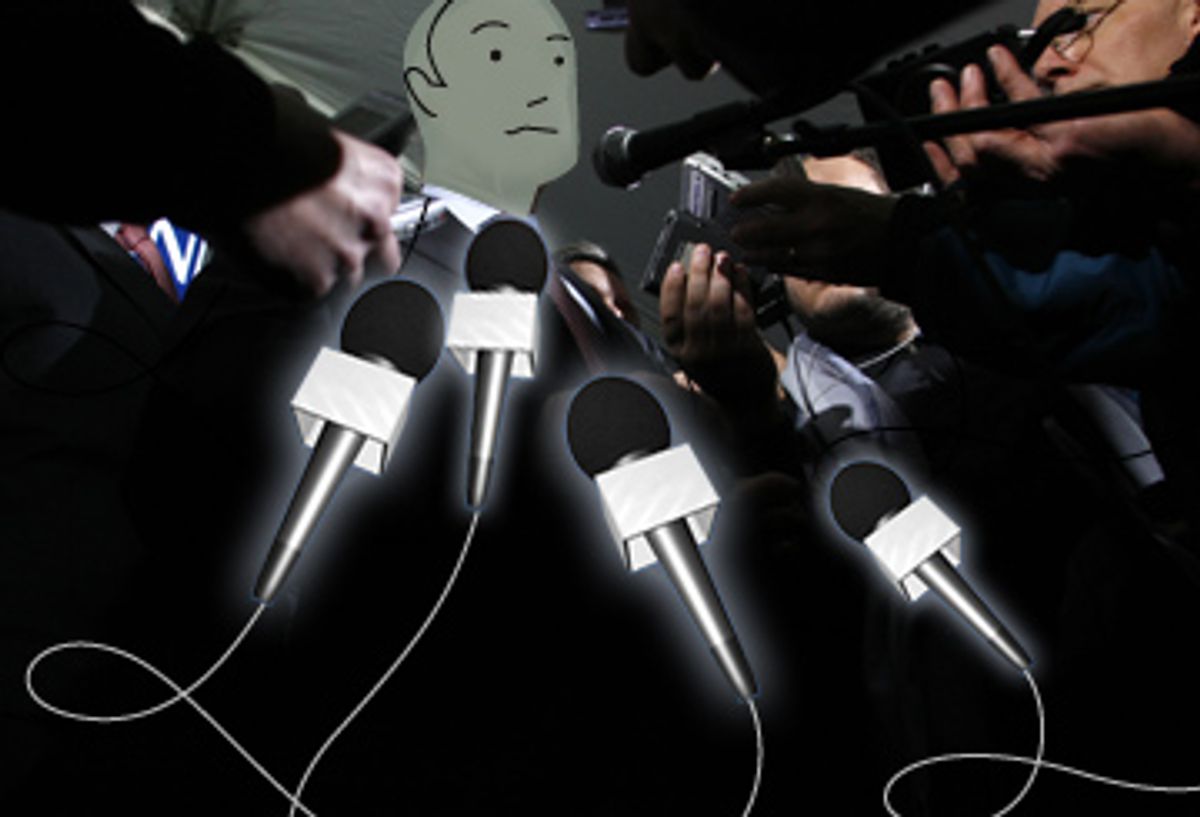
Just so you know, "the media" has no mind. It cannot make decisions. Which means it does not "get behind" candidates. It does not decide to oppose your guy... or gal. Nor does it "buy" this line or "swallow" that one. It is a beast without a brain. Most of the time, it doesn't know what it's doing.
1. The Herd of Independent Minds
This does not mean you cannot blame the media for things. Go right ahead! Brainless beasts at large in public life can do plenty of damage; and later on -- when people ask, "What happened here?" -- it sometimes does make sense to say... the beast did this. It's known as "the pack" in political journalism, but I prefer "the herd of independent minds" (from Harold Rosenberg, 1959) because I think it's more descriptive of the dynamic. Mark Halperin of Time's The Page (more about him later) calls the beast The Gang of 500. But gangs have leaders, which means a mind.
That's more than you can say about the media.
Now, the pack, lacking a brain, almost had a heart attack when Hillary Clinton won the New Hampshire primary, since they had told us Obama would run away with it because the pollsters told them the same thing. The near-heart attack wasn't triggered by a bad prediction, which can happen to anyone, but rather by some spectacular wreckage in the reality-making machinery of political journalism. The top players had begun to report on the Obama wave of victories before there was any Obama wave of victories. The campaign narrative had gotten needlessly -- one could say mindlessly -- ahead of itself, as when stories about anticipated outcomes in the New Hampshire vote reverberated into campaigns said to be preparing for those outcomes even before New Hampshire voted.
"PORTSMOUTH, N.H. -- Key campaign officials may be replaced. She may start calling herself the underdog. Donors would receive pleas that it is do-or-die time. And her political strategy could begin mirroring that of Rudolph W. Giuliani, a Republican rival..."
That's Patrick Healy in the New York Times the day of the New Hampshire primary, reporting on what would happen, according to nameless campaign insiders, if events about to unfold that day validated previous reports about what was likely to unfold that day. Healy's best defense would be: Wait a minute, people with the Clinton campaign actually told me those things. They turned out to be premature and wrong. I didn't make it up!
Which is true. But when actual facts are used in the construction of news fictions -- and reports about the moves to be made in Hillaryland after Obama won Iowa, New Hampshire, and South Carolina were precisely that, a news fiction -- your story can be accurate, well-edited, within genre conventions, and, at the same time, deeply un-informational, not to mention wrong. In fact, accurate news about the race that subtracts from our understanding of it is one of the quirky features of chronic mindlessness in campaign media.
By mindless I generally mean: No one's in charge, or "the process" is. Conventional forms thrive, even if few believe they work. Routines master people. The way it's been done "chooses" the way it shall be done.
Independent bloggers, who should have more distance from the pack mind (and often do) were not necessarily better on this score. Greg Sargent of TPM Media -- the blog empire run by political journalist Josh Marshall -- reported as follows on January 7th: "Camp Hillary insiders who have been with her a very long time, such as Patti Solis Doyle, are worried about the long term damage that could be done to Hillary if she decides to fight on after a New Hampshire loss, though there's no indication they are yet urging an exit." Doyle was said to be alarmed about damage to Clinton's Senate career from staying in the race amid a humiliating string of defeats.
Campaign news in the subjunctive isn't really news. And primary losses don't especially need to come at us pre-reacted-to, especially when there is plenty of time to air those reactions once any "string of defeats" actually happens. But while an individual mind in the press corps is quite capable of realizing this, the herd is not.
A good example would be an MSNBC program I saw just before the New Hampshire voting, where Dan Abrams asked his panel -- including Rachel Maddow, Pat Buchanan, and himself -- what each thought the final vote would be. The guests should have said, "How do we know? We're not New Hampshire voters, or professional pollsters." That would be intelligent -- and accurate. But they did something mindless instead. Each took a few points off the polls everyone else in the pack was reading and gave a "personal" prediction -- Obama by 4, Obama by 7.
Okay, so it's not a big offense -- but I didn't say it was. I said it was an illustration of routine mindlessness. That's when on-air journalism is dumber than the journalists who are on air.
Greg Sargent -- a smart reporter, quite aware of the absurdities the pack produces -- can, without great difficulty, dial back the use of nameless advisers pre-reacting to things that may not occur. (This post from his boss, Josh Marshall, suggests it may happen.) But the fact remains that his account, defining reactions-before-the-fact as news, was within the existing rules of journalism, relied upon by hundreds of other reporters adding their stories to the larger narrative. There's nothing to prevent those rules from being changed, of course. Nothing, except for the fact that the media has no mind and so can't easily change it.
2. Convergence of Judgment
Because we have evolved a way of talking about the news media that fails to recognize this very basic fact -- no mind! can't decide a thing! -- everyone is free to grant more intentionality to the organism than reasonably exists. Here are just a few samples from recent weeks:
Howard Kurtz of the Washington Post: "The media have decided, fairly or unfairly, that Iowa was Edwards's best shot at winning the nomination."
John Amato, Crooks and Liars: "The media will treat Democrats much harsher than Republicans from here on in."
Ken Silverstein, Harpers: "Another factor in Obama's favor is (just as the Clinton campaign claims) that the media seems to be strongly in his corner."
Blogger Tom Watson: "At the start of the campaign, I didn't think the national media could possibly be successful in an anti-woman campaign against a Democrat."
Chris Bowers at Open Left: "OK, The Media Hates Clinton-But Why?"
I think we know why people speak this way. We use collective nouns, even when they mash way too much together, because, despite all the flattening and collapsing, there is some rough justice in saying, "The media loves Obama right now." We know we're speaking imperfectly, or metaphorically, but we also know we're observing something that's really happening.
And that's fine, normal, human even. Nonetheless, it's important to remember: The media has no mind. It might appear to decide things, but if no one takes responsibility for "Edwards must win Iowa," then it's not really a decision the media made, but a convergence of judgment among people who may instantly converge around a different judgment if it turns out that Edwards isn't done after failing to win Iowa.
That's pretty mindless. Strangely, though, the argument that the media has no mind serves almost no one's agenda, with one exception, ably represented by Jon Stewart, but including all who satirize the news and the news criers, exposing their collective mindlessness and making it almost... enjoyable.
3. "We have special insight"
John Harris and Jim VandeHei, formerly of the Washington Post, are the top editors of The Politico, a new newspaper-and-web operation that only does politics. After the New Hampshire screw-up, which they called a "debacle" and a "humiliation," Harris and VandeHei asked themselves why their profession, political reporting, "supposedly devoted to depicting reality, obsesses about so many story lines that turn out to be fiction."
This is an excellent question and it's admirable that they don't mince words in framing it. "The loser -- not just of Tuesday's primary but of the 2008 campaign cycle so far -- was us," they write. That would be the pack, "...the community of reporters, pundits and prognosticators who so confidently -- and so rashly -- stake our reputations on the illusion that we understand politics and have special insight that allows us to predict the behavior of voters."
A key point: "we have special insight." The current generation of political reporters has based its bid for election-year authority on its horse race and handicapping skills. But reporters actually have no such skills. Think: what does a Howard Fineman (Newsweek, MSNBC) know about politics in America? I mean, what would you logically turn to him for? It's got to be: Who's ahead, what's the strategy, and how are the insiders sizing up the contest? That's supposedly his expertise, if he has any expertise; and if he doesn't have any expertise, then what is he doing on my television screen, night after night, talking about politics?
Even if Fineman and company had it, the ability to handicap the race is a pretty bogus skill set. Who cares if you are good at anticipating events that will unroll in clear fashion without you? Why do we need people who know how this is going to play out in South Carolina when we can just wait for the voters to play it out themselves?
Among the "bogus narratives" the campaign press has developed so far, the Politico editors chose three to illustrate their humiliation. John McCain's "collapse" in the summer of 2007, which meant we could write him off; Mike Huckabee's win in Iowa, where the candidate without an organization took a state where electoral success, we were assured, was all about organization; and Obama's "change the tone in politics" campaign which, according to the Gang, was not going to be in tune with the voters' rawer, more partisan feelings in '08. All three were a bust, suggesting political journalists have no special insight into: How is this going to play out? What they have are cheap, portable routines in which you ask that kind of question, and try to get ahead of the race. This, too, is what I mean by mindlessness.
"If journalists were candidates, there would be insurmountable pressure for us to leave the race," say Harris and VandeHei about their sorry-ass performance in '08. But they're at sea in trying to explain why such things happen. They blame addiction to the game of politics, journalists and their sources hanging out too much together, and personal bias among reporters unconsciously rooting for the candidate who is more fun to cover. Those are certainly three factors. Another 23 could be listed without running out of plausible reasons, because what they're really grappling with is routine mindlessness in their institution. Explaining that is a bit harder.
4. "Removed from the experience"
A much better attempt was this short and consistently to the point entry by Christopher Hayes of the Nation magazine: "WHY CAMPAIGN COVERAGE SO OFTEN SUCKS." He starts with something that is known to everyone in the pack: Campaign reporting is an essay in fear.
"Reporting at events like this is exciting and invigorating, but it's also terrifying. I've done it now a number of times at conventions and such, and in the past I was pretty much alone the entire time. I didn't know any other reporters, so I kept to myself and tried to navigate the tangle of schedules and parking lots and hotels and event venues. It's daunting and the whole time you think: 'Am I missing something? What's going? Oh man, I should go interview that guy in the parka with the fifteen buttons on his hat.' You fear getting lost, or missing some important piece of news, or making an ass out of yourself when you have to muster up that little burst of confidence it takes to walk up to a stranger and start asking them questions."
Whereas he had once thought of it as a rookie's experience, this year he learned that the fear never goes away. "Veteran reporters are just as panicked about getting lost or missing something, just as confused about who to talk to. This why reporters move in packs. It's like the first week of freshman orientation, when you hopped around to parties in groups of three dozen, because no one wanted to miss something or knew where anything was."
It is rare to find a campaign correspondent who is inner-directed, with a vision of how to report on the election season that sends her off on her own. Campaign reporters tend to be massively other-directed. The reality-check is what the rest of the press is doing -- and the Web makes it far easier to check. Mindless.
"When you go to one of these events as a reporter, there's part of you that's aware that you don't really belong there," writes Hayes.
"You're an outsider, standing on the edges observing the people who are there doing the actual stuff of politics: listening to a candidate, cheering, participating. So reporters run with that distance: they crack wise, they kibbitz in the back, they play up their detachment. That leads to coverage that is often weirdly condescending and removed from the experience of politics."
Removed from the experience. Well, yeah. That is the number one virtue of horse-race reporting and the inside baseball mentality: speed of removal from the immediate experience. Hayes thinks the "worst features of campaign reporting" can be traced back to the "psychological defenses that reporters erect to deal with their insecurities." First line of defense: pack behavior. A second is what the Politico guys said: "the illusion that we understand politics" and with our special insight can predict the behavior of voters, anticipate a turn in the narrative, divine a winning strategy.
Maybe this illusion is reproduced for us because it is fear-reducing for them to mount the horse-race production.
5. Under the influence.
In November, Mark Halperin of Time, who is both a student of pack behavior and a creature of the pack, wrote a revealing op-ed piece about this "illusion that we understand." He said he had been under the influence of Richard Ben Cramer's massive and fascinating book, "What It Takes," about the 1988 battle for the White House. Halperin wrote:
"I'm not alone. The book's thesis -- that prospective presidents are best evaluated by their ability to survive the grueling quadrennial coast-to-coast test of endurance required to win the office -- has shaped the universe of political coverage.
"Voters are bombarded with information about which contender has 'what it takes' to be the best candidate. Who can deliver the most stirring rhetoric? Who can build the most attractive facade? Who can mount the wiliest counterattack? Whose life makes for the neatest story? Our political and media culture reflects and drives an obsession with who is going to win, rather than who should win."
Right there, Halperin identifies the roots of mindlessness in campaign coverage: All right, press team, when that door opens, I want you go out there and find out for us... WHO IS GOING TO WIN?
That's the baseline question. But how good a question is it?
The only decent definition of "information" I know of states that it is a measure of uncertainty reduced. But voters are the ones who reduce uncertainty in elections. They can do it pretty well themselves, without the help of horse-race journalists. Halperin once thought it fine to obsess over "the race," because he considered the race a good proxy for the leadership test we're supposed to be conducting during the now-well-more-than-a-year it takes to elect a new president.
"But now I think I was wrong," he writes. George W. Bush passed his horse-race test and flunked the leadership test once in office. So did Bill Clinton, Halperin says. Both were good campaigners and strategists. Their weaknesses only became glaring to the pack when they were in office, he argues.
Let me say it again: Reporters have no special insight into how elections will turn out. According to Halperin, a thesis that has "shaped the universe of political coverage" is false; the rigors of the race do not produce good outcomes. So what does the pack do now? "Well, we pause, take a deep breath and resist. At least sometimes... we can try to keep from getting sucked in by it all."
This is the same limp remedy Harris and VandeHei offered. They know they're stuck with horse-race journalism. They know what a mindless beast it can be -- and what a mindless beast they can be. And, above all else, they know they're not going to change it. After all, they are it. Glenn Greenwald of Salon was right to point to this exchange between NBC's Tom Brokaw and Chris Matthews as the results from New Hampshire came in...
"BROKAW: You know what I think we're going to have to do?
"MATTHEWS: Yes sir?
"BROKAW: Wait for the voters to make their judgment.
"MATTHEWS: Well what do we do then in the days before the ballot? We must stay home, I guess."
Matthews was being the realist: Without who's-going-to-win, "we" might as well stay home. Brokaw (now long retired as the face of the NBC brand) gave him an apt warning in response: "The people out there are going to begin to make judgments about us if we don't begin to temper that temptation to constantly try to get ahead of what the voters are deciding." But he was speaking as if the media had a mind and could shift course.
6. Less innocence, more politics.
Let's see if we can bring these strands together. I've been picking at the weaknesses of horse-race coverage, but to really understand it we need to appreciate its practical strengths.
Who's-gonna-win is portable, reusable from cycle to cycle, and easily learned by newcomers to the press pack. Journalists believe it brings readers to the page and eyeballs to the screen. It "works" regardless of who the candidates are, or where the nation is in historical time. No expertise is actually needed to operate it. In that sense, it is economical. (And when everyone gets the winner wrong the "surprise" becomes a good story for a few days.) Who's going to win -- and what's their strategy -- plays well on television, because it generates an endless series of puzzles toward which journalists can gesture as they display their savviness, which is the unofficial religion of the mainstream press.
But the biggest advantage of horse-race journalism is that it permits reporters and pundits to "play up their detachment." Focusing on the race advertises the political innocence of the press because "who's gonna win?" is not an ideological question. By asking it you reaffirm that yours is not an ideological profession. This is experienced as pleasure by a lot of mainstream journalists. Ever noticed how spirits lift when the pundit roundtable turns from the Middle East or the looming recession to the horse race, and there's an opportunity for sizing up the candidates? To be manifestly agenda-less is journalistic bliss. Of course, since trying to get ahead of the voters can affect how voters view the candidates, the innocence, too, is an illusion. But a potent one.
Imagine if we had them all -- the whole Gang of 500 -- in a room and we asked them (off the record): How many of you feel roughly qualified to be Secretary of State? Ted Koppel having retired, no hands would go up. Secretary of the Treasury? No hands. White House Chief of Staff? Maybe one or two would raise a hand. Qualified to be President? No one would dare say that. Strategist for a presidential campaign? I'd say at least 200 hands would shoot up. Reporters identify with those guys -- the behind-the-scenes message senders -- and they cultivate the same knowledge.
What a waste! Journalists ought to be bringing new knowledge into the system, as Charlie Savage and the Boston Globe did in December. They gave the presidential candidates a detailed questionnaire on the limits of executive branch power and nine candidates responded. This is a major issue that any candidate for president should have to address, given the massive build-up of presidential power engineered by George W. Bush and Dick Cheney. We desperately need to know what the contenders for the presidency intend to do -- continue the build-up or roll it back? -- but we won't know unless the issue is injected into the campaign.
Now, that's both a political and a journalistic act. And where does the authority for doing such things come from? There is actually no good answer to that within the press system as it stands, and so the beast would never go there.
The Globe's questionnaire grew out of Savage's earlier reporting on the "unitary executive" and the drive to create an "unfettered presidency." (See this PBS interview with Savage; also, contrast the Globe's treatment with more of a throwaway effort from the New York Times.) Here, the job of the campaign press is not to preempt the voters' decision by asking endlessly, and predicting constantly, who's going to win. The job is to make certain that what needs to be discussed will be discussed in time to make a difference -- and then report on that.
- - - - - - - - - - - -
This article originally appeared on TomDispatch.com.
Shares