

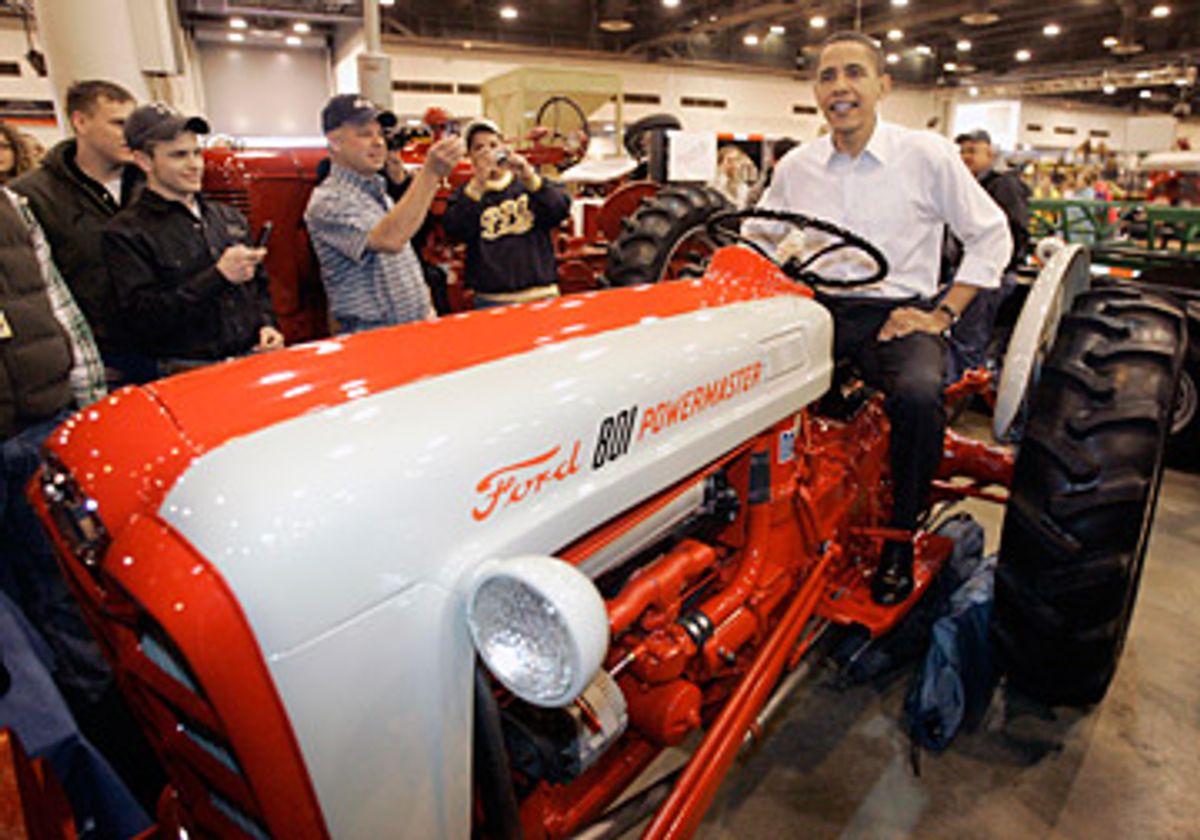
Rubes. Rednecks. Low-information voters. Beer-track voters. NASCAR man. Bubba. Retro America. These terms have all been used by well-known progressive writers and thinkers to describe white working-class Americans. This familiar litany of contempt provides the context for the firestorm that erupted Friday, when Sen. Barack Obama's remarks to a closed-door group of rich donors in San Francisco were made public by a blogger for the Huffington Post.
Referring to "these small towns in Pennsylvania," Obama told his wealthy audience that the views of these voters on a variety of subjects should be understood as responses to decades of economic distress. "It's not surprising," he said, "then they get bitter, they cling to guns or religion or antipathy to people who aren't like them or anti-immigrant sentiment or anti-trade sentiment as a way to explain their frustrations." When both Hillary Clinton and John McCain accused him of condescension toward nonelite voters, Obama, rather than retracting his assertion, simply restated it in somewhat milder terms the following day at a town hall meeting in Muncie, Ind., saying that there had been a "political flare-up because I said something that everybody knows is true."
The events of the past few days are additional evidence of a profound rift in the Democratic Party, one revealed in the differing constituencies of the two remaining candidates. One story, told by Obama backers and the mainstream media, holds that there is a white racist problem: The Democratic Party is deeply divided between anti-racists (that is, supporters of Barack Obama) and racists (Democratic primary voters who preferred Hillary Clinton or any candidate other than Barack Obama, particularly the working-class white men who are often described, in zoological terms, as "white males"). The other story, which has yet to be told, holds that the difference between the constituencies of Obama and Clinton has little to do with race and reflects instead long-familiar regional and cultural splits among whites in the Democratic electorate. The prospects of the Democratic Party in the fall depend in part on whether these rifts can be healed.
In the act of rushing to Obama's defense, some prominent liberal bloggers reinforced the stereotype of elite liberal snobbery. On Friday, regular DailyKos diarist RKA argued, "This quote and the resulting feeding frenzy are a huge opportunity for Obama to get the attention of low-information small-town voters who are skeptical of him and convince some of them to vote their pocketbooks instead of their culture." On TPM Cafe, Todd Gitlin wrote that "Obama spoke artlessly, forgetting that the first law of American politics is: Flatter the rubes."
Now there's a campaign slogan. Hey, rubes -- I mean low-information voters -- Vote Your Pocketbook, Not Your Culture!
Should anyone doubt that dissing rather than flattering the "rubes" is an aberration, examples of liberal snobbery are not hard to find in progressive publications. Sometimes it's genteel, sometimes it's raw. In an essay titled "The Urban Archipelago" a few years ago, the editors of Seattle's alt-weekly the Stranger wrote: "It's time to state something that we've felt for a long time but have been too polite to say out loud: Liberals, progressives, and Democrats do not live in a country that stretches from the Atlantic to the Pacific, from Canada to Mexico. We live on a chain of islands. We are citizens of the Urban Archipelago, the United Cities of America. We live on islands of sanity, liberalism, and compassion -- New York City, Chicago, Philadelphia, Seattle, St. Louis, Minneapolis, San Francisco, and on and on ... And we are the real Americans. They -- rural, red-state voters, the denizens of the exurbs -- are not real Americans. They are rubes, fools, and hate-mongers ... We can secede emotionally ... by turning our backs on the heartland ... We're everywhere any sane person wants to be. Let them have the shitholes, the Oklahomas, Wyomings, and Alabamas. We'll take Manhattan."
A similarly grotesque and repellent caricature of America is found in the 80-something billionaire John Sperling's self-published book "The Great Divide," in which he argues that "Metro America" should turn its back on "Retro America." As Sperling's coauthor Samuel George explained, "Think of it this way. They have Wal-Mart, we have Neiman Marcus." And a few years back, many liberal bloggers were delighted with a chart, soon exposed as a hoax, that purported to show that IQs were higher in blue states than in red states.
Now consider the disturbing way that mainstream progressive thinkers and strategists discuss working-class white voters in terms of demeaning stereotypes. Working-class Catholic voters in the industrial states used to be "hardhats." Now they are "Archie Bunker voters," or "Joe Lunchbucket," or "the beer track voters." Even worse are the terms used for the Southern white working class. It's composed of "rednecks" or "Bubbas" or -- more recently -- "NASCAR man" or even "white trash."
They are apparently aliens whose behavior is irrational, dangerous and unnerving. Peter Beinart, the former editor of the New Republic and now a fellow at the Council on Foreign Relations, wrote that liberals must "confront" a "scourge": "Let's call him Nascar Man ... Nascar Man is the guy liberals need to win, but usually don't. He loves guns, pickup trucks, chewing tobacco, and church on Sunday. He thinks liberals are high-taxing, culturally libertine, quasi-pacifist wimps. And, once liberals have conjured him up, they no longer say what they really believe -- even to one another ... Nascar Man inhibits intellectual inquiry. He's the bully everyone wants to appease."
With the controversy over Obama's remarks, the mainstream press and Obama supporters have finally noticed the class divide in Democratic politics. They've started to wonder why Mr. and Mrs. NASCAR may not be enthusiastic about the Obama candidacy. A Gallup Poll released on April 9 showed that among non-Hispanic white Democrats, support for Clinton vs. Obama among those with a high school education or less -- 61 to 33 -- was almost the exact reverse of the pattern among those with a postgraduate education -- 32 to 61.
The path of least resistance for liberal journalists and bloggers is to respond to these disturbing numbers by demonizing less-educated white Democrats. That is easier for them than to grasp the idea that these voters might actually like Hillary Clinton. One theory holds that "low information" voters, ignorant of the candidates and the issues, favor Clinton because of name recognition. But contrary to the progressive mythology about "low-information voters," a March Gallup poll shows that "both Obama and Clinton have near-universal name identification across all educational levels."
Even more common has been the claim by many supporters of Obama that the Clinton campaign, by means of subtle appeals to white racial prejudice, has attracted a large number of bigots who oppose Obama because he is black. The "race baiting" is alleged to have consisted of Bill Clinton's comparison of Obama to Clinton's friend Jesse Jackson, and Hillary Clinton's praise for the civil rights efforts of Lyndon Johnson, which, it was said, denigrated the achievements of Martin Luther King Jr. Since when have white race baiters praised Jesse Jackson and LBJ?
Polling data make it clear that the progressives and journalists who have denounced the Clintons as sinister figures "playing the race card" are in black helicopter/grassy knoll territory. According to Gallup, last August -- months before the mythical race baiting is supposed to have begun -- Clinton led among high-school-educated Democrats and tied Obama among more-educated voters in a multi-candidate race. Since then there has been a growth in Obama's support among educated Democrats, as other candidates have dropped out, but no augmentation of Clinton's support in general. The legions of racist white voters alleged to have been driven by subtle race baiting into the Clinton camp following the early primaries do not exist.
There is yet another problem with explaining pro-Clinton votes, not as positive votes for Clinton by people who support her and her positions, but as nothing more than racist anti-Obama votes. Obama has done well in many states, particularly in the Midwest and upper Plains, with nearly all-white populations. David Sirota, a progressive blogger, has suggested that white racist voting increases with the black proportion of the population of a state -- high in Mississippi, low in Minnesota. Racism is supposed to explain why Obama does poorly with white Catholic voters in big industrial cities, who presumably see themselves as competing for jobs, status and real estate with urban black Americans.
But what about Appalachia? Clinton does very well among the largely Scots-Irish population of the mountainous Appalachian region that runs from Pennsylvania down to northern Georgia and Alabama. Why doesn't this mostly white region vote like mostly white Minnesota and Wisconsin? The white racist theory of the 2008 presidential campaign can only be saved by an ad hoc auxiliary hypothesis -- Appalachian whites are Southerners, and everyone knows that all white Southerners are racists, even the ones without black neighbors.
Remarkably, the Sirota theory also suggests that all white Democrats are at least latent racists -- even those who support Obama. Obama's supporters in Minnesota and Wyoming vote for him only because their latent racism hasn't yet been triggered. If enough blacks moved into their states, then -- bang! -- they'd metamorphose into full-fledged Klansmen and vote for LBJ-praising bigots like the Clintons in a hurry.
To those who know anything about American political history, the Sirota theory is clearly nonsense. The key factor in regional support for Obama among whites is not the number of blacks in a state but the number of Yankee pioneers in the 19th century. As Josh Patashnik in the New Republic (quoting a 2004 essay of mine in the American Prospect) has pointed out, Obama finds his greatest white support in what the historian David Hackett Fischer calls "Greater New England" -- the vast region from New England and the Great Lakes to the upper Plains and Pacific Northwest settled by New England Yankees in the 19th century along with culturally similar Germans and Scandinavians. Another historian, Daniel J. Elazar, identifies this Northern band as the home of the "moralistic" political culture, distinct from the "individualist" political culture of the mid-Atlantic and the "traditionalist" political culture of the South. The political culture of this region, influenced by New England Puritanism and Nordic social democracy, has long been antiwar and pro-education, hostile to big business and in favor of civil rights. The moralists of Greater New England have a deep aversion to political conflict and favor consensus, bipartisanship and harmony. This region was the home, after all, in the early 20th century, of the Nonpartisan League. In the early 21st century, if you throw in a few blue college towns in the red states, it overlaps neatly with the Stranger's "Urban Archipelago."
Since 1992, when Ross Perot's Reform Party did best in Greater New England, this area has hosted the nation's only two independent governors -- Angus King of Maine and Jesse Ventura of Minnesota. Sixteen years later, Obama has won most of the Democratic primaries in the states in which John Anderson (1980), Ross Perot (1992, 1996) and Ralph Nader (2000) did best. All of these candidates, despite their different positions and worldviews, fared best among Greater New England voters, who tend to love third-party candidates. Obama's campaign is an overture synthesizing the greatest hits of Elazar's moralist tradition: It is antiwar and anti-partisan, reformist and inspirational. No wonder that the Northern white Protestants who were attracted to John Anderson, Ross Perot and Ralph Nader adore him. No wonder they love him in Wisconsin.
The question, then, is not why Greater New England progressives would vote for Obama. He presses all their age-old buttons: opposition to war, nonpartisan reform. The question is why anyone would assume that such a candidate would appeal to other Democratic constituencies, other than blacks (voting in this case for the favorite-son candidate).
Indeed, the Greater New England moralist culture has been rejected by practically every other substantial subculture in the United States: Irish-Americans in Northeastern cities, Appalachian white Baptists and now, evidently, Mexican-Americans. And this has always been the case.
As the historian Robert Kelley observed in 1979, "The culturally aggressive Yankees were disliked everywhere outside of New England." The reason was "a continuing sense of cultural superiority. The Yankees were certain that New England's common schools and colleges, its scholarship, its learned Congregational ministry, its libraries and journals demonstrated that they ... provided the nation's intellect." Unsurprisingly, the party dominated by Greater New England elitists -- the Whigs before the Civil War, the Republicans between 1932 and 1968, the Democrats in recent years -- has tended to be the minority party. It is ominous, therefore, that the geographic home base of the Democrats is increasingly that of the doomed Daniel Webster Whigs and the marginal Alf Landon Republicans.
In addition to this regional divide, there is a cultural split among white Democrats. Since the 1950s, there has been a rift between the Harry Truman wing of the Democratic Party and the Adlai Stevenson wing. The Truman wing produced electoral winners in Truman and Lyndon Johnson. The Stevenson wing produced one winner, John Kennedy, who barely squeaked across the finish line in 1960, and a parade of noble losers. Gary Hart, Michael Dukakis and John Kerry, despite their diverse origins, were, like Kennedy, Stevensonian patricians in style, as is Barack Obama. Jimmy Carter, Bill Clinton and Al Gore wanted to be viewed as the next JFK, not the next LBJ, but they were able to win three presidential elections (and the popular vote, in the case of 2000), only because they ran as Truman-style populists. (George McGovern in some ways belonged to the Truman tradition but became the figurehead of a Stevensonian insurgency. And lost.)
On one side of this intra-party divide are the extroverted, populist party regulars like Truman, supported by working-class voters who belong to Elazar's individualist and traditionalist cultures and see politics as a fight against enemies for the spoils of victory. On the other side of the culture gap are the Stevensonian reformers, urbane, ironic, detached, introverted, intellectual and disdainful of petty politics. They appeal to upper-middle-class professionals, as well as to academics and college students, and elite journalists, for whom politics is about inspirational ideals, not material interests.
The only three Democratic presidents to be elected since Kennedy -- Johnson, Carter and Clinton -- were Southerners who won because they were able to win a substantial part of the white working-class populist vote. Hillary Clinton has done well with this constituency because she addresses the issues that are most important to them. In the Ohio exit polls, Clinton voters cared more than Obama voters about the traditional, Truman-esque lunch-pail issues of the economy and healthcare.
The Greater New England theory, then, explains Obama's white primary victories better than Sirota's racial-chasm theory. The decades-old regular-reformer, or Truman-Stevenson, split within the Democratic Party pretty much explains everything else, with no need to posit racist voting by Clinton supporters, or imaginary race baiting by the Clinton campaign.
Indeed, while many liberal pundits assume that white Americans who do not go to college are xenophobic bigots, there is no evidence that less-educated white Democrats are significantly more racist than the college-educated. Gallup notes: "A December 2007 Gallup Poll, however, showed only a slight difference by education in the stated acceptance of a black candidate for president. Ninety-seven percent of those with college degrees said they would vote for a "generally well-qualified person for president who happened to be black," compared to 91 percent of those with a high school education or less. This lack of objection to a black candidate across the educational spectrum would not seem to support a theory that racism is at the base of the educational differences [in voting]."
In his remarks to the rich donors in San Francisco, Obama himself rejected the idea that white opposition to his candidacy is racially based: "The people are mis-appre ... they're misunderstanding why the demographics in our, in this contest have broken out as they are. Because everybody just ascribes it to white working-class don't wanna work -- don't wanna vote for the black guy. That's ... there were intimations of that in an article in the Sunday New York Times today -- kind of implies that it's sort of a race thing."
The problem instead, according to Obama in the sound bites that may keep him out of the White House, is the justified bitterness of the people in "these small towns." In his clarification Saturday, he said, "There are a whole bunch of folks in small towns in Pennsylvania, in towns right here in Indiana, in my hometown in Illinois, who are bitter. They are angry. They feel like they have been left behind. They feel like nobody is paying attention to what they're going through. So I said, well you know, when you're bitter you turn to what you can count on. So people, they vote about guns, or they take comfort from their faith and their family and their community. And they get mad about illegal immigrants who are coming over to this country."
To judge from Obama's several statements on the subject, he sincerely believes that working-class whites, lacking the self-awareness to recognize the actual economic origins of their distress, seek relief from their pain by praying in church, slaughtering deer, and making illegal immigrants and imports from foreign countries scapegoats for ills that have nothing to do with immigration or trade. They may not be racists, they may even be sympathetic victims, but they are too irrational to understand their genuine problems and their true interests, which are chiefly economic, a fact that university-educated progressives in big cities and college towns can readily perceive.
In the words of Todd Gitlin, Obama "did indeed fall into the Tom Frank vulgar Marxist trap of seeming to say that love of guns or religion (or antipathy, even) is merely derivative, not fundamental." The attempt by eminent figures on the left to belittle traditional values by reducing them to personal pathology dates back at least to 1950, when the German Marxist émigré Theodore Adorno, in "The Authoritarian Personality," attempted to explain fascism (and by implication American McCarthyism) in terms of repressed individuals who take out their psychic frustrations on minorities. Similarly, the sociologist Seymour Martin Lipset explained the Goldwater-Reagan conservative movement as the product of "status anxiety" on the part of socially insecure Americans. This line of thinking, inspired by absurd comparisons between Weimar Germany and post-1945 America and between libertarian conservatism and Hitlerian totalitarianism, has been discredited by scholars like Lisa McGirr, who shows in her 2001 book, "Suburban Warriors: The Origins of the New American Right," that Goldwater-Reagan activists tended to be successful, educated people for whom conservative ideology was not a mask for something else but a coherent belief system. Nevertheless, the cliché that working-class and even middle-class social traditionalists, when they are not simply ignorant, "low information" hicks, are maladjusted misfits whose political views are nothing more than feeble gestures of misdirected rage, persists as an article of faith among many progressives, who then wonder why the Democrats cannot win over more of the voters they despise.
Between now and June 3, Democrats will express their candidate preferences in eight more states and two more U.S. possessions. There is a possibility that Hillary Clinton will win as many as half of those contests, including primaries in Pennsylvania, Kentucky, West Virginia and Indiana. Rather than diagnosing the supposed rage disorder of blue-collar voters in those states to explain their aberrant behavior, consider the fact that they don't live in Greater New England and are drawn to the veteran party regular who focuses on bread-and-butter issues.
In 1992, with the help of Ross Perot's independent candidacy, these bread-and-butter issues, and some of these very voters, sent Bill Clinton to the White House. Bill Clinton won Pennsylvania, Ohio, Kentucky, and West Virginia in 1992 and again four years later. Is it at all surprising that these very same voters, facing a recession, would choose another Democrat with the last name Clinton? Only "low information" elitists from the Urban Archipelago would find that preference remarkable or sinister.
Whether the "bitter" controversy helps Hillary Clinton win enough votes in the final primaries to beat the odds and win the Democratic nomination remains to be seen. At press time, she was surging in the polls. One thing is certain: In the fall election, John McCain, whoever his Democratic opponent might be, will portray himself as the candidate who defends the dignity and pride of working-class and lower-middle-class Americans of all races against the disdain of elite liberals. Unfortunately, many progressives will make that task much easier by repeating the litany of contempt: Rubes. Rednecks. Retro.
Shares