

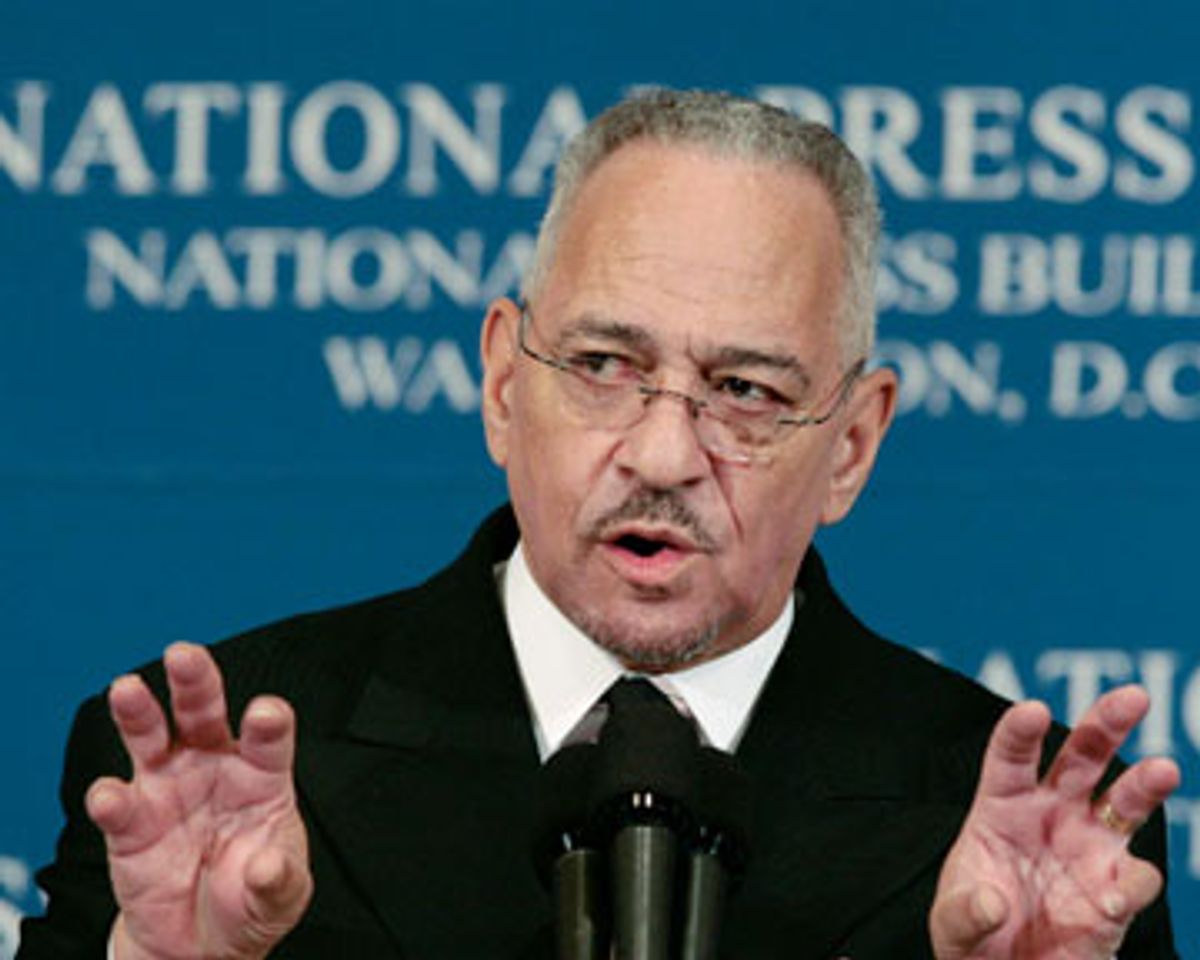
Although the firestorm over Barack Obama's former pastor, the Rev. Jeremiah Wright, is about politics, the notion that Wright's version of Christianity, black liberation theology, is radical, subversive, even un-American, is its essential subtext.
To discuss black theology, its history and its influence today, I spoke with Jonathan L. Walton, an ordained minister, expert on African-American religion and assistant professor of religious studies at the University of California at Riverside. Walton argues that black theology is not as radical as it has been made out to be and that Martin Luther King Jr. was actually more controversial than Wright. He also says that Wright -- the most visible adherent of black liberation theology in America -- will end up as a footnote in the history books alongside Gennifer Flowers, Willie Horton and Donna Rice.
Let's talk about the Rev. Jeremiah Wright and Martin Luther King. Some of Wright's critics have contrasted his approach to that of King, who they portray as using reconciliation rather than confrontation. Is that an accurate portrayal of King? Is that an accurate portrayal of Wright?
No to both. It's a mythic portrayal of King, a nostalgic portrayal of King -- because King was accused and vilified for being controversial, actually more controversial than Jeremiah Wright.
Didn't King become more radical in the course of his career, in the period leading up to his assassination?
It was largely because of the fact that he moved from civil rights to human rights. One of King's famous quotes after desegregation laws had been passed was that he began to find out that it mattered little if African-Americans -- he said Negroes, of course -- have the right to eat at the counter if they don't have a dollar to spend at the lunch counter.
In response to my question before, you said that portraying King as having a message of reconciliation and Wright having a message of confrontation or subversion was not accurate. You've explained how King's approach wasn't purely about reconciliation.
It was about reconciliation. But just because it was about reconciliation doesn't mean that he wasn't confrontational. King believed in nonviolent, direct confrontation. And thus when we come marching through the town, we are trying to expose inequality and expose violence. And if you practice nonviolent confrontation, you morally shame your opponent toward moral suasion. And when you shame them toward moral suasion, it's not to defeat your opponent, but to reunite with your opponent. You're trying to make them ashamed of themselves, so they will turn from their wicked ways. These are all Gospel principles.
Essentially you're saying Wright uses that same approach.
Wright ain't necessarily King. Wright sees himself in that tradition. King was very much in the tradition of the African-American jeremiad. And that is where he would call out the sins of the nation so the nation would live up to its ideals and its promises. That's how King saw himself. But that's not how people looked at King. On April 4, 1967, King stood in front of the Riverside Church and said that if America does not change its ways, America, if you continue to be so prideful, God will tear down this nation, and rise up another nation that doesn't even know my name.
It was his "God damn America" moment, except there wasn't YouTube.
It was his God damn America moment. And the Sunday after King was assassinated, do you know what King was scheduled to preach that Sunday morning? His sermon title was "Why America May Go to Hell."
Can you explain the origins of black liberation theology?
It is safe to say that black liberation theology began the very second that African-Americans landed on the shores of America on slave ships, and tried to reconcile their new position as hijacked bodies with the traditional gods of Africa. Slaves for the most part began converting to Christianity with the First Great Awakening in the 1730s-1740s. So their traditional African religions and their gods began to blend with stories they were hearing from the Bible. One of those major motifs was the Exodus narrative, as African-Americans began to identify with the enslaved Hebrews in Egypt. [Later, in the New Testament,] salvation did not just take a spiritual form, as in salvation of one's soul. So the language of salvation and the language of Jesus as a savior took on a very real and ever-present role in their theological worldview.
What happens after Emancipation?
Wherein the goal was freedom from slavery prior to 1863, after 1863, it becomes the attaining of civil rights and equal rights, equal protection under the law [articulated by various towering figures, including King].
Let's talk about the emergence of black liberation theology as articulated by Dr. James Cone, considered the founder of black liberation theology.
You begin to have scholars in the academy, young scholars who are beginning to be trained in the academic world. They're beginning to see in the academy that the theology and the theological reflection and the academic study of religion have little to do with the doings and sufferings of African-American life. What Cone saw himself as doing was articulating, in academic form, the theological worldview of this progressive strand of African-American experience.
So this is dovetailing with the civil rights movement, the black power movement.
Exactly. Actually, in 1966, the National Committee of Negro Churchmen, a group of African-American clergy, published a full-page ad in the New York Times, defining and supporting the black power movement. It was a theological manifesto, articulating the Gospel message of Jesus in relationship to the black community's need for power. And that became what animated and informed Cone's first book, "Black Theology and Black Power." It's not simply about deliverance. It's also about acquiring political and socioeconomic power for African-Americans.
What are the Christian principles, the Gospel principles that they were relying on, that would seem familiar to someone who's not familiar with black liberation theology but is familiar with Christianity?
Luke 4:18 -- "Preach the Gospel to the poor, heal the brokenhearted, set the captives free, offer sight to the blind and liberate those who are oppressed" is one verse that is central to the black theology of liberation. Another one is Matthew 25:40 -- "As you have done unto the least of these, you have done it unto me."
Can you discuss the meaning of some excerpts from Cone's writing, such as when he refers to whiteness as a "a symbol of man's depravity"? Is it fair, in your view, for Cone's critics to characterize those statements as racist? If not, how would you characterize them and what do they mean?
James Cone believed that the New Testament revealed Jesus as one who identified with those suffering under oppression, the socially marginalized and the cultural outcasts. And since the socially constructed categories of race in America (i.e., whiteness and blackness) had come to culturally signify dominance (whiteness) and oppression (blackness), from a theological perspective, Cone argued that Jesus reveals himself as black in order to disrupt and dismantle white oppression.
Now it is important to remember how culturally loaded the terms "whiteness" and "blackness" are as racial categories. Martin Luther King Jr. argued in his final book, "Where Do We Go From Here?": "The job of arousing humanity within a people that have been taught for so many centuries that they are nobody is not easy. Even semantics have conspired to make that which is black seem ugly and degrading."
Cone also said that Malcolm X was "not far wrong" when he called the white man "the devil," and "if God is not for us and against white people, then he is a murderer, and we had better kill him."
When Cone employed the terms "whiteness" and "blackness" in his theological interpretation of the Gospel narratives according to the lived realities of African-Americans in the American context, he was referring to them not as a physical descriptive category but as a cultural notion and spiritual concepts, [such as] when Cone says that "whiteness, as revealed in the history of America, is the expression of what is wrong with man. It is a symbol of man's depravity." So for Cone to say that Malcolm X was not "far from wrong when he called the white man the devil," Cone is not talking about white persons as innately evil. He is referring to the "white consciousness," of which many whites have embraced, which perpetuates white supremacy and power. For Cone, white supremacy is akin to what the New Testament refers to as "principalities and powers."
When Cone wrote that "if God is not for us and against white people, then he is a murderer, and we had better kill him," for Cone, "white people" signifies the "white consciousness" that is constructed upon black marginalization.
Now it is only fair to say that the black theology of liberation as an academic project cannot be reduced to James Cone. There are many variants and multiple trajectories of thought by an abundance of scholars that build upon, move beyond, critique and expand Cone's early writings. And, naturally, Cone's thought has even developed over the course of the past 40 years. Black theology of liberation is not static. As the condition of blacks in America has changed since 1969, so has black theology of liberation.
Would you consider Wright to be one of the more visible adherents to black liberation theology?
I consider him to be the most visible adherent.
Not just because of what has happened over the past few weeks.
The most prominent, before all this controversy started.
How prevalent is the black liberation theology in black churches? Can you find it in other denominations than Wright's United Church of Christ?
I'm not saying that the vast majority of African-American preachers have a copy of James Cone's "Black Theology and Black Power," but that doesn't mean that they don't preach, proclaim and live out on a regular basis Luke 4:18. So they may not have the academic, technical jargon for it, but that doesn't mean that the message itself doesn't resonate with their ministries. I really mean that; I say that strongly.
In the academy, in seminaries, black liberation theology is just one other strand of Christianity in America, right?
That's my point about its not being new or radical. If you contact the leading seminaries across this country, black theology of liberation is in all of their curriculums.
Because of this whole media firestorm around Wright, do you think that black liberation theology is being misunderstood as a result of the media treatment?
I would have to take one out of Jeremiah Wright, what he said on Bill Moyers' show. I don't think that it's being misunderstood, because I think it's being purposely manipulated by particular people. It's about balkanizing and browning Obama's post-racial body. He presents himself as the post-racial candidate, and this is a way to racialize him, to derail the mythology of this post-racial, post-political messianic figure. How do they do that? By presenting and packaging him in a way where he becomes the black or brown body that "mainstream America" is familiar with, yet is still largely scared of. He's aligned with the angry black man Jeremiah Wright. I don't, like Jeremiah Wright, say this is an attack on the black church. People don't care anything about that. Jeremiah Wright will go down in history somewhere next to Gennifer Flowers, Willie Horton and Donna Rice. His name will go down in infamy somewhere beside [them] as a historical marker of this presidential election.
Let's talk about some of the comments that did get spliced into the YouTube snippets. The "God damn America" comment, Rev. Wright explained it on Bill Moyers' program through the notion of God's blessings and curses. That's a common and familiar thread in conservative strands of Christianity, like when Jerry Falwell said after 9/11 that God was punishing America for secularism and homosexuality and abortion. Is that how you saw Wright's "God damn America" comment, as talking about God's blessings and curses on a country for the sins of its government, in waging war and killing innocents?
Yeah, sure.
What about his reference to the KKK of America?
Just hyperbole, rhetorical excess. Part of the homiletic tradition, part of oral tradition, is telling stories in grandiose ways. Hyperbole is a tool that is used to give clearly defined story lines where there are clearly articulated enemies, clearly articulated friends and foes, clearly articulated allies for justice. As is the case throughout the biblical record, there are clear demarcations between good and evil.
What about his statement about -- and he repeated it again on Monday -- about the U.S. government putting the AIDS virus in the African-American community?
Some may regard that as a trope for known, unjust practices, unjust medical practices against people of color.
Such as in Tuskegee?
Such as the Tuskegee experiments. Or America's complicity in Agent Orange. Or the American government's longtime denial of Gulf War syndrome. So that kind of becomes a rhetorical trope which is a heuristic shorthand for all of that -- for a failed healthcare system in America and failure to do anything about it. And while people may viscerally disagree with Rev. Wright's claim there, and while it may be clearly undocumented and unfounded, you're also talking about a man who had an HIV/AIDS outreach ministry to African-Americans, as well as gays and lesbians, in the 1980s, when the president of the United States, Ronald Reagan, wouldn't even say the word in public.
But at the National Press Club, he knew that he was on national television, he knew that that comment was one of the things that was making the loop about him. Yet he repeated it again.
I do not know. God only knows. I don't even want to try, and I've probably already tried to explain it too much.
A lot of the criticism of him is not really about black liberation theology at all, it's about him and his personality, that he's bombastic, he's self-aggrandizing, he's narcissistic. Has this become about him, about his personality?
It isn't about him. He's a pawn. If it wasn't Jeremiah Wright, somebody would be going to find some 6-year-old that went to school with Obama.
But do you think Wright himself created more news with how he undertook his public appearances over the past several days?
Did he play into it? Maybe. But I would also say that Wright's been Wright. He has been himself and he's going to be himself.
So what we saw on Monday, that's him?
That's him, especially in front of a crowd.
He does enjoy the performance.
He's a preacher, he had his crowd before him. That is the performative aspect of preaching; it's coupled with the thoughtful aspect. We saw very thoughtful sides of him to begin with, and then the more the crowd played to him, the more he got energized.
Do you think he took it too far?
What you can do in one context, maybe we could be more perceptive of, the way that would be perceived in another context.
Given that he was at the National Press Club.
The fact that he was at the National Press Club. Maybe he could have been more mindful of the ways that it could have been perceived by others in that context, because he wasn't inside the walls of his church. But then again, maybe he didn't care. Maybe he said, I'll be me, this is what I'd do anywhere, and I'll do it here. If it's good enough for Trinity, it's good enough for the National Press Club.
What about how Obama said, This isn't the man I knew?
I don't know Obama, I don't know what's in Obama's head.
The New York Times in its editorial Wednesday talked about Wright's racism and paranoia. And his embrace of Louis Farrakhan has taken a lot of heat. Do you see him as racist and paranoid, and how do you view his embrace of Farrakhan?
I view his embrace of Farrakhan as similar to John McCain's embrace of Jerry Falwell. That is to say, we may not agree with everything, I may not agree with you on everything. Obviously we don't agree with each other theologically, we're of different faith perspectives, but we have a shared constituency. That's what John McCain would have said to the late Jerry Falwell, or did say -- we have a shared constituency. We don't agree, but hey, we care about the same people. And thus, I embrace you on that level. And it seems to me that's what Jeremiah Wright was saying. I'm acknowledging that Louis Farrakhan is like [the] E.F. Hutton [slogan]: When he speaks, people listen.
But he said he was a great man, one of the great leaders of this and the last century.
For his constituents, for the persons on the South Side of Chicago, that's what they would say. That's what many on the South Side of Chicago would say.
What do you make of the Times saying that Wright exhibited racism and paranoia?
That's their right to say, they can say that. But many who look to Rev. Wright for leadership find in his voice, no matter how boisterous that voice can be, there are many who find courage and boldness embodied in his voice. He represents them. And so the New York Times may say that he reflects racism and paranoia -- well, they'd also have to say that about the many, many persons in the African-American community who look to him and find hope in his message. So whether there's truth or not to what the New York Times is saying, I'm not here to say. I'm not here to defend or denounce. But Wright's worldview clearly resonates with a critical mass of folk.
Shares