

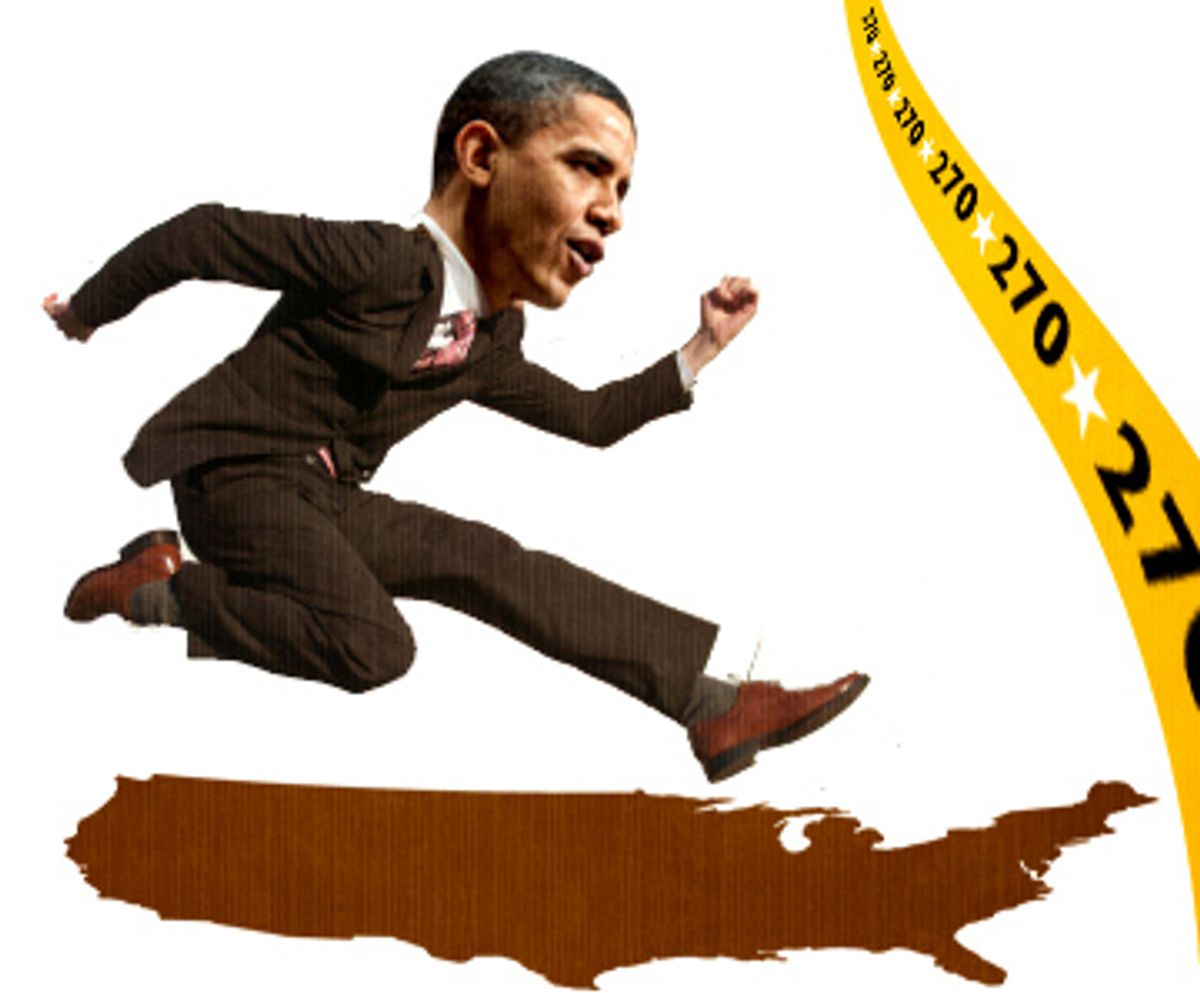
Thanks to John Adams and James Madison, an American presidential election really does begin and end with the Electoral College. Didn't 2000 tell us that? (Well, it ended with Anthony Kennedy and Sandra Day O'Connor, but you get the drift.)
Critics scoff and call it an antiquated and unfair system (it is). Many Democrats -- notably, this year, Obama backers -- would like their party to stop thinking in terms of three yards and a cloud of purple-state dust and instead embrace the beauty of a 50-state strategy. Somehow, they say, 2008 can and must be different.
OK, I'm listening. Different how? In that the Democrats win?
Certain cold realities haven't changed. A candidate must still reach 270 electoral votes to gain the White House. Unless there is a popular-vote landslide in November, the presidential election is still best seen as a collection of 50 statewide contests. Should this fall's election be as close as the last two in 2000 and 2004, no more than one-third of those 50 states will be in serious contention. In fact, only about half of that number will ultimately decide the outcome, since the vast majority of the other "close" states actually lean pretty strongly to one side or the other and are unlikely to shift their preference. Once again we're all going to be spending a lot of the next six months, at least psychically, in the Rust Belt.
To figure out how Obama can assemble the magic 270, then, let's look at the 17 states where this fall's outcome is not a mortal lock. I am a Democratic pollster -- this presidential election cycle I worked for Bill Richardson, and last time I worked for Howard Dean. But my collection of swing states is not based on current match-up polling between Obama and McCain. I mostly ignored the polls -- come on, it's May. Instead, I looked at long-term voting trends and demographics.
1) The number of competitive states has been contracting over the past two cycles. In 2000, 21 states fell into a competitive classification, meaning the winning candidate performed 5 points, or less, better than his national showing. It was 19 in 2004. The closest states, 2.5 points or less away from the national level, numbered 14 in 2000 and only 9 in 2004.
2) The number of states that shift markedly from one election to the next has also been contracting. In 2000 16 states moved more than 4 points away from the previous election's national performance level; in 2004 only 6 states did the same. If both of these first two trends continue, that means fewer, not more, states in play in 2008. (Note: This may be an incumbency phenomenon, since there was a similar effect in Bill Clinton's two wins. Once the winner establishes his level, it's hard for there to be much shift the next time he's on the ballot.)
3) In a non-incumbent year with two candidates from regions that have been unrepresented at this level for a long time -- the Rust Belt and the Southwest -- stronger regional variations could occur. Carter in 1976 (the South) is the archetype of this factor, but Clinton improved Democratic performance throughout the South in 1992, and Bob Dole bucked the national trend in several Plains states in 1996.
4) Every successful GOP candidate since 1968 has hailed from California or Texas. Their last two candidates from small to medium-size states lost badly. On the other hand, the last two successful Democrats came from the South, a region that had underperformed in previous elections. This year the two surviving Democrats live in two of the most reliably blue states. Obama does live in the largest state for a Democratic challenger since, well, Adlai Stevenson in 1956.
5) The choice of a vice-president has had a pretty spotty geographic impact in the past five elections. Bush father and son ignored it when picking a running mate (must run in the family). For the Democrats the impact has been nonexistent (Bentsen), negligible (Edwards), small (Lieberman) and shared (Gore and Clinton were both Southerners).
I. Swing states Obama absolutely, positively has to win
A reasonable projection of the Electoral College results for 2008 would award the Democrats 157 safe votes in 11 states and the District of Columbia. Of the 17 swing states where Obama has no guarantee but a good shot, six are really "must-wins" for him. Defeat in any -- particularly the two biggest -- either signals grave problems elsewhere or puts inordinate pressure on him to run the rest of the table.
Michigan -- 17 votes
If there is a worse state in which Democrats could've botched the primary this electoral season, I'm hard-pressed to think of it. But the primary was well and truly botched; there has still been no decision on how Michigan's delegates will be allotted, if at all. The saving grace could be that Michigan has always run ahead of Ohio for the Democrats, and better than Pennsylvania the past three elections. But Obama's failure to campaign here -- which he is finally correcting -- makes this state worrisome. Three interesting questions: 1) Will there be a "Lake Effect"? Meaning, can the geographic influence travel the 60 miles or so across Lake Michigan and produce better than normal Democratic performance, particularly in Western Michigan? 2) Does McCain's break from Bush on climate change make it difficult if not impossible for him to exploit Obama's embrace of tougher CAFE standards and greenhouse emission standards in this auto-dependent state? 3) Is it "Only a Northern Song"? For many years now, trends in the rural/small-town white vote have been linked to latitude. The closer to Canada one gets, the more white voting patterns diverge from those near or below the Mason-Dixon Line. Lately that has meant stronger Democratic performance in presidential elections in the most northern states and regions. Obama has clearly done better in this wintry tier. Compare his performance in Green Bay to that in Youngstown or Altoona. Will that hold in November, or be enhanced, making states such as Michigan, Minnesota and Wisconsin more secure? Or will race override this pattern, making the Northern Tier states more vulnerable for the Democrats?
Minnesota -- 10 votes
It's not Walter Mondale's Minnesota anymore. Democrats have been increasingly squeaking by in this state -- it ranked 6th bluest as recently as 1988 in terms of overall Democratic performance, then 12th, 15th, 17th and 18th the next four presidential elections. Plenty of Republicans have succeeded at the state level in recent years, with Tim Pawlenty and Norm Coleman the two latest examples. Is Pawlenty the kind of tactical vice-presidential choice -- in concert with a presumably successful GOP convention in St. Paul -- that McCain could make to steal 10 votes from the Democrats? Or will he eschew state considerations and go with a bolder choice? The Northern Effect reference above does favor Obama, but the volatility that may help McCain is in the suburbs. Small-town Minnesota tends to follow established voting patterns, but the burgeoning Twin Cities metropolitan area produces a lot more variation.
New Jersey -- 15 votes
The Garden State makes the list by virtue of some slippage between 2000 and 2004. Terrorism and proximity to New York City undoubtedly played a role in that. But Obama losing the state of Tony Soprano and Bruce Springsteen and still winning the election? Fuhgeddaboutit. Jersey's Philly and New York suburbs have been slowly and surely turning Democratic for two decades now. It's hard to imagine them swinging back this time. It's also an incredibly expensive proposition for the Republicans to try to make it happen. The GOP will buy ads in the Philadelphia market because of Pennsylvania, but New York airtime is three or four times more expensive and too many of the people who'd be watching the commercials live in the safe blue states of New York and Connecticut.
Oregon -- 7 votes
The land of Nike has hovered between true tossup and strongly Democratic for the past 25 years. But the nadir was Clinton 1996, when it ranked only 28th in Democratic performance. Since then it has moved up to 21st and then 16th. The state's blue-collar, timber industry roots are fading, leaving a fairly suburban and nearly all-white voting base. This is, for the most part, a fight over the educated and affluent, and unless the roof is caving in, one would suspect that Obama has a distinct edge over McCain. It is much harder for McCain to play the patriotic/values card here than in, say, Missouri or even New Mexico. And Portland and its environs is a decidedly different "West" than Phoenix, and for more reasons than just the weather.
Pennsylvania -- 21 votes
As when two American armies slugged it out at Gettysburg over three hot July days nearly 150 years ago, so too will this fall's Pennsylvania battle be an epic. The stakes are high for both sides. McCain must try to break Obama's back in working-class America, and what better place to attempt it than the Keystone State? Pennsylvania's recent track record has been narrow Democratic wins -- since 1996, better than Ohio but worse than Michigan. Democrats have balanced their losses due to abortion (Northeastern Pennsylvania), guns (the whole state) and values (ditto) with a shockingly improved showing in the four suburban counties surrounding Philadelphia. Shocking, at least, to this writer, who grew up in those suburbs at a time when in most of them the only election of any note was the Republican primary. Pennsylvania's rural voters are not as "Southern" as those in neighboring Ohio, but they are old and white and their dominance of the so-called T -- the area between Philadelphia and Pittsburgh and along the New York border -- gives the GOP enough votes to have an outside shot here. Notably, Pennsylvania's Democratic primary was Carter's coronation in 1976 and also provided easy margins for Mondale, Dukakis, Clinton, Gore and Kerry. Obama, not so much.
Can McCain play both sides of the coin -- winning back some of the lost suburban votes (where, it should be noted, Obama slipped versus Clinton in last month's primary) while at the same time picking off blue-collar Democrats in "Deer Hunter" territory? The answer to that question might answer the ultimate one as well.
Washington -- 11 votes
Two words. Starbucks. Microsoft. If the Democrats are in trouble here, then it's lights out nationally. Yes, Boeing is still a major influence. Yes, the African-American presence is negligible, Jimi Hendrix notwithstanding. But in a state dominated by the ethnically diverse and culturally tolerant media market of Seattle, it is hard to imagine Barack Obama falling short.
II. Expanding the universe -- the tough ones, Southern division
Obama's total, if he wins all six of the "must-win" states above, would be 238. (Eighty-one votes plus the safe blue 157 equals 238.) The next 32 votes are a harder slog, however.
Four states produced Bush victory margins between 5 and 10 points above his national edge in 2004, meaning that they would theoretically be within reach for a Democratic candidate this fall. Theory bumps up against reality in two of them, however. Arizona has now become a safe GOP victory because it has a native son in the race. In Arkansas, Democratic prospects would seem to be firmly linked to the presence or absence of a Clinton on the ticket. And even in the unlikely event that happens, given that it would be Hillary Clinton -- who now represents New York in the Senate -- one should feel a bit dubious about Democratic prospects.
The other two states in this quartet are North Carolina and Virginia, and therein lies a different tale.
North Carolina -- 15 votes
The Tarheel State's best Democratic ranking in the past five elections was 2004 -- but it was still only the 31st most Democratic state with the Kerry-Edwards ticket winning 43.6 percent of the vote. Where would another 6.5 percent come from? Well, some of it could arrive courtesy of African-Americans. While Democrats have traditionally enjoyed a huge advantage among the party's most loyal constituency, the prospect of an African-American president will assuredly take that contribution to a maximum level. What might that mean? I would think at least one-tenth of a percentage point for every 2 percentage points of a given state's electorate that is black -- and perhaps higher. The logic runs as follows: Democrats, in the past two presidential elections, have won the African-American vote by about 80 percentage points. Nine out of 10 black voters chose Gore in 2000, 88 out of 100 chose Kerry in 2004. Couldn't the margin easily be 84 points or even higher this time? And won't the turnout be demonstrably higher, as it has been in the primaries? What if, in North Carolina, where African-Americans are about 20 percent of the electorate, they rise to 21 percent this year and Obama wins them 93-7. That adds a point to the state's Democratic total from 2004.
So now Obama is at 44.6 percent. Could he possibly gain the additional 5 percent or so from new voters and the type of moderate whites in the Charlotte suburbs or the Research Triangle where he performed so well in the primary? Doubtful, but it is worth the effort, if for no other reason than to pin some of McCain's time and money down in at least one Southern state. And here is one area where a 50-state strategy really comes into play. Obama will have more money than John Kerry. He will be able to spend it in a longer list of states.
Virginia -- 13 votes
Democrats have come further in Virginia than in its neighbor to the south for one simple reason: the mighty and growing influence of the Washington, D.C., suburbs. With each year that passes the Northern Virginia suburbs increase in political importance. Kerry ran 2 points better in the Commonwealth than in North Carolina, though the African-American vote is nearly identical in size. Applying the Carolina logic above, all other things being equal, Obama should improve on Kerry's total by at least a point, meaning he might be at around 46 or 46.5 percent before four more years of Northern Virginia population growth is factored in.
But in Virginia, fortune both smiles and frowns on the Democrats. There is more good news in the fact that Obama could select one of two Virginia officeholders as his running mate. Either Gov. Tim Kaine or Sen. Jim Webb could push him over the top, which is already tantalizingly close. Webb in particular offers a military background that might help appeal to working-class Democrats and independents. But that same military component works against Obama as well. Will he be able to pick off military voters in the Tidewater region, home of the world's largest naval base, when he is running against a former Navy pilot and prisoner of war?
Despite Obama's impressive primary victory in Virginia, there is also the possibility that race might rear its head in the former headquarters of the Confederacy. But then one remembers that 19 years ago, Virginia's Doug Wilder won the laurels that had eluded Tom Bradley in California, becoming the nation's first elected black governor. Was Wilder the John the Baptist heralding an even greater victory in the land of Washington and Jefferson?
In the unlikely event that Obama wins both states, he'll be at 266 votes, four votes short of victory. But the event is unlikely. Time to call in reinforcements from the West.
III. Expanding the universe -- the tough ones west of the Mississippi
I suspect that one side or the other will look back at these next states rather wistfully after November, with regret over the fact that their opportunity ran smack into a clear strength for the other guy. It is simply too early to determine whose luck is rotten. Start with the three Western states.
Colorado -- 9 votes
It is axiomatic that the Northern Effect -- whites voting more Democratic the closer one gets to the Canadian border -- has a cousin: the Homogeneity Syndrome. Minority candidates will win a higher proportion of the white vote the lower the African-American population in that state or city. The logic is pretty simple. With exceptions, where white voters, be they in Chicago, Philadelphia or Alabama, feel threatened by a large black population, they bind together against the embodiment of that threat -- i.e, a minority candidate. Where the minority population is few and far between the perceived threat dissipates and so does much of the motivation for an anti-minority vote.
Barack Obama will need to win nearly half of the white vote in most Western states in order to carry them this fall -- and yet he is heavily favored in Oregon and Washington, and has a good chance in Colorado and Nevada. Colorado just elected someone who is not a white male to the Senate, but of course Ken Salazar is far more conservative than his Illinois counterpart. He is also Hispanic, wherein lies another conundrum. Latino Democrats have so far preferred Hillary Clinton by wide margins, and there is clearly at least some black-brown tension. Will the recent Democratic gains among Hispanics, fueled by Republican obsession with the immigration issue, survive 2008? I would suspect that the answer is a qualified yes. Hispanics, after all, are an ascendant force, and if there is a backlash quotient it is more likely to be the other way around. And is there enough tension in critical geographic areas to make a difference? Denver, for example, has had a recent African-American mayor but seems to be free of most black-brown rivalry.
The other reason why Obama could pull Colorado -- where John Kerry won 47 percent of the vote, a 3 point gain from Al Gore's 2000 total -- into the blue column is the nature of the Front Range, meaning the urban sprawl of greater Denver. This is an environmentally conscious, socially tolerant population that is culturally very in tune with Obama's change message. But it is the West, and John McCain of Arizona will attempt to appeal to voters throughout his home region with his own version of the distrust Washington/federal government/pioneer spirit/individualist regional message. I suspect Colorado, while not deaf to that message, will be less susceptible to it than the two states that follow.
Nevada -- 5 votes
I suppose the Silver State should not be compared to anything, so unique is its economy and social structure. Democrats have done relatively well here the last four elections, winning narrowly in 1992 and 1996 and falling just short in 2004. Obama has a wellspring of younger, unaffiliated voters to draw upon, but McCain does enjoy a closer proximity and shared desert identity. This one should go down to the wire.
New Mexico -- 5 votes
And this one always goes down to the wire, which usually means waiting for the latest vote-count snafus in Bernalillo County (Albuquerque) to be cleared up a day or two later. New Mexico has deviated a grand total of 1 percentage point from the winner's share of the vote in the last three elections combined, by far the closest collective finish of any state. That may not be a good sign for the Democrats. For while the Hispanic population is large at nearly 30 percent of the vote, it has always been counterbalanced by suburban voters around Albuquerque and also "Little Texas," the conservative ranching communities to the east. Will Hispanics turn out in larger numbers for an African-American nominee? Or will John McCain's Southwestern roots improve Republican hopes among Anglos enough to stem any Democratic turnout tide? Would adding Bill Richardson to the Democratic ticket make the difference -- assuming America is ready for a black-brown combination?
Assuming no defection from our list of Democratic states, the safe ones and the must-wins, the ticket would have amassed 238 electoral votes before reckoning with the seven tough and semi-tough states in the South and Southwest listed above. A Southwestern sweep would put Obama at 257, tantalizingly close to victory. Winning the two small states and not Colorado makes it 248; the reverse outcome (just as likely) would make it 247. A McCain sweep might require Obama to counterbalance that regional domination with his own in the Midwest.
Iowa -- 7 votes
The best shot for a Democratic pickup in the Midwest would be Iowa. Gore won the state narrowly, and Kerry lost it narrowly. It has vacillated between solidly Democratic and barely Democratic for 20 years. This would appear to be a year where solid is more likely. After all, Obama became the front-runner with a surprising caucus victory, while McCain has essentially ignored the state both times he has run for president. The Illinois influence is large in Eastern Iowa and the state is lousy with both Cubs and Bears fans. The only drawbacks are age and demography. Iowa has one of the nation's oldest populations (like Arizona, Florida, Pennsylvania and Arkansas) and lacks the type of large suburban population that contributes to Obama's popularity in the Northeast.
Missouri -- 11 votes
Obama also has a chance, albeit slimmer, to win the Show Me State. If the Western states feature a collision between New Age tolerance and desert ruggedness, Missouri is a showdown between Limbaugh and Chicago. It was no accident that Obama visited Cape Girardeau this week, the conservative radio commentator's Mississippi River hometown south of St. Louis. Can Obama ride an enhanced African-American vote out of St. Louis and Kansas City together with suburban support from those same markets, on top of the comfort level voters in Eastern Missouri must feel with him, since they have been watching his political ads since 2004? Can hip-hop top country, or will Branson and the Ozarks help create a strong conservative force that spills over to those same suburbs and uses the natural rivalry with Chicago that exists in Eastern Missouri against the Democrat? Recall also that Kansas and Missouri fought a border war in the 1850s, and the enmity is not forgotten.
Kerry gave up here and still won 46 percent of the vote. Obama won this primary, albeit by a whisker, his only success in any border state. Can a Chicago resident whose mother grew up in Kansas possibly carry Missouri?
IV. Déjà vu
Florida -- 27 votes
It would be nice for Democrats to right the wrong of 2000, to see political justice finally prevail, to gain vengeance and the White House in one fell swoop. And certainly it is improbable at best to envision a scenario where a Republican defeat in the Sunshine State could be overcome, no matter how large their blue-collar opportunity in the industrial belt might be. But to quote George H.W. Bush -- or at least Dana Carvey -- "nah gonna happen." To begin with, Democrats have been slipping here since 1996. Florida voted Democratic exactly at the national average in 1996, a tad (or is it a "chad") worse for Gore in 2000, and more than a point worse for Kerry. Hardly earth-shattering, but still a trend. Then there is the demographic problem. The state is not as old as people think but it's more elderly than most. Clearly Obama's worst primary difficulties have come among seniors. Then there is the Jewish problem -- and while it is still too early to proclaim a major hurdle for Obama to clear, obviously the GOP thinks they can exploit his background among Jews. Then there is the Hispanic problem -- a lot of them are Cubans and they still vote Republican. All in all, it's a swing state where Hillary Clinton could well have performed better than Obama.
And if all that were not enough, then there is whatever detritus has been left by the primary snafu. Perhaps a compromise will be reached, and feelings smoothed over, once Obama has secured enough delegates to win the nomination. Lingering problems in Appalachia and elsewhere among working-class white voters may force Obama and Co. back into Florida in a major way this fall, but it appears to be a tougher coconut to crack than, say, Pennsylvania or Michigan.
Ohio -- 20 votes
The Republican Holy Grail since Nixon's day. The supreme focus of John Kerry's campaign. The crucial general election victory for Jimmy Carter. After slipping in 2000, Democrats revived their chances in 2004, only to suffer a narrow, and fatal, loss. Surely with this economy, Bush's growing unpopularity and Obama's Midwest credentials and generational appeal Democrats can make up the missing 2 points? Perhaps, but it will be a war equal to that waged in Pennsylvania. The two states are quite similar, yet different in subtle but perhaps critical ways. The counties that adjoin the Ohio River are more Southern culturally than any similar area of Pennsylvania. They border, and resemble, West Virginia, where Obama was just crushed by Clinton. Cincinnati and Columbus are far more conservative cities than Pittsburgh or Philadelphia. The Cleveland suburbs -- while in some ways more gritty than their Philly counterparts -- are also a bit less sophisticated and perhaps less taken with the latte-ish phenomenon of Obama. Could choosing Ohio's popular Democratic governor as his running mate be Obama's answer? (Ted Strickland, conveniently, hails from Ohio's Appalachian southeast.) It may be the only way to prevail here in a close race.
V. Two final quirks
These last two states will appear on everyone's targeted list. They each featured razor-thin margins in both 2000 and 2004. Yet it wouldn't surprise me to see either or both veer off and be decided by a more substantial margin this time.
New Hampshire -- 4 votes
The Democratic trend line has been decidedly up here. The state ranked near last in Democratic performance in 1988, 33rd in 1992, but then roughly 20th ever since. Increasingly suburban, full of Boston transplants, it's got plenty of bedroom voters and a boatload of independents. It is also a Northern state with almost no African-American population, thus making Obama's job of winning the white vote much easier. And yet it is in many ways John McCain's second home. New Hampshire propelled his campaign forward in 2000 and rescued him from near-oblivion this time. He is the GOP nominee because of New Hampshire. If there is to be any Northeastern defection from a solid blue front, it will happen here.
Wisconsin -- 10 votes
How did it happen? Why was this state the one place where Barack broke through with everybody? Sure he won the campuses, and the Madison liberals, and African-Americans in Milwaukee. But he also won -- and often by stunning margins -- in blue-collar locales such as Green Bay, Sheboygan, Appleton and Oshkosh. Was it just one bad week for Hillary? She came into the state late; she went negative with arguments (asking for a debate, alleging plagiarism) that backfired. Or was it the Chicago effect? We (I live in Madison) may root against the Bears and Cubs, but we're kind of struck by the notion that such a nearby neighbor could become president.
Whatever the cause of his primary blowout, I do believe Obama has a chance to vault Wisconsin out of the partisan cage that two heart-rending, battle royale outcomes (Gore and Kerry each won by fewer than 11,000 votes) have built. Dukakis won here, after all. The only caveat is a stark one. Of all the major metropolitan areas from St. Louis to New York, essentially the entire northeast quadrant of the country, the only place where Democrats have failed to make major gains at the presidential level over the past 20 years is Milwaukee. Those suburbs, particularly to the north and west, remain overwhelmingly Republican. If Obama can crack them to any degree he probably wins the state by several points.
VI. Victory, by the numbers
So which of these 17 states do I think Obama really is going to win? How does he reach 270? Taking all these demographics and long-term trends into account, and then whipping out the dartboard, yields the following assessment:
States that strongly favor Obama ("strongly" in the context of close states, that is): Minnesota, New Jersey, Oregon, Washington. That's 43 electoral votes. Add that to the safe blue 157 votes in 11 states and D.C. and Obama is at 200.
States that slightly favor Obama: Iowa, Michigan, Pennsylvania, Wisconsin. Another 55 votes. He's now at 255
States that strongly favor McCain: Florida, North Carolina. Their 42 electoral votes are probably going to the Republicans.
States that slightly favor McCain: Colorado, 9 votes; Missouri, 11 votes; and Virginia, 13 votes. Obama's chances are better here.
Pure toss-ups: Nevada, 5 votes; New Hampshire, 4 votes; New Mexico, 5 votes; and Ohio, 20 votes.
Clearly, and I'm being cautious, I think it's going to be a close race. If Obama wins the 255 votes in the states where he's favored, then to get to 270 he needs to choose from the following menu: 1) Win Ohio, which takes him to 275; 2) win in the West -- Nevada, New Mexico and Colorado, for 274; 3) win the three N's (Nevada, New Mexico, New Hampshire) for 269, plus one other state; or 4) win two of the three N's and either Colorado or Virginia.
The bottom line is that 270 is achievable, provided the Democratic ticket keeps all of these 17 states in play as long as possible. And it looks like it can. Obama has the money to fight in the truly purple states and force his opponent to defend some of the redder ones. For the moment, McCain doesn't have the money to respond in kind. Obama can stretch McCain's scarcer resources. He can also improve the Democratic Party's odds of breaking through and winning its first Electoral College majority in a dozen years.
Shares