

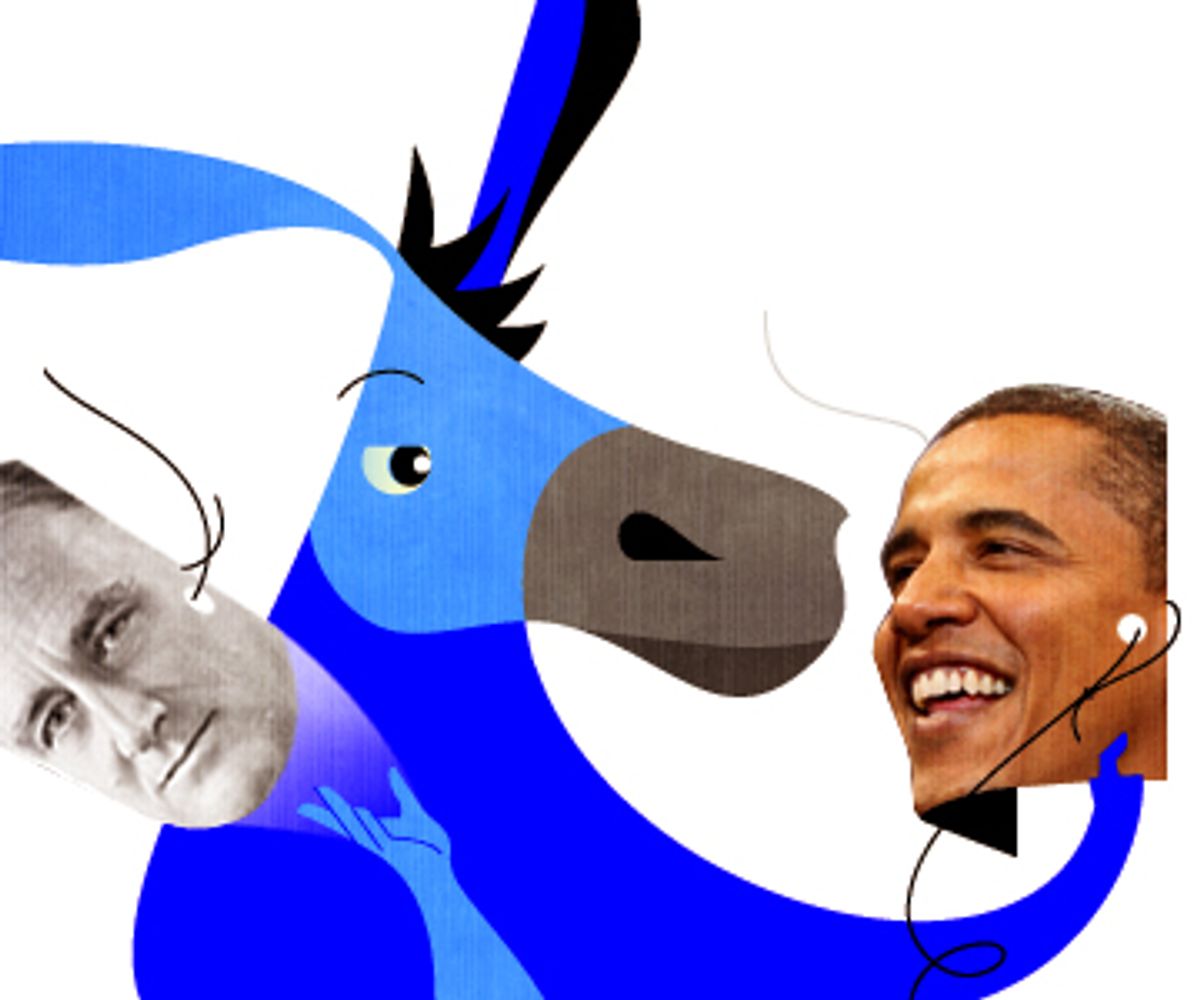
Virginia Woolf was wrong when she wrote, in her 1924 essay "Character in Fiction," that "on or around December 10, 1910, human nature changed." But there is no doubt that at some point between 2004 and 2008 American politics changed. It is clear to everyone, not least conservatives, that the era of right-wing hegemony that began with Richard Nixon's election in 1968 has come to an end. But this does not mean the triumph of post-1968 liberalism by default. If we are really in a new era, then the next Democratic Party will be as different and unfamiliar as the next Republican Party. Or so Democrats should hope, if they're looking beyond the favorable circumstances of this November -- if they want a lasting supermajority and not just a bare majority.
Both of the national parties today claim roots in the older eras of Roosevelt and Lincoln. But I am 46 years old, and today's Democratic Party and Republican Party are younger than I am. What happened beginning in 1968 was that one two-party system -- let us call it the Roosevelt Party versus the Hoover Party -- gave way to the present two-party system, which pits the Nixon Party versus the McGovern Party.
Today's Democrats and Republicans bear little resemblance to the pre-1968 groups of the same name. The pre-1968 Republican Party was based in the Northeast, Midwest and West Coast -- the very areas that are the base of today's "blue state" Democrats. The pre-1968 Democrats were the old Jefferson-Jackson alliance of white Southern Protestants and Northern urban Catholics, plus a big chunk of Northern Progressives, many of them former Republicans. Today the Republicans are a white working-class party based in the South and much of the West with a libertarian Wall Street wing. The Democrats since the 1970s have been an alliance of college-educated white professionals from the North and West with blacks and Latinos.
Between 1932 and 1964, the Roosevelt Party won seven of nine presidential elections, losing only in 1952 and 1956. Between 1968 and 2004, the Nixon Party won seven out of 10 presidential elections, losing only three times, to Jimmy Carter in 1976 and Bill Clinton in 1992 and 1996. Was this because red-state Rooseveltians were won over to supply-side economics, while blue-state blue-bloods suddenly became enamored of abortion rights and separation of church and state? No. Today's red-state Republican children of New Deal Democrats still like Social Security, and the Republican grandparents of today's blue-state Protestant Democrats were in favor of birth control -- for the Catholics, in particular. The values of these voting blocs didn't change. The issues that defined national politics changed.
The Roosevelt Party ran on economic issues, and didn't care whether voters were in favor of sex or against it on principle as long as they supported the New Deal. The McGovern Party, by contrast, has made social issues its litmus test. Economic conservatives have had a home in the McGovern Party, as long as they support abortion rights and affirmative action, but social democrats and populists who are pro-life or anti-affirmative action are not made nearly as welcome.
Beginning with its namesake, George McGovern, in 1972, the McGovern Party has been trounced repeatedly by the Nixon Party, not because of its economic agenda, which the public actually prefers to the alternative, but because of its unpopular stands on issues like race-based affirmative action, illegal immigration, crime and punishment, and national security. Progressives are fooling themselves when they dismiss these as insignificant "wedge issues." What can be more important than whether civil rights laws apply equally to everyone -- even those wicked "white males" -- regardless of race and gender, or whether, in an age of terrorism, the nation's border and immigration laws are enforced? There is no democracy in the world today where a party that stood for ethnic quotas that excluded the national majority or welfare benefits for illegal immigrants would not be in political danger. (As I write, all of the major European democracies except Britain are governed by parties of the right that are more nationalist and populist than the left parties they have defeated. And Gordon Brown isn't looking too hale either.)
Franklin Roosevelt's Democratic majority, despite defections by Southern segregationists, wobbled on until 1968, 23 years after his death. FDR was able to assemble his coalition only because social issues did not divide his voters. Nobody ever asked FDR or Harry Truman or John F. Kennedy or Lyndon Johnson their views on contraception, or abortion, or censorship. Not only were those issues not central to the message of the New Deal Democrats, they were not even national issues. Before the Supreme Court federalized them, they were fought out in state legislatures and city councils by the very same people who came together on Election Day to send Democrats to Congress and the White House. FDR's followers disagreed about Prohibition, but they agreed about the New Deal.
In fact, the majority of Americans, including many social conservatives, never ceased to support New Deal policies, which from Social Security and Medicare to the G.I. Bill have remained popular with the public throughout the entire Nixon-to-Bush era. Consider the results of a June 17, 2008, Rockefeller Foundation/Time poll. When "favor strongly" and "favor somewhat" are combined, one gets the following percentages for policies favored by overwhelming majorities: increase the minimum wage to keep up with the cost of living (88 percent); increase government spending on things like public-works projects to create jobs (86 percent); put stricter limits on pollution we put into the atmosphere (85 percent); limit rate increases on adjustable rate mortgages (82 percent); provide quality healthcare to all, regardless of ability to pay (81 percent); impose higher tax incentives for alternative energy (81 percent); provide government-funded childcare to all parents so they can work (77 percent); provide more paid maternity/dependent care leave (76 percent); make it less profitable for companies to outsource jobs to foreign countries (76 percent); expand unemployment benefits (76 percent).
Note that almost all of the policy proposals that excite the American public are exactly the sort of old-fashioned, "paleoliberal" spending programs or systems of government regulation that are supposed to be obsolete in this era of privatization, deregulation and free-market globalization, according to neoliberals and libertarians. Bill Clinton to the contrary, the public clearly does not think that "the era of big government is over." Nor does the public show any interest in the laundry lists of teeny-weeny tax credits for this and that that neoliberals love to propose, to appear compassionate without spending real money. The public wants the middle-class welfare state to be rounded out by a few major additions -- chiefly, healthcare and childcare -- and the public also wants the government to grow the economy by investing in public works and favoring companies that locate their production facilities inside the U.S. There, in a sentence, is a program for a neo-Rooseveltian party that could effect an epochal realignment in American politics.
A Newer Deal party that ran on this economic agenda could attract Southern Baptist creationists as well as Marin County agnostics. I hear the riposte already: "I'd rather move to Canada than share the Democratic Party with those people!" But across the country there are lots of potential Democratic congressional and senatorial candidates who would like to move to Washington -- and might be able to, if social conservatives were welcomed to a big-tent party defined almost exclusively by economic liberalism.
What's the alternative? The Cato Institute's Brink Lindsey has mused about a "liberaltarian" coalition uniting social-issue liberals with free-market anti-statists. Down with drug and sodomy laws -- and welfare and Social Security, too! The problem with this as a Democratic strategy is that Mike Huckabee conservatives who might be attracted to a Newer Deal greatly outnumber Ron Paul libertarians in the electorate, if not on college campuses and in editorial offices.
Anyway, the Democrats have already tried "liberaltarianism." That's what was promoted by Jimmy Carter and Bill Clinton, the only two presidents elected by the McGovern Party. Both Carter and Clinton ran as New Deal-style liberal populists, then, once in office, reneged on their campaign rhetoric and promoted a mix of economic conservatism -- deregulation, balanced budgets -- and social liberalism. Had Clinton been interested in restoring the Roosevelt coalition, he would have veered left on economics and right on cultural issues. Instead, under the influence of Robert Rubin, Clinton signed the Gramm-Leach-Bliley Financial Services Modernization Act of 1999, which dismantled many firewalls between investment banks, securities firms and commercial banks that the New Deal Congress had put in place, inadvertently contributing to the economic disaster we are now experiencing. Instead of opposing race-based affirmative action in favor of universal programs open to economically disadvantaged whites, Clinton said he would "mend it, not end it" and then forgot even to mend it. The 1990s neoliberal synthesis of Rubinomics and racial preferences, a version of "liberaltarianism," is popular in corporate boardrooms and newspaper editorial offices -- but deeply unpopular in Main Street America.
Under pressure from the voters, today's Democrats, including Hillary Clinton, have recently and in some cases reluctantly repudiated Rubinomics for more popular ideas about public investment and expanding the safety net. That's a step in the right direction. A big reason that the Democrats won back Congress in 2006 and are likely to keep it in 2008 is nominating and electing socially conservative economic populists like Heath Shuler. More progress. But to create an updated version of the New Deal, the Democrats have to treat economically liberal social conservatives as equal partners, with their own spokesmen and leadership roles in the party, not just as a handful of swing voters brought on reluctantly at the last moment. Conversely, Rubin Democrats and other economic conservatives should be invited to join Grover Norquist and the Club for Growth in a free-market deficit hawk party, which no doubt would prove to be as ineffectual and isolated as the Herbert Hoover Republicans during the New Deal era.
If Democrats don't create a new Roosevelt Party, the Republicans over time just might. In their recent insightful manifesto "Grand New Party," Reihan Salam and Ross Douthat call for the GOP to adopt activist government on behalf of the working class, while remaining a socially traditional party. That formula -- more Gaullist than Thatcherite -- has worked recently in Germany, France and Italy. It might work here, unless Democrats forestall the possibility by reaching out to Sam's Club Republicans.
Unfortunately, the upper-middle-class left, with its unerring instinct for political suicide, is probably incapable of seizing the moment and bringing more Baptists and Catholics into the Democratic Party, because it has developed an almost superstitious distaste for religious conservatives. This might make sense if the religious right were still a menace, as it was a generation ago. But with the exception of state referenda and constitutional amendments banning gay marriage, religious conservatives have lost one battle after another, from failed attempts to promote creationism on school boards to the doomed effort to repeal Roe v. Wade.
There would have been no Progressive Era without the followers of William Jennings Bryan and no New Deal without the support of ancestors of many of today's Protestant evangelicals and traditionalist Catholics. Social conservatives, having lost the culture war, should be offered not only a truce but also an opportunity to join a broad economic campaign for a middle-class America, as many of them did between 1932 and 1968. When pro-choicers and pro-lifers unite in cheering the public investment and living wage planks at the convention of the neo-Roosevelt party, we will know that the political era that began in 1968 is truly and finally over.
If Barack Obama is elected in November, he will have a choice. It would be easy for a President Obama to be the third president of the McGovern Party, following the examples of Carter and Clinton once in office by rejecting expensive New Deal-style public investment and middle-class entitlement expansion in favor of a neoliberal program of deficit reduction, dinky feel-good tax credits, equally symbolic Green initiatives and robust defenses of affirmative action for amnestied illegal immigrants. Or he could try to be the first president of a new party that is also called the Democrats, a party that would combine post-racial universalism in public policy with intelligent government activism to promote technology-driven economic growth and middle-class economic security.
If he were elected and made the right choice, there would be no need to call the successor to the McGovern Party the neo-Roosevelt Party. It would have a name of its own: the Obama Party.
Shares