

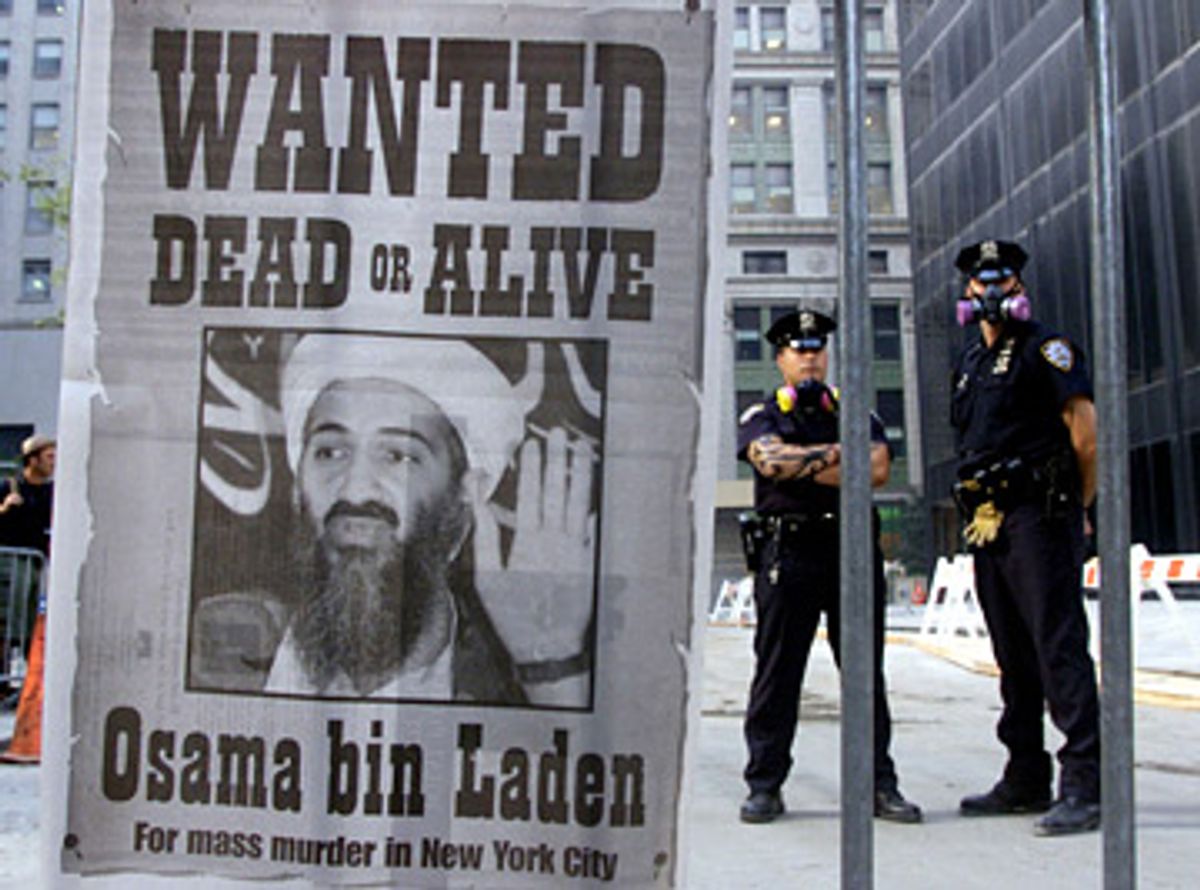
Where the hell are Osama bin Laden and Ayman al-Zawahiri? And why does virtually no one ask anymore? What's changed since the days when any suburban soccer mom would have strangled either of them with her bare hands if given the chance? And what happened to President Bush's declaration to a joint session of Congress nine days after 9/11 that "any nation that continues to harbor or support terrorism will be regarded by the United States as a hostile regime." Doesn't that apply to Pakistan?
These are things that I wonder as I watch from my perch in Philadelphia, where I'm a talk show host, columnist and MSNBC talking head. I have also spoken and written about them incessantly, so much so that I've exhausted my welcome with many conservative members of my own talk radio audience. My editors at the Philadelphia Daily News and the Philadelphia Inquirer have made it clear that I've published my last column on this issue because I have written seven to date. On the day after the Pennsylvania primary, I told Chris Matthews on "Hardball" that this was an issue that could help Barack Obama win support among white male voters; he recognized that it was "[my] issue," before adding, "And I agree with you completely."
I can't help myself. So strong is my belief that we've failed in our responsibility to 3,000 dead Americans that I am contemplating voting for a Democratic presidential candidate for the first time in my life. It's the chronology I find so compelling.
We're at the seven-year anniversary of 9/11, lacking not only closure with regard to the two top al-Qaida leaders but also public discourse about any plan to bring them to justice. To me, that suggests a continuation of what I perceive to be the Bush administration's outsourcing of this responsibility at great cost to a government with limited motivation to get the job done. Of course, I may be wrong; I have no inside information. And I'd love to be proven in error by breaking news of their capture or execution. But published accounts paint an intriguing and frustrating picture.
To begin, bin Laden is presumed to have been in Afghanistan on 9/11 and to have fled that nation during the battle at Tora Bora in December of 2001. Gary Berntsen, who was the CIA officer in charge on the ground, told me that his request for Army Rangers to prevent bin Laden's escape into Pakistan was denied, and sure enough, that's where bin Laden went. Then came a period when the Bush administration was supposed to be pressing the search through means it couldn't share publicly. But as time went by with no capture, the signs became more troubling.
We now know that in late 2005, the CIA disbanded Alec Station, the FBI-CIA unit dedicated to finding bin Laden, something that was reported on July 4, 2006, by the New York Times. At the time, I hoped we'd closed the bin Laden unit because Pakistani President Pervez Musharraf was fully engaged in the hunt in his country's northwest territories, where the duo were supposedly hiding. In September 2006, however, Musharraf reached an accord with tribal leaders there, notorious for their refusal to hand over a guest. In doing so, he agreed to give them continued free rein.
The following month, in October of 2006, I participated in a week-long, Pentagon-sponsored military immersion program called the Joint Civilian Orientation Conference. This was a unique opportunity for 45 civilians who were invited to play military tourist and learn firsthand about the United States Central Command (CENTCOM). We traveled 15,000 miles and spent time in four nations. Our days began at 5 or 6 a.m. and didn't end until 10 or 11 p.m. Along the way, we boarded the USS Iwo Jima by helicopter in the Persian Gulf, fired the best of the Army's weaponry in the Kuwait desert (just 10 miles from Iraq), drove an 11-kilometer Humvee obstacle course (designed to teach about IEDs), boarded the Air Force's most sophisticated surveillance aircraft in Qatar, and even took a tour of a military humanitarian outpost in the Horn of Africa. In addition to Secretary Rumsfeld, we were briefed by the vice chairman of the Joint Chiefs of Staff, the vice admiral of CENTCOM and other high-ranking war commanders.
I came home with the utmost respect for the men and women throughout the ranks of all five branches of the service committed to eradicating the forces of radical Islam. But there was one thing noticeably absent: the search for bin Laden and al-Zawahiri. It was not part of our otherwise comprehensive agenda, and when I did ask specific questions, there was no information forthcoming except a generic assertion that, indeed, the hunt continued.
When we were briefed at Andrews Air Force Base by Vice Adm. David Nichols, the No. 2 to Army Gen. John Abizaid, I asked him whether the hunt for bin Laden was, at that stage, completely dependent upon Pakistani President Pervez Musharraf. He told me we respect national sovereignty, and described the search as "difficult and nuanced." I took that as a confirmation of my concern about outsourcing.
When in Bahrain, I put the same question to Marine Brig. Gen. Anthony Jackson. He told me that the search was the equivalent of finding one man in the Rockies, an analogy that I heard repeatedly from men I met overseas. He also said that "no one is giving up," and that my question was better put to the guys in special ops.
So, when we got to the special ops headquarters in Qatar, I raised the matter yet again, this time with Col. Patrick Pihana, the chief of staff to the Combined Forces Special Operations Component Command. He offered nothing substantive on the issue.
No one told me the search was over, but I came home worried that the days of aggressively hunting bin Laden and al-Zawahiri had ended. Of course, I could fully appreciate that an aggressive pursuit was under way but that I, a blowhard from Philadelphia, was simply deemed unworthy of any information. That would have been fine.
But there was another consideration. More than one individual with whom I spoke -- and no one that I have named here -- raised with me the question of what would happen to public support for the war against radical Islam if we were to find and kill bin Laden and al-Zawahiri. They wanted to know: Would the American people then expect the military to pack up and go home? No one ever told me that we're not hunting bin Laden because killing him would cause Americans to want to close up shop in Iraq and Afghanistan, but it was absolutely on the minds of our warriors as support for the war in Iraq dissipated.
A few months before my return, there was news of our response to the accord reached between Musharraf and the tribal warlords. The agreement, which was effected on Sept. 5, 2006, stipulated that the Pakistani army would pull back from the tribal areas. A report from the BBC detailed what the tribal leaders would grant the army for withdrawing: "Local Taleban supporters, in turn, have pledged not to harbor foreign militants, launch cross-border raids or attack Pakistani government troops or facilities."
Meanwhile, there was no demand for accountability by our government. The White House and the Pentagon consistently played down the significance of capturing bin Laden and al-Zawahiri, and President Bush offered only superficial responses to the few questions raised on the status of the search. On Feb. 23, 2007, the Army's highest-ranking officer, Gen. Peter Schoomaker, said he didn't know whether we would find bin Laden, and "I don't know that it's all that important, frankly."
At a May 24, 2007, White House news conference, when asked why Osama was still at large, President Bush offered his usual refrain: "Because we haven't got him yet ... That's why. And he's hiding, and we're looking, and we will continue to look until we bring him to justice." For me, somewhere between two and four years removed from 9/11, it had all begun to wear thin -- especially because it seemed bin Laden remained active. Unfortunately, the president's standard line has long been accepted by the media and American people.
Then, On May 20, 2007, the Times reported that we were paying $80 million a month to Pakistan for its supposed counterterrorism efforts, for a total of $5.6 billion.
In July 2007, a National Security Estimate concluded that the failure of Musharraf's accord with warlords in Pakistan's tribal areas had allowed bin Laden's thugs to regroup there. On July 22, National Intelligence director Adm. Mike McConnell said on "Meet the Press" that he believed bin Laden was in Pakistan in the very region Musharraf had ceded to the warlords.
I hoped that the presidential campaign would move the issue to the front burner, but despite the campaign's 24/7 nature it failed to stir up a discussion about the failure to capture or kill those who pushed us down such a perilous path. In the first seven presidential-primary debates -- four for the D's, three for the R's -- there was only one question in 15 hours of discourse that touched on the subject of finding bin Laden in Pakistan, and it came from the audience. Though I did not keep count thereafter, I know that the issue never gained resonance in any subsequent debate.
Things changed somewhat on Aug. 1, 2007, when Barack Obama delivered a speech at the Woodrow Wilson International Center for Scholars: "If we have actionable intelligence about high-value terrorist targets, and President Musharraf won't act, we will," he said.
"We can't send millions and millions of dollars to Pakistan for military aid, and be a constant ally to them, and yet not see more aggressive action in dealing with al-Qaida."
Finally, I thought, a presidential candidate saying something about this foreign-policy failure.
The reaction? Ridicule.
Then presidential candidates Joe Biden and Chris Dodd responded derisively. Pakistani foreign ministers did likewise. Across the aisle, John McCain pounded Obama for a perceived lack of seasoning in the realm of foreign relations: "The best idea is to not broadcast what you're going to do," McCain said in February. "That's naive." (More recently, McCain has grown fond of saying that he'll "follow bin Laden to the gates of hell.") Not to be left out, Hillary Clinton said, "You can think big, but, remember, you shouldn't always say everything you think when you're running for president because it could have consequences across the world, and we don't need that right now."
Of course, that didn't stop Sen. Clinton from including bin Laden's image -- along with reminders of the attack on Pearl Harbor -- in a television commercial that aired in the final days before the Pennsylvania primary election. After scolding her opponent for advocating a specific course of action in Pakistan, the world's most infamous terrorist became a bankable issue for the junior senator from New York when her back was against the wall.
To his credit, Obama refused to back away from his insistence on reasserting American control over the hunt for bin Laden. I interviewed him on March 21, 2008, and he admitted that a resurgence of the Taliban had occurred in Pakistan.
"What's clear from ... what I've learned from talking to troops on the ground is that unless we can really pin down some of these Taliban leaders who flee into the Pakistan territories, we're going to continue to have instability, and al-Qaida's going to continue to have a safe haven, and that's not acceptable."
I was pleased by what he had to say about the issue, and asked about it again on April 18, 2008, when I interviewed him for a second time. He told me that Musharraf, despite being flush with billions in American aid, was not taking counterterrorism seriously.
"That's part of the reason that I've been a critic from the start of the war in Iraq," Obama told me. "It's not that I was opposed to war. It's that I felt we had a war that we had not finished."
"And al-Qaida is stronger now than at any time since 2001, and we've got to do something about that because those guys have a safe haven there and they are still planning to do Americans harm."
He also pointed out that the Bush administration had actually shown signs of following his lead. Obama reminded me that a late-January airstrike killed a senior al-Qaida commander in Pakistan, calling it an example of the type of action he'd been recommending since August. The CIA, it was reported a few weeks after the strike, acted without the direct approval of Musharraf.
Soon after I spoke with Sen. Obama, the nonpartisan Government Accountability Office, the investigative arm of the United States Congress, issued a report dated April 17, 2008, with a title requiring no interpretation: "Combating Terrorism: The United States Lacks Comprehensive Plan to Destroy the Terrorist Threat and Close the Safe Haven in Pakistan's Federally Administered Tribal Areas."
The report, undertaken at the bipartisan request of U.S House and Senate members, minced no words in issuing a conclusion that should have made Americans' blood boil: Six years after Sept. 11, the United States had failed to destroy the terrorist havens in Pakistan's federally administered tribal areas (known in the report as FATA). The GAO confirmed prior reports that al-Qaida was revitalized and poised to launch an attack, and said that no comprehensive U.S. plan existed to combat terrorism on its most central front.
In the days that followed its release, I spoke to Charles Johnson, under whose signature the GAO report was issued. He told me: "With respect to establishing a comprehensive plan, we found that there were some individual plans that had been prepared by the various entities I mentioned earlier [the Department of Defense, Department of State, U.S. Agency for International Development, among others]."
"But yet there was no comprehensive plan that integrated all of the key elements of national power that was called for by the 9/11 Commission, by the National Security Strategy for Combating Terrorism and the United States Congress. And those elements I'm referring to are: the use of military, economic and development assistance; law enforcement support; intelligence support; as well as political and diplomatic means by which we would want to address the root cause of terrorism in a particular region."
From there the headlines continued to defy the GAO recommendations. "Pakistan Asserts It Is Near a Deal With Militants," read the front page of the April 25 edition of the New York Times. Pakistan's newly elected government was again on the verge of an accord with the militants running amok in the FATA -- despite the new government's previously stated desires to move away from Musharraf's policies in those regions. Less than a week later, under the headline "Pakistan's Planned Accord With Militants Alarms U.S.," the New York Times reported that the Bush administration expressed concern that the new agreement could contribute to "further unraveling of security" in the region.
The arrangement was tailor made for bin Laden. It permitted the local Taliban group, Tehrik-e-Taliban, to assist in keeping law and order in the area known as Swat in the northwest frontier province -- while not attacking the existing security forces -- in return for an exchange of prisoners between the Pakistani army and the Taliban. The army also agreed to withdraw forces from parts of Swat. According to a report from the May 22 edition of the New York Times, the Bush administration was concerned that the deal would "give the Taliban and Al Qaeda the latitude to carry out attacks against American and NATO forces in Afghanistan." Some U.S. officials even went so far as to call it a "victory" for bin Laden, as reported by ABC News. What else are we to assume, except that the climate in Pakistan may grow even more hospitable to al-Qaida?
In a refreshing opportunity free from the stock answers so often given by politicians, I was offered the chance to interview Marcus Luttrell as part of my radio book club series in May 2008. He was the only survivor of Operation Red Wing, a mission that would result in the worst loss in Naval SEAL history. He earned a Navy Cross for his valor and wrote about his harrowing story in the New York Times' bestseller "Lone Survivor." Unlike most of the bureaucrats from Washington, who have only been able to offer me talking points from a failed policy, Luttrell gave a brutally honest account of the time he spent in the Hindu Kush, a mountainous area located just a few miles from the northwestern border of Pakistan. Luttrell described how his efforts were too often constricted by red tape.
"Yeah, we've got some problems with that border ... because we'd be chasing the bad guys in there and they had a lot of security set up and we have to stop what we're doing while they just run across and if we don't, we'll get engaged by the Paki border guards and that's an international incident."
Luttrell couldn't delve into the details of the prickly international problem that was created by the tension with the border guard, but when I asked him if the Pakistan issue was a problem in general, he wholeheartedly agreed.
"Hell, yeah, it's a problem. Heck, they're harboring the enemy. It's such a joke, it's so stupid. [T]hey come over and do their business, whatever is, and if it gets them into trouble, all they have to do is sink back into Pakistan and stay there. They say, 'We're good here, we're good here' ... It's frustrating."
Americans may be uncertain about which talking point of the day to believe on this issue, but I'm taking the word of a guy who saw the conditions firsthand. Marcus Luttrell and thousands of other men and women in uniform serve their country valiantly. Don't we owe it to them to aggressively pursue and kill the enemies that seek to destroy them?
Supporting the account of Marcus Luttrell is a chilling report released by the RAND Corp., a think tank, on June 9, 2008. The report warned that the "United States and its NATO allies will face crippling long-term consequences in their effort to stabilize and rebuild Afghanistan" if it does not eliminate Taliban strongholds in Pakistan.
All of this while the presidential contenders and the Americans headed to the polls were mostly silent in the face of a seven-year timeline moving in the wrong direction. For his part, Ayman al-Zawahiri was apparently so comfortable that he spent time logging into jihad chat rooms and attracting thousands of questions from the peon terrorists prepared to do his dirty work.
All of this drives me bat-shit, and it just might drive me into the Obama camp. That'd be quite a departure. I've been active in the Republican Party since I turned 18 and registered to vote for Ronald Reagan in 1980. While a college undergraduate at Lehigh University, I did advance work for then Vice President George H.W. Bush. And soon after I graduated from law school at the University of Pennsylvania, he appointed me, at age 29, to run the Department of Housing and Urban Development in five states under the direction of Secretary Jack Kemp. I supported Bush 43 in both of his campaigns. Hell, in 2004, I emceed his final Pennsylvania rally with 20,000 people in a suburban cornfield.
My frustration is so apparent that a fellow journalist from the Philadelphia Daily News has labeled me "fixated" with 9/11. At least I'm consistent. In 2004, I donated all of my proceeds from my first book, "Flying Blind: How Political Correctness Continues to Compromise Airline Safety Post 9/11," to a memorial in Bucks County, Pa., called the Garden of Reflection for ground zero victims. Many of my radio listeners bought that book. Now some of them pound out vitriolic e-mails to my Web site because, on the strength of this issue, I said Barack Obama was the better of the two Democrats in the Pennsylvania primary.
But, frankly, I don't care.
The Bush administration's failure to orchestrate a successful counterterrorism plan -- one topped off with justice for Osama bin Laden and Ayman al-Zawahiri -- has left me embarrassed of my party and angry. The oft-repeated explanations of the search being nuanced or covering difficult terrain should have worn thin long ago.
Unfortunately, even after dangling my vote in front of Sen. John McCain, the nominee from my own party, he only offered a continuation of the Bush administration's policy. In a conversation I had with the senator on June 13, 2008, he first attempted to say that our counterterrorism efforts were working and that remaining on good terms with Pakistan was imperative to our safety.
"There has been progress in those areas. Pakistan is a sovereign nation and we have to have the cooperation of Pakistan in order to have these operations succeed. I don't have any classified information, but I do know that there are activities taking place that are intended to counter some of these activities, so all I want to say to you is that if you alienate Pakistan and it turns into an anti-American government, then you will have much greater difficulties."
Even when the senator attempted to remind me of the fact that the United States also gives a great deal of money to Egypt, which, like Pakistan, could be more helpful in assisting the U.S. in the war on terror, I pointed out to him that these guys aren't hiding in Cairo. The people responsible for the atrocities of 9/11 are concentrated in an area of northwestern Pakistan, a fact that I repeated to the senator. He then pointed out the historic difficulty with the region.
"I have promised that I will get Osama bin Laden when I am president of the United States, but ... you can go on the Internet, and look at that countryside, and there's a reason why it hasn't been governed since the days of Alexander the Great. They're ruled by about, it's my understanding, 13 tribal entities, and nobody has ever governed them, not the Pakistani government, not the British -- nobody, and so it's a very, very difficult part of the world." He added, "I agree with you that we should've gotten Osama bin Laden, but I can't put all of it at the doorstep of the Pakistani government."
I have a great deal of respect for John McCain, but I have a serious disagreement with him over this issue, which I let him know would dramatically influence my vote in November. For the entirety of my interview, I tried to keep the senator focused on Pakistan, and though he answered all of my questions, at the end of the interview, he tried to insert his message of the day, which was about the Supreme Court ruling that granted habeas corpus rights to enemy combatants. When he did, I responded, "I hear you, and all I think is that the guys who sent those guys over here are still on the lam and we're writing a big check, and I'm unhappy about it." To my disappointment, McCain said the following, "Yes, sir, and I understand that, and if you let KSM, Khalid Sheikh Mohammad, and others go, they'll join them over there. Thirty guys who have been released have gone back to the battlefield."
It wasn't the fact that he once again dodged my dissatisfaction with the Pakistan issue that left me dismayed -- I've become quite used to it at this point; it was the fact that I clearly heard an aide mutter the line to him before he delivered it before me and my captive audience. The campaign had a stock answer for me, an answer that I've heard before and have rejected.
Put quite simply, the support for this failed policy is driving me to the edge of my long Republican career. And despite never pulling a lever for a Democratic presidential candidate, I believe the election this November will present the chance to relieve this country of the conventional wisdom that President Bush has offered for seven years and Sen. McCain appears resigned to advance: that President Musharraf was a friend who did what he could to prevent Pakistan from defaulting toward further extremism; that the hunt for Osama bin Laden is nuanced and U.S. forces are doing everything they can to find him; and that the war in Iraq is a necessary one that hasn't distracted from the fight against those who perpetrated and planned 9/11.
That wisdom has been proven unequivocally wrong.
The kicker? We, the taxpayers, are footing the bill for this negligence. According to a June 25, 2008, article in the Philadelphia Inquirer, a GAO report showed that nearly $2 billion given in aid to Pakistan was spent improperly. The article states:
"'For a large number of claims, Defense did not obtain sufficient documentation from Pakistan to verify that claimed costs were incremental, actually incurred or correctly calculated,' the report concluded. 'It seems as though the Pakistani military went on a spending spree with American taxpayers' wallets and no one bothered to investigate the charges,' said Sen. Tom Harkin (D., Iowa), a member of the Senate Appropriations Committee. 'How hard would it have been to confirm that a road we paid $15 million for was ever built?'"
The leaks about our Pakistani misadventures continued. It was reported in the New York Times on June 30, 2008, that the Bush administration had created a secret plan in late 2007 to settle disagreements between counterterrorism agencies that were blocking the path of special ops forces into Pakistan. Months after the plan was developed, however, the special ops are still waiting, entangled in bureaucratic red tape. As these highly trained soldiers, who should be on the prowl for Osama bin Laden, sit with their hands tied, al Qaida's presence has grown. According to the Times:
"After the Sept. 11 attacks, President Bush committed the nation to a 'war on terrorism' and made the destruction of Mr. bin Laden's network the top priority of his presidency. But it is increasingly clear that the Bush administration will leave office with Al Qaeda having successfully relocated its base from Afghanistan to Pakistan's tribal areas, where it has rebuilt much of its ability to attack from the region and broadcast its messages to militants across the world."
My ranting and raving on this issue seems to have caught the attention of the national campaigns. In June 2008, the Obama campaign used my praise of the candidate to supplement its fact-check section of the Web site on the senator's quest to catch bin Laden.
It became apparent that the Obama campaign wasn't the only one to take notice; the interview I had done with Sen. McCain in June 2008, and general ire with the Republican establishment on this issue, had obviously raised some red flags over at the campaign. On July 24, 2008, former Mayor Rudy Giuliani appeared on the program at his own request. Though I was thrilled to have Rudy back to the show, as he was my first choice out of the Republican presidential candidates, it was clear that he was sent as a surrogate of the McCain camp. Realizing this, I told Rudy exactly what was keeping me from enthusiastically supporting McCain. Specifically, I referenced a story that had run in the New York Times that morning, describing the Bush administration's plan to divert $230 billion in aid to Pakistan, which was intended to be used for a variety of military purposes. According to the Times, the money would be used for everything, "from counterterrorism programs to upgrading that country's aging F-16 attack planes, which Pakistan prizes more for their contribution to its military rivalry with India than for fighting insurgents along its Afghan border."
In my opinion, it looked like we were continuing to fund a country that had already grossly mismanaged the effort to find bin Laden, and doing so while knowing that the funds would be used to embolden the Pakistani army with regard to the age-old conflict with India. When I asked the former mayor how he, the leader most defined by the 9/11 attacks, could tolerate this sort of negligence, I ended my question by telling him that I thought we were getting "rolled." He agreed with my analysis at face value, but qualified his comments, "I don't know what the background of this one is. On the face of it, it makes no sense. Pakistan does not face an imminent threat from India. India is becoming a closer and closer ally. I think one of the good things the Bush administration has done is really turned it to a very positive one, particularly with this deal regarding the use of fuel that can be used for nuclear reactors, but the only way this would make sense, is if it's part of an overall deal to get them to allow us the leeway [to get bin Laden] we were just talking about."
I agreed with his analysis of this one instance, but after a long train of abuses involving Pakistan, it's difficult to keep an open mind. No campaign will ever be able to convince me that we haven't dropped the ball in Pakistan, and have disgraced the memories of the 9/11 victims in doing so.
While candidates talk, the dismaying story continues. A recent report from the New York Times in July 2008 suggested that the CIA might not even be receiving proper intelligence on the al-Qaida problem in Pakistan: "The C.I.A. has depended heavily on the ISI for information about militants in Pakistan, despite longstanding concerns about divided loyalties within the Pakistani spy service, which had close relations with the Taliban in Afghanistan before the Sept. 11 attacks. That ISI officers have maintained important ties to anti-American militants has been the subject of previous reports in The New York Times. But the C.I.A. and the Bush administration have generally sought to avoid criticism of Pakistan, which they regard as a crucial ally in the fight against terrorism." It was reported two days later that officers from this same intelligence service played a role in the bombing of the Indian embassy in Kabul, Afghanistan, on July 7, 2008, which left 54 people dead.
Still not convinced that Pakistan is knowingly harboring the people working full-time to attack us? On Aug. 12, 2008, Abu Saeed al-Masri, a senior al-Qaida commander, was killed in an American airstrike. Where? The border between Afghanistan and Pakistan, of course.
When President Musharaff resigned in August 2008 due to political pressure from lingering doubts as to his legitimacy from the previous election, President Bush offered undue praise for the former president. A statement said, "President Bush appreciates President Musharraf's efforts in the democratic transition of Pakistan as well as his commitment to fighting al Qaeda and extremist groups." Commitment? What a farce.
I say that because the weeks following Musharraf's resignation have already brought incremental changes in policy and faint reasons for optimism. The Pakistani military spent most of August launching airstrikes against the Taliban militants attacking American forces from the fence straddling the Afghan-Pakistan border -- an effort that resulted in more than 400 Taliban casualties and a shallow retreat by the terrorists. It's "shallow" because the Pakistani government followed up those airstrikes by declaring a cease-fire to coincide with the Muslim holy month of Ramadan. Legislators from the tribal areas promised political support for the top candidate in Pakistan's presidential election in exchange for the truce, which was announced in the days leading up to the country's vote.
Less than a week later, though, American forces finally showed signs of taking the matter of the central front of the war on terror into their own hands. A New York Times report indicated that U.S. special ops forces attacked al-Qaida militants gathered in a Pakistani village called Jalal Khel. U.S. officials said the move might represent the early stages of a more dedicated and aggressive American presence in Pakistan in the wake of Gen. Musharraf's resignation.
Don't get me wrong, a more sustained United States assault against the terrorists squatting in Pakistan is welcome news, and it signifies a more urgent effort to hunt down and snuff out the greatest threat to Americans' safety on our own shores.
But it's about 2,555 days late and $11 billion short. Seven years after 9/11, the country is stoking what was supposed to be a complete and consuming "war on terror" with faint signs of a sustained operation in the country where the bad guys have been hiding for years.
How appalling. I doubt the families of the 3,000 innocents murdered on 9/11 -- and of the 4,000 Americans killed in Iraq -- are content with it. After all, it's seven years, thousands of troops and billions of dollars later, and our country has failed to deliver on what we really owe them: justice.
Nor have we answered the most important question pertaining to our nation's future: Can we really win this war with Islamic extremism? Because if we don't have the fire in our belly to defend the American troops stonewalled by the Afghan-Pakistani border; to hunt down and destroy the Taliban and al-Qaida militants camping out on the other side of that border; and do everything we possibly can to capture and kill Osama bin Laden and Ayman al-Zawahiri, I fear we'll be left to deal with another fire -- one raging in another building, burning a hole in another American city.
Shares