

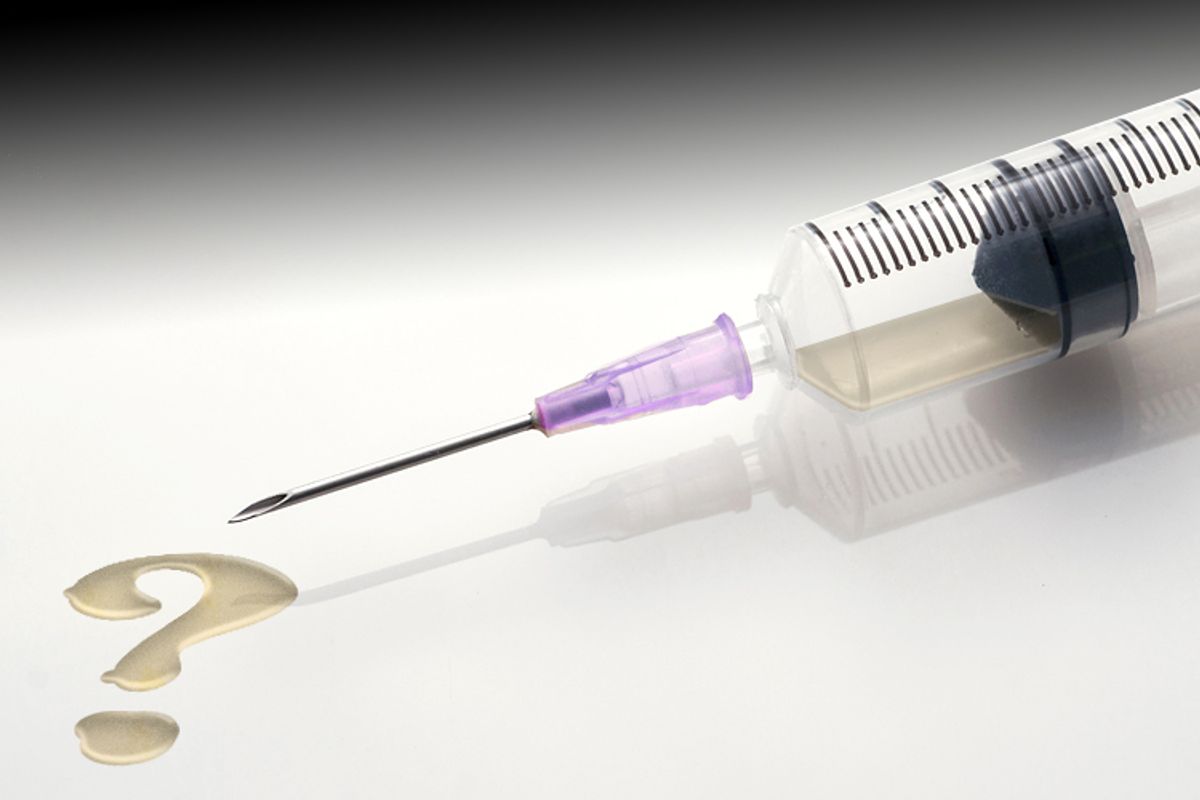
In 1988, at a remote Siberian laboratory, a 44-year-old Russian germ warfare researcher named Nikolai Ustinov was preparing to jab a guinea pig with a syringe full of Marburg virus when he slipped and pricked his thumb instead. That was the end for Comrade Ustinov. For two weeks, helpless doctors watched as the pullulating, Ebola-like organism overwhelmed Ustinov, until he died with blood oozing out of his pores. For his colleagues, Ustinov's gruesome demise was a preview of the deaths they were manufacturing -- by the millions -- in violation of global bans on biological warfare development. But if they were horrified by what they saw, it did not deter the scientists from capitalizing on Ustinov's accidental experiment. The virus, which had mutated in its host, was harvested and purified into a new, even deadlier strain for the Soviet arsenal. In honor of the scientist who died to create it, the new weapon was called Marburg Variant "U."
The weaponization of Ustinov is one of the more harrowing episodes in "Biohazard," a new book by Kanatja Alibekov, who worked for two decades at the biological weapon conglomerate Biopreparat and was deputy director before his defection in 1992. Having changed his name to Ken Alibek, he now works for a northern Virginia consulting firm, devising ways to enhance immunity to the weapons he once designed. Alibek's book reveals the secrets of the enormous Soviet germ warfare program, and implies that many of its scientists may still be at work. As such, it's a good advertisement for the Clinton administration's $1.4 billion bioterrorism initiative, whose most visible component is a program to inoculate all 2.4 million active and reserve service members against deadly anthrax bacteria. It comes as something of a surprise, then, to learn that Alibek thinks the $130 million anthrax vaccination program is not very sound.
In this, he is by no means alone. At Dover Air Force Base in Delaware on May 5, Col. Felix Grieder, the wing commander, temporarily suspended vaccinations on the 3,600-strong base because the performance of a Pentagon briefer sent to explain the shots had been "inadequate to dispel rumors and misinformation" about the vaccine's safety, Grieder's spokesman said. The incident at Dover reflects growing skepticism in and outside the military over the safety and reliability of the anthrax shots. A movement to make the shot voluntary has been orchestrated by an extremely loose coalition of critics -- everyone from Clinton-bashing militia types to left-wing activists, along with a General Accounting Office investigator in Washington and a day-care provider in suburban Denver who serves as electronic den mother for thousands of disgruntled soldiers, sailors and airmen. In the past six weeks, top brass and Food and Drug Administration officials have twice been called before Congress to answer critics of the program. In the middle of a war, the Pentagon is being accused of reckless disregard for the health of its men and women. "It would seem that troops are being used as guinea pigs," says Mark Zaid, a lawyer who represents several sailors disciplined for refusing the vaccine.
The careful observer is inclined, initially, to interpret the uproar as a farrago of half-baked claims and misapprehensions. It began early last year when, in the course of filing a lawsuit on behalf of a former CIA agent, Zaid turned up documents revealing irregularities in the Michigan laboratory that produces the anthrax vaccine used during the Gulf War and in the current vaccination campaign. Another vector of opposition was a group of anti-war activists, including a Freeport, Maine, emergency room doctor named Meryl Nass, who has contended for many years that the United States was conducting its own biowarfare program. The documents suggested that the anthrax vaccine, licensed in 1970 but used by only about 20,000 people prior to the Gulf War, had been inadequately tested and was being sloppily produced. Furthermore, the critics claimed, some troops were suffering devastating illness after taking the shots -- and six shots in all were required for full protection.
By early 1999, doubts about the vaccine had spread to several members of Congress. A report in late March by the GAO -- the investigative arm of Congress -- called on the Pentagon to investigate questions about the vaccine raised in work by Pam Asa, a freelance scientist in Tennessee, and Robert Garry, a retrovirologist at Tulane University medical school. During the silicone breast implant controversy, Asa and Garry presented evidence purporting to show that silicone leaks were causing autoimmune disease -- in which the immune system attacks the body's own benign tissues. Garry subsequently devised a test to detect antibodies to silicone and similar fatty substances. He now says he has detected antibodies to one of these substances -- called squalene -- in the blood of most members of a group of 75 severely ill veterans and recent anthrax vaccines he tested. About 200 people in control populations tested negative for the antibodies, Garry says. He hypothesizes that there was squalene in the vaccines injected into the service members, or that their disease, which he contends is an autoimmune disorder, somehow results in the production of antibodies to squalene, an unhealthy state of affairs since squalene is a naturally occurring substance in cell membranes.
The conspiratorially inclined have noted that squalene is used as an adjuvant -- an immune booster -- in several experimental vaccines. In the May Vanity Fair, Gary Matsumoto put this jumble of evidence together to claim, in an article titled "The Pentagon's Toxic Secret," that Gulf War vets and active soldiers had been vaccinated with experimental substances without informed consent, in violation of the Nuremberg Principles. But the Pentagon, along with several retired and active officers involved in the Gulf War vaccination program, flatly denies that vaccines containing squalene were ever used on troops, except in small trials for HIV and malaria vaccines. "Short of evidence to the contrary, I guess we have to believe that," Garry says. Ironically, squalene and other experimental adjuvants may be key to a new generation of safer vaccines. These vaccines, containing small particles designed to produce very specific immune responses in the body, are more pure than most current vaccines, but must be administered in conjunction with adjuvants to bolster their capacity to stimulate the immune system. I spoke to half a dozen scientists who work with squalene adjuvants and all of them denied the substances were intrinsically dangerous. They reacted quizzically to Garry's hypotheses. "It's plausible, but I'd like to see the data," says Dr. Andria Langenberg, director of clinical research at the California biotech firm Chiron, whose squalene adjuvant has been administered to 18,000 people in trials, and was commercially licensed last year for a flu vaccine in Italy.
The Pentagon, reasonably, says it is waiting for Garry's results to be published before it does anything about the squalene issue. Both the Pentagon and the FDA claim the anthrax lots approved for the troops are safe and that adverse reaction rates are low. They point out that about 4,500 employees in the U.S. germ warfare defense program have been vaccinated against anthrax since 1973, and although hundreds have probably been exposed to anthrax spores, none are known to have gotten the disease -- or suffered a long-term reaction to the vaccine. Researchers at Fort Detrick, Md., have bombarded 45 vaccinated monkeys with powdered anthrax in recent years, and all but one survived. For ethical reasons, this method can't be tested on humans. If the vaccine failed, most of them would die after a few days of coughing, vomiting and internal bleeding.
On the other hand, the Gulf War troop population was two orders of magnitude larger than the previous group exposed to the anthrax vaccine -- and critics believe the Pentagon should have designed follow-up studies on the 150,000 or so Americans who got multiple vaccinations during that brief war. A few studies, including one published by British researchers in the Lancet in January, have suggested that multiple vaccinations are the factor that most closely correlates with the symptoms of Gulf War illness. On March 30 of last year, a sailor aboard the USS Independence, Erik Julius, sent an e-mail to his mother asking her to find out if the anthrax vaccine was safe. Julius' mother, Lori Greenleaf, told her son that reports on the Internet linked it to Gulf War illness. When Julius refused the vaccination, he was reduced in rank, she says. Under threat of more serious punishment, Julius relented, and got three shots over the following year that his mother says caused headaches, muscle pains, exhaustion and diarrhea, the typical constellation of non-specific ailments that has bedeviled thousands of Gulf War veterans. Greenleaf, convinced the vaccine has hurt her son, and angered at the military's insistence he take the shot, began campaigning against the obligatory vaccine on the Web. She claims to be in contact with more than 7,000 worried troops and veterans. "We're still not getting honest answers," she says.
The Pentagon, mindful of Iraq's known anthrax stocks, has so far stood by the vaccine as a key element of force protection. "Anthrax is the biological weapon most likely to be encountered by U.S. forces," Brig. Gen. Eddie Cain, who is in charge of the Pentagon's biological defense, testified before a congressional hearing on April 29. "If anthrax is used as a biological weapon ... death is the usual outcome once clinical symptoms appear, regardless of any post-exposure treatment." At Fort Detrick, there is frank puzzlement over opposition to the vaccine. "We're not vaccinating people for pleasure," says Col. Arthur Friedlander, M.D., a top anthrax researcher. "We're talking about trying to protect troops. Do you want your son to go into Iraq when Saddam has weaponized anthrax sitting out on the airfield?"
But even if the anthrax vaccine is safe and has nothing to do with Gulf War or other illnesses, is mandatory vaccination a smart policy? Alibek, for one, thinks not. Any errant Russian biowarfare expert with a briefcase full of germs could help any of a dozen states weaponize any of a dozen killers besides anthrax -- plague, Marburg, Venezuelan equine encephalitis, you name it. "If an enemy of the United States knows that our army is vaccinated against anthrax, they'll try to develop some other weapon -- they have many to choose from," Alibek said in an interview. What's more, the licensed anthrax vaccine "probably wouldn't work," he believes, against at least one strain of anthrax genetically altered by Soviet scientists.
One of the stories recounted in Alibek's book is the 1979 disaster at Sverdlovsk, now Yekaterinburg, in which a bungling technician at a germ factory failed to replace an air filter, releasing billions of anthrax spores into the night air. At least 66 people died in this, the worst confirmed germ warfare incident. The strain of anthrax released at Sverdlovsk -- Anthrax 836 -- was put into the tips of hundreds of Russian warheads. This virulent strain, Alibek notes, was itself a genetic mutant derived from sewer rats that contracted anthrax from a spill. When I asked Friedlander if his monkeys had been "challenged" with 836, he said, "We'd like to, but we can't get it [from the Russians]." He added, "We have tested 30 other strains, and have no reason to believe it is fundamentally different." Friedlander and others in the military have no convincing counter-argument, however, to the suggestion that U.S. enemies could easily use another germ agent. "If you use the anthrax vaccine, you're shutting down one of the enemy's capabilities," Friedlander says. Not a hugely reassuring statement.
In the current constellation of global power, it is hard to imagine any state that would be foolish enough to fire germ-filled shells against American soldiers, since retaliation would certainly be massive. Terrorist attacks seem more likely, against troops or civilians. The FBI, one well-placed source told me, already knows of at least 12 terrorist groups that have tried to procure killer germs. But you can't inoculate the entire population against all of these organisms. Alibek thinks the answer lies in designing new drugs to enhance nonspecific immunity -- drugs that could be used once an attack has begun to accelerate the body's natural response to a range of foreign particles. But while growing knowledge of the immune system makes the future of such compounds more plausible, they don't exist now. "I think we could produce these in a decade," Alibek insists. "Vaccines are not the answer."
Shares