

Barack Obama's candidacy has brought the issue of race back to center stage in America. A provocative shot was fired by Debra Dickerson, who in the Jan. 22 issue of Salon argued that because Barack Obama is not a descendant of African slaves, he is not black. Dickerson's piece raises a number of important issues. And it should be read in the context of her other writings on race, in which she takes a courageous and admirably free-thinking position, refusing to kowtow to received racial definitions or etiquette. But I think she has it wrong about Obama's blackness, or lack thereof. Obama is black -- he just isn't "black."
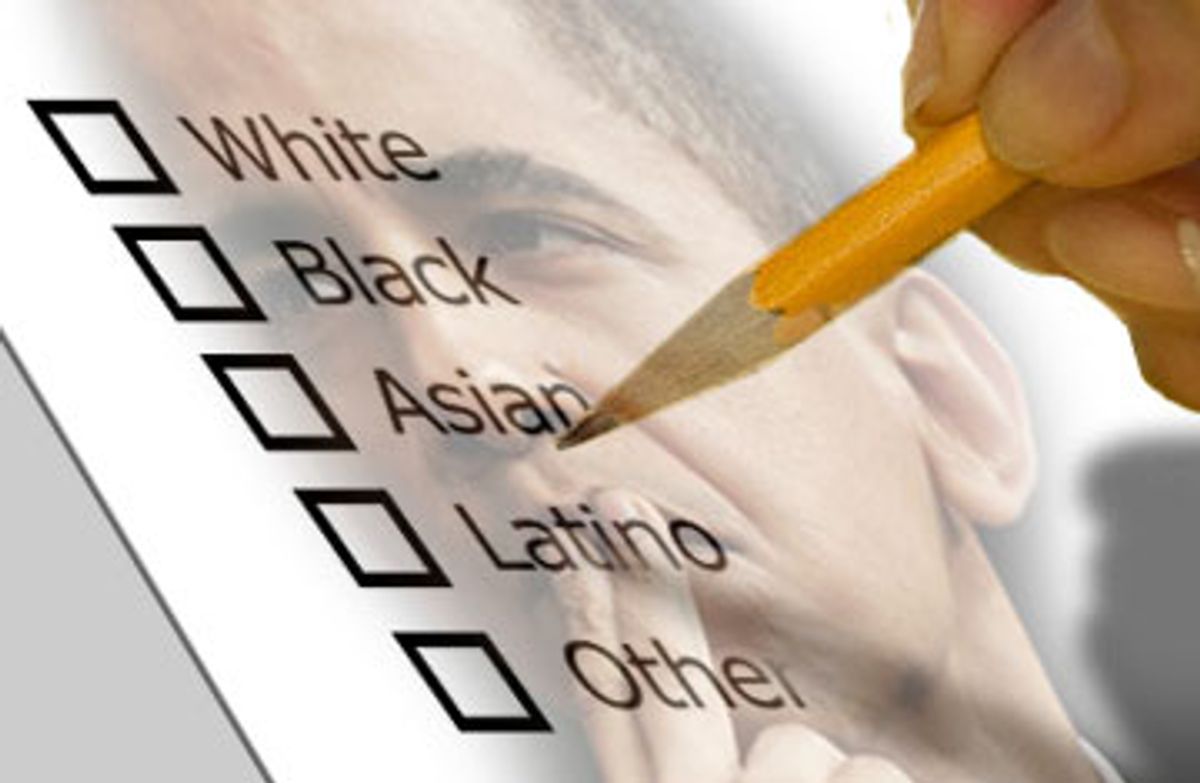
To explain what I mean, let me delve a little into my own racial background. I started a part-time teaching gig last week at the University of California at Berkeley, and part of the paperwork (which included a form on which you had to pledge allegiance to the state of California, an entity I had not thought needed my vassalage) was a form that asked what my ethnicity was. You had to identify yourself as white, black, Asian or Latino. I think there were a few others, though I can't remember. I'm half-Japanese, so I looked for a mixed-race box, but there wasn't one. I asked the woman who was doing the paperwork if I could put down that I was half-white and half-Asian, but she said, "No, you just have to choose one." Even though I knew I was probably bumming out some U.C. diversity honcho, I put an X in the box marked "white."
Why did I choose "white"? It was a matter of intellectual honesty. This takes a bit of explaining.
The truth is, I don't think of myself as either white or Asian. In fact, I don't think of myself in racial terms at all. If asked, I of course identify myself as what I am -- mixed-race, or Eurasian, or half-Japanese. I try to work the Scottish part of the mix in as well, because I like trumpeting my weird mongrel gene pool. But although I know I am a person of mixed race, that fact plays only the most minor role in my sense of myself. I am a mixed-race person, not a "mixed-race person."
What's the difference? People whose race or ethnicity defines their identity, or at least makes up a major part of it, are what I think of as quotation-mark people. They are not only mixed-race, they are "mixed-race." Those whose race or ethnicity has little or nothing to do with their identity, with their sense of themselves, are non-quotation-mark people. They may recognize themselves as black or Latino or Asian, be whatever race or ethnicity they are to the core, and proudly affirm they are such, but they aren't "black" or "Latino" or "Asian."
For me, my racial background has never meant anything one way or the other. There are no doubt many specific reasons for this, including my parents' unconcern about race, not having had any kind of a Japanese upbringing (whatever that means), growing up in Berkeley in the '60s, and so on. The bottom line is that no one ever really paid any attention to my race, so I didn't either. If I do think about it, it's with a smug, slightly juvenile sense of satisfaction that I'm different from just about everybody else and in a "cool" way. Beyond that, though, my racial background is meaningless. It plays no role in my sense of myself.
What this adds up to for me is that when I am forced against my will to make a reductive choice, as I was at U.C., the most honest thing is to choose white. I do that not because I see whiteness as a positive identification, or as my identity, but for precisely the opposite reason: because whiteness is the marker of racial invisibility in America. White, in other words, means no race, not the master race. I don't "feel" either Japanese or white. To feel either would involve some bad-faith reduction of my identity. But if forced to choose, I choose white, because that category, inaccurate as it is, reflects the fact that my racial background does not form my identity.
This is, in fact, how most white people in America -- unless they subscribe to some virulent form of identity politics, whether on the Ku Klux Klan right or the I-am-a-member-of-the-oppressors left -- see themselves. White people don't go around feeling "white" unless they are either racists or have just come out of a corporate diversity consciousness-raising session.
Of course, the fact that white people are the majority in America makes it easy for them not to feel "white." A majority group's racial identity, since it encounters no external obstacles, singling out or bigotry, is always invisible to itself. But -- and now we come to the interesting racial questions posed by Barack Obama -- I would argue that not all members of minority ethnic or racial groups, even ones that have historically been subject to racism, necessarily see themselves as "Asian" or "Latino" or "black." They may just see themselves as Asian or Latino or black. This doesn't mean they necessarily reject any cultural traditions or community ties: It simply means they see themselves first and foremost as human beings who happen to be a certain race or ethnicity.
Let me be clear. I am not talking about disavowing one's culture or background, acting "white," or any other external actions. I am simply talking about an inner freedom from a superficial definition imposed by others. This freedom can -- and in the case of blacks, probably usually does -- coexist with a stronger consciousness of one's racial identity than exists for white Americans, whose racial status is invisible to themselves. For many minorities -- even though their minority status makes their ethnicity more visible to others, and thus to themselves, and even though they may have suffered from racial or ethnic prejudice -- visibility and prejudice alone do not necessarily create a race or ethnicity-based identity.
And if that's the case, they're lucky. Because who wants to go around carrying the burden of being "Asian" or "black" all the time? It's a burden because it's a phantom, an abstract concept, that nonetheless weighs you down. To feel "Asian," for me, would be to embrace an entirely political definition of myself, one simultaneously empty and all-encompassing. I would become a caricature of myself, a spokesman for a "myself" entirely constructed by others. Having no racial self-identification is a utopian state because it allows you to escape this malignant mirror. In America, the white majority is fortunate to enjoy this. But so are many minorities.
Of course, I know perfectly well that not everyone is dealt this lucky hand. It's all well and good to preach colorblindness, to celebrate a society without quotation marks, but as long as racism exists, it puts pressure on those who are subject to it to define their identity in terms laid down by others. The quotation marks appear as a reaction to the deforming gaze of the dominant group. This is true to some degree for all minority groups, and far more so for black people. Blacks were stigmatized in a way different from that of any other racial group. Blackness was so demonized that blacks alone were -- and still to a large degree are -- defined by the notorious "one drop" rule: One drop of black blood, and you were considered black. For years, the concept of being mixed race did not apply to black people. Today, whites are in a state of confused transition about this concept; most see the one-drop rule as perpetuating an outmoded binary, oppositional state of race relations and are waiting for a signal from the black community that would allow them to abandon it. But no clear signal is forthcoming. The one-drop rule, ironically, is now defended not so much by whites as by many blacks, who regard refusing to identify as "black" as a betrayal of racial solidarity, and correctly see the advent of a mixed-race category that is not trumped by "blackness," à la Tiger Woods' "Cablinasian," as threatening the very cornerstone of their own identities.
This, too, is understandable. Blacks, who were enslaved, treated as inferiors and discriminated against in every aspect of life, got dealt by far the worst racial hand, and it's accordingly the hardest for them to move beyond a race-based identity. Any person who isn't black who tries to gloss over this fact, and blandly demands that blacks simply stop seeing themselves as "black," is insensitive to the power of history and the identity-distorting effects of dominance.
And yet, removing the quotation marks from around one's racial identity is ultimately liberating. It is, I believe, what every human being on earth wants to do. I disagree with Colin Powell about many things, but I find his racial credo, one he learned from his parents, admirable. Powell's parents taught him a simple mantra: "My race is somebody else's problem. It's not my problem." The greatest of all American novels, Mark Twain's story of Huck Finn and the runaway slave Jim, floating down the Mississippi on a voyage to find the American soul, is a tale of how the love between a black man and a white boy washes away Huck's quotation marks, leaving them both free -- Huck figuratively, Jim literally.
Barack Obama simply happens to represent a very public manifestation of this non-quotation-mark approach to race. There are many, many other African-American blacks who exemplify the same approach. Dickerson argues that Obama is not black because he is not the descendant of African slaves. But I would argue that blackness -- or, more accurately, "blackness" -- is determined not by whether one is descended from slaves, but the degree to which one sees one's identity as determined by one's race. Clearly, the fact that Obama's father was African, not American, plays a role in his well-known lack of "blackness," as does the fact that his mother is white. And yet, I believe that none of this is determinative. Someone of Obama's background could be "black" -- and a Ronald Washington from Detroit might not be "black" at all. It depends on how they see themselves; if others see them differently, that's their problem.
White Americans are obviously drawn to blacks (and yes, they do see Obama as black) who are not "black." Everyone is comfortable with Colin Powell and Condoleezza Rice -- and that goes triple for Barack Obama, who is not only racially unthreatening but charismatic and attractive. This is hardly surprising. No one is drawn to someone who threatens them, or whose persona creates a sense of racial guilt. But I can understand why this sudden, rapturous embrace of a black man who is not "black" might be exasperating to many blacks. It gives rise to suspicions that white America just wants to happily declare "racism is over" and move on, not confronting the degree to which its weariness with "blackness" is really a sophisticated form of racism. The heart of Dickerson's equivocal uneasiness with Obama is her fear that embracing him is just too damn easy for white people, who haven't really settled their accounts with black folks yet.
There is no doubt something to this suspicion. A pathology as vast and deep as racism is not expunged in a decade. And "blackness" is not so easy to separate from blackness as my somewhat facile use of quotation marks suggests. What happens when the mask becomes the face? For many whites, it may be easier to just turn away from what can be the troubling, intertwined complexities of black and "black" identities, and embrace a black man who presents no such problems.
But having said that, I believe that white America's embrace of Obama is a virtually unalloyed good. It's good because Obama is a dynamic and exciting candidate who is offering not only a racial truce but also a fresh and progressive take on many issues. But it's also good because that embrace demonstrates that we're moving toward racial invisibility. It is in everyone's interests -- blacks and whites and Latinos and Asians and the growing number of mongrels like me -- for racial quotation marks to disappear. And the best way to get rid of them is to establish greater trust and communication between blacks and whites. The more black people come to trust white people, the more they believe -- to quote Dr. King -- that they are judged by the content of their character, not the color of their skin, the less they will be compelled to define themselves as "black," and the more liberated they will be to explore a purely human destiny, not one bound by something as meaningless and stupid as race. The fact that so many whites have embraced the black senator from Illinois, even if he does not share the experiences or worldview of some African-Americans, will, I hope, help build that trust. After all, the guy is still black.
We are caught in a time of churn and change, when the old racial rules no longer apply. We have tried the old, formal, accuse-and-apologize model. It was needed in its day, but we are past that now. Now we need something lighter, something more fragile, more intimate, to wash away the last of this terrible, false duality that has poisoned America for too long. We need friendship. We need trust. We need love. And love surrounded by quotation marks isn't love at all.
Shares