

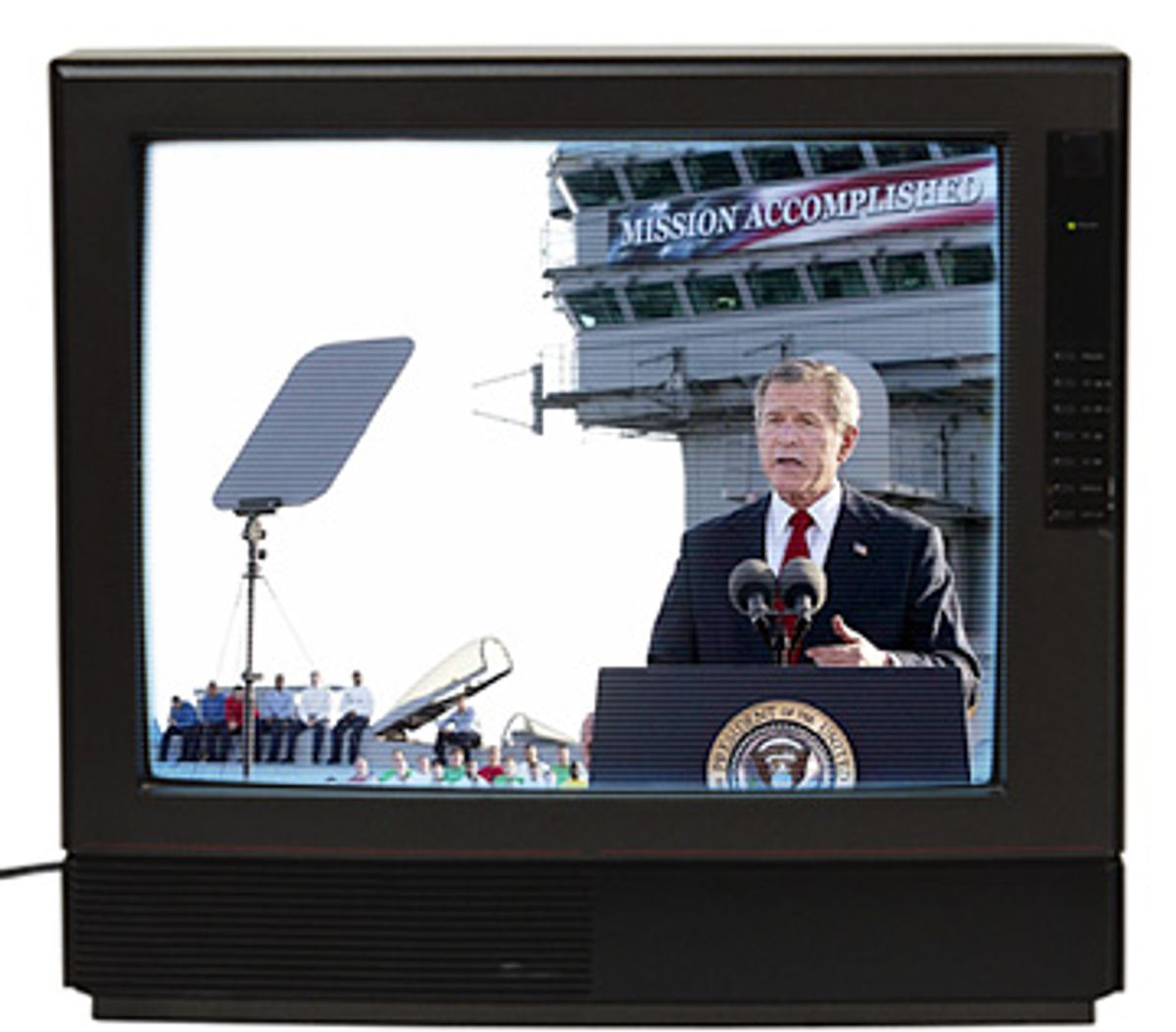
It's no secret that the period of time between 9/11 and the invasion of Iraq represents one of the greatest collapses in the history of the American media. Every branch of the media failed, from daily newspapers, magazines and Web sites to television networks, cable channels and radio. I'm not going to go into chapter and verse about the media's specific failures, its credulousness about aluminum tubes and mushroom clouds and failure to make clear that Saddam Hussein had nothing to do with 9/11 -- they're too well known to repeat. In any case, the real failing was not in any one area; it was across the board. Bush administration lies and distortions went unchallenged, or were actively promoted. Fundamental and problematic assumptions about terrorism and the "war on terror" were rarely debated or even discussed. Vital historical context was almost never provided. And it wasn't just a failure of analysis. With some honorable exceptions, good old-fashioned reporting was also absent.
But perhaps the press's most notable failure was its inability to determine just why this disastrous war was ever launched. Kristina Borjesson, author of "Feet to the Fire," a collection of interviews with 21 journalists about why the press collapsed, summed this up succinctly. "The thing that I found really profound was that there really was no consensus among this nation's top messengers about why we went to war," Borjesson told AlterNet. "[War is the] most extreme activity a nation can engage in, and if they weren't clear about it, that means the public wasn't necessarily clear about the real reasons. And I still don't think the American people are clear about it."
Of course, the media was not alone in its collapse. Congress rolled over and gave Bush authorization to go to war. And the majority of the American people, traumatized by 9/11, followed their delusional president down the primrose path. Had the media done its job, Bush's war of choice might still have taken place. But we'll never know.
Why did the media fail so disastrously in its response to the biggest issue of a generation? To answer this, we need to look at three broad, interrelated areas, which I have called psychological, institutional and ideological. The media had serious preexisting weaknesses on all three fronts, and when a devastating terrorist attack and a radical, reckless and duplicitous administration came together, the result was a perfect storm.
The psychological category is the most amorphous of the three and the most inexactly named -- it could just as easily be termed sociological. By it, I mean the subtle, internalized, often unconscious way that the media conforms and defers to certain sacrosanct values and ideals. Journalists like to think of themselves as autonomous agents who pursue truth without fear or favor. In fact, the media, especially the mass media, adheres to a whole set of sometimes explicit, sometimes implicit codes that govern what it feels it can say. Network television provides the clearest example. From decency codes to subject matter, the networks have always been surrounded by a vast, mostly invisible web of constraints.
Seen in this light, the mass media is a quasi-official institution, an info-nanny, that is held responsible for maintaining a kind of national consensus. Just as our legal system is largely based on what a "reasonable" person would think, so our mass media is charged with presenting not just an accurate view of the world but also an "appropriate" one.
What "appropriate" means in absolute terms is impossible to define. In practice, however, its meaning is quite clear. It's reflected in a cautious, centrist media that defers to accepted national dogmas and allows itself to shade cautiously into advocacy on issues only when it thinks it has the popular imprimatur to do so. The "culture wars" of recent decades are largely a backlash by enraged conservatives who correctly perceive that the "liberal" media has conferred its quasi-official seal of approval on issues like gay rights and women's right to abortion. In fact, the mainstream media only dares to deviate from the imagined national center, from "appropriate" discourse, within a highly circumscribed area.
Parents may be justified in basing their decisions on what is "appropriate." But for media organizations to do it is extremely dangerous -- and even more so in times of war or national trauma. After 9/11, the area of allowed deviation shrank even more. What was "appropriate" became deference to the nation's leaders. Patriotism and national unity trumped truth.
The outburst of media patriotism after the attacks reveals how fragile the barrier is between journalism and propaganda. Fox News, whose newscasters sported American flag pins and where the "news" consisted of cheerleading for Bush administration policies, was, of course, the most egregious case. One month after the United States began bombing Kabul, Fox anchor Brit Hume actually said, "Over at ABC News, where the wearing of American flag lapel pins is banned, Peter Jennings and his team have devoted far more time to the coverage of civilian casualties in Afghanistan than either of their broadcast network competitors." Reading this statement five years later is a salutary reminder of how pervasive such jingoist, near-Stalinist groupthink was in those days -- and still is on Fox.
Fox was the worst, but the rest of the mainstream media was clearly influenced by the perceived need to be "Americans first and journalists second." This was manifested less in obviously biased or flawed stories than in subtler ways: the simple failure to investigate Bush administration claims, go outside the magic circle of approved wise men, or in general aggressively question the whole surreal adventure. This failure was even more glaring because the run-up to war took place in slow motion. For nine months or more, everyone knew Bush was determined to attack Iraq, and no one really knew why. Yet the mainstream media was unable to break out of its stupor. At a critical moment, that stupor appeared almost literal.
In an infamous Bush press conference on March 6, 2003, just days before the Iraq war began, the assembled media bigwigs were so lethargic and apparently resigned to the inevitability of war that they seemed to be drugged. ABC News White House correspondent Terry Moran said that the press corps left "looking like zombies."
I'm not saying that there's no place for patriotism, or fellow feeling, in journalism. 9/11 was a special case. Thousands of Americans had just been killed, and a heightened emotional awareness of our shared national identity was both inevitable and unexceptionable. Who, for example, would quarrel with the "Portraits of Grief" series the New York Times ran, honoring each of the victims of 9/11? Running this series had clear political ramifications. The Times, for instance, has never run a series about the 3,000 or more victims of automobile accidents killed every month in the United States. But it was a legitimate news decision.
But when it comes to forward-looking analysis and reporting -- as opposed to elegiac coverage -- patriotism and groupthink are journalistic poison. Hume's implicit argument that it was "un-American" to report extensively on civilian casualties was an extreme example. But in newsrooms across the land, thousands of smaller, unnoticed cases of self-censorship or selective reporting were taking place. 9/11 in particular was a sacred taboo that even the most cold-blooded, dispassionate journalists feared to disturb. They'd seen what happened to Susan Sontag, who was crucified for daring to say that the 9/11 attackers were not cowards, that President Bush's tough-talking response was "robotic," and that America urgently needed to rethink its Middle East policies. (The New Republic ran an article that began, "What do Osama bin Laden, Saddam Hussein and Susan Sontag have in common?") Bill Maher lost his network TV show after he refused to kowtow to the "terrorists are cowards" line, and Noam Chomsky was virtually declared a traitor for calling America a terrorist state and warning that a violent response to 9/11 would backfire.
A personal example: In a Salon piece I wrote before the 2004 elections, when the worst of the patriotic fervor had long subsided, I wrote, "Heretical as it is to say, the terror attacks proved that it is possible to overreact -- more specifically, to react foolishly -- to an attack that left 3,000 dead." The idea that we had "overreacted" to this sacred event was so explosive, even then, that my editor flagged the line and questioned me about it. In the end the line stayed, but I write for Salon -- one of the few major media outlets that were consistently against the war from the beginning, one that has no corporate owner and is aggressively independent. How many such sentiments ended up on cutting-room floors across the country -- or were never even typed? As Mark Hertsgaard noted in his important study of the media's weakness during the Reagan years, "On Bended Knee: The Press and the Reagan Presidency," the most effective censorship is self-censorship.
In short, the attacks not only killed almost 3,000 Americans, but also killed the mainstream media's ability to challenge the administration -- one that was expert at framing all dissent as bordering on treason. When Ari Fleischer infamously said that "all Americans ... need to watch what they say, watch what they do," the mainstream media obeyed. This timorousness was brought into stark relief by the far more trenchant and critical perspectives offered by analysts, often academics, who didn't write for a mass audience, and who therefore had not learned, as so many mainstream journalists have, to defer to the best and brightest and make their opinions conform to an imagined American center.
Time and again, in the run-up to war and during its early phase, I was amazed at the difference between the clear-eyed analysis to be found in books, and the mushy centrist pap that dominated the papers and TV. It was a kind of surreal battle of books vs. the mass media -- and books won hands down.
Rashid Khalidi's "Resurrecting Empire," written before and during the early days of the Iraq war, accurately predicted the quagmire that America was about to step into, hammering home the notion that for people in the Middle East, who have a long historical memory of imperialist oppression, our "noble" mission would not be seen as such. Michael Mann's "Incoherent Empire," also written just before and in the early days of the Iraq war, exposed the incoherence of Bush's "war on terror." Mann pointed out that there is a fundamental difference between "national" terrorists like Hamas and "international" ones like al-Qaida, and that treating them as if they were the same, as Bush moralistically did and still does, was a catastrophic blunder. And Malise Ruthven's "A Fury for God," which came out before the Iraq war, traced the historical and intellectual roots of violent Islamism through the Muslim Brotherhood to Sayyid Qutb, noted the corrosive effect of the Israeli-Palestinian conflict on Muslim minds, and cautioned that "another Gulf War will do far more harm than good."
Not all was lost. Some of the best breaking commentary was on the Internet, on blogs like Juan Cole's "Informed Comment" and Helena Cobban's "Just World News," but these sites had a limited readership. There were some notable exceptions on the print side, like the superb reporting of Knight Ridder's Jonathan Landay and Warren Strobel, who aggressively reported out the Bush administration's bogus claims about the "threat" posed by Saddam Hussein. The Washington Post's Walter Pincus also questioned Bush administration claims about WMD (his big pre-war story on this subject, after almost being killed, was relegated to page A-17). And the New Yorker's Seymour Hersh and Mark Danner, writing for the New York Review of Books, also distinguished themselves with excellent coverage of Abu Ghraib, following the thread that led directly from the blood-spattered rooms outside Baghdad to Defense Secretary Donald Rumsfeld.
But such authors and journalists were few and far between, and they were almost never seen on TV. Long into the Iraq war, much of the mainstream media continued to fixate on Saddam Hussein's missing WMD and bloviate about the challenges of "reshaping the Middle East," ignoring these deeper arguments. It was a stark illustration of the difference between journalism and scholarship.
Even before Iraq and the Bush presidency revealed its feet of clay, American journalism was not in one of its heroic phases. The press is less aggressive than it was in the Watergate era. Its adversarial role has been weakened. It defers more to authority. It is tamer, more docile, less threatening to what the great Israeli journalist Amira Hass called "the centers of power."
There are a number of reasons for this softening of journalism's backbone. One is economic. The decline of newspapers, the rise of infotainment, and media company owners' insistence on delivering high returns to their shareholders have diminished resources and led to a bottom-line fixation unconducive to aggressive reporting. There are big bucks to be made in being aggressively adversarial, but most of those bucks are on the right, not the left. The meteoric success of right-wing media outlets like Fox News and ranting demagogues like Rush Limbaugh and Ann Coulter has not encouraged media owners, too shortsighted to see that there are viable alternatives to the kind of bland national nanny-ism manifest on the networks, to pursue real journalism. (The blogosphere represents the beginning of a national revolt against the now-discredited media gatekeepers.)
Another is the opiating effect of corporate culture: Major media has become increasingly bland and toothless, just like the huge bureaucracies that own it and that are increasingly indistinguishable from each other and from the federal government. It is harder to "monitor the centers of power" when you work for a gigantic corporation that is itself at the bull's-eye of power.
Then there is the Faustian trade-off of "access" journalism, to which, as the Judith Miller debacle revealed, more and more prominent journalists have succumbed. As Pentagon Papers leaker Daniel Ellsberg told Editor and Publisher in 2003, this is a cardinal journalistic sin. "It is irresponsible for anyone in the press to take your understanding exclusively from government accounts, from the president or secretary of defense or lower-level officials," Ellsberg said. "That definitely includes backgrounders that purport to be the 'real' inside story. Just as press conferences are a vehicle for lying to the public, backgrounders are a vehicle for lying to the press, convincing the press they are getting the inside story when all they are getting is a story that is sellable to the press."
As the war drums beat, the Beltway press bought and bought and bought -- before they discovered they'd been sold.
A closely related issue is the rise of a super-class of journalists, mostly TV talking heads, who are as wealthy and famous as the people they cover -- and who routinely hobnob with them at parties and social events. These celebrity journalists may make a show of their "toughness," but they swim happily in the conventional wisdom that flows all around them. And as it relates to the Middle East, that conventional wisdom is bankrupt.
Which leads us to the third and final area where journalism failed in the aftermath of 9/11: ideology. Evaluating why America was attacked required journalists to learn about the history of the Arab/Muslim world -- and not just skim one of Bernard Lewis' tendentious articles discounting Arab grievances. Evaluating how dangerous Saddam Hussein really was required knowledge of the contemporary Middle East -- not just a quick read of Kenneth Pollack's "The Threatening Storm," which argued that Saddam posed so great a threat to America that war was necessary. Assessing Bush's entire "war on terror" required a dispassionate exploration of terrorism itself -- an understanding that terrorism is essentially a form of asymmetrical warfare, that it often succeeds by provoking an overreaction, that it can be waged in the service of legitimate goals, and that most terrorists are not cowards or madmen -- free of 9/11 emotionalism. Indeed, every one of these issues needed to be looked at completely objectively, without sacred cows of any kind.
None of this happened for three closely related reasons. The first was simple ignorance: Most mainstream journalists simply didn't know very much about the Middle East, and in thrall to a kind of bad humility, deemed it above their pay grade to find out.
Second, American society in general has a strongly pro-Israel orientation -- one that journalists generally share (or are too intimidated or ignorant to contest) -- which inevitably guides their assumptions and beliefs about Arabs, terrorism and the Middle East in general. The historian Tony Judt argued in the London Review of Books that the support so many liberal journalists and pundits gave to Bush's war is best explained by their backing for Israel. This orientation, because it is deemed "appropriate," affects virtually every aspect of the media's coverage of the Middle East. Arab and Muslim perspectives, because they tend to be anti-Israeli, are rarely heard in the American media; if they had been, many Americans might have had quite a different assessment of the Iraq war's chances of success. Instead, the U.S. media works within a tiny ideological spectrum on the Middle East, using the same center-right and right-wing sources again and again. To take just one specific example, the New York Times, when it needs comment on Israeli affairs, often relies on experts from the Washington Institute on Near East Affairs (WINEP), a center-right, pro-Israel think tank. The Times rarely asks center-left or left-wing Middle East experts like Cobban or M.J. Rosenberg to comment on Israel. There is no evidence that the Iraq debacle, which these right-wing pundits almost universally supported, has led the media to rethink its sources or its ideological orientation.
Still worse, perhaps, the taboo against discussing this subject in public helped stifle vitally needed debate about the war. As Michael Kinsley pointed out more than four years ago in Slate, the fact that a large motivation for the war was influential neoconservatives' support for Israel was "the proverbial elephant in the room: Everybody sees it, no one mentions it." Kinsley correctly points out that there were honorable motivations behind this silence: no one wanted to put in play the crude anti-Semitic smear that this war was drummed up by Jews whose primary allegiance was to Israel. This is a caricature. As Kinsley and I have both argued, for the neoconservative Jews who played a key role in brainstorming the war, it was simply taken as axiomatic that America's interests and Israel's are identical. But that assumption of shared interests is itself highly problematic, to say the least. Some commentators, like Philip Weiss, have begun to raise the sensitive issue of the role played by the neocons' concern for Israel's security. In years to come, historians will ponder why America under Bush adopted, in effect, the Israeli position toward the Arab world without the ramifications of this radical and extremely risky move ever being discussed, or indeed the parallels even being acknowledged.
Finally, the media was unable to deal with the abstract and highly ideological motivations for Bush's war -- especially because those motivations, as Paul Wolfowitz notoriously admitted, were never really made clear. To oppose the war, one had to challenge the two real reasons behind it -- the neoconservative crusade against "Islamofascism" and the cold warriors' desire to assert American power -- head on. But this meant not only taking on the sacred cows of 9/11 and Israel, but also dealing with the refusal of the administration to publicly acknowledge these abstract reasons, and challenging a White House that "for bureaucratic reasons," in Wolfowitz's words, was hiding behind its trumped-up "evidence" about Saddam's WMD. For the mainstream media -- unprepared, intimidated, caught up in the torrent of Beltway wisdom and flag-waving -- this was far too much to deal with. As Kristina Borjesson noted, the result was that the media signed off on a war that it itself did not understand. There could be no more damning indictment.
We should note one more reason for the media's Iraq failure: the Bush administration. The mainstream media, especially in its current enfeebled form, is simply not equipped to deal with a regime as secretive, manipulative, vengeful and, not to put too fine a point on it, malignant as the present one. Watching the mainstream press try to contend with the Bush-Cheney gang is like watching the Polish cavalry galloping up in 1939 as the Wehrmacht tanks approach.
So has the media learned its lesson? And what does the future hold? In many ways, the media has definitely improved. After the war turned south and the WMD failed to appear, most news organizations began to get much tougher on the Bush administration. The New York Times, in particular, has found its backbone, roasting the administration for its incompetence and duplicity and turning an increasingly skeptical eye on its claims of progress in Iraq. And from the beginning of the war, the media's reporting from the field in Iraq has been far better than its analysis.
The problem, of course, is that the press only really turned on Bush when his ratings began to fall -- another indication that the Fourth Estate has become more of a weathervane than a truth teller.
The final verdict is not yet in. The media has improved, without question, but it has a lot of making up to do. The structural problems -- psychological, institutional, ideological -- that played so big a role in its collapse have not gone away, and there is no reason to think they will. And then there's war, which reduced so much of the media to flag-waving courtiers. If the media has learned that a bugle blast can be sounded by a fool, that not every war the United States launches is wise or necessary, and that self-righteousness is not an argument, maybe something can be salvaged from this sorry chapter after all.
Shares