

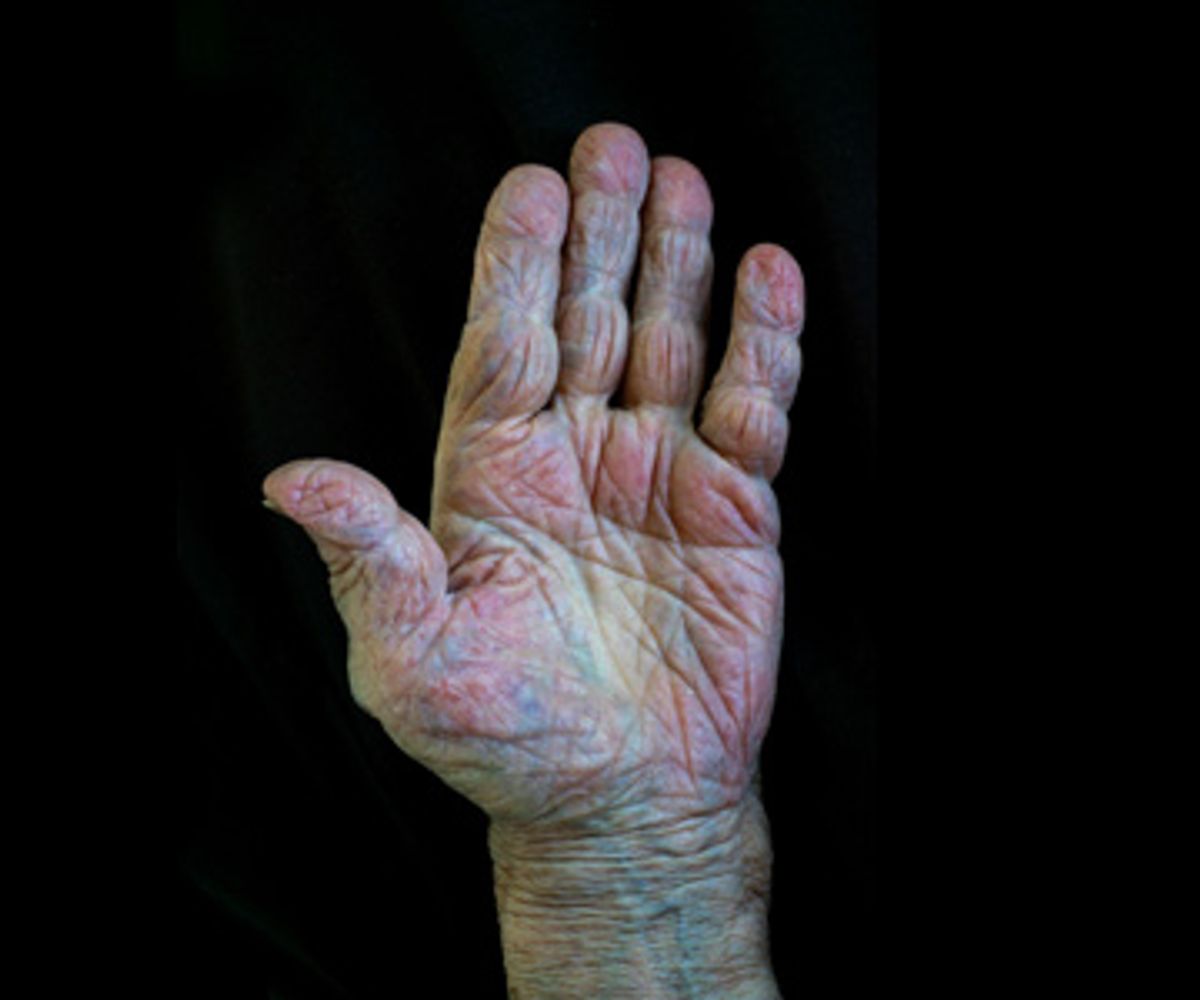
Getting old, as elderly people are wont to point out, is no picnic. Perhaps the only real consolation to aging is that it beats the alternative; even those of us who dread old age still hope to reach it. The celebrated upside to advanced years is, of course, the wisdom that supposedly comes with them, and it's this wisdom that Henry Alford seeks out in his new book, "How to Live: A Search for Wisdom From Old People." Alford's reasonable premise is that "the older we get, the more life experiences we are likely to have -- and the more experiences we have, the greater the body of information we have to work from." So why not ask older folks for a little advance on those earnings? "If people are repositories of knowledge -- the death of an old person, an African saying runs, is like the burning of a library -- then I want a library card."
Common sense suggests that if the simple transfer of wisdom were as easy as ordering up a copy of "The Murder of Roger Ackroyd" from the main branch, then humanity would be a lot less foolish than it manifestly is. Nevertheless, Alford remained resolute. For "How to Live," he interviewed dozens of people in their 70s, 80s and 90s, among them Yale professor Harold Bloom, spiritual teacher Ram Dass, actress and party animal Sylvia Miles, grumpy Pulitzer-winning playwright Edward Albee and activist Doris "Granny D" Haddock, famous for walking across the continental U.S. at age 89 in support of campaign finance reform. Woven through the book's interviews and research is the story of Alford's 80-year-old mother's divorce from his stepfather, Will. This event was precipitated by Alford himself: The interview he did with Will (who stated, "I'm satisfied. But if it all stops tomorrow -- so what?") seems to have prompted Will's ambiguously "accidental" overdose of sleeping pills shortly thereafter. Alford's mom resolved that she'd had enough of her husband's gloom, and began looking for a retirement community to move into -- alone.
This development spooks Alford; it's hard to imagine a less auspicious beginning for a new project than to have it lead to the end of a 31-year partnership. Yet one of the things he learns along the way is that old age can be ruthless in separating the sheep from the goats. Will comes to stand for the unwisdom of certain old people, the ones who just seem to give up and settle into a pre-funereal funk for the long slide to oblivion. His mom -- who kicks off her move to a North Carolina retirement village by appearing as Chiquita Banana in their talent show -- is the counterexample. She's not wise in the sense that Alford originally anticipates; she doesn't dispense "life lessons" in discrete, portable pellets like an Oprah-sanctioned self-help author. Instead, she leads by example.
That example features enterprise, imagination, what Alford calls "gameness" and a sparkling wit, the last of which Alford seems to have inherited. He once took his mom along on a helicopter ride over an active volcano in Hawaii, and when the pilot, tipping the aircraft sharply toward Alford's side, jokingly reassured his mom that they didn't have plans for a human sacrifice that day, she quipped, "Well, you wouldn't sacrifice him -- he's not a virgin." Of the crowd in her retirement center's dining room, she remarks, "This is the land of unfinished sentences. Down here, I'm Mensa."
As for her claim that, "We've misinterpreted Darwin. It's not survival of the fittest. It's survival of the most adaptable," an amendment seems in order. For the Alfords, it's survival of the funniest, the most charming. Just as his mother will find a way to make herself welcome wherever she goes, the author manages to be beguiling whatever he writes about, a good thing when your topic is as daunting as old age. Even so, at times Alford must resort to devious tactics. In the course of his research, he throws out his back and has to hobble around like an old man for a couple of weeks, something he'd rather not do in front of a cute store clerk with whom he often flirts. Alford's solution is to create an irresistible distraction; as he walks into the shop he announces, "I just saw a flying manhole cover!" -- a phenomenon that is, as he rightly claims, "the El Dorado of the urban pedestrian."
"How to Live" has a lot of flying manhole covers, but that may be part of Alford's point. He offers the manhole cover story as a preview of his strategy for coping with old age, an illustration of how he intends to "get in the habit now of compensating for my ultimate wanings." The anecdote is much more valuable that the usual nuggets of precooked wisdom offered by elderly survivors, like Phyllis Diller's recommendation that you "protect" yourself from "negativity" or Granny D's advice to "help other people until you don't notice your own needs and pains anymore." Such maxims are probably true enough, but they have the inabsorbability of greeting card messages and tend to sound, as Alford observes, like something printed on the side of a box of Celestial Seasonings tea bags. "Life lessons," when presented as such, come across as banal; but lives, real lives when spoken of honestly, sink in.
The best sort of inspiration to be had from those who've aged gracefully, it seems, comes in the examples they set. Diana Athill, a woman who worked for 50 years in the British publishing industry before making a late-life career as a memoirist, offers an excellent illustration of this principle with "Somewhere Towards the End," an account of how life looks to someone in her late 80s. (Athill is now 91.) She enjoys few of the conventional comforts of old age; she has never married, has no children and little money, and doesn't believe in God or an afterlife. Her single great advantage, as she see it, is good health and reason to hope that she'll partake in her family's heritage of "lucky" deaths -- quick, quiet and relatively painless. (One of her uncles popped off "on his horse at a meet of the Norwich Stag-hounds at the age of 82, talking with friends, when flop! and he fell off his horse stone dead in the middle of a laugh." A cousin slipped away while making a cup of tea.)
While searching through "Somewhere Towards the End" for pithy quotes that could convey the pervasive sense of wisdom I received from it, I came up almost empty-handed, despite the fact that the book is beautifully written. Athill's wisdom is more ambient than aphoristic; to read her memoir is to feel as if you are sitting in the company of someone who has really got things sorted out, even if you can't always discern the overarching system.
Still, the hankering for a system persists, especially in those of us just creeping nervously past our prime, and so Alford diligently boils down the world's wisdom traditions into three major concepts, espoused by three great thinkers: reciprocity (Confucius), nonattachment (Buddha) and doubt (Socrates). Alford has even discovered that old age has its own peculiar and acknowledged aesthetic, or "creative idiom." Literature professor Barbara Herrnstein Smith has labeled it with the somewhat unfortunate term "senile sublime." The great works of the old are stripped down, purged of the inessential and the merely personal, and organized around a central "stillness" in which oppositions and contrasts are both recognized and accommodated.
Certainly "Somewhere Towards the End" has exactly this quality. It surveys the struggles of Athill's long life without actually struggling itself. It is serene, but not synthetically so. A small example: Athill writes that she now enjoys "the return of the comfortable warmth of my early youth," the result of feeling lately "pleased with myself" for a variety of reasons (most notably her writing). "If this is smugness," she continues, "and I can't help feeling that it is, then I have to report that I have learned through experience that, though repulsive to witness, it is a far more comfortable state to be in than its opposite." She isn't letting herself off the hook, but she isn't going to deny herself the pleasure of a minor personality flaw, either.
Alford corroborates this picture by looking at a 1994 study conducted on people of various ages by Stanford University. Scientists gave beepers to 200 individuals, and the beepers were then set off at random times during the day, with the instruction that the participants record their moods at that moment. "The older folks had fewer negative emotions," Alford writes, "and were able to bounce back from their negative emotions far more readily than the younger respondees were." But perhaps more important, "the younger respondees' emotional states tended to be either wholly positive or negative at any given time, while the older folks were more likely to be experiencing a mixture of emotions."
You don't have to be old to recognize that as you mature, most of your feelings become mixed. Hope is tempered by the memory of past disappointments, but so, too, is fear tamed by the recollection of everything you've managed to survive. The purity of youthful emotions gives them vigor, and among other things makes them a magnificent fuel for getting stuff done. One reason why older people, according to Athill, derive so much pleasure from the company of younger people is the vicarious hit of this energy that they receive. But the layers and complexity of later experiences, tinted by everything that's come before, have their own beauty; in exchange for intensity, if you're lucky, you get richness.
Yet not everybody gets this richness, and as Alford observes, men seem to find it particularly difficult to attain. Athill, in turn, has found herself caring for an ailing lover-turned-companion who can barely interest himself in anything besides food -- not even that ubiquitous pacifier of toddlers and oldsters, the TV. "Quite often nowadays," she writes, "I will go into his room while the television is on and find him lying facing away from it." The similarities to the relationship between Alford's mother and stepfather are both telling and ironic. One reason people offer for getting married is the companionship a spouse provides in old age. Athill has led an unconventional, hippie-ish personal life, with a minimal interest in sexual fidelity, and once her romantic love for this man had petered out, they remained roommates and eventually she welcomed his lover into their home. (This young woman later moved out and got married, and her offspring have become the equivalent in Athill's life of beloved grandchildren.) Intent for most of her life on avoiding what she calls "wifehood," Athill has nevertheless slipped into it "automatically," while the guarantee of lifelong togetherness purportedly promised by Alford's mother's officially sanctioned marriage didn't pan out.
Alford blames the "malaise of senior gents" on the fact that "the Aspberger's-like traits that are the hallmark of some men -- social awkwardness and an inability to read cues -- can intensify with age," leaving them unable to call upon the "social networks" that help many older women thrive. He offers two literary examples of masculine raging against "the dying of light" in the form of Norman Mailer and Kingsley Amis, to ambiguous effect; I'm not entirely sure what he means to say about them, so here's my shot: Both men were overweening characters, and Amis, for all his talent, was a truly nasty piece of work. In the end, every bully will see his powers dwindle; time and death are immune to bravado and intimidation. Perhaps when that moment comes, a person whose identity has hinged on mastery discovers that its rewards are pretty thin after all, and the knack for enjoying other kinds of relationships has atrophied. Humility and adaptability, as Athill and Alford's mother demonstrate, serve the aged much better.
Surely someone warned these men about that possibility, long ago? But, then, who ever really heeds such warnings? The paradox of experience is that it pays off in a type of understanding that's almost impossible to put into words without resorting to cliches. (The late novelist David Foster Wallace wrote much the same thing about Alcoholics Anonymous mottoes in "Infinite Jest"; they're trite, yet they work.) What you know about life as a result of having lived it for -- pick a number -- 40, 50, 60, 70 or 80 years can only really be known by someone who's done that time; the reward is relatively nontransferable.
In the same way that it's difficult to remember a smell (as opposed to an image), it's hard to imagine what the presence of those years feels like, how different the world looks when you're standing on top of them. So you wind up telling younger people that they need to stop and smell the roses, or that they ought not to care so much what others think of them, even though the felt truth of this has leached out of those shopworn sayings, and eventually you're left helplessly shrugging your shoulders. To paraphrase Shakespeare, wisdom is bred in neither the heart nor the head, but in the bones that carry us through the decades. A few very talented artists, like Diana Athill, may persuade their old bones to yield up a glimpse or two of what they've learned, but for the most part, you had to be there.
Shares