

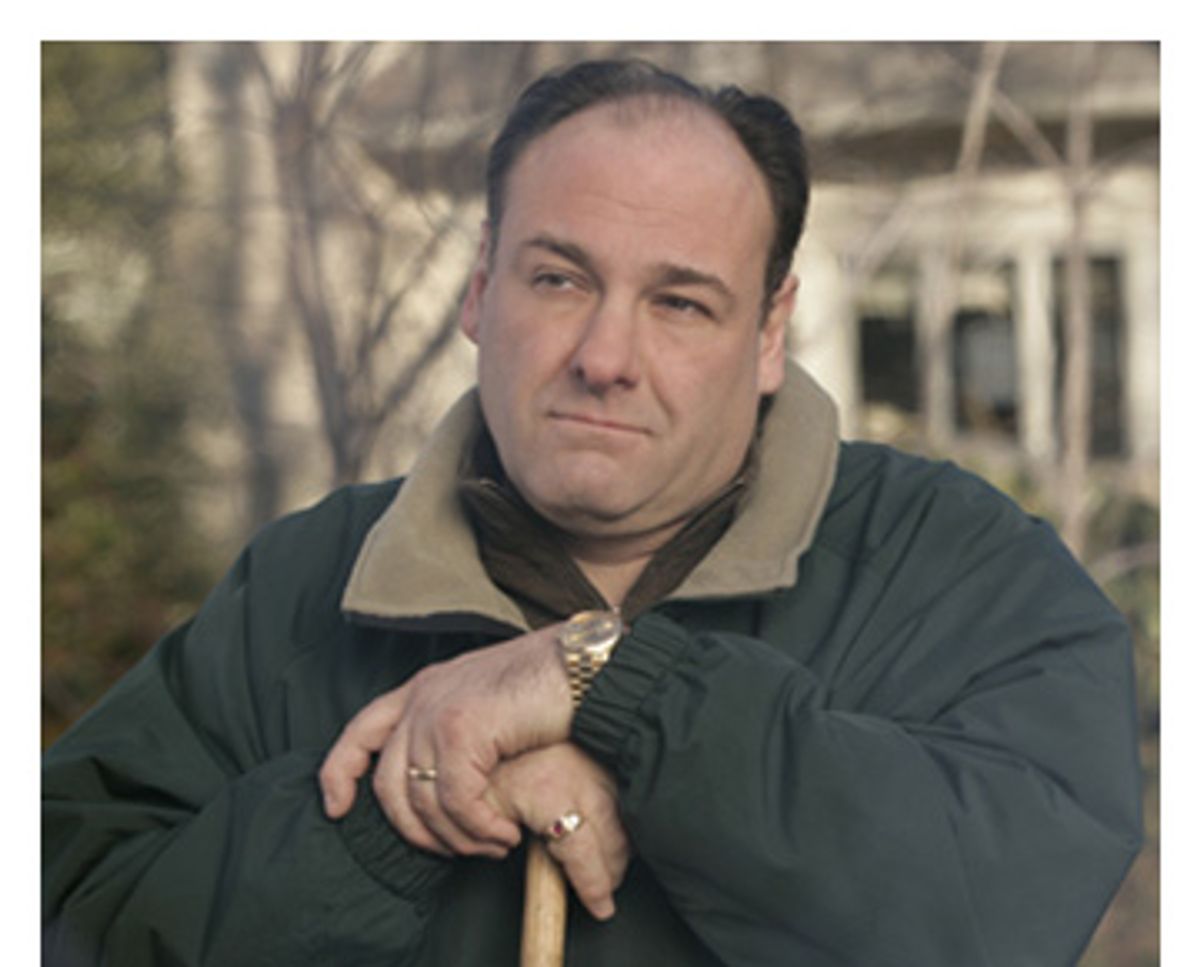
I'm bummed for a lot of reasons about the end of "The Sopranos." I'll miss Tony's invincible life force, and the shambling way he pulls late-night snacks out of the refrigerator. I'll miss Carm's shrewd emotional casuistry, and Meadow's fight to make a clean life, and Artie's weird unkillable marriage, and Paulie's utter lack of self-insight, and Dr. Melfi's half-sexy, half-unnerving voice. I'll miss the Bada Bing and Satriale's and that great opening sequence, the drive through stratified class layers until we arrive at Tony's vulgar McMansion. I'll even miss poor little lost A.J., who, God help him, not only tried to commit suicide, but discovered the Israeli-Palestinian conflict.
But mostly, I'll miss the show's absolute and perverse amorality. In the age of Bush, how am I going to survive without my weekly double shot of ethical ambiguity?
The genius of "The Sopranos" has always been that it presents two apparently contradictory realities simultaneously, like one of those illustrations that looks alternatively like a vase or a picture of Abraham Lincoln. Its shtick is that it is a show about an American family just like ours -- who are also a bunch of coldblooded murderers whom according to even the laxest moral standards we should loathe. And the king of these monsters is, of course, our dear old Tony.
And he is our dear old Tony. We try to loathe him, but we can't make it stick. Not for very long, and not really at all. We identify with him too much. We feel for him. In a weird but undeniable way, we actually love him. Because even after he murders his relatives, or whacks some terrified kid who's pissing in his pants, a few minutes later he bobs back up, the original and literal whack-a-mole, the same old crinkly-eyed Tony. Tony is just Tony, as real as you or me -- and a hell of a lot more real than just about any other character on TV. We know him too well not to love him, this careworn family man damaged by his cruel mom, this dad trying to raise his kids and keep his marriage going, this hardworking guy who just happens to have this unusual job that involves killing people. He's our favorite murderer.
This puts us in a deliciously uncomfortable position. Loving Tony, like loving Hitler or Osama bin Laden, is not something we're supposed to do. In one episode, Tony callously murders his nephew Christopher -- then in the next reveals his most wounded, deeply sympathetic side, wrapping his arms around his suicidal son while groaning, "My baby, my baby." Neither of these is the "real" Tony, for there is no "real" Tony -- there are a multiplicity of Tonys, and at every moment he is free to choose. "The Sopranos" is existentialist TV: To paraphrase the legendary French capo Jean-Paul Sartre, Tony's existence precedes his essence.
"The Sopranos" is built not just on moral ambiguity, but moral obscenity. It achieves this by graphically depicting the most brutal events, while suspending all judgment about them. This holds true for the good guys and bad guys alike. Actually, there are no good guys. FBI agents are icy zombies. Priests are corrupt and confused. Psychiatrists are backstabbing pedants, trotting out neat phrases like "sociopath" that illuminate nothing. Married men are only as faithful as their options. Married women are manipulative and self-serving. Human behavior of any kind, from adultery to blackmail to murder, has no transcendental meaning. If Tony Soprano can strangle somebody and then return to checking out a college campus, it doesn't mean he's a madman. It's what he does.
"The Sopranos" wasn't the first mass entertainment to challenge the unwritten (and sometimes written) moral codes laid down by our national entertainment nannies. Film noir flirted with reversals of moral and narrative expectation. The '70s saw a wave of revisionist westerns and war movies. And many TV shows have pushed the envelope. But David Chase's creation represents the most decisive break ever with pop culture's punish-evil, reward-good rules.
Tony may die Sunday night, but if he does, his death will not represent "payment" for his sins. Whether he lived or died was just a matter of fate. Even Francis Ford Coppola's "The Godfather," which brilliantly subverted traditional moral judgments -- and was attacked for glorifying criminal violence -- was not as nihilistic as "The Sopranos." The film's famous final shot, in which Michael Corleone, now completely and irrevocably alone, broods bitterly as his command to kill his older brother is carried out, implied some kind of cosmic justice: As ye sow, so shall we reap. In the universe of "The Sopranos," Michael would have brooded for a few minutes, then called up his goomah, done a few lines and partied. And then gotten depressed again a few weeks later. And then gone out to eat.
The sheer duration of "The Sopranos" helps to explain its oceanic approach to narrative and morality. Since the writers are not confined to a two-hour story, they aren't under pressure to make their stories mean anything. And the fact that most of the main characters have had a fictional life -- the entire show is 80 hours long! -- pushes the form toward the picaresque. There are dozens of little climaxes but no big plot hinge. This deepens the show's contingent, arbitrary, lost-at-sea feeling. Like the beautifully realized characters in John Dos Passos' great, insufficiently appreciated "USA" trilogy -- an achievement that led Sartre to call Dos Passos "the greatest writer of our time" -- the characters in "The Sopranos" wander aimlessly about, bump into obstacles, and eventually fall down.
For me, and obviously for many viewers, the amorality of "The Sopranos" is a consummation devoutly to be wished for. Growing up, I hated the bogus quasi-official morality promulgated by popular entertainment -- in movies, but especially in TV shows. I couldn't stand the fact that the Good Guys always won and the Bad Guys always lost. I groaned at the two-bit narrative semiotics employed by Hollywood hacks on shows like "Dragnet" -- the "maniacal" laughter of a villain, a hero's "noble" profile, all accompanied by message music piped in by some dreadful cosmic DJ.
In "The Story of the Bad Little Boy," Mark Twain viciously sends up the Sunday school tales he was forced to read as a child. "Once there was a bad little boy whose name was Jim -- though, if you will notice, you will find that bad little boys are nearly always called James in your Sunday-school books," Twain begins. "It was strange, but still it was true that this one was called Jim." Jim, Twain tells us, didn't have a sick mother, "who was pious and had the consumption, and would be glad to lie down in the grave and be at rest but for the strong love she bore her boy." No, his mother was "rather stout than otherwise, and she was not pious; moreover, she was not anxious on Jim's account. She said if he were to break his neck it wouldn't be much loss." Twain then goes on to relate how Jim did all kinds of horrible things, but instead of being caught and punished, he blamed them on other people and laughed coarsely. Finally, "he grew up and married, and raised a large family, and brained them all with an axe one night, and got wealthy by all manner of cheating and rascality; and now he is the infernalest wickedest scoundrel in his native village, and is universally respected, and belongs to the Legislature."
Give or take a detail or two, this is the Tony Soprano story.
But of course there's more going on with "The Sopranos" than just a satisfying reversal of bogus moral strictures. Its goal is not just to tear down pious, mom 'n' apple pie subjects like the family, but to use that destruction to wake us up to the quiet violence and repressed mayhem that haunt our own oh-so-respectable lives. The existence of Tony Soprano, whose combination of lovableness and explosive violence makes him an utterly familiar enigma, makes our own lives stranger and scarier and bigger.
And this is one reason why the corrosive moral ambiguity of "The Sopranos" speaks to us. Like Tony Soprano at the start of the series, America is a little stressed these days, a little anxious. On the surface, everything is fine. Under our devoutly Christian leader, we are all highly moral. We have right and God on our side as we fight the evildoers. Except that, well, we've been feeling kind of weird. And, to tell the truth, we have a few skeletons in our closet.
Somebody whacked some of our crew, and we were scared, so we whacked Iraq. Just like Tony ordered the hit on Adriana. Steps were taken, as Sil would say. Except it turned out there were some unexpected consequences. We basically killed an entire country, and a whole lot of Americans, and people are dying all the time. And what are we doing? Nothing. We're going to the Bada Bing. We're having dinner at Artie's. Same old same old. Everything's fine. It's just fine.
Except that it's wearing us down, having this strange war that no one thinks about, and this president who keeps preaching about good and evil and how we're the greatest country in the world and why we have to keep fighting this "war on terror" that no one understands. And it's hard to say anything back to him because he's really prickly and self-righteous. It's kind of like having a really mean, manipulative mom -- the kind who says, "Take the knife out of the ham and stab me here!"
We're trying to act like nothing's wrong but all this stuff is working on our minds. Nothing they tell us about right and wrong seems to make sense anymore. It's all self-contradictory. They told us all terrorism is evil, but it seems like some terrorist acts are more evil than others. Like this Turkey deal. Some Kurdish separatists just set off a bomb outside a shopping center in Turkey's capitol, Ankara, killing six innocent people. The Turks want to cross the border into Iraq and wipe out the terrorists. But we don't want them to, even though we cited a terror attack against us as justification for invading a country that didn't even have anything to do with the attack. What's up with that? They tell us lying is wrong. But after Lewis Libby was convicted of lying to federal investigators, the same people who were screaming the loudest about America's moral decline and the need to embrace transcendent values are now raging that it didn't matter because no crime was ever discovered. What's that about? It's all confusing, and the pressure is building up, and we're starting to get these anxiety attacks. And there's no Dr. Melfi in sight.
Art serves a cathartic function by exposing the unspoken, the repressed, the taboo. In this case, the taboo is our moral code -- a rigid, black-and-white, self-righteous insistence that what we are doing must be right and no one must question it. In Bush's America, this code has become singularly oppressive. But it predates Bush. It's the way we simplify the world, the story we tell ourselves to make sense out of life's senselessness.
Among its many other achievements, "The Sopranos" has allowed us to mock that frozen certainty. For seven years, it has been a saturnalia of ethical meaninglessness. It has given us a precious breather from sanctimony, a holiday from the tyranny of right and wrong. It has thrown us into the big, blue, endless sea and let us swim. It's scary being out in the middle of the ocean, no horizon in sight. But it's liberating.
And now that "The Sopranos" is over, we'll have to find other seas to swim in, other stories to reflect our lives. Stories that are bigger and darker and truer than the ones they've been telling us, and the ones that we tell ourselves.
Shares