

I've wanted to write about editors and editing for years, but since I was one of that invisible tribe myself until a year ago, it felt unseemly. But now that I have switched full time to the other side of the desk, I can gush without stint. [That's what you think, bub -- Ed.]
To people not in the business, editing is a mysterious thing. (Actually, it's mysterious to most bloggers, who despite having been in existence for less than 10 years, probably outnumber every writer who ever wrote. But more on them later.) Many times over the past 20 years, people have asked me, "What exactly does an editor do?"
It's not an easy question to answer. Editors are craftsmen, ghosts, psychiatrists, bullies, sparring partners, experts, enablers, ignoramuses, translators, writers, goalies, friends, foremen, wimps, ditch diggers, mind readers, coaches, bomb throwers, muses and spittoons -- sometimes all while working on the same piece. Early in my editing career I was startled when, after we had finished an edit, a crusty, hard-bitten culture writer, a woman at least twice my age, told me, "That was great -- better than sex!"
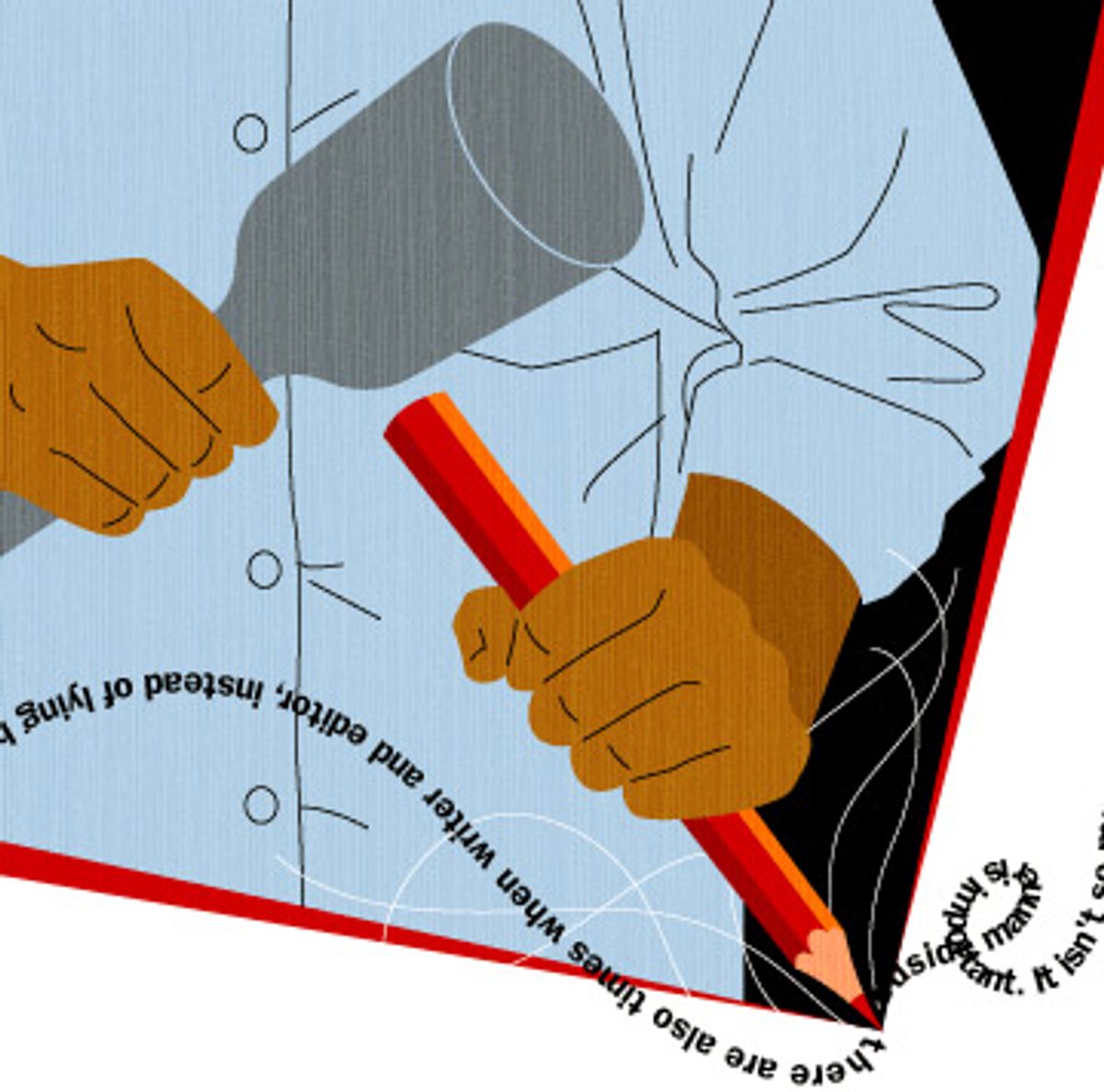
I make no such exalted claims, but there's no doubt the editing process can be an intimate and gratifying experience for both parties. Although, to pursue our somewhat dubious metaphor, there are also times when writer and editor, instead of lying back and enjoying a soothing post-fact-check cigarette, stare emptily at the ceiling and vow never to share verb tenses with anyone again.
When an editor's lucky, the piece comes in chiseled in immortal Carrara marble, every semicolon in place, ready to be wheeled into the Uffizi Gallery -- that is, straight to publication. (A very rare event.) A good editor knows when to leave a piece alone. Practically every writer has had the unfortunate experience of crossing paths with editors -- often inexperienced ones -- who feel the need to do something, just to show they're doing their job. This is almost as frustrating as the too-many-editors problem, in which a piece bounces from a senior editor to the managing editor to the executive editor, each of whom gives contradictory instructions, and finally ends up in the hands of the editor in chief, who after Olympian reflection pronounces that it was better the way it was when it started. It is experiences like these that lead writers to engage in one of their favorite pastimes: bitching and moaning about the lameness of editors.
Good editors work with and not against a writer. They calibrate how aggressively they edit according to how good the writer is, how good the piece is, the type of piece it is, the kind of relationship they have with the writer, how tight the deadline is, and what mood they're in. But an editor's primary responsibility is not to the writer but to the reader. He or she must be ruthlessly dedicated to making the piece stronger. Since this is ultimately a subjective judgment, and quite a tricky one, a good editor needs to be as self-confident as a writer.
Most good editors are tactful in communicating with their writers. Bedside manner is important. It isn't so much that writers are sensitive plants -- some are, some aren't -- as that there is a fundamental difference in what each party brings to the table. An editor needs to remember that writing is much harder work than editing. Sending something you've written off into the world exposes you, leaves you vulnerable. It is a creative process, while editing is merely a reactive one.
Of course, some writers are more vulnerable than others. Daily news reporters tend to be like old suits of armor, so dented and dinged by years of combat that they are impervious. When I was an editor at a daily newspaper, I worked with some reporters who had been so ground down by impossible deadlines, column-inch restrictions, and that soul-destroying newspaper specialty of cutting pieces from the bottom that you could replace every adjective in their stories with a different one and they would just shrug. I've also worked with writers who have reacted to my gentle suggestion that one of their precious, ungrammatical commas might perhaps be removed as if I'd insisted that Maria Callas perform "Yummy, Yummy, Yummy" as the final aria in Bellini's "Norma." Like a savvy football coach, an editor learns which players need the stick and which the carrot.
Most writers understand that their editor is not a half-literate, envious wannabe who takes perverse joy in mangling their prose, but a professional who is paid to make their work better. Still, the moment when you -- and now I -- open the e-mail your editor has sent you in response to your story is always fraught with anxiety. You've exposed your soul, or at least part of your brain, to another person. What will they do with it?
The truth is, you have to learn how to be edited just as much as you have to learn how to edit. And learning how to be edited teaches you a lot about writing, about distance and objectivity and humility, and ultimately about yourself.
In an odd way, the exchange between writer and editor encapsulates the process of growing up. The act of writing is godlike, omnipotent, infantile. Your piece is a statement delivered from on high, a pronouncement ex cathedra, as egotistical and unchecked as the wail of a baby. Then it goes out into the world, to an editor, and the reality principle rears its ugly head. You are forced as a writer to come to terms with the gap between your idea and your execution -- and still more deflating, between your idea and what your idea should have been.
This isn't easy. You have to let go of your attachment to the specific words you've written and open yourself to what you were aiming for. You need enough confidence in yourself to accept constructive criticism, some of which can feel like your internal organs are being more or less gently moved around. More than just about any other non-artistic activity -- therapy and, yes, sex are possible exceptions -- being edited forces you to see yourself, or at least what you've written, the way others see you. It is a depersonalizing process in some ways, yet having to stand outside yourself deepens you as a person. You need to grow a thick skin in order to have a thinner, more sensitive one.
The good news is that you're not (yet) throwing yourself on the not-so-tender mercies of the readers, but putting yourself in the hands of a smart, sympathetic reader who only wants to clean up your dangling participles, remove your factually incorrect assertions, and turn your Rod McKuen-like treacle into something fit for public consumption. At a certain point, most writers realize this and come to truly value their editors. (Some authors, weary of what they see as a serious decline in the quality of editing in book publishing, go so far as to hire their own editors.) That doesn't mean that the relationship isn't capable of going wrong, or that a writer doesn't inwardly pop a bottle of champagne on those occasions when an editor sends a draft back with next to no changes.
Actually, some writers -- especially old-school reporters -- come to rely on editors too much. Every editor has had the experience of being the recipient of the dread "notebook dump," in which the disjointed, undigested contents of a month's reporting are dumped from a notebook onto the page. At this moment, the editor has to rip off his meek Clark Kent disguise and reveal himself as a writer or, more accurately, a rewriter. (Rewriting someone else's prose, no matter how convoluted or illogical, is never as hard as writing your own. It's still more like knitting or doing a jigsaw puzzle than inventing something.) It isn't just notebook dumps that require massive rewriting, either -- sometimes even good pieces by good writers go off the tracks in really weird ways, and an editor gets called in to clean up the mess, like Mr. Wolf in "Pulp Fiction."
It's good fun now and then to tear apart a piece and put it back together on a short deadline. Your brain is humming like a Ferrari, you've got sections marked A and B and Z and arrows going everywhere; you're rewriting the lede, racing through tricky transitions, doing some fast spot-reporting, getting rid of clunkers from every graf, and pulling together this whole 4,000-word piece in six hours. When you're done, you emerge from your office with smoke pouring from your ears. You've earned your salary and you pour yourself a well-deserved drink. You won't get any fame and glory but as an editor you don't expect any.
Some writers and editors work like this all the time. If a great reporter who can't write has a killer line editor, and they have a good rapport, it's much more efficient to work this way than to make the reporter agonize over how he's going to modulate his conclusion and the editor tiptoe around him. Not every reporter has to be a great writer. Conversely, some people who are good at moving other people's words couldn't pick up a phone, or write a piece themselves, if their life depended on it. This is why in the old days newspapers had "legmen" and "rewrite men." Sometimes I think it might not be a bad idea to bring them back.
The worst-case scenario for an editor is dealing with a writer who by talent should be a legman but who has somehow gone through his career remaining blissfully unaware of this fact. And, I suspect, some writers are aware, but like cunning parasites that attach themselves to larger animals, they ride through their careers clinging to their long-suffering editors. Years ago, I was handed a piece that was written in some unknown language, between Esperanto and pig Latin. Seizing my Rosetta stone, I descended into the foul-smelling cave and emerged hours later, having successfully translated the cryptic runes. Imagine my surprise when I later learned that the writer had used "his" piece to get a job at a good magazine. All I could do was laugh and say a little prayer for whoever would be editing him.
In the brave new world of self-publishing, editors are an endangered species. This isn't all bad. It's good that anyone who wants to publish and has access to a computer now faces no barriers. And some bloggers don't really need editors: Their prose is fluent and conversational, and readers have no expectation that the work is going to be elegant or beautifully shaped. Its main function is to communicate clearly. It isn't intended to last.
Still, editors and editing will be more important than ever as the Internet age rockets forward. The online world is not just about millions of newborn writers exulting in their powers. It's also about millions of readers who need to sort through this endless universe and figure out which writers are worth reading. Who is going to sort out the exceptional ones? Editors, of some type. Some smart group of people is going to have to separate the wheat from the chaff. And the more refined that separation process is, the more talent -- and perhaps more training -- will be required.
We already use other readers to sort things out for us: My bookmarks are mostly referrals from writers I've learned to trust. Some utopians may dream that an anarcho-Wikipedia model will prevail, that a vast self-correcting democracy of amateurs will end up pointing readers to the most worthwhile pieces. But that is only "editing" in its crudest, most general form -- it's really sorting. In the chaotic new online universe, the old-fashioned, elitist, non-democratic system of sorting information will become increasingly important, if only because it enforces a salutary reduction of the sheer mind-swamping number of options available. The real problem is glut, and it's only going to get worse.
In any case, real editing is something different. It takes place before a piece ever sees the light of day -- and it's this kind of painstaking, word-by-word editing that so much online writing needs. If learning how to be edited is a form of growing up, much of the blogosphere still seems to be in adolescence, loudly affirming its identity and raging against authority. But teenagers eventually realize that authority is not as tyrannical and unhip as they once thought. It's edited prose, with its points sharpened by another, that will ultimately stand the test of time. There is a place for mayfly commentary, which buzzes about and dies in a day. But we don't want to get to the point where the mayflies and mosquitoes are so thick that we can't breathe or think.
The art of editing is running against the cultural tide. We are in an age of volume; editing is about refinement. It's about getting deeper into a piece, its ideas, its structure, its language. It's a handmade art, a craft. You don't learn it overnight. Editing aims at making a piece more like a Stradivarius and less like a microchip. And as the media universe becomes larger and more filled with microchips, we need the violin makers.
So here's to you, editors, whose names never appear on an article, who are unknown except to their peers and to the writers who owe you so much. Keep fitting those delicate pieces of wood together. Use the skill it took you years to acquire. Don't give up and just slap the thing together. Make it light and tight and strong so that it sings. Someone is noticing. Someone is reading. Someone cares.
Shares