

Once again, major fissures in American conservatism have appeared. Leaders of the Christian right, appalled that a pro-choice, thrice-married candidate, Rudy Giuliani, is leading in the polls, have threatened to lead a mass defection from the GOP ranks and support a third-party presidential bid in 2008. Few expect them to make good on their threat. If they leave, they'll cost the Republicans the election; loyalty will almost certainly prevail. But the real issue isn't the loyalty of the hardcore religious right, who may never find another candidate so congenial as Bush to their fundamentalist beliefs and reactionary agenda. It's the inexplicable loyalty of that majority of American conservatives who are not driven solely by biblical fervor. The real question is: After seven years of George W. Bush, why would any genuine conservative still support his party?
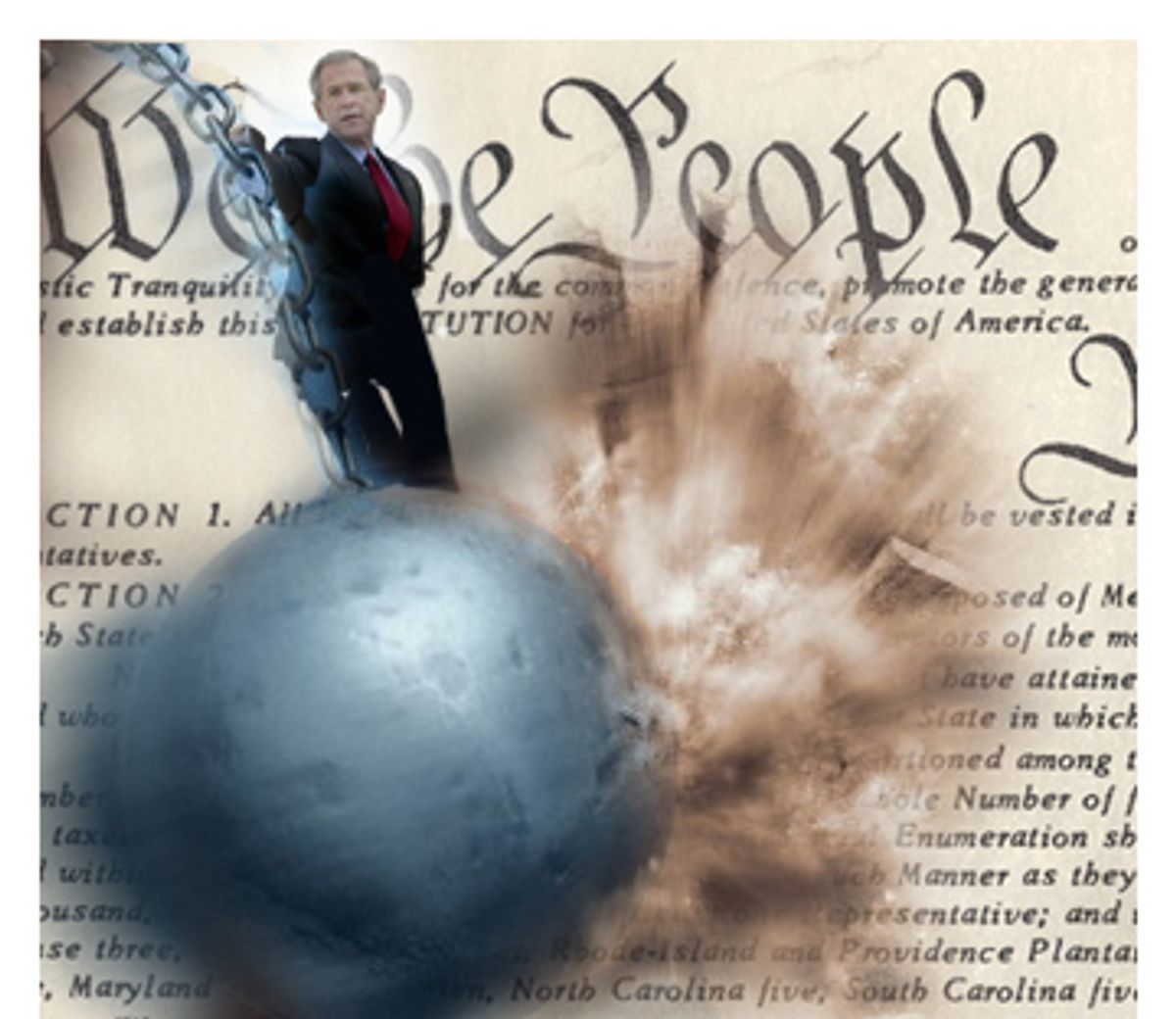
Bush's presidency has made a shambles of real conservatism. Let's leave aside the issues on which liberals and conservatives can be expected to disagree, like his tax cuts for the rich, expansion of Medicare or his position on immigration, and focus solely on ones that should be above partisan rancor -- ones involving the Constitution and all-American values. On issue after Mom-and-apple-pie issue, from authorizing torture to approving illegal wiretapping to launching a self-destructive war, Bush has done incalculable damage to conservative principles -- far more, in fact, than any recent Democratic president. And he has been supported every step of the way by Republicans in Congress, who have voted in lockstep for his radical policies. None of the major Republican candidates running for office have repudiated any of Bush's policies. They simply promise to execute them better.
The Bush presidency has damaged American civil society in many ways, but one of the most lasting may be its destructive effect on conservatism. Even those who do not call themselves conservatives must acknowledge the power and enduring value of core conservative beliefs: belief in individual agency and responsibility, respect for American institutions and traditions, a resolute commitment to freedom, a willingness to take principled moral stands. It is a movement that draws its inspiration from towering figures: Adam Smith, Thomas Jefferson, Edmund Burke. It stands for caution in foreign adventures, fiscal sobriety and a profound respect for tradition.
Or at least it used to stand for those things. Today's conservatism is a caricature of that movement: It embraces pointless wars, runs up a vast debt, and trashes the Constitution. Selling out their principles for power, abandoning deeply seated American values and traditions simply because someone on "their side" demanded that they do so, conservatives have made a deal with the devil that has reduced their movement to an empty, ends-obsessed shell. How did the party of Lincoln end up marching under the banner of Tom DeLay and Rush Limbaugh, Dick Cheney and Ann Coulter?
To be sure, Bush is not single-handedly responsible for the sorry state that American conservatism finds itself in today. The movement has always been intellectually fractured, riven by contradictory beliefs. As George Nash pointed out in his classic "The Conservative Intellectual Movement in America," from the beginning modern American conservatism has been divided between traditionalists and libertarians. Libertarians regard individual freedom as the highest good, support the free market, and oppose coercive government policies. Traditionalists regard virtue, not freedom, as the highest good, believe in a transcendental moral order and are wary of unfettered individualism. Despite attempts to "fuse" them, the two worldviews are fundamentally incompatible -- you either believe in surrendering to God and tradition or you don't. Time and again, conservative attempts to implement policies that do justice to both the movement's "freedom" and "virtue" wings have failed.
The classic example is the Republican embrace of supply-side economics, aka trickle-down economics, which holds that cutting taxes on the rich will result in money trickling down to everyone else. Starting with Ronald Reagan, Republicans adopted this economic policy because its insistence that getting rich is morally good satisfies the demands of both freedom and virtue. As events proved, and as its architect, David Stockman, famously acknowledged, supply-side economics failed miserably. But this did not prevent Reagan and all subsequent Republican presidents from claiming it worked, and continuing to pursue similar economic policies. Reagan raised taxes and expanded the federal government enormously, but he insisted that he had cut taxes and dismantled "big government."
Similarly, the moral impulse of conservatism has from the outset been caught in a welter of self-contradiction. When the Judeo-Christian injunction to help the less fortunate collides with the "I've got mine, Jack" ethos of Ayn Rand individualism, selfishness inevitably triumphs. Crony capitalism, corruption and unchecked greed have been the inevitable result. As a result, conservative morality in practice has been squeezed into an ever smaller, ever more theocentric core. The fact that the Christian right claims to stand at the pinnacle of American virtue is grotesque, but it's the logical consequence of the shriveling of conservative morality.
In one sense, George W. Bush's presidency represents the ugly culmination of all of these tendencies. But in a more important sense, it is a radical departure from earlier American conservatism. Bush has undermined core American institutions and values in ways that no previous president, Democratic or Republican, has ever done.
However much liberal critics (like this writer) might disagree with them, Republican presidents from Ford to Reagan to the elder Bush generally refrained from radically changing American institutions, law and values. They possessed some internal governor that prevented them from going too far, some deeply rooted sense of civic parameters. Like their Democratic counterparts, they kept faith with what the great British conservative Edmund Burke called the "settled tradition." There were occasional exceptions: The Iran-Contra scandal, in which an unelected cabal within the government arrogated to itself the right to make policy and ignore Congress, permanently stained Reagan's legacy. But not even Reagan's harshest critics would assert that this secretive, dissembling, autocratic episode was characteristic of his entire presidency. Bush, by contrast, has been secretive, dissembling and autocratic from the moment five Republican Supreme Court justices installed him in the White House -- and about far more important issues.
If it happened under Bush, Iran-Contra wouldn't even make Page A-18. Reagan covertly funded a guerrilla operation in an inconsequential Central American country. Bush covertly and duplicitously laid the groundwork for one of the longest and most expensive wars in American history. Bush declared that habeas corpus, a magnificent cornerstone of Western law, did not apply to those he designated, without judicial review, "enemy combatants." He claimed the right to lock those individuals up forever, without allowing them to bring their case before a jury. He made torture official U.S. policy, and was directly responsible for the American-run torture factory at Abu Ghraib. His approval of warrantless wiretapping constitutes perhaps the most serious frontal attack on the right of privacy enshrined in the Fourth Amendment in American history. He has made unprecedented use of "signing statements" to disobey laws he disagrees with, marginalizing Congress in the process. His radical theory of the "unitary executive" runs roughshod over the balance-of-powers doctrine that has guided American governance since the Founders.
These Bush policies all represent a direct assault on the U.S. Constitution, long-established legal and political traditions, and accepted American values -- in short, on the heart and soul of American civic life. If American conservatism will not take its stand in defense of these things, what will it take a stand for?
The answer, sadly, is nothing -- or rather, nothing except power. But power devoid of moral content is precisely what genuine conservatism should reject.
Conservatives might respond that Bush is justified in undermining the Constitution, abandoning American values and vastly expanding the power of the federal government because he's fighting a deadly enemy. They might argue that self-preservation is a nation's highest duty, and that the real moral relativists are those who fail to recognize the utter evil of militant Islam. This is not the first time that conservatives have cited "national security" to justify draconian policies. For decades, anti-communism held the unruly conservative movement together; the all-or-nothing conservative reaction to communism culminated in the surreal, quasi-fascistic reign of Joe McCarthy. The new bogeyman, which fell like manna from heaven to give George W. Bush a Higher Purpose, is militant Islam, and his reaction to it is more than a little reminiscent of McCarthy's.
The fact that conservatives have given Bush a pass on his disastrous Iraq war, and on the radical domestic policies that have accompanied it, indicates that the shelf life of the toxic right-wing mythologies that led to McCarthyism has not expired -- even though the dusty vials containing those myths are now almost 50 years old.
Bush's reaction to the 9/11 attacks represents a kind of return of the repressed right wing, an alternative universe in which the über-hawks get to rewrite history their way. Sen. Barry Goldwater famously rejected "containment," George Kennan's doctrine that was followed by every U.S. president and that helped prevent a nuclear holocaust for 40 years. He urged the U.S. to defeat the communists. Goldwater wasn't alone. There was a significant group of extreme rightists within the U.S. establishment who demanded that the U.S. put an end to what Reagan called "the most dangerous enemy that has ever faced mankind in his long climb from the swamp to the stars." Gen. Curtis LeMay urged President Kennedy to launch a preemptive nuclear strike on the Soviet Union. Of course, neither Kennedy nor any subsequent U.S. presidents chose to start a nuclear war with Russia. And when Goldwater famously intoned, "Extremism in defense of liberty is no vice," in 1962, he was excoriated as a scary loose cannon.
Goldwater's words could be Bush's credo. Bush's "war on terror" is a rerun of the Cold War, with "Islamofascism" replacing communism and Dr. Strangelove at the controls. By attacking Iraq, Bush made up for all those decades of compromise and weakness, all that Neville Chamberlain-like appeasement, that groveling accommodation with evil. This time, we're nuking the bastards!
Bush's unprovoked war on Iraq provided a satisfying catharsis for American conservatives, an opportunity to play Winston Churchill and fight the good fight against Evil. But the satisfaction of urging on a Manichaean struggle from one's armchair should only go so far before reality kicks in. Just as most conservatives during the Cold War realized that attacking the Soviet Union was not in America's interests, so one would think that today's conservatives would realize that Bush's "war on terror" is not only unwinnable, but both unnecessary and counterproductive. By now, it's obvious to all but myopic ideologues that attacking the Arab world to teach it a lesson was like kicking a vast wasp's nest while wearing a Speedo. We want to win the "war on terror," not strike heroic poses while being stung to death. No one disputes the virtue of moral clarity, but without intelligence, moral clarity is useless. Where is it written that conservatives have to be stupid?
In the age of Bush, even the conservatives' much-vaunted moral clarity does not always bear close inspection. A Pew poll taken in March found that only 18 percent of self-described conservative Republicans believed that torture was never justified. Who was it who said, "Do not repay anyone evil for evil, but take thought for what is noble in the sight of all ... Do not be overcome by evil, but overcome evil with good"? It must be one of those damn liberals.*
Of course, it isn't surprising that those who hold a given set of political beliefs, whether liberal or conservative, will support the party and leader that purports to represent those values. Party loyalty is based on a willingness to support even a flawed leader and party in the interests of a higher goal. But there can be times when that leader and party are so injurious to one's deepest moral values and beliefs that it becomes irrelevant what banner they march under. At such moments, those who think for themselves, who are guided by principle and not mere expediency, who are true conservatives -- or liberals -- and not just partisan hacks, will break with their leaders. They will rebel.
There is precedent for such a rebellion in American history: It's how our country came into existence. These are the times that try men's souls. But anyone expecting today's sunshine patriots to stand and fire the shot heard 'round the world is lacking in common sense.
*Romans 12:17, 21
Shares