

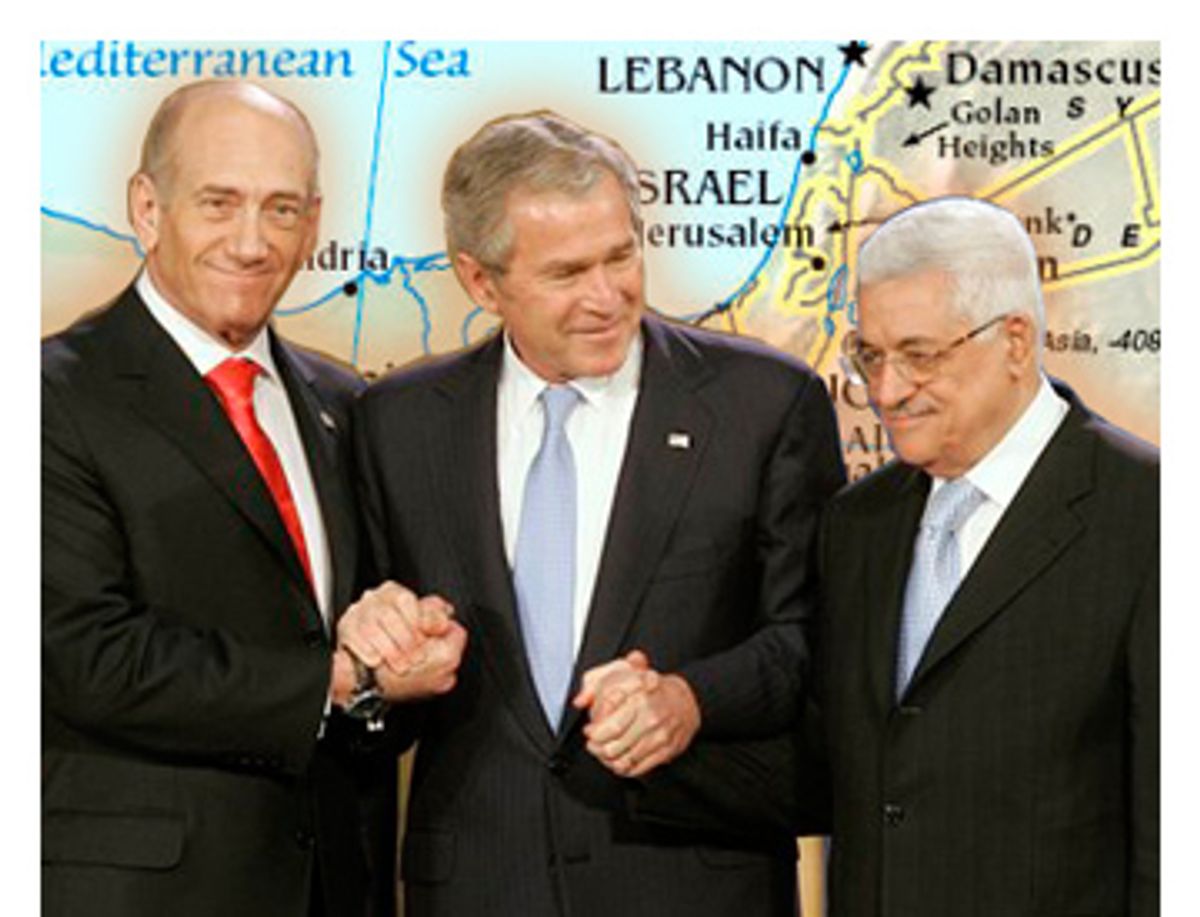
I'd like to find reasons for optimism about the Annapolis peace conference. It feels mean-spirited and cynical to abandon all hope when the diplomats have barely hung up their dark suits. Talking, in theory, is better than not talking. After seven agonizing years of neglect, at least President Bush has put the Israeli-Palestinian issue on the table. Israeli Prime Minister Ehud Olmert seems to be sincere in his belief that a two-state solution is necessary. And if a miracle happens, maybe peace really will come to pass.
But miracles are not posted on the betting board at Las Vegas. And the reality is that the Annapolis conference and what follows it will almost certainly do more harm than good.
Annapolis will fail to make peace between Israelis and Palestinians because it was not intended to succeed. It was a charade. And in the Middle East, charades don't just leave things the way they are -- they make them much worse. The tragedy is that Olmert seems to realize the urgency of cutting a two-state deal. But there is a giant gap between seeing the goal and achieving it, and only the United States can fill it. Olmert can take the politically explosive yet necessary steps only if the United States clearly states in advance what needs to be done and then forces both sides to do it. Bush completely failed to do that. He called for the conference almost in passing. He never set an agenda. He refused to outline what the U.S. vision of peace is. Going forward, the only thing he offered the two beleaguered leaders, Olmert and Palestinian Authority President Mahmoud Abbas, was a promise to monitor the process -- which in these circumstances is like promising a dying man that if he calls you on your cellphone, you'll be sure to check the message.
The sad thing about this mess is that there's no mystery about what needs to happen. Both Israel and the Palestinians must give up some of their most cherished dreams. The 40-year-old Israeli occupation of Palestinian lands must end. East Jerusalem must become the capital of a contiguous Palestinian state based on the 1967 borders. Those will be bitter concessions for Israel, but the Palestinians must give up even more. They must accept a state that comprises only 22 percent of the historic Palestine. They probably must allow the largest settlements on the West Bank to become part of Israel. And most painfully of all, they must accept a compromise on Palestinian refugees that will resettle most of them outside their ancestral homes in what is now Israel.
But neither Bush nor Condoleezza Rice have ever been interested in brokering a fair and lasting Israeli-Palestinian peace deal. After all, this is the president who announced at his first National Security Council meeting that he was going to let Ariel Sharon have a free hand to smash the Palestinians because "sometimes a show of force by one side can really clarify things." This is the Secretary of State who prevented the U.N. from imposing a cease-fire on Israel in the last weeks of the 2006 Israel-Lebanon war and infamously defended the carnage as the "birth pangs of a new Middle East."
Bush's open bias favoring Israel, which he sees as a noble comrade in the fight against terrorism, along with his shameful lack of understanding of Palestinian grievances, explains why he's shown no interest in brokering a peace deal. But the god-awful mess he has made of the Middle East forced his hand. Annapolis was a desperation gambit that Bush reluctantly agreed to because he wanted to line up the "good guys," Israel and America's autocratic Sunni allies, Saudi Arabia, Jordan, Egypt and the Gulf states, against the "bad guys" -- Hamas, Hezbollah and above all Iran. He's pumping up Abbas because he wants to destroy Hamas.
In short, Bush doesn't want peace -- he wants victory. For Bush, the forces of good are locked in apocalyptic struggle with the forces of evil: As he notoriously said in his nationally televised address after 9/11, "Either you are with us or you are with the terrorists." Both the true-believer Bush and the lightweight Rice continue to see the Israeli-Palestinian conflict, indeed the entire region, as a struggle between "moderates" and "extremists" and refuse to negotiate with any state or group tainted by "extremism."
As the Middle East goes up in flames, the ideological smugness of this administration verges on the clinically delusional. One of the reasons Bush invaded Iraq was his belief that the road to Jerusalem went through Baghdad -- that toppling Saddam would force the Palestinians to make peace on U.S.-Israeli terms. Incredibly, he and his team still seem to believe this. In a speech at Johns Hopkins after Annapolis, Bush's national security advisor, Stephen Hadley, claimed that "the policies that President Bush has pursued over the last six years," in particular his identifying of "terrorism as the primary obstacle to peace in the Middle East," were largely responsible for creating an opportunity for peace between the Israelis and the Palestinians. Annapolis reveals that Bush is still clinging to the same fallacy -- except now, he believes that the road to Jerusalem goes through Tehran.
Annapolis is almost certainly doomed because it repeats the same failed incrementalist approach taken by previous peace initiatives, from Oslo to the defunct, now-revived "road map"; because its success depends on the destruction of Hamas; and because it utterly lacks U.S. engagement.
Previous attempts to broker an Israeli-Palestinian peace failed because they did not go immediately to final-status issues, instead insisting on incremental "trust-building" steps. The incrementalist approach, as countless analysts have pointed out, is fatally flawed because it gives rejectionists on both sides veto power over the entire process. When the incremental steps faltered, as they were bound to, the process collapsed.
Annapolis takes the same flawed approach and adds a new wrinkle: The content-free "joint understanding" read by Bush declares that final-status talks should proceed at the same time as the incrementalist road map. Daniel Levy, the former lead Israeli drafter of the Geneva Initiative and one of the sharpest analysts of the conflict, finds reason for guarded optimism in this fact. "This change is unequivocally positive," Levy said in a phone interview. "We've locked in a reversal of road map logic. You can do permanent-status negotiations even if the road map is not met. Part of an equation that was guaranteed not to deliver has been flipped." Another insightful analyst, M.J. Rosenberg of the Israel Policy Forum, finds grounds for hope in the fact that the United States, not Israel or the Palestinians, will be the judge of whether the involved parties have lived up to their road map obligations.
But Levy also pointed out that "another part of the equation which also guarantees failure has not been flipped -- the idea that an occupied people can provide security for the occupier. That logic is still there." Any attempt to broker peace is a nonstarter, Levy argues, if it proclaims that Palestinian violence justifies breaking off negotiations while ignoring the 40-year-old occupation and the new settlements being continuously built on Palestinian land.
The key player here is Hamas, which refuses to recognize Israel or forswear violence but serves as the elected representative of the Palestinian people, controls the Gaza Strip, and still has many supporters in the West Bank. Levy argues that simple realism dictates that Hamas needs to be part of the peace process. Bush's "extremists vs. moderates" framework, which requires that Hamas be destroyed or magically disappear, is a recipe for disaster -- because Hamas is not going to do either.
"If the process is about creating a sustainable two-state solution, then Hamas is a factor in that," Levy said. "There's a misguided tendency to think that a two-state solution, even a realistic one, is all gain and no pain for the Palestinians. But even the most realistic, decent two-state solution is going to require hard swallows on both sides, including the Palestinian. Now, in the case of Annapolis, if you have to try to implement that plan and gain broad enough legitimacy and acceptance on the Palestinian side, you're not only coming up against a substantive, content-induced pushback, which you might just be able to deal with, but you're also coming up against a pushback because you're doing it in a political context that's all about driving Hamas out of Palestine. And I think you can almost guarantee that this is not going to be able to hold. Asking Hamas supporters to sign on to the destruction of their movement is probably unreasonable."
Levy said that despite their use of terrorism, it was possible to deal with Hamas. "There's a degree of realism and pragmatism that I think one can appeal to in Hamas," he said. "But they're not going to do the full Monty in advance. Because they look back at this process and say, Fatah gave all the recognitions Israel demanded and there's still the occupation."
Although a remote possibility at best, it's worth trying to imagine how a successful post-Annapolis process could play out. But as you plot out possible successful scenarios for peace, you come up against the same problem: Without aggressive U.S. involvement, success is almost inconceivable.
If Israel and the Palestinians make peace, the key player is likely to be not George W. Bush, but Ehud Olmert. To his credit, Olmert has acknowledged that Israel must leave the territory it captured in the 1967 war if it is to survive. In a post-Annapolis interview with the Israeli newspaper Ha'aretz, Olmert said, "If the day comes when the two-state solution collapses, and we face a South African-style struggle for equal voting rights (also for the Palestinians in the territories), then as soon as that happens, the state of Israel is finished. The Jewish organizations, which were our power base in America, will be the first to come out against us, because they will say they cannot support a state that does not support democracy and equal voting rights for all its residents."
Most observers believe that Olmert sincerely believes this and genuinely wants to make peace with the Palestinians. Aluf Benn, Ha'aretz's diplomatic correspondent and a contributor to Salon, said in response to an e-mail inquiry that "Olmert has been preaching these ideas since late 2003, when he was Sharon's deputy PM and 'came out of the closet' upon hearing hints of Sharon's change of heart over the settlements." Benn notes that before the 2006 election, Olmert proposed a plan to "remove most West Bank settlements and withdraw unilaterally to behind the barrier," but rocket attacks from Gaza and the Lebanon war forced him to abandon it. "Most Israelis now believe that withdrawal from any area will only create another terrorist haven and rocket launching pad," Benn wrote. "Hence there is no real ability to cede military control over the West Bank, and [Olmert has adopted] the compromise idea of 'agreement in principle,' whose implementation would have to wait until security is better."
The key questions, of course, are how far Olmert will go, and whether he will be willing to make bold moves in the absence of a cease-fire. Let's indulge ourselves in the best-case scenario. Olmert manages to push through substantive measures -- he freezes settlement building, dismantles outposts, opens roads, opens the cash spigot -- that immediately make a difference in the lives of Palestinians on the West Bank. Hamas grumbles and continues to fire its Qassam rockets at Sderot, but fortunately no one is killed; the Israeli Defense Forces don't invade Gaza, and a Palestinian civil war does not break out. A revived Palestinian Authority, which has delivered for its people, gains power, and Hamas dwindles. Final-status issues go on the table, and (now we're really smoking the optimism pipe) the two sides manage to hammer out an agreement. Most Hamas members and far-right Jewish settlers come on board; the violent rejectionists are arrested. Peace breaks out. Palestinians worship freely at the al-Aqsa Mosque, a few hundred yards from Jews praying at the Western Wall. A jointly produced Israeli-Palestinian olive oil becomes the biggest seller in the world and is found on every trendy restaurant table in New York and Berkeley. George W. Bush has achieved the Holy Grail of American diplomacy and receives the Nobel Peace Prize.
And I'm the Buddha. Alas, there are huge obstacles in the way of this happy scenario, and the Israeli ones are as formidable as the Palestinian ones. Olmert is politically weak (although Benn notes that he is extraordinarily politically skilled) and faces unrelenting domestic opposition on all final-status issues. Under these circumstances, the deeply entrenched status quo is likely to prevail -- which will mean an end to the peace process. As Benn notes, "For Israel, the most convenient situation is entering a peace process (no external pressure) and not implementing anything (no domestic rift). This is where we are today. Is it sustainable and for how long? -- this is the $64,000 question."
The status quo may well be sustainable for Israelis for some time: The security wall protects them from Palestinian suicide bombers, the agony in the gigantic open-air prison called Gaza is unseen, Bush will not pressure them to take more than small, cosmetic steps, and they can count on Hamas or dissident elements in Fatah to bail them out by engaging in terror attacks. But at what price?
As Olmert (and Jimmy Carter, who was reviled as an anti-Semite for saying essentially the same thing Olmert did) pointed out, the Israeli occupation creates a ticking demographic time bomb whose result, if Israel is to remain a Jewish state, will be some form of more or less explicit apartheid. Neither America nor the world will indefinitely put up with this. And the inner destruction wrought by the occupation is just as deadly as the outer. As two of Israel's greatest writers, Amos Oz and David Grossman, have eloquently argued, the occupation of Palestinian land is a moral cancer eating away at Israel's soul.
Israel thus finds itself in a peculiar, almost drugged situation. As Benn noted in a recent piece in Salon, the occupation, and indeed Palestinians themselves, are invisible to most Israelis. The status quo seems fine. But below the surface, huge historic trends and forces are working against Israel. As radical Islam rises, the Holocaust recedes, and American Jews continue to assimilate and lose connection to the Jewish state, Israeli exceptionalism will come to acquire more of a negative than a positive connotation. And at the most basic level, no state wants to remain locked in endless hostility with all of its neighbors.
At this strange, quietly dangerous moment, Israel needs someone to save it from itself -- and only America can play that role. Only America can give Olmert, or his successor, the political cover to negotiate an end to the occupation. But Bush is incapable of seeing what needs to be done. In one of those ironic reversals that haunt the Holy Land, the most pro-Israeli president in U.S. history may be remembered as Israel's worst enemy.
Shares