

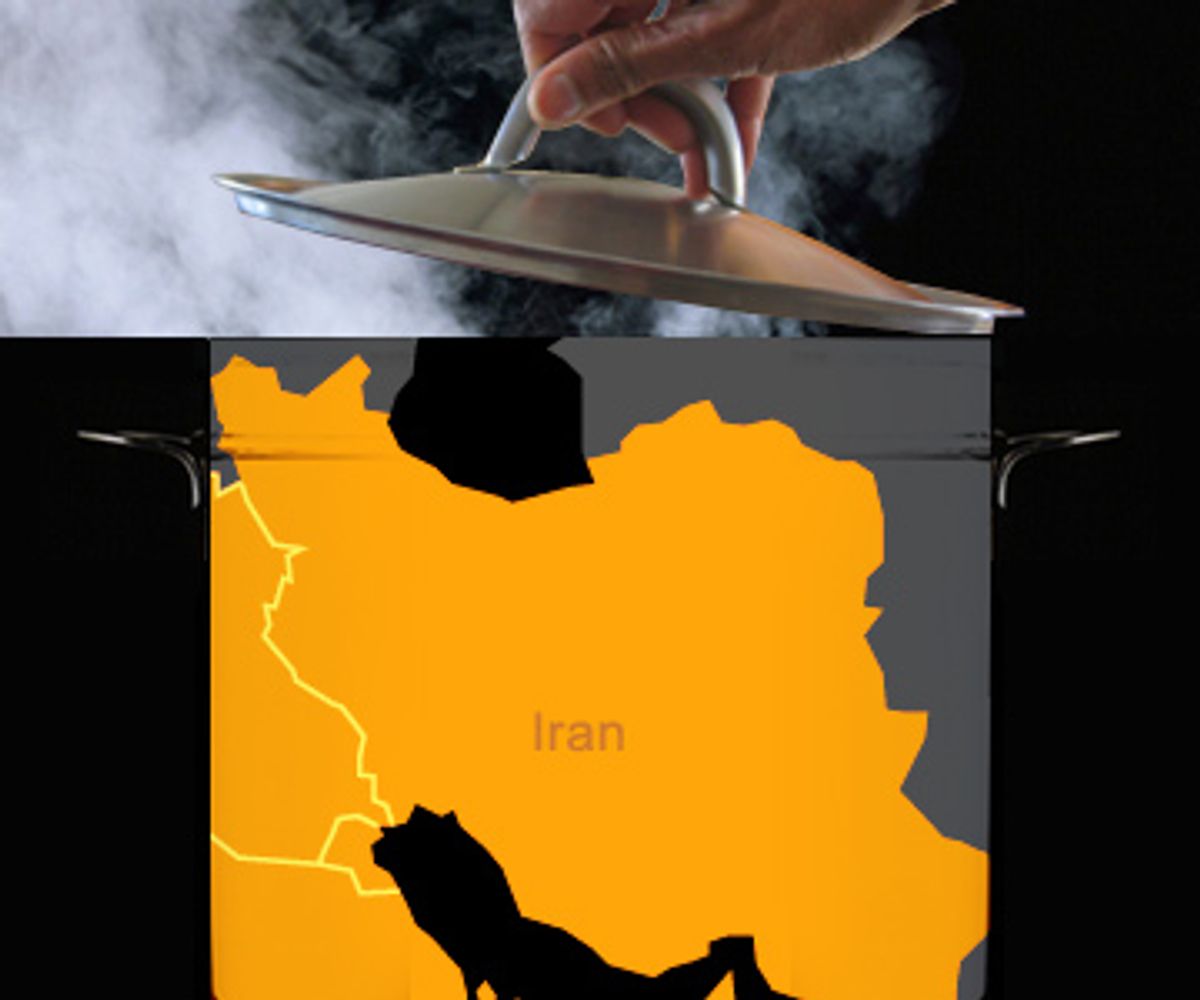
Bush's disastrous legacy is now locked in place. The National Intelligence Estimate released last week, which stated that Iran stopped its nuclear weapons program in 2003, is an explicit repudiation of the Bush doctrine and a preemptive strike against war with Iran. The professionals have struck back against the ideologues.
But in spite of the NIE findings, Bush and the wider U.S. establishment still share a view of Iran as evil and unapproachable. Until Washington realizes that it would be better off engaging with the Iranian regime than demonizing it, its Mideast policy will continue to flounder along the failed path of Bush's "war on terror." To avoid that outcome, it's going to have to be willing to question everything it thought it knew about Iran.
Congress and the media's so-what response to the Bush administration's outrageous attempt to cook the Iran intelligence does not inspire confidence. The Bush administration sat on the NIE for more than a year, trying to change the report to make it harsher on Iran, and all the while beating the drums for war. This fact has gone largely uncriticized, even though it's Iraq all over again. Bush has gotten a pass on his deception yet again for a simple reason: America views Iran as so innately dangerous, irrational and undeterrable that it doesn't care that Bush lied about what he knew and when he knew it.
In the eyes of the mainstream media, Congress and much of the public, Iran is the ultimate bad guy, a combination of al-Qaida and Adolf Hitler. This substratum of fear and hatred, some reasonable but much irrational, explains why leading Democrats, from Harry Reid to Hillary Clinton to Barack Obama, have reacted so tepidly to the NIE and Bush's obvious lies about it. More important, it explains why even a Democratic president could still pursue a self-destructive course of confrontation with Tehran.
Bush has been able to keep a second bullet in his gun, even after the Iraq disaster, because the Muslim country that the United States really fears and hates isn't Iraq but Iran. The 1979 hostages drama, the fanatical image of Ayatollah Khomeini and Iran's extreme hostility to Israel combine to make Iran a nearly demonic entity in U.S. eyes. One of the reasons the NIE is so politically sensitive is that it is really not about whether a nuclear Iran threatens America but about whether it threatens Israel. The Israel connection makes it extremely difficult for any U.S. politician to advocate anything other than a confrontational stance with Iran. Iranian President Mahmoud Ahmadinejad's venomous comments about Israel and his repulsive flirtation with Holocaust denial, combined with Iran's support for Palestinian and Lebanese terrorist groups, have virtually ensured Iran's diplomatic isolation.
The U.S., and the rest of the world, have legitimate concerns about Iran's nuclear intentions. Beyond the doomsday scenario of an attack on Israel, a nuclear-armed Iran would trigger a regional arms race, which would make the Middle East even more unstable. But it's the existential threat to Israel that has allowed Bush to play let's-make-war-on-Iraq all over again, with just as little resistance. It's no accident that Bush used the inflammatory expression "nuclear holocaust" when discussing Iran in August. At an October press conference, Bush was even more explicit. "We got a leader in Iran who has announced that he wants to destroy Israel," Bush said. "So I've told people that if you're interested in avoiding World War III, it seems like you ought to be interested in preventing them from hav[ing] the knowledge necessary to make a nuclear weapon."
Because they don't want to come across as Neville Chamberlain, few analysts and politicians have tried to determine whether Bush's claim that Ahmadinejad wants to destroy Israel is actually true, whether Ahmadinejad would have the power to launch such an attack even if he wanted to, and whether Iran would pursue a policy that it knows would lead to its immediate and complete destruction. The status quo position of treating Iran as a rogue state prevails.
But according to an important new book, America's hard-line position on Iran is counterproductive, and based on a fundamental misunderstanding of the country.
Trita Parsi's "Treacherous Alliance: The Secret Dealings of Israel, Iran and the United States" shatters the image of Iran put forward by the Bush administration. In Parsi's view, the Iranian regime is neither evil nor irrational. It is not primarily driven by religious or anti-Israeli ideology but by national self-interest. It is prepared to do just about anything, except abandon Islam, to maximize its regional power and preserve itself. It is a bitter enemy of Israel, but the enmity is based on geopolitics, not ideology, and it is prepared to make peace with Israel in return for strategic gains. Indeed, it has made many pragmatic overtures to both the U.S. and Israel; four years ago, it made an astonishing peace offer to Washington, which the Bush administration rejected out of hand.
Washington's hard line against Tehran, Parsi argues, has only strengthened rejectionists in Iran and impeded reforms. Given Iran's size, history, population, location, wealth, resources, education and military might, it is inevitably going to play a major role in the Gulf region and the Middle East. Ever since the Iranian revolution of 1979, American attempts to prevent Iran from playing this role have been largely responsible for the hostility between the two nations. It is in America's interests, and ultimately Israel's, to integrate Iran into the region as peacefully as possible.
Parsi, who is the president of the National Iranian American Council and adjunct professor at Johns Hopkins' School of Advanced International Studies, bases his book on 130 in-depth interviews with Israeli, American and -- crucially -- Iranian officials and analysts. His access to Iranian policymakers gives his book unusual authority.
One of Parsi's more remarkable tales takes place in May 2003, just after U.S. troops occupied Baghdad. Fearing that the U.S. was about to invade Tehran, Iran approached the U.S. with an amazing offer. In a dialogue of "mutual respect," it offered to stop its backing of Hamas and Islamic Jihad, support the transformation of Hezbollah into a disarmed political party, open up its nuclear program to international inspection and accept the Arab League's two-state plan for Israel and Palestine, thus making peace with the Jewish state. In return, Tehran asked for the U.S. to abandon its plans to topple the reign of the mullahs, end sanctions, turn over antiregime terrorists and accept Iran's legitimate interests in the region.
Secretary of State Colin Powell and others in the State Department, to which the offer was sent via a Swiss intermediary, were stunned. This was a bombshell: Iran was offering to resolve all the issues separating it, the U.S. and Israel in one fell swoop. Powell, his deputy Richard Armitage and National Security Advisor Condoleezza Rice took the proposal to President Bush, but the discussion was immediately stopped by Vice President Dick Cheney and Secretary of Defense Donald Rumsfeld. "We don't speak to evil," they said. The proposal died right then.
A hard-liner could see Tehran's desperate offer as a sign that the mullahs respond only to force. But history doesn't bear out that view. Again and again, Parsi shows, the U.S. has failed to respond to positive steps taken by the Iranian regime, instead hoping to smash or pressure Tehran into submission, or simply sideline it.
In 1992, the U.S. missed a major opportunity at the Madrid Mideast peace conference, when Iranian President Akbar Hashemi Rafsanjani was pursuing a policy of détente with the United States. Rafsanjani had declared that Iran would agree to any Israeli-Palestinian solution acceptable to the Palestinians. But the U.S. decided to freeze Iran out of the process and didn't invite it. "Washington failed to pick up on Iran's readiness because of the image of Iran as an inherently anti-American nation, formed by a decade of tensions between the two countries," Parsi writes.
The snub, along with Washington's insistence on maintaining some of Saddam Hussein's Republican Guard to check Iran, and its refusal to accept that Iran had a legitimate security role in the region, killed Rafsanjani's détente overture. It also strengthened extremists, who argued that Washington's rebuff showed that no matter what Iran did, it would never receive any concessions in return. Afterward, Iran began to support rejectionist Palestinian groups like Hamas for the first time.
Iran's unique position as a non-Arab, Shiite-majority state in the heart of the Middle East, and its tense relations with "moderate" Sunni Arab states like Egypt and Saudi Arabia, have forced it into a complicated tactical dance, which Americans have completely misread. Parsi argues that Iran's extreme anti-Israeli rhetoric and support for Hamas, Islamic Jihad and Hezbollah are driven more by strategic objectives than by ideology. They are an attempt to play to the Arab street, which is the only way Iran can overcome the political enmity of Arab leaders, as well as an attempt to gain regional clout in the only way open to it. Despite its support for the terrorist groups, Iran has almost always avoided taking actions against Israel that would jeopardize its geopolitical goals. Its bark has been worse than its bite.
"When one scratches the surface, even Iran's President Ahmadinejad's venomous outbursts against Israel turn out to have strategic motivations," Parsi writes. For example, Ahmadinejad and his fellow hard-liners defended his questioning of the Holocaust as a way of broadening the debate over Iran's nuclear policies to include Israel, strengthening Iran's bargaining position. More moderate Iranians vigorously disagreed with Ahmadinejad's speech and urged him not to raise inflammatory subjects such as Israel's right to exist or the Holocaust, saying they would turn the West against Iran. One reformist newspaper, which Ahmadinejad later closed, blasted his Holocaust denial. "What was conspicuously absent from the internal debate in Tehran, however, was the ideological motivations and factors that Iran publicly invoked to justify its stance on Israel," Parsi writes. "Neither the honor of Islam nor the suffering of the Palestinian people figured in the deliberations. Rather, both the terms of the debate and its outcome were of a purely strategic nature." Parsi notes that Iran's supreme jurisprudent, Ali Khamenei, forbade all Iranian officials to repeat the Holocaust denials, and Ahmadinejad subsequently softened his stand.
The Iranian-Israeli confrontation is a struggle over power, not ideology, Parsi argues. "The current enmity between the two states has more to do with the shift in the balance of power in the Middle East after the Cold War and the defeat of Iraq in the first Gulf War than it does with the Islamic Revolution of 1979." Iran and Israel both seek dominance in a disordered region that lacks a defined hierarchy; they employ ideology only as a means to achieve that goal.
As he recounts the Byzantine and ever-shifting relations between the three countries, Parsi portrays Israel and Iran as odd mirrors of each other. Both exist outside the Arab world and are disdainful of that world. They share a long and complicated history of wheeling and dealing, friendship and betrayal. Iran still has the largest Jewish community in the Middle East outside of Israel, which is protected by a fatwa issued by Khomeini himself. Israel repeatedly tried to strike up an alliance with Iran as part of its so-called periphery doctrine, which saw ties with non-Arab countries like Iran, Turkey and India as strategically necessary to counter Israel's Arab enemies. Ironically, Israel and the Israel lobby in the U.S. urged Washington to ignore Iran's anti-Israel rhetoric in the 1980s.
Today, however, both countries "seem to calculate -- or miscalculate -- that portraying their struggle in ideological and apocalyptic terms will provide each with a critical edge in their efforts to define the order of the Middle East to their own benefit," Parsi writes. The "mad mullahs" argument pushed by Israel and Israel's U.S. lobby has prevailed, and it drives U.S. policy to this day -- the NIE notwithstanding. But Parsi argues that the costs of clinging to this policy are becoming intolerably high, with saber rattling on all sides getting louder.
Although war is now extremely unlikely, the U.S. still faces a momentous decision: How should it deal with Iran? Parsi argues that the three approaches the U.S. has tried or considered -- regime change, containment and invasion -- have all failed. A change to a secular regime, even if it happened, would probably not change the underlying power struggle between Israel and Iran. Containment, the attempt to keep Iran boxed in and weakened, has also failed, as Israel's disastrous 2006 war in Lebanon demonstrated. A military solution is off the books now and in any case would not be worth the costs.
The only policy that will work, and which has never been pursued, is giving Iran a seat at the table by accepting its legitimate interests in the region -- what Parsi calls "regional integration and collective security." This approach, he maintains, would break the standoff between Iran and the West, as well as between Iran and its Arab neighbors. Indeed, it could even help resolve the Israeli-Palestinian conflict. "It is the geopolitical imbalance in the region that renders that conflict all the more unsolvable," Parsi writes. "Unless the underlying conflicts in the region are addressed, any process seeking to resolve the Israeli-Palestinian dispute will be subject to geopolitical rivalries."
Some respected Israeli analysts share Parsi's view. Parsi quotes Israel's former Foreign Minister Shlomo Ben-Ami as saying that "Iran is not driven by an obsession to destroy Israel, but by its determination to preserve its regime ... The answer to the Iranian threat is a policy of detente, which would change the Iranian elite's pattern of conduct." Haaretz analyst Zvi Bar'el takes the same view, arguing in a piece titled "They Stole the Threat From Us" that "Iran is indeed deceptive, but it is not crazy. It operates according to a systematic political and diplomatic rationale."
And, of course, the NIE itself, which represents the consensus opinion of all 16 U.S. intelligence agencies, expressed this view. "Our assessment that Iran halted the program in 2003 primarily in response to international pressure indicates Teheran's decisions are judged by a cost-benefit approach rather than a rush to a weapon irrespective of the political, economic, and military costs," the NIE report said.
But the dominant view of Iran, in both Israel and the United States, continues to be that it is a mad regime bent on destroying Israel. Haaretz reporter Shmuel Rosner wrote that "observers from the right and left have told Haaretz that the report released a week ago on Iran halting its nuclear program will have no impact on U.S. public opinion or its effect will erode."
America has legitimate differences with Iran, not just concerning Tehran's hostility to Israel and its support for terrorist groups, but its appalling human rights record. Détente will not be easy to achieve. But as the U.S. tries to figure out how to get out of the Iraq quagmire, broker a lasting Israeli-Palestinian peace and ensure regional stability, sooner or later we're going to have to talk to Iran.
Shares