

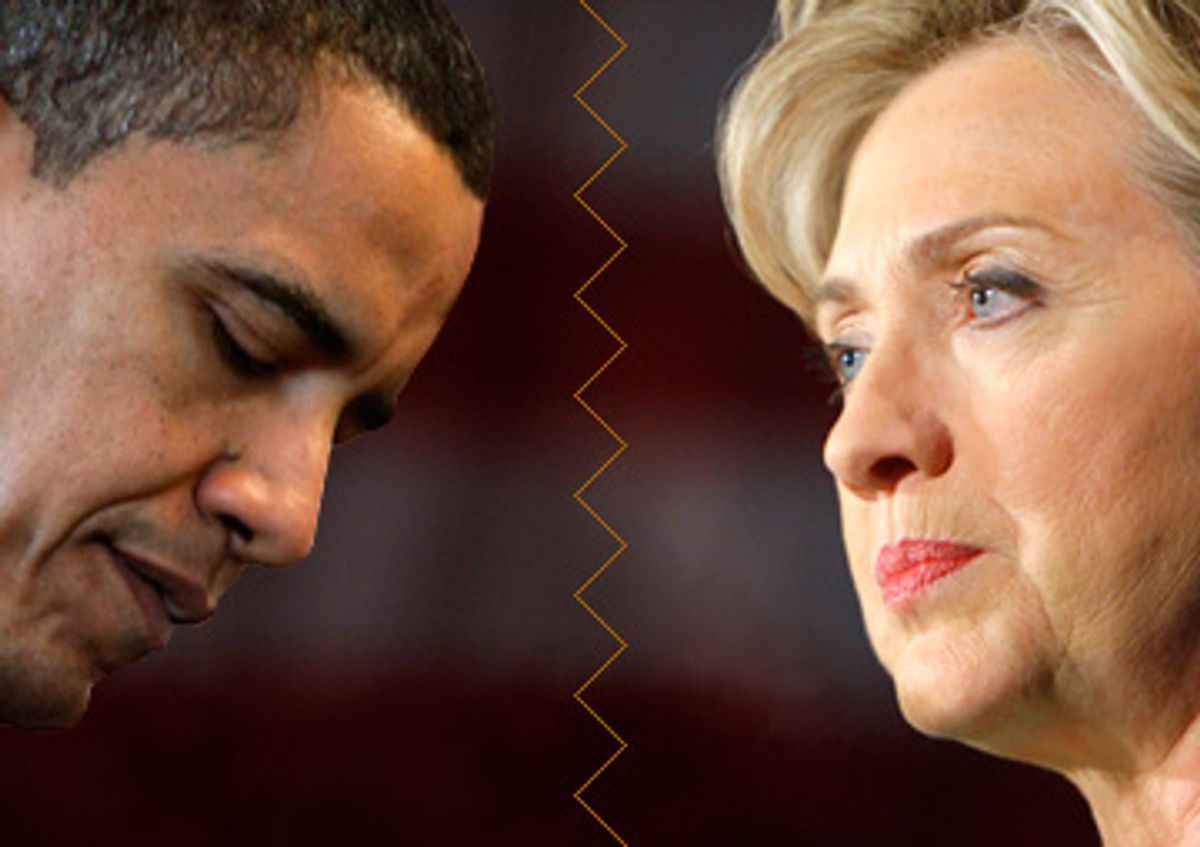
Politics tends to cause even the most lofty principles to sink to their lowest level, and recently the historic contest between Hillary Clinton and Barack Obama -- the first woman and black man to be serious contenders for the presidency -- is starting to resemble a compulsory oppressed minorities course taught by political consultants.
Until a week or so ago, neither Obama nor Clinton played up identity politics. But predictably, as soon as one candidate was threatened with defeat, the gender and race cards began to fly.After Obama won Iowa, the woman-victim vs. black-victim game was on.
It's a surreal and depressing spectacle. The opponents in the race find themselves hunkered down inside two clanking tanks, one marked "Black" and one marked "Woman." Since both the candidates and their supporters hold progressive views on these matters and know that a misstep would be fatal, the two tanks must fight each other according to Marquis of Queensbury rules, while still trying to blow each other up. Obama supporters accuse Clinton of racial insensitivity for saying that Martin Luther King Jr. needed LBJ to implement his policies, and blast Clinton mouthpieces for using the expression "shuck and jive." Women react to Obama and John Edwards ganging up on Clinton in a debate, or a few media loudmouths writing her off, as if an army of heavily armed male chauvinist pigs had stormed Wellesley. The fight resembles a dispute in a Subaltern Studies Department, one of those academic disputes of whom some wag once remarked that they were so vicious because the stakes were so small.
Except, of course, that here the stakes are huge. If things go on this way, the nomination could be determined by whether there are more white men drawn to Obama's racial get-out-of-jail-free card than women who will support Clinton because they share her gender. Which would be a shame. With our country disunited after seven years of Bush, facing a recession, and mired in a disastrous war, we need the Democratic Party to unite to elect the best candidate, not just the the Great Female Hope or the Great Black Hope.
The feminist icon Gloria Steinem fired an early salvo in the war, with a widely discussed Op-Ed in the New York Times. It's worth looking in some depth at Steinem's argument, because it epitomizes the mainstream feminist defense of Clinton. Asserting that what she called America's "sexual caste system" remains in place, Steinem argued that "[g]ender is probably the most restricting force in American life." To support that claim, she noted that black men were given the right to vote a half-century before women were, and asserted that black men "generally have ascended to positions of power, from the military to the boardroom, before any women." Moreover, she claimed that no woman with Obama's résumé could run for president.
Decrying the fact that "[Obama] is seen as unifying by his race while [Clinton] is seen as divisive by her sex," Steinem cited a number of examples of alleged sexism in the responses to Obama's and Clinton's candidacies. She said that Clinton was "accused of 'playing the gender card' when citing the old boys' club, while [Obama] is seen as unifying by citing civil rights confrontations," and that "male Iowa voters were seen as gender-free when supporting their own, while female voters were seen as biased if they did and disloyal if they didn't."
In effect, Steinem was arguing that sexism trumps racism as a national concern and backing that up by claiming that women in America have fewer options than black men. But this claim is flawed, as a simple thought experiment shows. Would you rather be born in the U.S. today as a white woman (to choose the most privileged subset of Steinem's "restricted" caste) or as a black man? Few would choose to be black. More white women are not in prison than in college, thousands of young white women are not shot down on inner-city streets every year, few if any white women have ever been arrested for driving while female, and so on. Steinem's historical arguments are unconvincing because they aren't up to date: She ignores the exponential advances made by white women and the failure of black men to keep pace. Leaving aside her omission of Jim Crow laws, and no matter how many black men may have made it into boardrooms before women (and there weren't too many), it was never better to be a black man than a white woman at any time in U.S. history.
If we compare only middle-class black men to middle-class white women, Steinem's thesis gets a little stronger -- but not much. There is no way to quantify these things, of course, but I would argue that middle-class black men still suffer from the legacy of slavery and racial bigotry far more than middle-class white women suffer from sexism. Only if we compare wealthy black men to poor white women does Steinem's argument ring true.
Some critics of Steinem's piece have argued that racism and sexism can't be compared because they're apples and oranges, and that she's inciting conflict between two victimized groups and two worthy candidates. But that's evasive. Steinem had every right to make the comparison -- she was just wrong.
This doesn't mean that Democrats should vote for Obama instead of Clinton, however. The presidential race should not be decided solely on the basis of competing victimhoods. But neither does it mean that the issues shouldn't be raised. Voters choosing between the two should look closely at the race-gender issue, examine how the candidates are dealing with it, and decide whether in their view it would be better for the country if Obama or Clinton became president. But their race or gender should only be one factor in their decision: A figurehead, albeit a powerful one, will not necessarily advance women's rights or race relations.
What this dust-up is really all about is politics -- in particular, Obama's racial teflon. It's hard to believe that Steinem really believes that women are worse off than black men (which is what saying they are more "restricted" really means). Her real animus seems to be the same thing that drives Clinton supporters crazy: that the black Obama is treated with reverence, while the female Clinton is fodder for gossip, penny-ante psychoanalyzing, schadenfreude, projection and every other high- and low-class reaction under the patriarchal sun. To Steinem, this proves that sexism is a more pernicious force in American society than racism.
Steinem's right that gender clichés and biases play a role in the criticism directed against Clinton. And she's also right that Obama has gotten a free pass because of his race. But she draws the wrong conclusions from these things.
First, she ignores the fact that the biggest problem many Democrats have with Clinton is not the fact that she's a woman, but that she voted to authorize the use of force in Iraq. Had Clinton not voted for the Iraq war (and let's be real, that's what that vote meant), she would be a shoo-in. In fact, it is widely believed that Clinton cast her fateful vote because she calculated that, being a woman, she needed to appear even more "tough on national security" than her male Democratic colleagues (most of whom, of course, also voted for the war).
This casts the whole gender-bias issue in a much more complex light. It isn't Democrats who are troubled by Clinton being a woman -- it was Clinton who was worried by what she perceived to be the political baggage that came with her gender. For those of us sympathetic to Clinton, this is painfully ironic. In fact, I suspect that many Democratic voters who are on the fence -- and I count myself in that camp, and haven't written Edwards off either -- are prepared to consider supporting Clinton despite her Iraq vote because they believe that didn't really support the war, but felt she had to make up for her perceived "weakness" as a woman by voting for it. These voters hope that if elected she will tear off the tough-guy mask and emerge as who she really is. In other words, the hope that Clinton is actually a stealth "woman" -- that is, not addicted to military solutions and favoring diplomacy -- is the best thing she has going for her now.
Of course, there's a reason Clinton felt she had to act tough (or "male"), and that reason is the sexist cliché that women are too soft to lead a nation, especially during a time of war. But that cliché may be less powerful than many think -- and in any case, Clinton didn't have to go along with it. By aiming at the general election, she played it unnecessarily safe. A 2007 Pew Poll found that although a significant gender gap in support for female candidates still exists, Democrats -- men and women alike -- are prepared to vote for qualified female candidates. Indeed, in 40 Senate and gubernatorial races since 1998, female Democrats got 4 percent more votes than male Democrats when both were running against male Republicans. And a 2007 Gallup poll found that 88 percent of Americans said they would vote for a well-qualified woman candidate for president. Clinton didn't need to tilt so far to the masculine right.
Steinem also draws the wrong conclusions from Obama's free pass by the media. The fact that Obama is being treated with kid gloves shows not that racism is less potent than sexism, but that racism remains a much more radioactive force in American society. Politeness is a sign of ignorance, distance and fear. The mostly white commentariat feels freer to attack Clinton, a white woman, than it does Obama in part because he doesn't have as long a track record, but mostly because most white people dread being perceived as racist. It's good that white people don't want to be seen as racist, but their wariness about criticizing him shows that America still has a long way to go.
Obama himself has avoided tangling with the media by running on an inspirational message of hope and unity. But that message, as his critics point out, can veer into the ethereal. Obama is caught in a dilemma similar to that Clinton faces, but he has even less room to maneuver. If he gets tough, he risks being seen as "too black," a perception that would doom his bid; if he floats above the fray, he invites criticism as being a fairy tale, all style and no substance.
Obama is not going to change his lofty message until he gets into the White House, if he does -- because doing so is too risky. But it would be healthier for race relations if he did. Symbolic absolution is good, but getting down and dirty is better. Indeed, one of the best things about an Obama presidency would be that it would usher in an era in which blacks and whites would be forced to drop the politeness act and get real. You don't have equality until everyone gets their fair share of abuse. One of Vince Lombardi's black players once said, "He treats us all alike -- like dogs." This is a desirable state.
It's easy to forget that one of the reasons Clinton is casually embraced and denounced, and kicked around like an old shoe over the water cooler, is because Americans feel comfortable enough with women to use the familiar mode of address with them. The powerful positive and negative reactions to Clinton are the result of a dozen different things -- personal antipathy or affection, anger over her vote for the war, belief that she's a more experienced candidate, celebrity fixation, weariness with the Clinton era, nostalgia for the Clinton era, the desire to elect a woman, and so on. Of course, sexism plays a role, too. There are plenty of social conservatives who are still fighting modernity, plenty of resentful reactionaries who find it improper or unseemly that any woman should run for president, or indeed hold any position of power, and who disguise their unreconstructed sexism by disingenuously claiming that they think it's only Clinton who is a castrating bitch, or whatever other ugly psychosexual epithet they pull out of the muck of their ids. But these troglodytes are a small minority.
And even when Clinton's "womanliness" or "authenticity" or "coldness" or "ambition" are dissected in the press, it's too facile to assume this scrutiny always reflects sexism. We live in a world of personal judgments on public figures, and gender is a deeply personal issue. We all psychoanalyze candidates all the time; from Nixon to Reagan to Carter to Bush, we tear presidents apart and put them back together like cheap toy cars. Nor do media pile-ons necessarily indicate sexism -- remember what happened to Al Gore? When you run for president, you're going to be judged by an audience of Jerry Springers. Clinton is not Everywoman: She is a unique individual, one who is married to a president irrationally despised by millions of people, and one who has been part of a long-running national soap opera. A different female candidate would not be subjected to the flak that she rightly or wrongly attracts.
Matthew Yglesias has argued that black candidates have an advantage over women candidates because "it's possible for any individual African-American to 'transcend' [negative] stereotypes by simply not living up to them," while women candidates are trapped in a can't-win situation: "A woman who's seen as possessing the stereotypical characteristics of femininity won't do well in presidential politics. But a woman who's seen as lacking those characteristics will be penalized as well." It's the familiar "damned if they do and damned if they don't" argument.
There's some truth to this, but I question whether the gender- codes line that women have to walk is really so impossibly narrow. For one thing, it's no longer quite so clear just what the "stereotypical characteristics of femininity" really are. Let's suppose that Hillary Clinton was running for president, with two things magically changed: She was married to some innocuous businessman named Bill Clinton, and had never voted for the war. I would argue that most of the criticism, psychosexual speculation, excessive animus and general weirdness that follows her around would simply not exist. Take away her familial and political baggage and Hillary Clinton would fall well within the range of electability: She wouldn't come across as too ambitious or too coldblooded, too butch or too femme. To appropriate Obama's ungracious words and use them in a more appropriate context, she's likable enough to be elected president. You don't have to be some paradoxical female Superwoman to be elected president of the United States.
But if Clinton is caught in the damned-if-she-does, damned-if-she-doesn't trap, Obama is caught in a similar, even more extreme one. He has a bigger head start because of racial guilt, but a bigger downside because of racial fear. His tightrope is higher up, but it's a longer fall. Since he cannot get too confrontational without triggering white racial guilt and fear, he has to remain somewhat amorphous. And to pull that off he has to be consistently inspiring -- not an easy task.
Moreover, Clinton also has her own potent gender cards to play. Just as Clinton supporters could only fume as the media anointed Obama as the new unifier after Iowa, Obama supporters could only curse as Clinton garnered massive publicity and female sympathy by showing a little emotion in New Hampshire. I'll see your beyond-race hoo-ha and raise you a moist-eyed moment, fairy-tale man!
In the end, the race and gender cards may cancel each other out, and voters may make their decision based on more than just the accidents of gender and race. But things could get a lot uglier before that happens. And if they do, the only one cheering will be John McCain.
Shares