

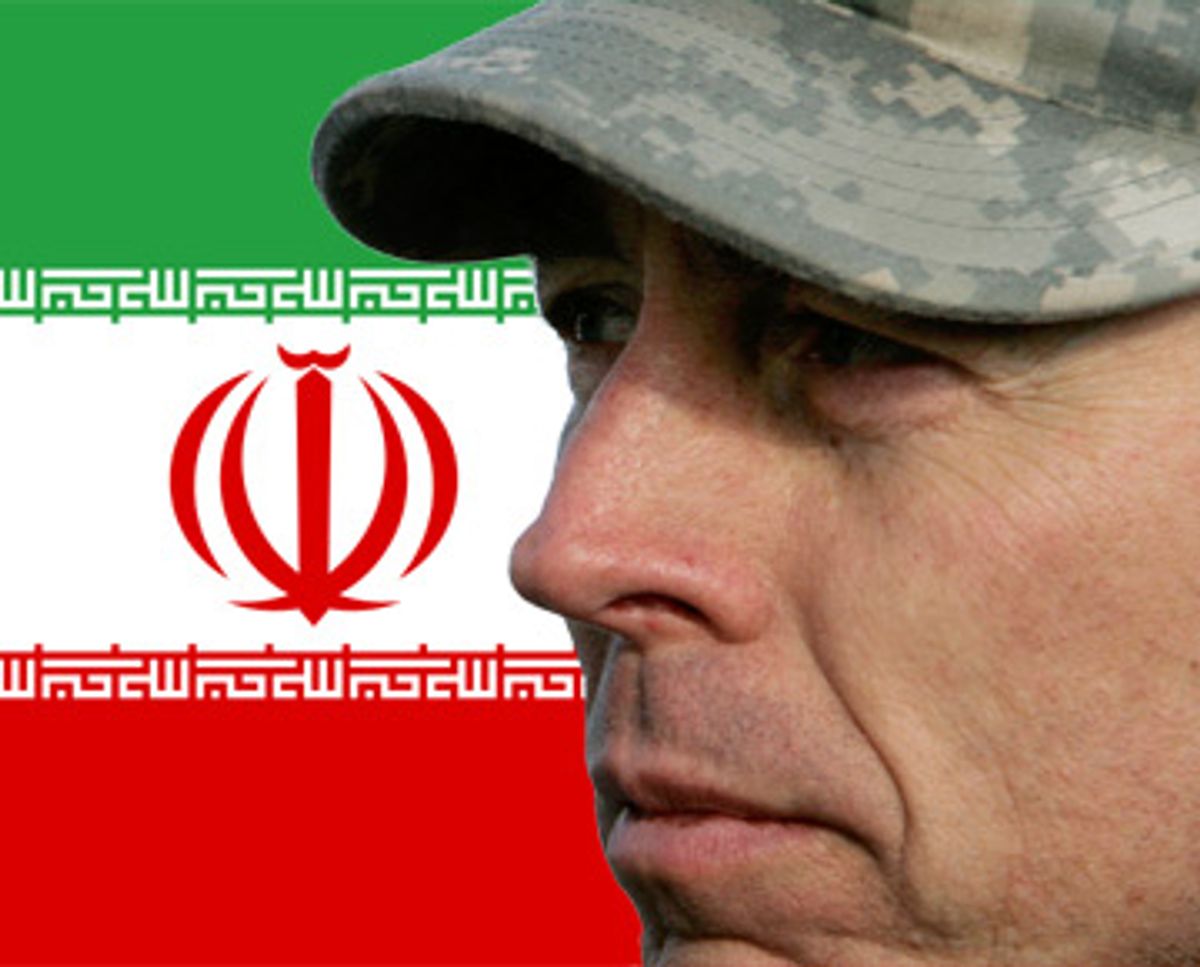
In his much-awaited testimony before the U.S. Senate this week, Gen. David Petraeus is reportedly going to cite Iranian aggression to justify keeping U.S. troops in Iraq. According to the Times of London, Petraeus will claim that Iranian troops fought alongside Muqtada al-Sadr's Mahdi Army against Iraqi government troops in Basra. The U.S. ambassador to Iraq, Ryan Crocker, who will also testify, accused Iran of providing some of the rockets that have struck the Green Zone in Baghdad, causing a number of U.S. casualties. "We got the tailfins of what was dropping on us ... This was quite literally made in Iran," Crocker told reporters.
It's blame-blame-blame, blame-blame Iran. We've heard this song before. The Bush administration warbles it every time it needs to justify its failed Iraq policies and rally a skeptical public. Evil Iran, our archenemy, a charter member of the Axis of Evil, is killing American troops, and we can't leave Iraq, or Ahmedinejad and his cronies will take over the whole country. It's an updated version of the Cold War "domino effect" argument, with Iran taking the place of the communist menace. And in the latest version, Muqtada al-Sadr, the vehemently anti-American cleric, is portrayed as Public Enemy No. 1, an Iranian tool fighting the good guys in the Maliki government. U.S. troops have been fighting Sadr's militia in Baghdad's Sadr City in the last few days, making it even easier to portray him this way.
There's just one problem with this story: It's nonsense.
The truth is that the Maliki government and its allied Shiite faction, the Islamic Supreme Council of Iraq (ISCI, formerly known as SCIRI), are much closer to Iran than the Sadrists are. Maliki's campaign against Sadr isn't a noble crusade by the good Iraqi government against the bad Iranian-backed Sadrists, but a battle waged by a weak Shiite leader backed by one militia, ISCI's Badr Corps, against another, stronger Shiite leader, Sadr, with his own militia, the Mahdi Army. Not only that, the "good" militia, the Badr Corps, was created in Iran by Iran's Revolutionary Guard -- the same organization whose Quds Force the United States notoriously declared to be a "terrorist organization" last year. The maraschino cherry on this sundae of absurdity: It was the head of that Quds Force, an Iranian general, who bailed out Maliki after Maliki's assault on Basra ignominiously failed, forcing him to send officials to Iran to broker a truce.
As Juan Cole, a regular Salon contributor, told me, "The Americans are doing propaganda." I called Cole, a nationally recognized expert on Shiite Islam, because I wanted to get a reality check not just on Petraeus and Crocker's expected Iran-is-to-blame spin, but to hear what Cole thinks the United States should do to extricate itself from Iraq. As it turns out, the two questions are inseparable. Cole makes a disturbing case that the Bush administration's hard-line position on Iran and Sadr could end up wrecking our chances of getting out of Iraq without leaving chaos in our wake.
U.S. claims that Iranian troops were involved in the fighting in Basra have to examined closely. "If what's being alleged is that Supreme Jurisprudent Khamenei, theocrat of Iran, ordered Revolutionary Guards into the slums of Basra, that's not plausible," Cole said. "Now, there are Iranians going through Iraq all the time. If you count all the pilgrims who come to Iraq every year, there are probably over a million of them. So let's say there are some Iranians in Basra, and the troops came down and they were caught in the crossfire and had to make a choice. And there may have been some who had friends among the Mahdi Army and decided to support the Mahdi Army. That's possible."
Cole also questioned U.S. claims that Iran was intentionally supplying weapons to the Mahdi Army. "There's no proof for that, and whenever the U.S. Army is pressed for evidence, they always back off." The weapons are available on the black market, and the Mahdi Army, flush with funds, can easily buy them.
Gregory Gause, a Middle East expert who testified before the U.S. Senate last week, also found the idea that Iran would have ordered troops to fight against the Maliki regime extremely unlikely. "I'm open to evidence, but it would be a real departure if Iran had organized units fighting," Gause said. "It wouldn't make sense to make their own guys [Maliki and ISCI] look bad."
In a larger sense, both Cole and Gause said it would make no sense for the Iranians to try to destabilize the Maliki regime. "The status quo is in their interest," Gause said. Iran supports all the Shiite parties and militias, including Sadr's, for obvious reasons: They want to retain influence. "The only strategic logic they might have for aiding the Mahdi Army against their own allies is that the Mahdi Army remains very anti-American and will make life difficult for American forces and perhaps hasten their departure," Gause said. But he pointed out that the Iranians are wary of Sadr. "I've always thought that the Sadrists are actually the least reliable of Iran's Shia relations in Iraq. They're indigenous, homegrown. And Sadr has a reputation for being much more nationalist. He's also always opposed these extreme federalist plans that ISCI have put forward for this Shia super-province."
Cole took the same position. "I don't think the Iranians want chaos in Iraq. It's too easy for it to spill over onto them. I think they want a finger in every pie."
In short, the truth about Iraq, which the Bush administration has withheld from the American people, is that Iran and the United States have an alliance of convenience in Iraq. Both support ISCI and Maliki. Iran does give limited support to the nationalist firebrand Sadr, but the significance of that pales in comparison to the two countries' shared interests.
The Bush administration has concealed that inconvenient truth and pushed its good guys-bad guys narrative on the American people because that narrative is needed to sell the war. The Basra battle made it uncomfortably clear just how much Iraq resembles Lebanon -- a Byzantine place of shifting alliances where there are no heroes and villains, and where you can't even tell the players without a scorecard. If that truth sinks in, public support for the war will dry up. Which is why Iran, the convenient boogeyman, is suddenly coming up again.
Gause said the Iranians' worst fear is a situation in which "elements of the former regime take power -- a Sunni-dominated government allied with the U.S., which could be used to pressure Iran and maybe even attack Iran." He said Iran might even fight to prevent that outcome. But he said it was highly unlikely. "What they want is their people, which is basically ISCI, Maliki and elements of Dawa [Maliki's religious party], who they think are loyal clients, to control Baghdad."
In short, Iran wants the status quo -- which is pretty much what the United States wants, too. So why shouldn't the U.S. just work out the most harmonious way of achieving that goal by talking to the Iranians? That, in fact, is just what Gause argued the United States should do in his testimony before Congress. But the Bush administration, in thrall to its neoconservative ideology, will never conduct serious negotiations with Iran. Indeed, it seems to be too ideologically blinkered, or incompetent, even to realize that Iran and the United States have a significant shared interest in Iraq.
The Bush administration's great fear is that after the United States leaves, the Iranians will simply take over. Cole derides this idea as ignorant, pointing out that when Iraqi Shiites fought Iran, only about 40,000 troops out of a million-man army defected over eight years of hard fighting. "It seems to me that the current cozying up to Iran by the Iraqi Shiites is being sparked by their desire to diversify and not have the Americans dominate them," Cole said. "If the Americans got out, the first thing you would see would be tensions between the Shiite Iraqis and the Iranians. The idea that Iran would just waltz in and dominate -- I mean, does Iraq seem like a place that's easy for a foreign country to dominate?"
It's tempting to dismiss the Bush administration's posturing on Iran and Sadr as just more propaganda. But Cole fears it could have catastrophic consequences. He said the Bush administration's hard line on Iran, its misguided support for Maliki and ISCI, and its misreading of Sadr, could precipitate a crisis that would destabilize Iraq and lead to a bloody civil war.
The key to a stable Iraq and a reasonably successful U.S. departure, he said, is the upcoming provincial elections in October. If free and fair elections are held throughout Iraq, Iraq could become much more stable. "You'd get representative provincial governments backed by local elites, and they could work for social peace," he said. "This would be across sectarian lines. The Sunnis didn't participate in the last provincial elections in 2005, resulting in a situation in which a Sunni-majority province like Diyala is being ruled by ISCI. Well, you only have to say that and you know there's trouble. If the Sunni Arabs in Diyala get their 60 percent on the provincial council, it's much more likely that they'll cooperate with the provincial security forces."
Cole said that the United States could negotiate a withdrawal with these provincial governments, "and there's much more hope that they could keep order as we left. It's not impossible to have a soft landing."
But Maliki, ISCI and Bush seem determined to undermine those elections. Maliki justified his assault on the Mahdi Army in Basra by claiming he was merely cracking down on "criminal gangs" in Iraq's second-largest city. And he has couched his new demand that Sadr disarm the Mahdi Army in lofty terms, saying no state can tolerate private militias. But that explanation is transparently hypocritical, since he has not also demanded that "his" militia, the Badr Corps, or the Kurdish peshmerga disarm. Most analysts believe the real reason Maliki ordered the assault and is attacking the Mahdi Army is to weaken Sadr's powerful movement before the elections. "Both Bush and the ISCI are congenitally unable to accept a Sadrist victory in the provincial elections," Cole said.
In fact, the Americans have never understood the Mahdi Army. "They don't understand that it is a movement," Cole said. "It is a political movement with a very large number of adherents. A movement is not exactly like a party. If you think about the civil rights movement, you couldn't deny that it existed, but if you ever tried to nail it down, it'd be awfully difficult. It didn't always have a treasurer. Sadrism is like that: It's a grassroots movement."
The problem, for America, is that Sadrism, because it is a genuine movement, cannot be ignored and will not go away. Cole pointed out that it's the disenfranchised areas of Iraq that have been prone to the most violence. And he fears that if ISCI keeps going down the path it's on and steals the elections in the south, the disenfranchised Sadrists are likely to rise up, with catastrophic consequences.
I told Cole the Bush administration should be telling Maliki to lay off the Mahdi Army and accept that the Sadr movement is going to play a political role. "Exactly," he responded. "The problem is, that message is going to be unwelcome on the American side, because the Sadrists want us out. People will say, 'Well, you're handing it over to the Mahdi Army.' Well, that's what's there. If we're going to set up a democratic system in Iraq, then we have to let it work. It's like in the Philippines, where their Senate voted out our naval base in Subic Bay. I can't tell you how much the Navy wants to be in Subic Bay, but that's how the cookie crumbles.
"The thing that I see in Iraq is an unwillingness to let those processes play out," Cole said. "Instead, we insist that we have to have military bases in Iraq and make sure that U.S. petroleum companies have a favorable negotiating position. I have a sinking feeling that the two of them, the Americans and the Iran-backed militia, are going to sink what's left of Iraqi democracy in the south. They're going to set the stage for major violence. As usual, Cheney and Bush are shooting themselves in the foot."
Shares