

The End of Days is approaching for John McCain and Sarah Palin, and at least one member of the ticket is not likely to greet this development with religious rapture. Their numbers are tanking. Their campaign has had to pull out of Michigan, and they are trailing in most of the battleground states they must hold onto. Even Karl Rove has predicted an Obama win if the election were held today. McCain's hotheaded behavior during the Wall Street crisis and his numerous other erratic tactical swerves have backfired. And his biggest gamble, choosing Sarah Palin as vice president, is increasingly looking like a disaster.
McCain's all-too-predictable response: get ugly, as he did on Monday is his disturbing rant against Obama in New Mexico.
The man who incessantly talks about "honor" has checked his own at the door. Back in April, McCain -- himself the victim of a vicious, race-baiting smear campaign orchestrated by Karl Rove in 2000 -- disavowed a North Carolina ad attacking Obama for his association with the Rev. Jeremiah Wright. "It's not the message of the Republican Party," McCain said. "It's not the message of my campaign. I've pledged to conduct a respectful campaign."
But that was before McCain faced imminent defeat. His "pledge" has turned out to be about as credible as his sudden incarnation as a lifelong enemy of Wall Street. On Monday, McCain rolled out a new TV ad, "Dangerous," that accuses Obama of being "dishonorable." "Who is Barack Obama?" a narrator ominously asks. "He says our troops in Afghanistan are 'just air-raiding villages and killing civilians.' How dishonorable."
Of course, this is an outrageous smear. Obama was simply pointing out the well-known fact that in fighting an insurgency, over-reliance on air power is counterproductive. That's because airstrikes inevitably result in civilian deaths, which turn the population against the side carrying them out. U.S. airstrikes and the ensuing civilian casualties are one of the biggest points of contention between the U.S. and Hamid Karzai's regime in Afghanistan, and they are a huge issue in Pakistan and Iraq as well.
But none of those facts matter, because McCain desperately needs to paint Obama as a traitor, an alien, a defeatist, and un-American. The rhetorical question "Who is Barack Obama?" is not accidental: It is intended to raise fundamental doubts about whether he is a real American. It ties into the online smears that accuse him of being a Muslim, a terrorist, of not saluting the flag, hating the troops, attending a madrassa, hating Israel, and so on.
In a fear-mongering speech on Monday, McCain continued this Mysterious Stranger tactic. "Whatever the question, whatever the issue, there's always a back story with Sen. Obama," McCain said. "All people want to know is: What has this man ever actually accomplished in government? What does he plan for America? In short: Who is the real Barack Obama?" Cue a subconscious image of a dark, menacing figure planning to impose sharia law on America.
Sarah Palin, confidently pronouncing on Obama's bona fides despite the fact that she has repeatedly revealed herself to a terrified world to be someone who must be kept as far away from the presidency as possible, joined in the smear campaign. Citing Obama's acquaintance with former Weatherman founder Bill Ayers, Palin said about the Democratic presidential nominee, "This is not a man who sees America as you and I do -- as the greatest force for good in the world. This is someone who sees America as imperfect enough to pal around with terrorists who targeted their own country."
Never mind the fact that Palin herself supported, and her husband belonged to, a secessionist Alaska political party that advocated armed opposition to the U.S. Never mind the fact that Obama's relationship with Ayers, as detailed in the very New York Times story that Palin cited as her source, was utterly casual. Facts are for those in the reality-based community. The point is to paint Obama not just as a terrorist sympathizer and America-hater, but as an alien. Hence Palin's description of him as "not a man who sees America as you and I do."
McCain is also using Palin to bring up the Rev. Wright. Prompted by GOP publicist Bill Kristol, whose intellectually vacuous, water-carrying New York Times column is one of the biggest embarrassments in that paper's storied history, Palin said that "I don't know why that association isn't discussed more, because those were appalling things that that pastor had said about our great country ... But, you know, I guess that would be a John McCain call on whether he wants to bring that up."
Ah, the joys of having your vacuous, yet robotically perky, running mate do your dirty work for you, while she pretends that she isn't.
Calling Obama a traitor, un-American and dishonorable may be somewhat effective, but the best thing McCain and Palin have going for them is that Obama is ... black. The subliminal message of all their ads is "scary, black, unknown, black, alien, black, un-American, black." The challenge for McCain, however, is that he can't be explicitly racist: It's no longer acceptable to run Willie Horton-type ads. But ingenious minds find a way to get around this.
In a McCain ad called "Mum," Obama is portrayed as a tax-raising incompetent. But the real point of the ad, which is so nonsensical it's hard to believe anyone will pay attention to its ostensible message, may be to incite racial fears.
"In crisis, experience matters," a tough voice warns. "McCain and his congressional allies led. Tough rules on Wall Street. Stop CEO rip-offs. [An image of a grinning black man in a suit appears.] Protect your savings and pensions. [An image of an elderly white woman appears.] Obama and his liberal allies, 'mum on the market crisis.' Because 'no one knows what to do.' More taxes. No leadership. A risk your family can't afford."
This ad requires voters to have ignored reality in three ways. First, they must have somehow missed the fact that it was Republican congressmen, not Democrats, who stalled the bailout package. Second, they must swallow the fairy tale that McCain "led" the effort. And third, they must believe that McCain and the GOP have magically been transformed into sworn enemies of "Wall Street" and "CEO rip-offs." With all due respect for the incapacity of Americans, that's too much stupidity to ask for.
Which is why the real point of the ad may have been the image of the smirking black man who appears as the poster child for "CEO rip-offs." The man is Franklin Raines, former head of Fannie Mae, who resigned in 2004 under a cloud of scandal. It may seem odd that McCain's hit team selected a black CEO to illustrate the Wall Street meltdown -- there are about as many black CEOs as there are white defensive backs in the NFL. But it isn't odd at all. Using Raines serves the GOP's interests in two ways, both of them with explicit racial subtexts.
First, it furthers the bogus right-wing story that Fannie Mae and Freddie Mac, pushed by the Clinton administration to increase the number of minority homeowners, were responsible for the Wall Street meltdown. (In fact, as the New York Times has reported, rapacious Wall Street investors pushed Fannie Mae into the exotic, high-risk bundled deals that brought it down.)
More important, it associates Barack Obama with an allegedly corrupt black man. Few viewers are likely to know who that black face belongs to, but that doesn't matter. Working-class white voters have repeatedly told reporters that they're worried that if he's elected, Obama will turn the country over to black people. The "Mum" ad plays to those racial fears in a way that allows plausible deniability.
The GOP and its media allies are going into their two-minute drill, and it ain't pretty. Moving in lockstep with the GOP, as usual, Fox News ran a ludicrous Sean Hannity show Sunday night that painted Obama as a terrorist sympathizer and dangerous radical. And we can expect more smears, concealed race-baiting, overwrought accusations of "radicalism" and crude ad hominem attacks in the next month.
McCain's last-ditch smear campaign isn't surprising. The modern conservative movement came to power by playing on white racial fears, and McCain is hoping that there's one shot left in that gun.
The seeds of modern conservatism were sown by Barry Goldwater, whose anti-government ideology was crafted to appeal to Southern whites enraged at federal intervention into what they considered to be their own racial business. Richard Nixon's "Southern strategy" brought Goldwater's approach to fruition. By inciting populist white anger at do-gooder liberals and the black poor, Nixon was able to split the Democratic Party, peeling off the South and making deep inroads with blue-collar ethnic Democrats in states like Ohio, Michigan and Pennsylvania. Some analysts believe that the South will remain Republican forever, although demographic changes could weaken the GOP's grip. Ronald Reagan continued the strategy, kicking off his 1980 presidential campaign by giving a speech in Philadelphia, Miss., where three civil rights workers were killed, in which he promised to support states' rights -- a code word for institutional Southern racism.
The founding success of the modern conservative movement was that it convinced large numbers of Americans to reject "liberalism" and "big government," even if they themselves benefited from both, because they were associated with social programs aimed at helping poor blacks.
In one of the climactic political showdowns in American history, McCain and Palin are now using the GOP's time-tested tactics -- against a black man. The tactics always worked before, and one might think they would be foolproof now, with a black target. But a closer look at the very beginning of the GOP's rise to power reveals why they may not.
In fall 1964, Barry Goldwater was tanking in the polls, hammered by the media and by his Democratic opponent, Lyndon Johnson, as a radical who might start a nuclear war and would threaten cherished social programs like Social Security. As Rick Perlstein relates in "Before the Storm: Barry Goldwater and the Unmaking of the American Consensus," Goldwater realized that he needed to scare Americans. So he turned away from his high-minded speeches about freedom and started talking incessantly about moral decay and social unrest -- subjects that had never been raised by a presidential candidate before.
To spread its message about scary blacks and moral rot, the Goldwater campaign let loose a bare-knuckle political operative named Rus Walton, who "was possessed of an almost desperate need to burn conservative truths into an audience's heart by whatever means worked -- high or low, fair or foul." Walton's staff cranked out brochures depicting black Harlemites caught in the act of smashing windows and attacking policemen, with captions like "Lyndon Johnson's Administration Is Too Busy Protecting Itself to Protect You." Another brochure read, "Are you safe on the streets? What about your wife? Your kids? Your property? What about after dark? Why should we have to be afraid? This is America!" A poster linked government with race riots, braying, "Government officials make millions while in public service. They let crime run riot in the streets ..."
Goldwater commissioned a bizarre documentary film, "Choice," that interwove images of a speeding Cadillac, wild revelers, shapely, twisting derrieres, civil rights protests, naked breasts, and criminals resisting arrest. Over these images Raymond Massey intoned, "Now there are two Americas. One is words like 'allegiance' and 'Republic' ... The other America -- the other America is no longer a dream but a nightmare." It was the first shot fired in what would later come to be called the culture wars. (Goldwater chickened out and disavowed the film.)
As Joseph Lowndes argues in his book "From the New Deal to the New Right: Race and the Southern Origins of Modern Conservatism," "race was probably the most compelling issue Goldwater had on his side." And Goldwater, though himself no racist, did his best to appeal to white fears. But it didn't work. He went on to lose in a landslide, carrying only a handful of Deep South states. The reason, as Lowndes points out, was that "[c]onservatism did not yet appeal to a majority of Americans, who saw conservatism and the Republican Party as representing wealthy, elite interests."
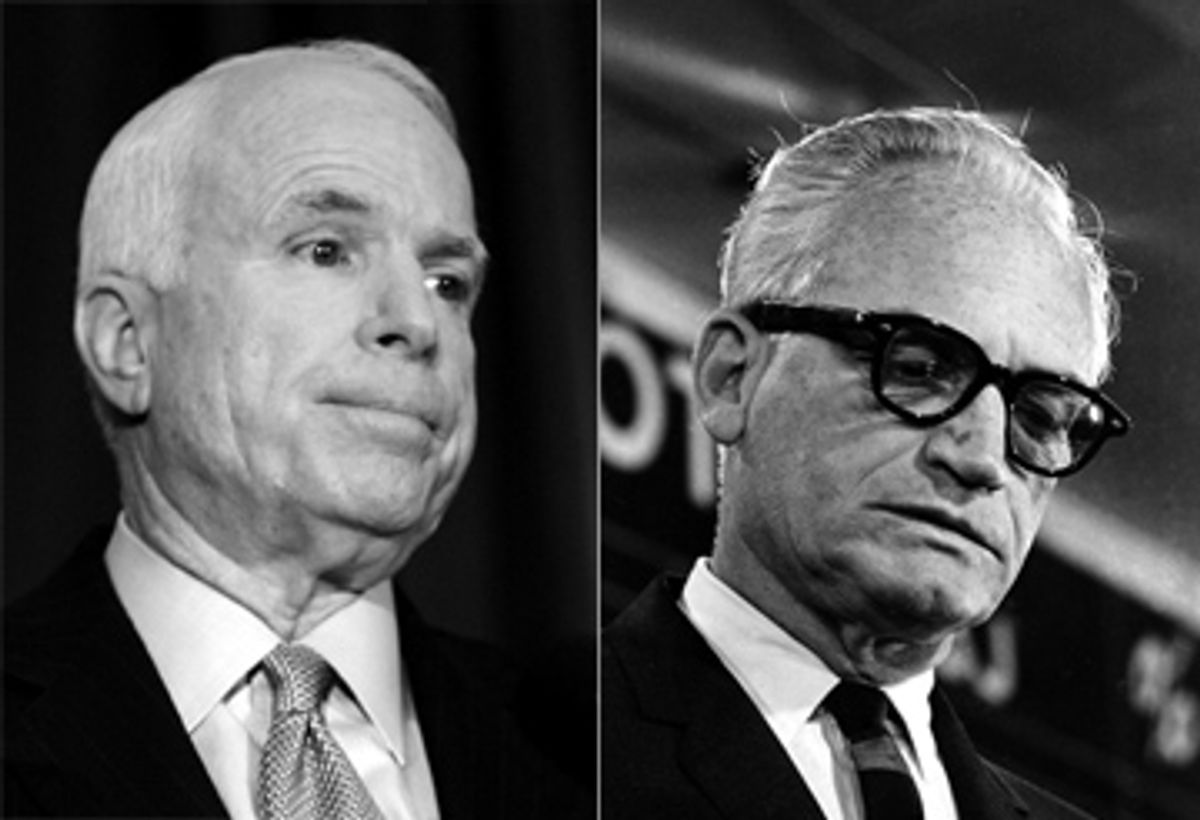
There are some uncanny parallels between Goldwater's campaign and McCain's. The American right has come full circle in 44 years, with two allegedly maverick senators from Arizona playing bookend roles, one at the beginning, one perhaps at the end. Goldwater was the prophet of modern conservatism, but he came too early. For his part, McCain may have come too late. He may be remembered as the last, failed Republican candidate to use the GOP's four-decade-old strategy of attacking big government, demonizing liberals and mobilizing white resentment of blacks.
McCain is playing dirtier than Goldwater did. But the smear game still may not work. And if McCain loses, it will be for the same reasons that Goldwater lost: because conservatism itself -- which means the GOP, since it no longer has a moderate branch -- has been discredited. The Republican Party under Nixon and Reagan succeeded because it was able to convince enough white Democrats and swing voters that it was the party of the "average American," oppressed by federal bureaucrats and do-gooder programs like busing and affirmative action. It was able to conceal the fact that it was the party of the rich beneath a populist, race-tinged appeal to white resentment.
But the truth is that America is not a particularly ideological country, and Americans' allegiance to conservative ideas has always been fairly superficial. Yes, our frontier mythology and tradition of federalism makes us less supportive of the welfare state than European countries -- but New Deal-inspired programs like Social Security and Medicare are deeply rooted in our society. A loose, de facto centrism is America's default position. By embracing cracked ideologies like trickle-down economics, by letting big corporations do whatever they want, and by religiously refusing to raise taxes, the GOP since Reagan has tilted much too far to the right. George W. Bush pushed the party over the cliff, with the final straw being his own unique contribution, a demented and pointless war.
Now the bills are coming due. The colossal failure of the Bush administration has destroyed the right wing's appeal to most Americans. In effect, conservatism has returned to being what it was in the days of Goldwater -- a fringe movement. McCain is desperately trying to disavow the movement he has followed all his life by painting himself as a "maverick," but as Joe Biden pointed out in perhaps the most devastating retort in his "debate" with Palin, he has not voted like a maverick on any issue of importance -- he has voted like a Republican.
Which is why so much hangs on this election. An Obama victory could signal a fundamental correction in the course of American politics, one that could last for decades. If McCain wins, it will mean that all the forces that led to the rise of modern conservatism -- racial resentment, unthinking anti-governmentalism and hatred of "liberals" -- still reign supreme. And that would force us all to stare into a national chasm, one deeper than any since McCarthyism.
Shares