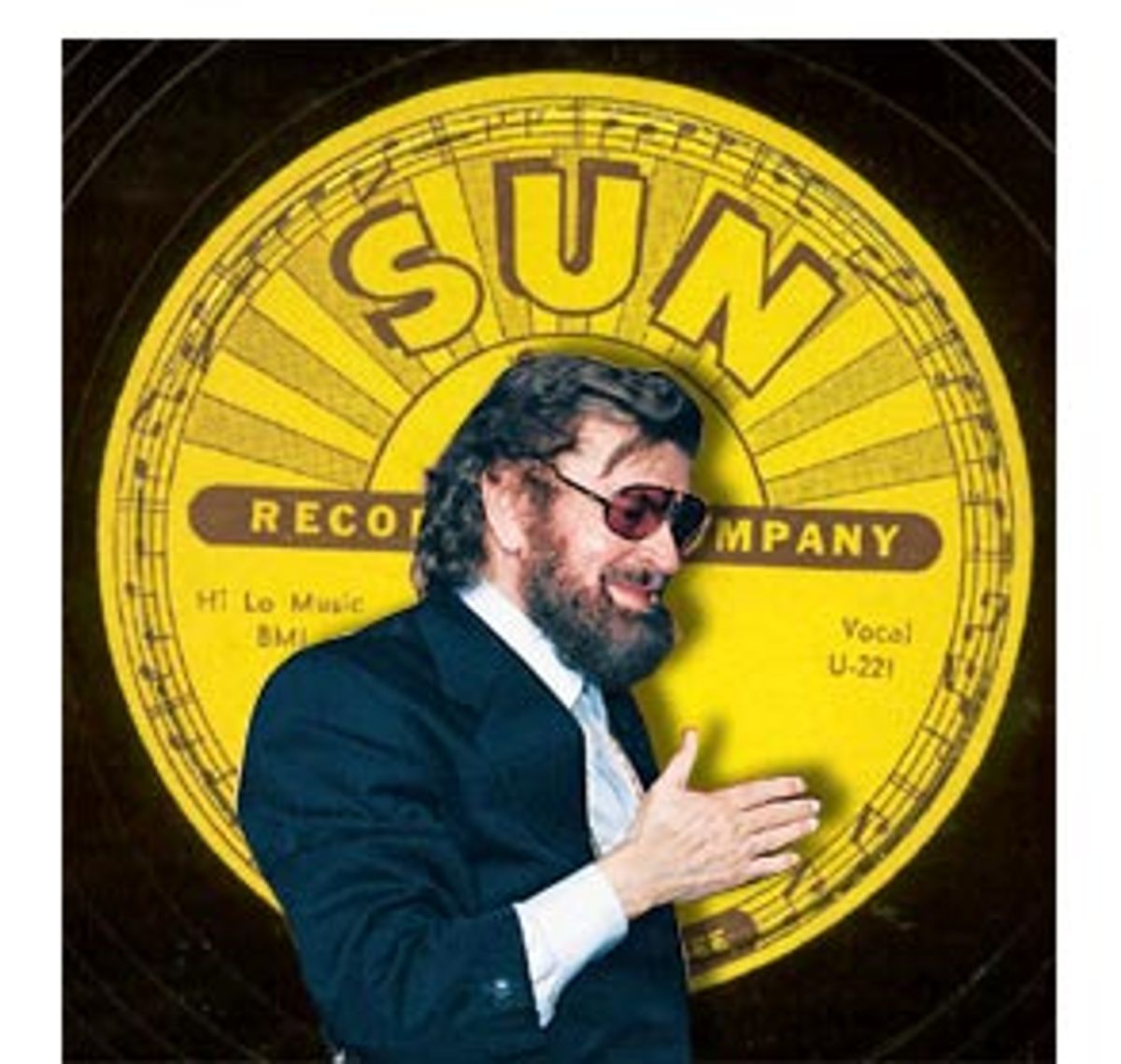
Hiding from the heat at an East Memphis bar, I mention to a friend that I've come to town to interview Sam Phillips. A bearded middle-aged white man at the adjacent stool turns towards us slowly, and in a sarcastic voice says: "How original."
It seems as though everyone in Memphis knows the story of Phillips, which, like the man himself, has become a classic of 20th century American pop culture. In 1954, in a one-room storefront studio called the Memphis Recording Service, home of a fledgling label called Sun, Phillips recorded a teenaged truck driver named Elvis Presley performing an old Arthur "Big Boy" Crudup song, "That's Alright Mama." The record had a feel somewhere between rhythm and country, recognizable as neither black nor white. Several days later, when deejay Dewey Phillips (no relation) played a test pressing of it on his popular "Red Hot and Blue" broadcast on station WHBQ from the Hotel Chisca, the response was instantaneous. He played the record 7 times or 12 times or 4 times in a row, depending on who's telling the story. It didn't matter -- in two years Presley would became the best-known singer in the world. In the half-decade that followed, Phillips launched the careers of some of the greatest performers of American music: Jerry Lee Lewis, Johnny Cash, Carl Perkins, Roy Orbison, Charlie Rich and numerous others, cementing his reputation as the finest record man of his time.
But Phillips' contribution is far broader than the legend suggests. Had he never recorded a white man, Phillips would be remembered today as one of the great pioneering producers for his work with black artists such as Howling Wolf, Bobby "Blue" Bland, B.B. King, and Rufus Thomas. And his unorthodox vision of American society didn't stop with race -- in 1955 he founded WHER, an "all girl" radio station ("One thousand beautiful watts!") that almost single-handedly opened the field of radio to women.
Today, Phillips lives on a nondescript residential street, and the fleet of Cadillacs and Lincolns in front of his house provides the only clue to the identity of the resident. I'm shown inside by Sally Wilbourn, who has been with Phillips since she began working as a receptionist at Sun almost 50 years ago. The man who descends a spiral staircase to greet me looks to be about 55 (he's 78), with reddish hair and beard, dressed in a white T-shirt, tight jeans and a broad black belt studded with chrome rivets. He takes off a heavy pair of purple and gold aviators -- "these are my Elvis glasses" -- and fixes me with the intense pale blue eyes that Sun Records alumnus Jim Dickinson once described as "swirling pools of madness." As we talk, Phillips speaks slowly and at length, with an evangelical flair that friends attribute to an early job at a funeral home.
Afterwards, I ask him to sign an Elvis postcard. He obliges, and also presents me with an issue of Life magazine titled "The 100 Most Important Events & People of the Past 1,000 Years." Inside, at No. 99, sandwiched between the invention of the calendar and the Rosetta Stone, is the discovery of Elvis. Phillips smiles with a mix of irony and genuine pride. "We made it, " he says.
Have you always wanted to be involved in music?
When I was growing up, I wanted to be a criminal defense lawyer, because I saw so many people, especially black people, railroaded. When I was a child I'd go down to the courthouse in Florence, Ala.; they'd have spring and fall Circuit Court. I'd sit on those benches because I'd love to hear the attorneys. To me, they were kind of evangelical in their approach. A lot of times it didn't matter what the facts were -- all you had to do was sway the jury. There was a lawyer in the white cases, if the [defendants] had any property or any cattle or chickens or pigs. The blacks were usually not represented by anyone. I saw both blacks and whites get sentences because they didn't have the money to be represented like they were supposed to. I saw so many people mortgage the homes that they had farmed for generations because their child or a member of the family had gotten in trouble, and they couldn't afford a lawyer.
But I knew I couldn't go to college and become a lawyer -- my brother Judd and I were the only support my mother had after Daddy died, and Judd had joined the Marine Corp. My mother knew I wanted to be a criminal defense lawyer, so I told her a lie: "No, I lost interest, I like radio." My mama died thinking that was what I wanted to do. The only way to get a job back then -- the war had just started -- was to get a third-class radio-telephone operator's permit from the FCC. Well, the closest place I could get that was Atlanta, and I didn't have the bus fare to get to Atlanta. So I got on the radio by accident, because I organized a little 20-piece band for an American Legion gig. Mr. Connely, a manager of a little 250-watt station, asked me if I would announce. I got my first job on "Hymn Time," a 30-minute gospel program.
When you started the Memphis Recording Service, in 1950, it was unheard of in the South for a white man to record black artists. You must have known it would be difficult -- why didn't you gravitate toward something more conventional, like country music or big bands?
I never heard no music I didn't like. I was born and raised on the "Grand Ole Opry," and I thought they were doing a great job in Nashville with country music. I loved the big bands; of course they were falling on disfavor. But they wouldn't have been a challenge to me.
I just thought that black music should be exposed in the right forum, and somebody that purveyed it should not be ashamed of it. As a child, there was a real awakening of my spirit because I had spent so much time around black people. I saw the unbelievable talents that these people had. In Florence, white and black people picked cotton together, plowed together, did everything except quote-unquote socialize. Florence was 12 to 15 percent black, and Memphis was 35 to 40 percent black. When I decided to move there some people back home asked me, "Do you really want to go where there are so many niggers?"
How did you deal with these situations?
You almost have to transpose yourself back to those days, and to what people had to confront. I knew the way whites felt about blacks. I didn't feel that way, yet I didn't condemn the other people because I knew that to a degree they had no control over generation after generation of prejudice. These things I had to deal with, the social situations -- I'm not a shrinking violet -- but I never would have made it had I gone out and tried to challenge. I really found this out when I started Sun -- how deep the resistance was. I just did my thing and tried to do it in the manner in which it would have been most effective for our causes. I say our causes because I knew it would involve mostly black people.
I looked at every distributor, every jukebox operator and every retail customer in the face. When I'd hear [a racist comment] I didn't get into a big argument with them. I listened and learned their feelings. Just leaning on the counter, talking. We just didn't talk about "You ought to have a different attitude ..." I was going to let the product deliver itself. I didn't need to make any damn enemies. There were enough already there.
Rufus Thomas, among others, has said that after Elvis became a star, you lost interest in the black artists that you had recorded during Sun's early days.
When I started recording whites, I was accused of abandoning black people after getting out of them what I wanted. That I was using black people. In actuality it was totally to the contrary. I would love to have kept recording black people, period. And I continued to record some, but not as many. My thinking was that if we could record white people that felt the emotions that were so akin to black people's emotions -- this could broaden the base for the acceptance of that type of feel in music. [I felt that] this would not be achieved in any other way -- maybe never or certainly not as soon as it was.
In working with the artists at Sun, what was the most crucial aspect of your job as a producer?
I had to get their confidence up. You can't record anybody when their damn throat is in their stomach. Having worked in radio, I knew the toughest thing in the world to do is an audition. I knew what they were going through. They were so damn proud, and the toughest thing is: "Lord, I never thought I'd get this opportunity, now I can't blow it." Well that just makes it more difficult.
I would often take less than their capabilities would provide, and I didn't want that, I wanted the best they could provide, I'm real selfish. But it was up to me to set the stage for them, where it looked appetizing. Even if I didn't get what I wanted, they got to the point where they felt like they were maybe not doing it in their garage at home, but close to it. [Try to imagine] a black musician trying to play, looking at some white dude behind a window, and they've been kicked around all their life.
It reminds me of one time going to see a radio executive named Mr. Sudbury, an older man, and Elvis was my chauffeur. When we got there, Elvis asked Sudbury if he could use the restroom. Now you know Elvis was the most polite person in the world. And Sudbury said "Elvis, why don't you go downstairs and use the restroom across the street at the filling station." He wouldn't let him use the restroom. On the way back, it was on Elvis' mind that it was a purely personal thing. He was wondering what he had done. That's how people like Elvis came up. I had to tell him: "I've known Mr. Sudbury for years, and he's just a funny man."
Was there an artist who you felt unable to get the best from?
Probably Charlie Rich. There was not one human being I know who was more talented than Charlie. When I met him I was just blown away by the guy. But the big difficulty I had with Charlie was that he was afraid he was not going to do the thing that would please you. If I had my way I would have spent more time with Charlie, because he needed that. Rather than just coming into the studio -- I never wanted that atmosphere with any of the artists, but Charlie especially needed that. Charlie had a little old studio in his garage. He would go out there and have a couple of drinks and play. I would have given anything to have it rigged with microphones ... I'm just sorry I didn't cut some marvelous thing on him -- it damn sure wasn't his fault. I didn't do him justice; there's no question about that.
How did you come up with the idea for WHER?
I actually had wanted to have an all-black station, but it was blocked. However, a 250-watt daytime station became available. At that time, women weren't in radio. So I got this wild-ass idea. Becky, my wife, and I met in a little station back in Alabama. I said, "Becky, I've got a wild notion that women in radio could have some appeal. But how in hell are we gonna get anybody who can compete in this market?" The people who came in to record for me [at Sun] had never seen a radio station much less a recording studio. And I thought -- these girls can be taught, too.
It wasn't all woman, it wasn't all female, it was all girl. I don't give a damn if they were 50 years old, they were all girls. There will not be any experience greater than that. Everybody had to work their own board, and [in the beginning] most of them didn't know what a turntable was. These girls were up to snuff in the shortest period of time. We broke another barrier, and that is in the matter of five years there were women in radio everywhere. Every person at WHER was a girl, except I couldn't find a girl head engineer.
"One thousand beautiful watts" was our slogan. But I never thought of it as a novelty. I really believe this little radio station transposed itself into markets all over the country. We started a second all-girl station in Lakewood, Fla.-- WLIZ. I hired girls who had no experience and it became the hottest thing in that market. It was easily 75 to 100 women who got their start at these stations.
In the 1950s, you broke half a dozen national stars from a storefront studio in Memphis. Today, with the corporate takeover of radio and the prevalence of independent promotion and other pay-for-play schemes, do you think a small record company can hope to duplicate your feat?
There's not an opportunity for the people who can do it. Payola, that is real bad, but it's a symptom of the problem and not the problem itself. Today, the greatest form of communication in this world does not matter one iota to the record companies, the big ones. Most radio is programmed by someone who has never talked to a creative person. Even the manufacturers won't gamble on something different.
What do you think? BMG? They don't give a shit what you sound like, they ain't going out knocking on doors. They ought to be beating the bushes for entrepreneurial people that are hungry who can and want and will shake the talent out of the trees. Hasn't even entered their minds. All they want to do is build bigger studios and get more synthesizers and all this shit. I have nothing against improved sound; in fact I'm for it. But my God, let's don't substitute sound for soul and feel.
They think that they can get an artist and build them up. Now I believe in promotion. But deliver music that can revolutionize, whatever category it's in. And you will only get that from hungry people, who want to do that, and do it unselfishly. I realized early, that if I had gone into what I was doing for the wrong reasons, it never would have happened for me. That is what worries me the most. If we thwart creativity in any way, we hurt the soul of the greatest thing that we will ever be exposed to, and that's music.
Shares