

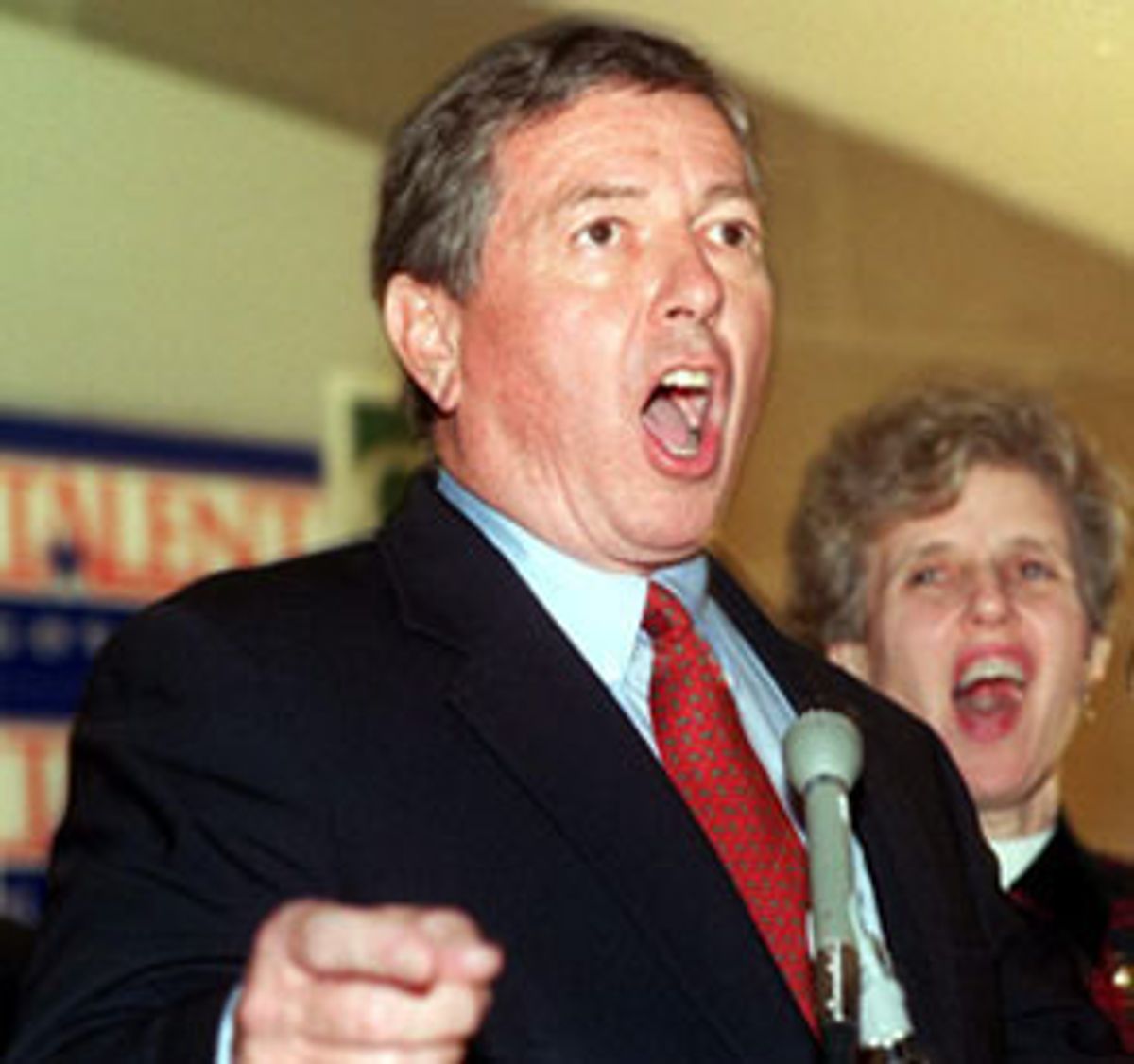
Can John Ashcroft be stopped? With Trent Lott shoring up his own flagging support by putting his full weight behind the attorney general nominee -- and with liberal public-interest groups churning out opposition research and declaring all-out war against him -- the Ashcroft confirmation hearings scheduled to begin Tuesday are taking shape as the defining early battle for political primacy in the dawning Bush restoration.
Forget the Linda Chavez imbroglio: By lying to Bush and the FBI, Chavez Borked herself out of the labor secretary job in a way that gained the Democrats little and cost Bush less. Ashcroft is the game that counts.
And there is far more involved than Beltway bragging rights. For some sense of the stakes in this fight, turn to Janet Reno's farewell speech to the Department of Justice on Thursday. As Reno expressed her thanks to each of her agency's divisions in turn, it provided a vivid portrait of the sweep of agencies Ashcroft would now command. Not just those high profile outfits like the FBI and the Civil Rights Division, but offices dedicated to taxes, to consumer protection, to victims of crime, to the environment, on and on. Ashcroft, serving a new president who seems to rely more heavily upon his Cabinet and advisors than any chief executive in memory, would assume office vested with unprecedented power, touching a broad panorama of daily life.
Yet for all the ruckus over Ashcroft's conservative extremism -- his opposition to abortion and contraception, his hostility to African-American interests and his vision of a highly permeable church-state wall -- it's striking how Senate Democrats like Judiciary Committee chairman Patrick Leahy and senior Democrat Joe Biden have so far accepted George W. Bush's description of Ashcroft as a "man of integrity." Democrats, while preparing to grandstand on a handful of hot-button issues, seem content to allow Bush and Ashcroft to frame the basic story he will carry into the confirmation hearing.
In fact, Ashcroft's record on at least a few key issues ought to be enough to call into question that "man of integrity" image, at least if "integrity" implies some commitment to public interest rather than marital fidelity and an aversion to dancing. Consider one issue far removed from abortion, or gay rights, or desegregation, or any of those ideological fault lines: healthcare. As a senator, Ashcroft has for years carried water for some of the greediest players on the healthcare scene: pharmaceutical companies, for-profit HMOs, insurance companies, all at the expense of consumer interest.
With all of the emotion surrounding Ashcroft's stands on abortion and school desegregation and the death penalty, this key part of his record has received short shrift. Yet think back to 1993, and recall that what initially roused opposition to President Clinton's first nominee for attorney general, Zoe Baird, was not her "nanny problem." It was her career as top lawyer for an insurance conglomerate -- a background, many public-interest advocates pointed out, that imperiled her ability to serve as the People's Lawyer on the increasingly crucial terrain of healthcare reform.
With Ashcroft those same healthcare profiteers have won the grand prize, but they paid well for it. Between 1994 and 1998 the pharmaceutical industry, insurance industry and various anti-consumer healthcare lobbies paid out nearly $1 million in contributions to Ashcroft's reelection campaign. Ashcroft returned the favor on multiple occasions: Four times in the last year he voted against prescription-drug benefits for Medicaid recipients; twice he helped kill the bipartisan Patients' Bill of Rights, which would have allowed consumers to sue managed-care companies for delayed or denied care. He also backed a phony business-sponsored Patients' Bill of Rights that would prohibit consumers from suing their managed-care providers.
In the case of one pharmaceutical giant, the Schering-Plough Corp., Ashcroft's services -- and compensation -- were even more explicit. In 1999 Ashcroft, chair of the Senate's subcommittee on patents, played a pivotal role in extending patents for several drugs, most significantly Schering-Plough's allergy medication Claritin. By keeping Claritin from going generic, Ashcroft cost consumers an estimated $10 billion. One month after the patents were extended, Schering-Plough returned the favor with a $50,000 Ashcroft contribution.
What's that? You say carrying water for the managed-care mafia is just Beltway business as usual? Then how about this: When Ashcroft was governor of Missouri, he specialized in rewarding his high-rolling contributors by naming them judges. As the St. Louis Post-Dispatch reported in 1988, 12 of Ashcroft's first 24 appointees to the Missouri bench or their spouses were contributors.
And that was just the beginning. Over eight years as governor, Ashcroft had the opportunity to name seven justices to the state Supreme Court -- in fact, to fill every seat. As People for the American Way notes in a report on Ashcroft's Missouri record, five of those seven justices were the Man of Integrity's cronies, either close personal friends, subordinates or political and financial supporters. One of those appointments -- of a 33-year-old aide just eight years out of law school, with no judicial experience -- led the state Legislature to attempt to curb Ashcroft's nomination powers. Another had contributed $1,000 to Ashcroft just weeks before he named her to a lower state court, a few years before her Supreme Court appointment.
Is this an attorney general to entrust with the federal courts? Look at Ashcroft's Missouri record and the picture that emerges is of an individual who can most generously be called ethically challenged -- a striking nomination from a president who has promised an administration free of scandal.
The point is that Ashcroft's "man of integrity" image need not be the governing narrative of this confirmation. That Democrats like Biden and Leahy have so far let this yarn take shape reflects a fundamental problem for Ashcroft's opponents: The biggest obstacle to defeating Ashcroft may be Judiciary Committee Democrats themselves.
The Bush team understands this, because they remember well the fiercely contested nomination of Clarence Thomas to the Supreme Court under President-elect Bush's father. Today, Thomas' hearing is remembered almost entirely for law professor Anita Hill's incendiary charge of sexual harassment. But anyone who sat through those hearings -- as I did -- knows one of Washington's best-kept secrets: that it was bungling by key Democratic senators that ensured Thomas' confirmation to the Supreme Court.
The Thomas episode is worth recalling, heading into the Ashcroft hearings, because Ashcroft, like Thomas, uses a story of heartland integrity to disguise troubling questions both about his idiosyncratic conservative extremism and his ethical shortcomings. Indeed, the Thomas hearings in some respect are a model for the Ashcroft confirmation fight already underway.
Republicans had already been savaged by the Supreme Court confirmation process, when the Democrats defeated Judge Robert Bork in 1987. The fight over Bork linked Washington civil-liberties lobbyists with extensive grass-roots constituencies outside the Beltway -- labor, civil rights groups and reproductive-rights activists. And the prospect of future "Borkings" of nominees with extensive far-right track records led to a series of "stealth" nominations by Reagan and Bush. Indeed, one John Ashcroft, then governor of Missouri, was rejected by President Bush for a midterm vacancy in the attorney general post because he was thought to be too polarizing a figure.
So when Bush nominated Clarence Thomas to the Supreme Court in the summer of 1991, it seemed a singularly shrewd political move -- replacing outgoing Justice Thurgood Marshall with a conservative African-American. Yet despite Thomas' race, there was much about his record that could have provided fodder for shrewd senators -- alliances and writings nearly as provocative as Ashcroft's Southern Partisan interview or Bob Jones speech.
Thomas was on the editorial board of a fiercely anti-civil-rights journal. His close friends included paid lobbyists for South Africa's apartheid government. He praised anti-abortion articles. He'd written in opposition to the minimum wage. He also came to those hearings -- well before Hill's allegations surfaced -- with a long and documented history of dissembling, on everything from his troubles as head of the Equal Employment Opportunity Commission to his own sister, whom he falsely described as foundering on welfare.
Had Democrats pursued those questions, Anita Hill's allegations might have seemed less crucial. Yet among the Judiciary Committee's Democrats, only Sen. Paul Simon of Illinois and Howard Metzenbaum of Ohio -- both regarded as left-wing cranks by the media -- bothered to press Thomas on such keys to his character. Instead, before Anita Hill surfaced, committee chair Joseph Biden led Thomas down long, meandering walks through the doctrine of "natural law" that Thomas was said to subscribe to -- arguments that went nowhere and failed to captivate either senators or the public.
And after Hill's charge of sexual harassment went public, the situation went from bad to worse. Judiciary Republicans Orrin Hatch and Arlen Specter went on the attack against Hill. Democrats, meanwhile, mounted no comparable line of inquiry against Thomas or defense of Hill. As Sen. Simon later recalled, "One side had advocates, the others did not ... [Democrats] did not sit back and ask ourselves what was happening, in terms of public perception, and how we might deal with that."
In the end, the Senate confirmed Thomas by a 52-48 margin. Two Republicans opposed him, and 11 Democrats voted for him. Weeks later, he was sworn in as the 106th justice on the U.S. Supreme Court.
What led the Democrats to bungle their encounter with Thomas? In part, it was the sheer vanity of then-committee chair Biden. Biden -- who a few years earlier had been caught plagiarizing a speech by British labor leader Neil Kinnock -- still harbored presidential aspirations and was fearful of appearing prosecutorial. The Delaware Democrat has long been one of the Senate's most famous wafflers on controversial nominations, perhaps because he so fears being seen as in the pocket of any constituency that he is late to read the clearest writing on the wall.
In 1986, he praised Bork as a qualified conservative and promised to vote for him should he be named to the Supreme Court: "I'd have to vote for him, and if the groups tear me apart that's the medicine I'd have to take." Yet a year later he ended up opposing Bork's nomination -- only to grow so bitter toward liberal anti-Bork lobbying groups for what he viewed as distortions of his statements that he refused to meet with them anymore. The bad blood between Biden and civil rights groups hampered the opposition to Thomas.
And in 1991, he was as equivocal on Thomas as he'd been about Bork, first praising and then ultimately opposing him with a long awkward period of fence-straddling in between.
But even more important, Biden and the other Judiciary Committee Democrats were effectively disarmed by two weapons Thomas brought with him into the confirmation room: the sponsorship of his first boss and patron, Sen. John Danforth, with whom Thomas visited virtually every member of the Senate in advance of his hearings; and a compelling personal story of a hardscrabble childhood in Pinpoint, Ga., a narrative of rising from the poverty of the segregated South to Yale Law School and the federal bench. On one of Thomas' shoulders stood the angel of senatorial courtesy, on the other sat Horatio Alger.
With John Ashcroft, Bush strategists have invited those two angels back. Ashcroft, too, is a Danforth protégé. Ashcroft, too, has a compelling personal narrative -- not a Horatio Alger story this time, but a faith-drenched tale of family integrity: his minister father inviting black missionaries into the family home in segregated Missouri; Ashcroft's devout religious practice; his charity toward gay and minority staff members. As with Thomas, Republicans hope that Ashcroft's public stature and personal story will disarm Democratic opposition, no matter how many provocative speeches, articles and campaign contributions surface.
What's more, the Republicans may have an Anita Hill they can demonize. There are already indications that Ashcroft's advocates are planning to rough up Missouri Judge Ronnie White to legitimize Ashcroft's opposition to his federal appointment. White himself is expected to testify at the Ashcroft confirmation hearing this week. So once again, the Judiciary Republicans may go on the attack against an African-American accuser -- and it will be interesting to see if Democrats mount a more effective counteroffensive this time, or if they simply hang White out to dry as they once hung Hill.
The early signs suggest that the Republicans' strategy could work. The influential Biden is reprising his muddled role, declaring within days of Ashcroft's nomination that he was "inclined" to vote for the nomination, only to back off on Sunday talk shows a few days later. Meanwhile Republicans keep sticking to a clear and simple message: that Ashcroft's record of integrity will carry the day.
The irony is that the climate for defeating Ashcroft is far more favorable than that faced by Thomas' antagonists in 1991. The unintended byproduct of President Clinton's impeachment was to reveal in the American public a deep mistrust of moral extremists in the John Ashcroft-Ken Starr mold. The excesses of the war on drugs, the exonerations of death-row inmates and concerns about the cost of the nation's burgeoning prison population have all reduced the appeal of the hard-line, law-and-order agenda pursued by Ashcroft in Missouri and in the Senate.
And Clarence Thomas was nominated in the shadow of the still overwhelmingly popular Ronald Reagan; Ashcroft goes to confirmation on behalf of an administration that lost the popular vote. Thomas' odder writings were circulated only among a small circle of opposition lobbyists and journalists; Ashcroft's praise for the neo-confederate Southern Partisan is available on the Internet for all to see.
The question, then, is not whether the public could turn against Ashcroft. Between his dinosaur conservatism, his extreme opposition to reproductive rights -- even contraception -- and his paid service to the insurance industry, going after Ashcroft in today's climate is like shooting fish in a barrel. The question is whether Senate Democrats have the sense to recognize their political opportunity, and the strategic capacity to tell a different story about the Man of Integrity.
Shares