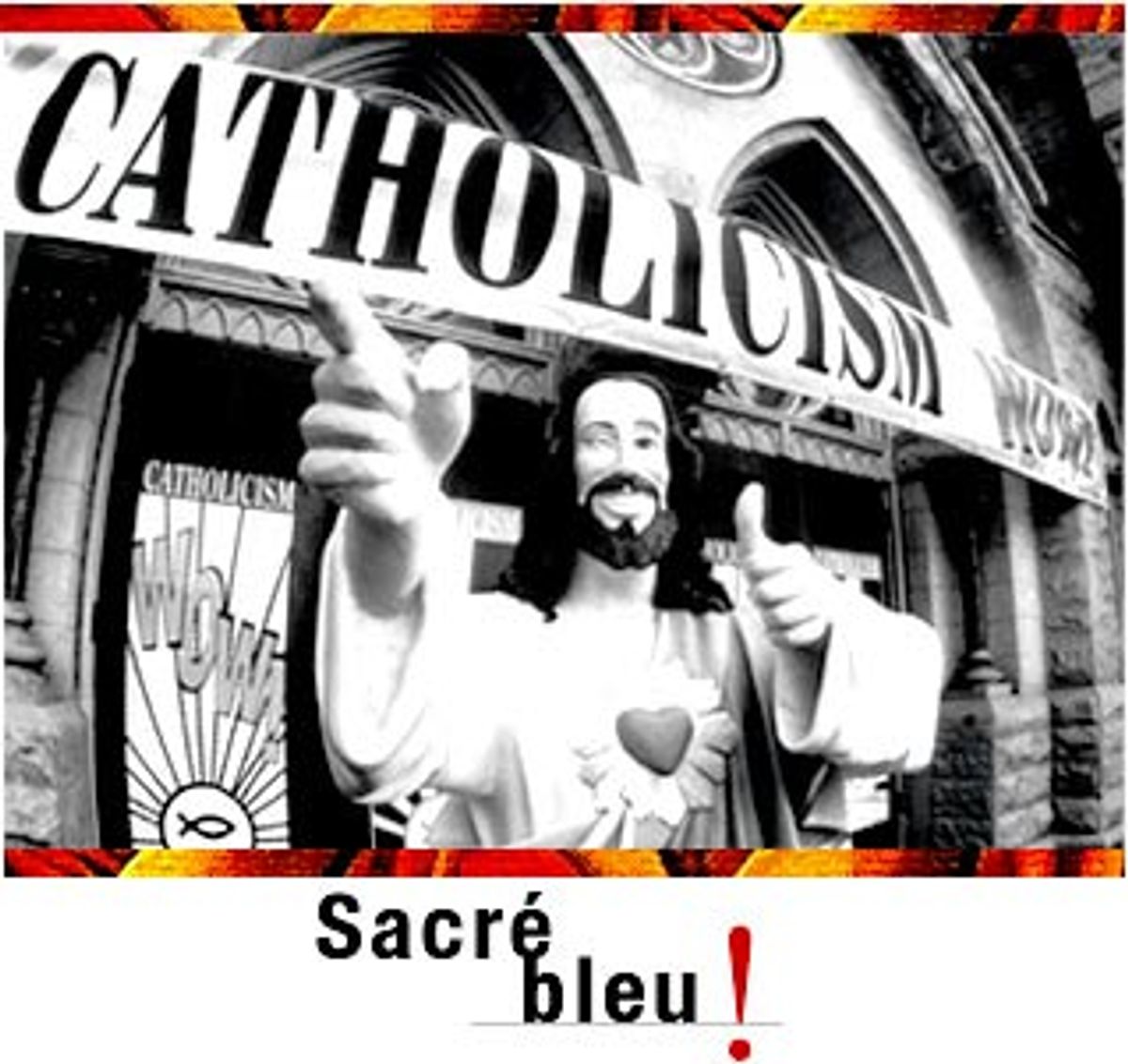
"We've come a long, long way together. Through the hard times and the good. I have to celebrate you, baby, I have to praise you like I should."
-- Fatboy Slim, "Praise You"
In Kevin Smith's "Dogma," an immortal creature (played by Salma Hayek) says in frustration to a group of humans, "You people don't celebrate your faith; you mourn it."
The line may very well be the fulcrum of the movie -- a picture that Smith, who says he is a practicing Catholic, has called a "trifle." But "Dogma" is more than a trifle, and Smith knows it. It's a fable about the mysterious nature of God, and it wrangles with some intense spiritual questions -- particularly the issue of what it means to want to be a "good" Catholic and yet to feel at odds with some of the church's doctrines. The conclusion that "Dogma" reaches -- that God exists, and that she is a loving God (as well as one with both a sense of humor and a penchant for Christian Lacroix bustiers) -- is startlingly heartfelt. "Dogma" is hardly a movie made by a hateful man.
But in order to come to that conclusion, or any conclusion, you'd have to actually see it first -- something that most of the Catholics who've already targeted it as blasphemous (or, at the very least, as a grievous instance of Catholic-bashing) seem to have no intention of doing.
"It's one of those Howard Stern insult toilet-humor attacks, where you see a woman who is purportedly a descendant of Jesus who just happens to work in an abortion clinic," says William Donohue, president of the Catholic League for Religious and Civil Rights, which began protesting the movie earlier this year, after the script became publicly available over the Internet.
Though Donohue claims he's at least willing to see the movie, he admits that his mind is pretty much made up. "Let's put it this way," Donohue says. "I will go to see it when it comes out Nov. 12. My life doesn't turn on seeing 'Dogma.' I think I probably could see it in my sleep, having read enough about it and written about it for well over a year."
Apparently, the reviews alone provided the Catholic League with enough fodder to pull together and distribute an anti-"Dogma" booklet last spring, consisting of brief quotes about the movie (most of them from critics' Cannes round-ups) and selections from interviews Smith has given. In his introduction to the booklet, Donohue makes the point that most critics weren't bothered by the "anti-Catholicism" of "Dogma," and their indifference is a large part of the problem: "When demonstrating the reality of anti-Catholicism (or any form of bigotry), there's no better evidence than to cite chapter and verse what the offenders, and their sympathizers, have said." The Catholic League's booklet doesn't overtly advise Catholics to stay away from the movie (it was compiled long before the movie's release date), but it certainly amounts to an implicit call for a boycott, if not an overt one.
If reading about a movie can be equated with seeing it, then why should any of us ever leave the house? How much credence should artists of any stripe -- painters, filmmakers, writers -- give to the views of people who simply can't be bothered to evaluate their work based on direct experience? But the bigger question is, if we're fixated on running every movie, every painting, every book through our own personal-affrontery filters (that is, assuming we actually bother to see or read what's in front of us), how are we ever going to be able to evaluate art intelligently and openly?
Many religious groups speak up now and then when faced with a work they find offensive -- the Ayatollah Khomeini's fatwah against Salman Rushdie being the most famous (and most extreme) example. The cultural watchdogs of the Catholic faith, particularly the Catholic League (which is not an official church organization, though its offices are in the same building as Cardinal John O'Connor's office, on First Avenue in New York), have been especially busy these days, leading the crusade not just against "Dogma" but also against Chris Ofili's painting "The Holy Virgin Mary." Ofili's work is part of the "Sensation" exhibit at the Brooklyn Art Museum, a rendering of the Virgin that incorporates elephant dung and images of anuses and vaginas clipped from porn magazines.
The Catholic League has deemed the painting deeply offensive to the Catholic faith, and it typifies what Donohue claims is a virulent strain of anti-Catholicism in contemporary art. "I don't know of any segment of the population which is more arrogant than the artistic community," Donohue says. "They seem to think that they have a carte blanche right to the public's purse and yet want to be held to no standards whatsoever of public accountability."
Clearly, neither Ofili nor Smith has held himself to any standard of public accountability -- and to anyone who believes in the First Amendment and the unassailable necessity for the separation of church and state in this country, that's a sure sign that there is a God after all. But even if you look at the long line of officially accepted Catholic art -- much of it commissioned by the church itself -- you're bound to find a work here and there that isn't easily explained as a flat symbol of devotion. When you assume that all "good" Catholic art is toothless, devoid of electricity, you run the risk of actually diminishing its greatness.
When we think of Catholic art, we think of cathedrals built to make men feel like munchkins, or endless and relentlessly European renditions of the Madonna and Child. But what about the essential weirdness of a sculpture like Bernini's magnificent "Ecstasy of St. Theresa" -- weirdness that's only intensified by the work's exquisite beauty? Bernini's St. Theresa is generally accepted as a representation of deep spiritual mysteries. It's also undeniably kinky -- unless you can think of another way to explain why the Carmelite saint's head is thrown back, her lips curved into a gentle suggestion of a smile in anticipation of some exquisite pleasure, as a rather adolescent-looking angel fixes to pierce her breast with an arrow. That's not to diminish the sacred nature of the subject matter. If anything, I'd argue that it intensifies it: This isn't your garden-variety sexual encounter, but one whose erotic charge has the power of the Almighty behind it. It's almost enough to make a girl want to run out and become a Carmelite.
Ofili is no Bernini. Indeed, the Catholic League has argued that his painting isn't art, period. But just as the anti-"Dogma" cause has been taken up by people who have no interest in actually seeing the movie, it's likely that few of the Catholics protesting Ofili's painting have seen the actual work at all, which is now behind Plexiglass and minded by a full-time guard. (A federal judge ruled last week that New York Mayor Rudy Giuliani's efforts to cut the Brooklyn Museum's financing and to evict it from its quarters amounted to a violation of the First Amendment, saying that it's not the government's business "to suppress real or imagined attacks upon a particular religious doctrine, whether they appear in publications, speeches or motion pictures.")
By now everyone has seen a small reproduction of Ofili's painting, and everyone has heard that some artist has "thrown" elephant dung on the Virgin. Of course, most sensible people realize that the dung is hardly thrown (if anything, it's very artfully placed), and they've also taken into account that Ofili is of Nigerian descent. (In African culture, elephant dung is often a symbol of regeneration.)
Yet from looking at a small reproduction it's impossible to gauge the painting's obvious celebratory nature. Ofili's Virgin is surrounded by a swirling mosaic of gold dots (apparently, they're map tacks), recalling the tradition of gilt religious portraits. The two balls of elephant dung that provide a pedestal for the painting are decorated with the words "Virgin" and "Mary" written in glitter paint.
If you were to ask devout, hard-line Catholics (who will probably tell you that any other kind of Catholic is no Catholic at all) why the idea of a "Dogma" or a "Holy Virgin Mother" is so offensive, they'd be likely to tell you that the church, or the Virgin herself, is like their mother. And they'd ask you, as several of them asked of me, "Would you like to see your mother insulted and desecrated?"
It's a tack designed to tug at our heartstrings: Mom, surrounded by images of vaginas? (Does that mean we have to admit that she actually had one herself?) As entreaties go, this one isn't particularly persuasive. Most of us love our parents, but that love is often complex and sometimes conflicted. Parents, like venerated religious figures, are sometimes complicated and mysterious beings, and artists and filmmakers often do some very fine work mining their complicated feelings toward them.
But apparently, the Catholic Church isn't the kind of mother who tolerates complicated feelings. The Catholic League's outrage over the Ofili painting -- and the fact that both Cardinal John O'Connor, of the archidocese of New York, and Bishop Thomas Daily, of the diocese of Brooklyn, have supported the organization's, as well as Rudy Giuliani's, view -- suggests that neither the Catholic League nor certain powerful members of the church itself are willing to face up to the complicated questions some Catholics have about their faith. Ofili says he is a Catholic himself, and the placard for his painting reads, "As an altar boy, I was confused by the idea of a holy Virgin Mother giving birth to a young boy. Now when I go to the National Gallery and see paintings of the Virgin Mary, I see how sexually charged they are. Mine is simply a hip-hop version."
What's more, no Catholic group has mentioned this Virgin's color. She's black, and you can't help wondering if Ofili's decidedly Afrocentric treatment is an unspoken part of their problem: "This isn't the Virgin we know." In Ofili's view, the idea of a black Madonna actually answers more questions than it raises -- if Ofili sees her as his mother, as the Catholic faith asks him to do, then why shouldn't he envision her as a black woman?
It's also worth evaluating Ofili's painting within another context: The literature of the Catholic Church is filled with references to Mary's "womb." It's a tame, dignified, motherly word, suitable for a holy virgin. The pedestrian extras -- things like anuses and vaginas -- are left to the rest of us unholy girls. By surrounding his Holy Virgin with images of anuses and vaginas (they're cut, from porn magazines, to resemble stylized butterflies, and they're obviously substitutes for putti), Ofili is reminding us that she was indeed a human, with all the attendant parts. He may even be suggesting that acknowledging them might seem pornographic to the faithful. It's also one way of freeing us -- especially those of us who are women -- from the tyranny of the Virgin's sexual purity.
The church may not particularly like that view, but how can it deny that it exists? Lord knows there are plenty of scholars who have pointed it out. "Unlike the myth of the incarnate God, the myth of the Virgin Mother is translated into moral exhortation," writes Marina Warner in "Alone of All Her Sex: The Myth and the Cult of the Virgin Mary." "Mary establishes the child as the destiny of woman, but escapes the sexual intercourse necessary for all other women to fulfill this destiny. Thus the very purpose of women established by the myth with one hand is slighted with the other. The Catholic religion therefore binds its female followers in particular on a double wheel, to be pulled one way and then the other, like Catherine of Alexandria during her martyrdom."
Maybe what will finally sink groups like the Catholic League in their efforts to snuff out works that it believes are offensive is that these protests carry more than a whiff of condescension toward the very people they're designed to "protect." The point of such protests -- so transparent it can't even be considered a subtext -- is that art that questions or challenges sacred beliefs is unacceptable. The message is that Catholics require a kind of cultural baby-sitting as if they were, to use one of the more common Christian metaphors, merely sheep.
It's hard to tell if many of the world's devout Catholics want to be considered sheep, or if that's simply the role that their church has assigned for them. "People are ultimately responsible to God for their own souls, and their conscience. The church is there in order to guide people toward heaven, toward salvation," says the Rev. John McCloskey, director of the Catholic Information Center of the Archdiocese of Washington. "Ultimately the person is responsible for accepting that advice or not, according to the circumstance. At the same time, by the very fact of making a commitment to being a serious Christian in the Catholic faith, that means that they will be docile and open and listening very carefully to what the church says on a particular issue or another."
But when we're talking about interpreting the culture around us -- and the wide range of experience it covers -- docility is just another way of relinquishing responsibility. Why bother to seriously consider art, or anything else for that matter, when you have a 2,000-year-old institution to do it for you?
I saw for myself a particularly gentle and toothless protest, one that I'd say exemplifies docility: a quiet prayer session led by the Organization for the Defense of Tradition, Family and Property (TFP), from Pennsylvania, outside Lincoln Center at the New York Film Festival premiere of "Dogma" on Oct. 4.
TFP is not recognized by the Catholic Church; in fact, Donohue calls the group "a cult." But as a bunch of polite, rather zombified subjects who take the church's teachings very, very seriously, you couldn't find a more tractable group. Its "protest" consisted of a few speakers (using mics but not bullhorns, the tactic that Donohue prefers when he goes out with his posse) and some recited prayers, and the protesters sang a few songs. Most of them stood well behind the barricades that had been set up for them. At the end, the speakers thanked the police for providing crowd control (as if there had actually been a need) and the group filed away so quietly, I barely knew they'd gone -- I simply looked up and noticed that their street-festival-style Madonna statue was bobbing noiselessly down the street.
I had spoken with some of the TFP people while the protest was under way. I found myself feeling strangely protective of some of them. Many were around 60 or older, wearing kerchiefs and simple tops or cardigans, clutching rosaries and holding aloft gently garish portraits of the Blessed Mother. A few gangly adolescent girls, wearing prairie skirts almost down to their ankles, distributed literature from behind the barricade. I didn't witness a single instance of rudeness on TFP's part. I did, however, hear several taunts hurtled by some of the film-festival goers as they passed by; perhaps they were feeling smug in their cultural sophistication, but this eerily meek group was too easy a target. They'd spent an awful lot of money to come to New York in order to stand around quietly and hand out a few brochures.
Two of the women I spoke with -- middle-aged and conservatively dressed, they seemed birdlike and anxious -- told me they hadn't seen the movie, but they'd read about it and had heard how offensive it was: "We hear that Joseph and Mary are portrayed as not being virgins, and that Mary had a daughter. The sacrament of the Mass is made to look like bad sex. There's a 13th apostle that's very foul-mouthed," said Andrea Taylor, who'd come from Scranton for the event. "There were some things in it that were so bad, you can't even speak of them."
Taylor and her friend talked about "Dogma" with a kind of wide-eyed enthusiasm, the way a very young child might answer questions about sexual intercourse, embroidering the act beyond all human recognition because they really have no idea what they're talking about. Armed with their reviews and their second- and thirdhand accounts (most of them, it seemed, taken from the Catholic League booklet), they'd reinvented "Dogma" for themselves, endowing the movie with their own halo of hyper-reality. The church would be hard-pressed to find more ideal innocents.
Again, of course, the most vocal Catholic groups do not represent the official views of the church. But McCloskey notes that the Catholic League is "totally faithful to the church" -- which suggests that by and large, the church is probably happy to let it wield the bullhorn.
When the church as an organization does make itself heard, it's much more likely to offer guidelines like "Toward a Pastoral Approach to Culture," prepared by the Pontifical Council for Culture and available on the Vatican Web site. The guidelines are designed to give members of the Catholic clergy some ideas for advising their constituents about navigating the surrounding culture. Among the pronouncements included in the guideline is a definition of culture, which, taken by itself, is as sensible and as open an explanation as you're likely to find anywhere: "Culture only exists through man, by man and for man. It is the whole of human activity, human intelligence and emotions, the human quest for meaning, human customs and ethics. Culture is so natural to man that human nature can only be revealed through culture."
So what do we make of Kevin Smith's "Dogma," as it encompasses experiences or feelings that many of us -- Catholics and non-Catholics alike -- have had? Smith, who insists that his movie isn't Catholic-bashing but is "pro-faith," has made a picture about the nature of God, with a comic-book sensibility. It does feature, as Smith readily admits, plenty of fart and dick jokes, as well as a character who is alleged to have descended from the Virgin Mary and who works in an abortion clinic.
Smith's movie expresses some doubts, but it's ultimately a serious examination of the nature of faith -- not an attempt to shatter it. There's some anger in "Dogma," but that's also what makes it unfailingly passionate, as well as entertaining. And in the end, "Dogma" is incredibly touching, perhaps precisely because Smith is so honest about his doubts, as well as about his unabashed love for his faith. In the context of that Vatican council's definition of culture, can doubt be considered an angle of human nature and experience? What about poop jokes? What about questioning the validity, as Smith does, of the idea that after the Virgin birth (which, by the way, Smith never refutes), Mary actually had sex with Joseph and raised a purely human family? That idea cuts against the church's notion of Mary as a sexually pure being, but it reinforces the equally revered notion that family and motherhood are sacred. There are Catholics who may not like Smith's conclusion -- but why is there anything wrong with exploring the questions?
McCloskey insists that the church isn't closed off to questioning. "There are lots of different ways to question," he says. "There's a way to question that shows a lot of eagerness to learn, without having to express those questions in a way that's offensive."
But it's still hard to understand why Smith's movie -- or any work of any sort -- shouldn't be taken by Catholics on its own terms. (To his credit, even Pat Buchanan dropped into the Brooklyn Art Museum last week to see Ofili's painting. He decided it was offensive -- but noted that his training as a journalist required that he see it for himself before making any pronouncement.) When I mentioned to both Donohue and McCloskey that Kevin Smith says he is a practicing Catholic -- noting that they'd probably consider him a "cafeteria Catholic," one who picks and chooses from among the doctrines -- they both dismissed his claim out of hand. "A cafeteria Catholic is basically a person who's saying that their Catholicism is their own," McCloskey explains. "But it's not the church's. And the definition of that is the Protestant."
Only Kevin Smith knows what kind of a Catholic he is. (If the pastor of his church has any doubts, he might do well to return every dollar Smith has ever dropped into the collection basket.) At the New York Film Festival press conference, Smith noted that he's tried to get his wife to attend Mass with him. She refuses, on the grounds that she wants nothing to do with the people who have treated him so badly. Some of the more extreme protests against the movie have included death threats sent to Smith as well as viciously anti-Semitic letters sent to Miramax's Bob and Harvey Weinstein, who bought the film with their own money when Disney, Miramax's parent company, dropped it last spring.
Smith has also said publicly that he's glad he was raised Roman Catholic. Even if, in the church's eyes, Smith is considered a "Protestant," his avowal of faith isn't exactly common. How many times do you hear a member of the lapsed faithful (I count myself among them) expressing gratitude for having been raised in the church -- compared with the number of times you hear them complaining about having their hands whacked by a nun's ruler?
But in the church's eyes, Smith isn't playing by the rules. He's gone and thought for himself, which probably isn't considered as bad a sin as murder, but may come in a notch above adultery on the scale. But worst of all, it's a shame that the noises made by the most vocal Catholic groups will probably keep many Catholics away from "Dogma." They'll never know how joyful it really is. Celebrating your faith, as either Smith or Ofili could tell you, is very delicate business. Just look what happens when you praise it like you should.
Shares