

"Would you like something to read?"
"Do you have anything light?"
"How about this leaflet, 'Famous Jewish Sports Legends.'"
-- "Airplane"
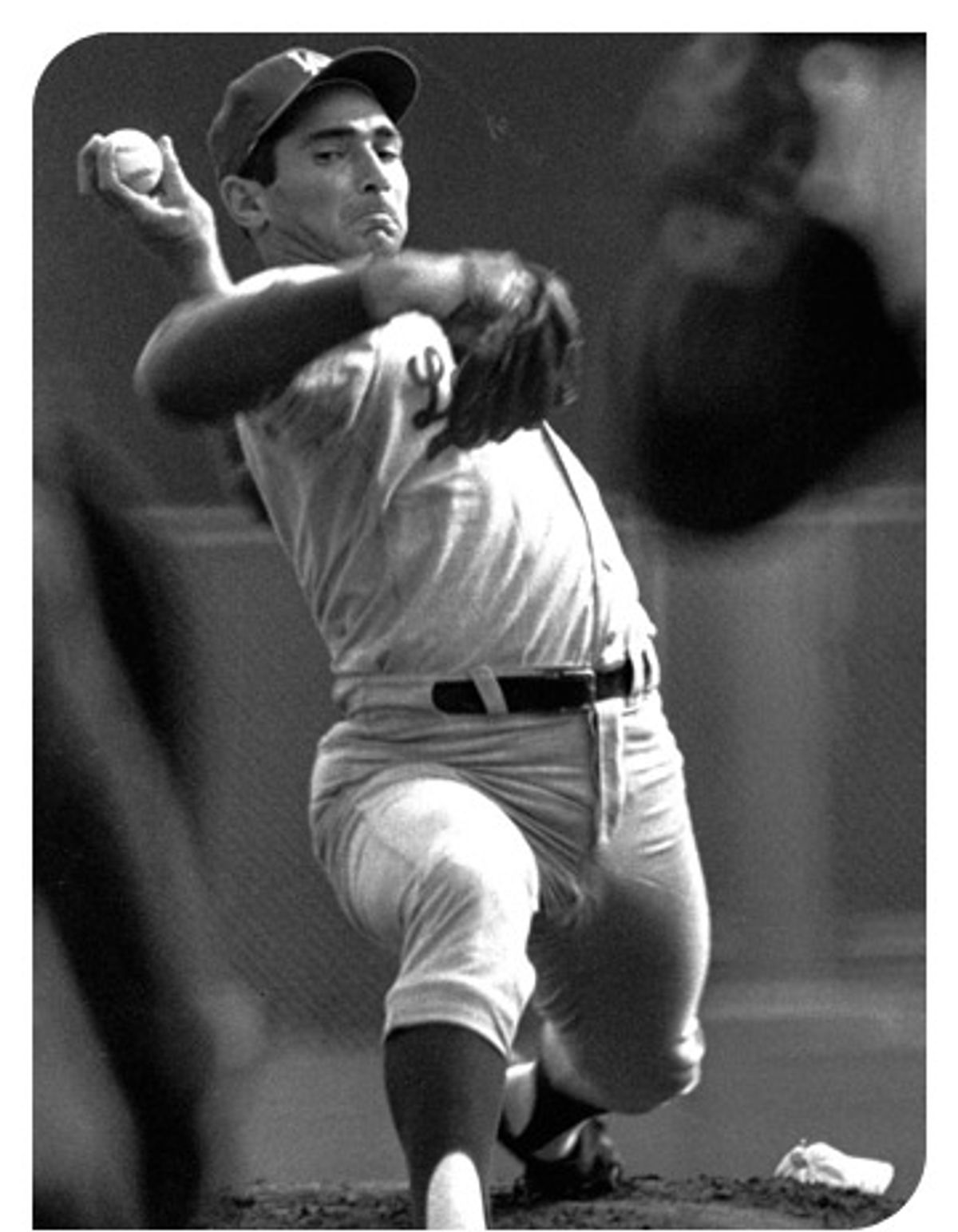
Mark Spitz, the seven-time gold medalist swimmer at the 1972 Olympics, is Jewish. So's Dolph Schayes, honored as one of the 50 greatest NBA players of all time. Then there's the great Sandy Koufax. His refusal to play on Yom Kippur in 1965 sparked a firestorm of criticism and philosophical debate, since the holiday fell during Game 1 of the World Series. But Koufax came back to start three times, including a complete-game shutout in Game 5 and a three-hit shutout on just two days rest in Game 7, which clinched the Series for the Dodgers.
Koufax's decision to put his religious beliefs ahead of his pitching career enhanced his Jewish folk hero status and his legacy remains a big reason why so many otherwise non-observant Jews take the day off every Yom Kippur. Yet Spitz, Schayes and Sandy represent an exceptionally rare group of Jewish athletes who have reached the top of their profession.
Given the guidance that many Jewish children get from an early age, it's no surprise that few become superstar athletes. Growing up, I wanted to be a professional basketball player. I was 6 feet tall by the time I hit my bar mitzvah, 6-foot-4 by age 14, and had been playing competitively since I was 7. But in the Jewish culture, old biases still often rule. Kids are encouraged to become doctors or lawyers. Practicing jump shots and learning to throw a curve ball are seen as frivolous pursuits. I quickly realized I lacked the natural talent to even play Division I basketball, let alone get a shot at the NBA. So at one family dinner just before I started college, my great-uncle Jack asked me what I wanted to do for a living. Sportswriting, I said, smiling. Jack threw me a cold stare and shouted: "What kind of career is that for a good Jewish boy?!"
As luck would have it, 2007 has been a banner year for Jewish athletes, most notably on the baseball diamond. Ryan Braun, a third baseman for the Milwaukee Brewers, has led the charge, engineering one of the greatest rookie seasons in the history of the game. While most of his teammates have struggled in recent weeks, Braun has kept crushing the ball, keeping the Brewers in the race as they pursue their first division title in 25 years. And yes, Ryan Braun is a member of the tribe (Jewish, not a player for the Cleveland Indians). The great thing about being part of an exclusive group of athletes is that it allows a player to immediately jump to all-time-best status. Braun's meteoric rise has propelled him onto the list of the 18 greatest Jewish baseball players in history.
So who are these 18 bashin' boychiks? You'll find the answers below. Some quick ground rules: In the name of inclusiveness, we're counting players with one or more Jewish parents (even those not raised Jewish), converts to Judaism, and non-Jews who practiced the Jewish faith. For instance, Rod Carew was married to a Jewish woman, raised his children as Jewish, while never actually converting to Judaism himself -- but he still counts. Also, since this list includes 12-year veterans and rookies alike, from all different eras, the players are ranked using a combination of statistical analysis and wildly irrational bias. Oh, and if you're wondering why this is a top 18 list, the number "18," in Hebrew numerology, stands for the word "Chai," meaning "life." It's also a symbol for good luck -- not that any of these guys need it.
18) Ian Kinsler
This second-year second baseman for the Texas Rangers is short on track record but long on potential, after finishing 7th in Rookie of the Year voting last season and swatting 17 homers so far this year. On the downside, you ever try getting a decent potato knish in Arlington, Texas? Not easy.
17) Brad Ausmus
His life looked so promising 20 years ago. Smart kid from Connecticut, shuns the Yankees out of high school and goes to Dartmouth instead. Ausmus would later leave the Big Green to take up baseball as a career. Oh sure, he's now a 15-year veteran considered one of the best defensive catchers to ever play the game. Still -- an Ivy League education, and he chooses mound meetings with Jose Lima over a career in law or medicine? Oy gevalt!
16) Dave Roberts
No, this isn't the guy who famously stole second base in Game 4 of the 2004 ALCS against the Yankees, launching the Red Sox's historic run to the World Series. This Roberts, from Gallipolis, Ohio, pitched 13 seasons in the big leagues for eight different teams. He showed flashes of brilliance, especially in 1971, when his 2.10 ERA ranked 2nd in the league and placed him 6th in Cy Young voting. On the 61-100 Padres, though, that was merely good for a 14-17 record, typifying a career spent with some forgettable ball clubs.
15) Ryan Braun
My buddy Chris Liss of fantasy sports site Rotowire.com has dubbed Braun "the Hebrew Hammer" -- but I'm pretending I made it up. The 23-year-old Southern California native ranks among the major league leaders in batting average, home runs and slugging percentage. Had he gotten the call before late May, Braun would be a legitimate candidate for MVP, an award only two other rookies (Fred Lynn 1975, Ichiro 2001) have ever won.
14) Kevin Youkilis
In Michael Lewis' bestseller "Moneyball," Billy Beane famously referred to Youkilis as "the Greek God of Walks." Not quite. The Red Sox first baseman has parlayed a great batting eye into a key role on baseball's best team. But he's actually Jewish, not Greek. He's also the inspiration for the funniest Internet clip ever about Jews in baseball. "Where's Mel Gibson now?! Where's Mel Gibson now?! He's in rehab, and Youkilis is at first base!"
13) Harry Danning
"Harry the Horse" was a four-time All-Star for the New York Giants, ranking as one of the best catchers in the National League in the late '30s and early '40s. Danning's career was solid if not quite spectacular -- kind of like fellow Giant Freddie Lindstrom's career. The biggest difference between the two: Lindstrom made the Hall of Fame on the strength of his teammates' success a few years earlier, while Danning could only settle for No. 13 in this slightly less illustrious fraternity.
12) Benny Kauff
The Ty Cobb of the Federal League hit .370 and .342 in his two seasons in that splinter circuit, before catching on as an outfielder with the Giants in 1916. Historians have long called the defunct Federal League an inferior version of the major leagues. But Kauff's stats still count on his career record -- a .311 batting average and 234 stolen bases. Kauff later evoked some of Cobb's uglier personality traits, getting implicated in a car theft ring that prematurely ended his career. Although later acquitted, commissioner Kenesaw Mountain Landis upheld Kauff's ban from the game, calling the acquittal "one of the worst miscarriages of justice that ever came under my observation."
11) Ron Blomberg
A high school star in baseball, football and basketball, Blomberg received 125 scholarship offers to play college hoops and 100 more to hit the gridiron. Choosing baseball instead, Blomberg was drafted 1st overall by the Yankees in 1967, where he spent most of his impressive, but injury-shortened eight-year career. Asked for his thoughts on becoming the first designated hitter in major league history, Blomberg quipped: "I've been a DH all my life: Designated Hebrew."
10) Mike Lieberthal
Lieberthal ranks 5th on the list of Jewish major leaguers with the most homers, with 150. He's now a rarely used backup for the Dodgers, finishing out an impressive career that includes 13 prior seasons with the Phillies and a pair of All-Star berths. Lieberthal wasn't raised in the Jewish faith, and only his father is Jewish, which would disqualify him according to certain branches of Judaism. Here, we say, "Bruchim habaim" (welcome)!
9) Steve Stone
For the first nine years of his career, Stone was an effective if uninspiring pitcher, toiling for his fourth team. Then, in 1980, the light clicked on: Stone went 25-7, posted a 3.23 ERA in 250.1 innings, and became one of the unlikeliest Cy Young Award winners ever. A year later, he was out of baseball after ongoing struggles with tendinitis. His broadcasting career has met with mixed reviews, with supporters admiring his cerebral take on the game and his critics complaining about his sometimes abrasive style.
8) Sid Gordon
An excellent hitter who posted a .377 career on-base percentage and made two All-Star teams, Gordon is nonetheless unfairly remembered as the reason the Braves left Boston for Milwaukee in the 1950s. When franchise shortstop Alvin Dark and veteran second baseman Eddie Stanky stopped getting along with embattled manager Billy Southworth, the Braves responded by trading them to the Giants for a four-player package, led by Gordon. Dark led the 1951 Giants team to the pennant and the 1954 team to the World Series title. Gordon enjoyed three excellent seasons in Boston, but the fans hardly noticed, as attendance plunged from 14,000 a game before the trade to 3,000 per game in 1952. The next year, the team fled for Milwaukee.
7) Shawn Green
Growing up, Green felt little connection to Judaism, and was not bar mitzvahed. That all changed when he cracked the big leagues as a sweet-swinging outfielder for the Blue Jays. Green began embracing his religion while developing a bond with that city's vibrant Jewish community, often getting invited to local simchas. Traded to the Dodgers in 1999, he continued to reconnect with his Jewish roots in Los Angeles. When he famously took a day off to honor the Jewish atonement day of Yom Kippur, he evoked memories of Koufax decades earlier. With more than 300 homers and 1,000 RBIs in his standout career, Green ranks as one of the prolific Jewish sluggers of all time.
6) Ken Holtzman
Only Koufax won more games or struck out more batters among Jewish pitchers. Holtzman's 15-year career included three World Series titles with the A's in the '70s, capped by a 21-13, 2.97 ERA effort in 1973. One of the most successful postseason pitchers in history, Holtzman spun a 6-1 record and 2.30 ERA in four playoff appearances. Like Blomberg, Holtzman is a manager in the fledgling Israel Baseball League, where he serves as skipper for the Petah Tikva Pioneers.
5) Al Rosen
Considered by many as the 3rd-greatest Jewish player in MLB annals, Rosen ranks 5th on this more inclusive list. Not that there's anything wrong with that. Rosen's 1953 MVP season remains one of the best ever for a third baseman: .336 batting average; .422 on-base percentage; .613 slugging percentage, with 43 homers and 145 RBIs. The four-time All-Star and five-time 100-RBI man retired at age 32 due to back and leg injuries. But Rosen's legacy lived on in his 20 years in MLB front offices, including a turnaround with the Giants from worst in 1985 to first two years later. Slurred in his youth and his playing days for his Jewish heritage, Rosen was a tough customer who'd stand up to anyone who insulted his lineage. An amateur boxer who broke his nose 13 times during his baseball playing career, Rosen defied the stereotype of the skinny, nebbish Jew who lacked toughness.
4) Lou Boudreau
He wasn't raised Jewish and never identified with being Jewish. But his mother was on the team, so he is too. Boudreau was one of the greatest shortstops of any faith to ever play, making eight All-Star teams and winning the MVP award in 1949 with a .355 average and 106 RBIs. Following a long managing career, Boudreau was inducted into the Hall of Fame in 1970, making him one of four players on this list to be enshrined.
3) Rod Carew
"O.J. Simpson, not a Jew. But guess who is? Hall of Famer Rod Carew."
Adam Sandler missed the mark a bit in his "Chanukah Song," since Carew isn't actually Jewish. But the man who once appeared on the cover of Time as "Baseball's Best Hitter" stood by his convictions. Carew received death threats when he announced plans to marry a Jewish woman, but went through with the ceremony. He went on to observe Jewish customs, including raising his kids in the Jewish faith. One of the best pure hitters the game has ever known, Carew retired with 3,053 hits, a .328 batting average, and a 1991 induction in Cooperstown.
2) Hank Greenberg
As with Ted Williams, you wonder what Greenberg's career numbers would've looked like if he hadn't taken three years off for World War II. Even with those lost seasons, the two-time MVP was one of the most feared sluggers of his day. The original Hammerin' Hank, Greenberg's 58 homers in 1938 stood as the single-season record by a right-handed hitter for 60 years. He was also the first Jewish baseball player to gain widespread attention for refusing to play on Yom Kippur, a decision that was especially controversial since it occurred in the middle of the 1934 pennant race. If you've never seen the superb 1998 documentary "The Life and Times of Hank Greenberg," run, don't walk, to your Netflix queue.
1) Sandy Koufax
This year's Hall of Fame ceremony brought 55 of the 63 living inducted players to Cooperstown, including Willie Mays, Bob Feller and Tom Seaver. But only one player truly left me in awe -- Koufax. Tremendous career, one of the best pitchers who ever lived, yada yada. But how about this: In 1995, a New Jersey collectibles company sold yarmulkes signed by Sandy for $75 each. Let's see Tom Terrific do that.
Shares