From the sun-fired dunes of a Saharan erg to the watery emerald sprawl of the Okovanggo, the vistas of Africa are primordially beautiful, their shapes and hues drawn from another epoch. A lucky few have beheld the thundering splendor of Victoria Falls, one of the planet's most unspeakably humbling places; or marveled at the baobab forests of Senegal, where a sea of gnarled limbs claw desperately at the heavens, frozen in suspended animation against a cobalt sky.
Then there's Kumasi.
Should anyone need a reminder that abstracting a whole continent into a slide show of romantic imagery is at best unfair, I welcome you to Ghana's second-largest city and one of West Africa's busiest commercial centers -- a swarming, oven-baked semitropolis marked by an ever-present blanket of filthy air and Bangkok-esque traffic jams. "Frenetic" some might call it, or to employ that most irritating of travel guide euphemisms, "bustling." To me, it's a great convective hurricane of a place that embodies everything one can and perhaps should despise about cities. You don't experience Kumasi so much as survive it: The simplest excursion is a battle against impenetrable crowds, scorching heat and a mad, horn-blaring rodeo of cars, trucks and buses.
To be fair, Kumasi provides an excellent base from which to explore Ghana's Ashanti region, but after three days in and around town, my traveling companion, Julia, and I want out.
And the best way out -- back to the capital, Accra, for the long flight home via Europe the next morning -- is by air. Somehow, six hours crammed into the back of a tro-tro (the taxi-bus hybrid by which most locals get around) along partially paved roads has us eager to splurge on the $80 plane ride.
Even if, according to conventional wisdom, we'll be risking life and limb. Technically, West and Central Africa are the world's most unsafe regions for air travel, where even the savviest fliers balk at climbing aboard. Here, roughly one in every 150,000 commercial departures is involved in a serious incident -- a rate some 30 times worse than in the United States. A stone's throw from Ghana is Nigeria, where aviation catastrophes are outnumbered only by Internet e-mail scams. In many ways, this is the last frontier of commercial flying. Almost everything risky about air travel seems to have a nexus here: shady airlines with questionable practices, ill-equipped airports, sporadic radar coverage and communications problems, hazardous weather, dangerous terrain and porous security.
Am I nervous? The above notwithstanding, Lord knows that if one thing drives me crazy, it's people's ignorant presumptions about the safety of foreign airlines. In four years of column writing I've devoted more ink to this topic than almost any other: debunking myths, tearing down stereotypes, and doing what I can to stick up for the underdog aviators of the developing world. One in 150,000? Not to worry; numbers like that make provocative blurbs, but they aren't the full story, lumping respectable scheduled airlines with all manner of shady ad hoc operators, from smugglers using creaky Russian freighters to bush runners in small Cessnas. I think of Air Afrique, defunct since 2001 but for many years the largest airline in all of West Africa. Its only fatal accident was the crash of a DC-6 in 1963. Or Ghana Airways, which until its demise three years ago was one of only four African carriers with full Federal Aviation Administration accreditation, allowing it to operate Ghanaian-registered planes with locally certified crews into U.S. airports without restrictions. Its safety record was even cleaner than Air Afrique's, marred by a single fatality in 1969.
So why then, in shameful contradiction to my own sensibilities and snotty advice, am I less than fully confident?
To begin with, I'm going with a company I'd never heard of before. It's something of a weird bragging point, but my familiarity with the planet's airlines, large and small, is pretty comprehensive, and it's not very often that you can sneak one past me. But I had not heard the name "Antrak Air" until I got to Kumasi, and the Canadian expatriate owner of our hotel recommended it.
"Antrak are usually very good. On time, and price is more than reasonable."
"Who? You mean like the train?"
"No, not Amtrak, Annnnn-trak."
The name, so generic and apparently meaningless, has me baffled and wary. And when I call to book, I'm asked only for first names and a contact number. It just doesn't feel right.
But chickening out would be rank hypocrisy. And besides, it can't be any less safe -- or any more horrible -- than an overnight trip by road.
The drive to Kumasi's airport takes about 45 minutes. That's five minutes of actual travel time and 40 minutes of idling in gridlock amid mufflerless trucks, overpacked tro-tros, ambling goats, and gangs of adolescent hawkers going car to car peddling everything from cellphones to wallets to burlap sacks of that staple of Ghanaian subsistence, the cassava root.
The terminal is spartan and cheerless, but a pleasant enough place, all things considered. It's a single-story block with windows facing the runway. The arrival and departure zones are basically the same room, separated by a corridor of offices and a small waiting area cooled by ceiling fans. I'd describe the décor as "Soviet tropical." The Antrak ticket counter, if we can call it such, is a claustrophobic room on the arrivals side.
Inside, two women are seated behind a small desk. Like almost everybody in Ghana, the women are remarkably friendly. They recognize me from the earlier phone call and extend a warm greeting.
"Is the flight to Accra on time?" I ask.
"Yes, of course!"
The women tick our names from the reservations list, then politely ask us to pay.
"Sure." I nod toward Julia, who has already pulled out the Visa card and placed it on the desk.
With this, one of the women opens her eyes wide and makes a moaning sound. The other makes a tsk-tsk noise and shakes her head. They appear startled, eyeing the credit card as if were a rotten cassava.
"Oh, I'm sorry. We don't take credit cards."
"But ... you mean?"
"Cash only, please!"
"Um."
Now, maybe I'm not as well traveled as I think I am, because who ever heard of an airline, particularly one with resources enough to operate a $9 million ATR turboprop on scheduled services, that doesn't accept credit cards? I'm either too jaded, or too naive, but I think to myself: This isn't Congo or Mali, for heck's sake, it's Ghana!
The problem is, we're out of money. The nearest ATM is back downtown, and departure is only half an hour away. There are no more flights until tomorrow.
"But this is all we have."
"I'm sorry" is the verdict, delivered with a huge, beaming smile. "Then I guess you cannot fly today!" Everybody smiles in Ghana, even when they're hitting you with the worst possible news.
Now what? Avoiding traipsing back into the snarl of Kumasi calls for drastic, even shameless measures. I sit back for a moment and come up with a plan. I'm resourceful this way, remembering the time, in 1994, that I talked my way onto an overbooked 727 without a ticket, or the time I finagled passage on a Twin Otter carrying auto parts from Culebra, Puerto Rico, to St. Croix in the U.S. Virgin Islands.
This time, digging out my pilot's licenses and issuing a garbled plea about being an "aviation journalist," I ask to speak with the captain.
The women are perplexed, but they oblige. A few minutes later I am speaking with Capt. Kwame Mamphey, the company's senior pilot.
I explain the situation, repeating the journalist bit while showing him my licenses and airline credentials. The deal I propose is a simple one: He lets us ride to Accra sans tickets, and upon arrival one of us will head immediately to the nearest ATM to withdraw the required cash. We'll give the money to the counter staff at the terminal, and everybody can go home happy. What do you say? Mamphey accepts the offer. He consults with the agents in the ticketing room, who issue no protest, and just like that we're cleared to board.
"I'll see you out there," says the captain, pointing us toward the security checkpoint. Even in upcountry Ghana there's the standard X-ray belt and metal detector, though the Ghanaian inspectors are, let's just say, less meticulous than their Transportation Security Administration counterparts. There's no fussing over shoes or liquids, that's for sure (which suits me fine), and within a few seconds we're through.
The plane is an ATR-42, a popular, European-built regional craft with seating for 46 passengers. Antrak operates a pair of ATRs, on routes within Ghana and to neighboring Burkina Faso.
Out on the apron, the red and blue aircraft looks clean and well maintained. Judging the airworthiness of a plane by its age or superficial condition isn't a good idea -- soiled seats and exhaust-smeared nacelles do not, necessarily, indicate neglect -- but any carrier, particularly one in this part of the world, can make a good first impression by keeping its planes clean.
Who can say what the name "Antrak" may or may not mean, and the red and blue stripes aren't very Ghanaian (the flag is green, red, yellow and black), but the airline's geometric logo, visible here on the engines and forward fuselage, appears to be an Adinkra motif. That's the famous, hand-printed Ashanti cloth. Specifically, the marking looks to be the "Nsaa" symbol. "Nea onim nsaa na oto nago."
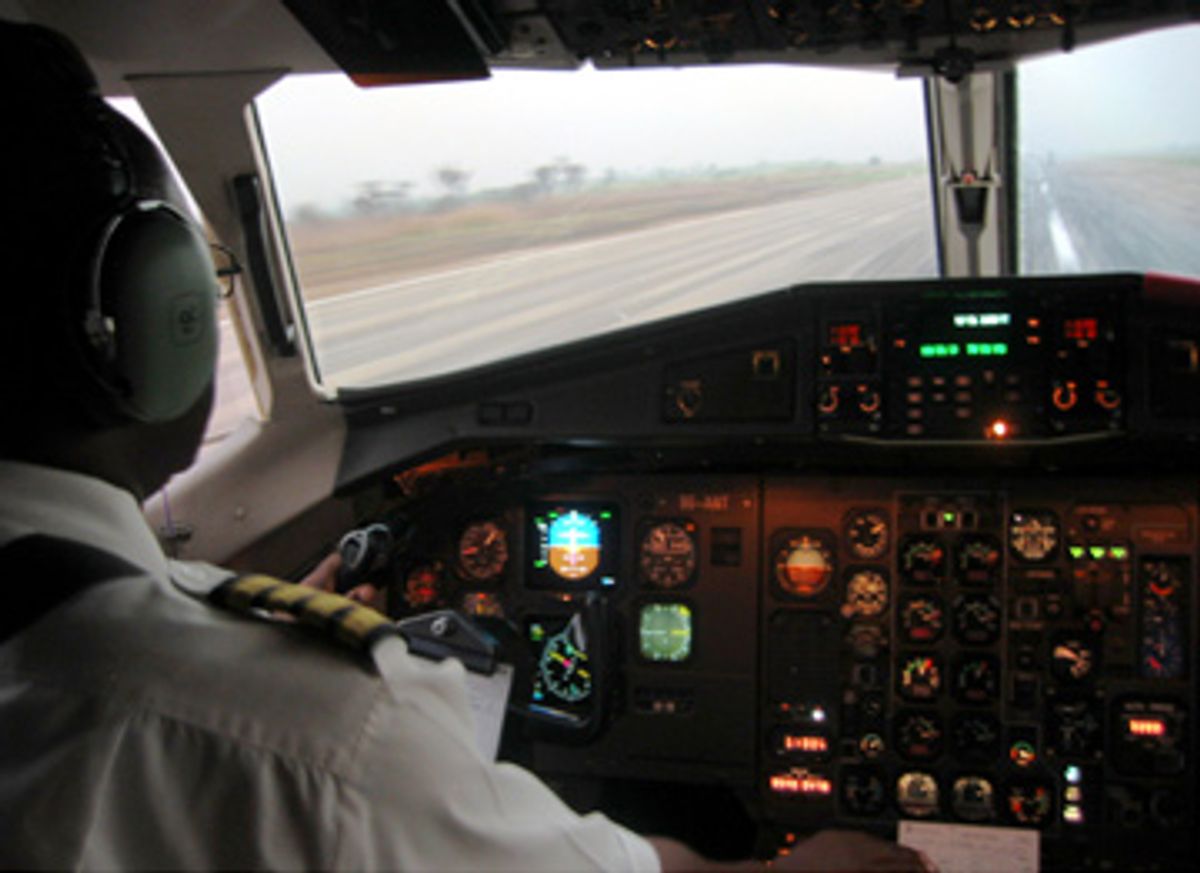
Flight 264, scheduled for departure at 5:45 p.m., will be a half-hour hop. Sensing that I'm on a roll, I ask to sit in the jump seat. Capt. Mamphey grants permission and I strap in. (It's just after Christmas, and at least for the next two months I am still a very furloughed pilot, and normally not eligible for such perks. Outside the United States, however, captains typically have more discretion.) The jump seat is a fold-down affair and there isn't much room at the shoulders, but there's a good view, and a cup holder for my can of Coke Light. I'm handed a spare headset, allowing me to follow communications with air traffic control.
As Mamphey and his first officer run through their checks, a scan of the instrument panel brings on painful flashbacks. The plane is pretty much identical to the ATRs I once flew for American Eagle -- bringing in $250 a week during the searing hot summer of 1995. The ATR was never my favorite aircraft, and it's a wonderful example of technology for the sake of itself: fragile, overengineered and gratuitously sophisticated. And in all that fancy wiring and plumbing, they forgot the air conditioning. Tiny eyeball vents blow wisps of tepid air around the cockpit and cabin -- just the thing in a climate like Ghana's. The layout of the auto-flight panel; the unique doorbell chime of the aural warning system; the beads of sweat on my forehead -- it's all coming back to me.
As we taxi toward the airport's sole, 6,500-foot runway, the sky is thick with a dusty, pearl-colored haze. Night comes fast this close to the equator. It will be dark within the hour.
The tower clears us to go, and as the plane accelerates, a headline flashes to mind: "Columnist and aviation author among victims of African plane crash." Not that my demise would actually make the papers. What a shame it would be, in this case, for the irony to go uncelebrated.
We lift off, bank toward the south and climb smoothly to 11,000 feet. Below, in the last throes of daylight, the terrain of central Ghana is a featureless blur of earth tones. Then it dissolves entirely into night.
At cruise, Mamphey removes his headset and turns around to talk, handing me his business card. He isn't just the captain, it turns out, he's the airline's head of flight operations. He spent three decades in the Ghanaian air force, and was previously assigned to the president's Gulfstream executive jet, which he flew throughout Africa and the world on diplomatic missions.
The first officer is Asiwome Dzakuma, a young guy who went to school at Middle Tennessee State University. He learned to fly ATRs at the manufacturer's classrooms and simulators in Toulouse, France. Flight 264 is Dzakuma's leg. He's at the controls while Mamphey backs him up and works the radios.
As I watch and listen, nothing strikes me as the least bit unusual. In a matter of minutes I've become wholly disconnected from the exotica of Ghana below. I could be on any ATR anywhere -- be it over the hinterlands of Africa or the suburbs of Milwaukee. We're in radar contact the entire time; the controllers speak unencumbered English as the crew tracks a southbound airway toward Accra; Mamphey and Dzakuma read their checklists and fly the aircraft exactly as an American crew would. All those scary statistics and warnings seem a distant world away.
If anything is out of the ordinary, from this observer's point of view, it's the pilots' accents and the color of their skin. Fewer than 1 percent of all airline pilots in the United States are black, and to find two black pilots in the cockpit at the same time is exceptionally rare. The percentage is highest at cargo giant UPS, with about 4 percent, but according to the Organization of Black Airline Pilots, the industry-wide total is fewer than 800, out of roughly 100,000 aviators. (This fraternity once included first officer LeRoy "Lee" Homer, the copilot of United Airlines Flight 93, hijacked and destroyed on Sept. 11, 2001.) Of those 700, a mere 14 are women, eight of whom are employed by United.
In the days of apartheid, incidentally, South African Airways was denied overflight permission by adjacent countries, forcing the carrier to fly around the continent's contours, greatly extending flying times to and from Europe. That's a thing of the past, of course, and today SAA is a Star Alliance member and Africa's largest airline.
I ask Dzakuma about his days in Tennessee, and if he has considered applying for a visa with an eye toward flying in the United States. He has thought about it, he says, "but the process is a lot more difficult now."
Julia's report from the cabin: Antrak's ATRs are staffed with two flight attendants instead of the customary lone attendant. Labor comes cheap in Ghana, sure, but there's more to it than that. It's both pleasant and disheartening to see how the emphasis on passenger service, so common outside the United States, extends even to the smallest, most anonymous carriers.
There are safety cards in each seat pocket. Prior to takeoff, the flight attendants go around securing luggage and ensuring belts are fastened, but there is no formal safety demonstration. (I had left my backpack on my assigned seat. Because it was too large for the overhead bin, I'd buckled it in like a person. One of the attendants saw that it wasn't really secure, so he took it to the aft entrance area and stowed it with the crew bags.)
The in-flight snack consists of plantain chips and drinks. The chips are very tasty and come in clear, unmarked plastic bags, just like you'd buy from a street vendor at the tro-tro station. There's no refreshment cart. Everything is served by hand or from a basket. The cabin lights are not dimmed for takeoff, they are shut off altogether. Thus the mood is dark and peaceful, and the lights of the capital, when they finally come into view, are especially dramatic.
We are assigned an ILS approach at Accra's Kotoka International Airport, second in the queue for runway 21 behind an Airbus A330 -- Lufthansa's regular arrival from Frankfurt, Germany. Capt. Mamphey has radioed ahead on the company frequency, arranging for one of Antrak's vans to drive us to the nearest cash machine.
At 50 feet or so, gliding over the threshold, Dzakuma lets the plane drift left of the centerline. I'm silently critical, until I realize he's doing it on purpose to keep the nose gear clear from the runway centerline lights. Centerline lights are inlaid and flush with the surface, but striking them directly causes a rattle. A larger plane will always be aimed down the middle, but with a lighter craft like the ATR, an offset touchdown is a thoughtful technique.
Once on the ground, Dzakuma backs the power levers into reverse, and the props let out a roar.
The rollout along runway 21 takes you past a museum of sorts -- a lineup of mothballed and derelict airliners, including a Ghana Airways DC-10. That very plane was once a regular visitor at New York's Kennedy airport, where I saw it many times. Now it sits engineless, cannibalized for parts and presumably destined for the scrap heap. Saturated by dust and pollution, its once white hull has turned the color of sandstone.
Ghana Airways' successor is something called Ghana International Airlines, or GIA, whose network includes daily service to London. Somehow it's not the same.
Mamphey escorts us into the terminal, and a few minutes later the Antrak van pulls up at the curb for the five-minute ride to the money machine. The driver takes the cash -- 160 U.S. dollars means a pocket-stuffing 1.5 million Ghanaian cedis -- and offers to drop us off at our nearby hotel.
And there you have it. You can read this as a story of inconvenience, or as one about an airline that went out of its way so that two foreign visitors could make it to Accra. Say what you want about the risks and hassles of third-world air travel, what I experienced in Ghana was a blend of impromptu flexibility, trust, courtesy and safety. Sounds like corporate ad copy, but really, we could use more of that spirit in America.
Shares