My comments last week on the recent crash in Congo elicited the following letter:
As an aviation professional in Africa, I am very familiar with the operations of Hewa Bora Airways, and have flown in and out of Goma airport, where the accident occurred, on several occasions.Previously, the 8,000-foot runway in Goma was sufficiently long for most aircraft. But in 2002 a nearby volcano erupted, and lava flow cut the available distance to 5,000 feet. Back in colonial times, the area beyond the runway was fenced off, providing a clear way. When the volcano erupted, destroying homes and businesses near the airport, people relocated directly onto the airport itself, constructing houses, businesses, mosques and markets there. Today there are dwellings as close as a hundred feet from the runway.
On the day of the accident, the surface was wet and the crew took off in the direction of the lava flow. I suspect they blew a tire, and concern about immediate loss of control on the ground was their motivation for rejecting the takeoff. The aircraft hit the lava, skipped up into the air, then flopped into the open-air market adjacent to the airport. The crash and rescue service consisted of people throwing wash basins of water on the flaming fuselage, while others tried to force the main cabin door open using cement bricks.
Hewa Bora maintained its aircraft as well as it could. They had a good attitude toward maintenance and tried their best. To obtain the best aircraft possible with a very limited budget, the airline tried to buy its jets secondhand from the same U.S. carrier, assuring that the planes had been well maintained over their lives. The airline's crews were cautious and conscientious and had a good understanding of the aircraft and its systems.
However, any country in the middle of a civil war will suffer shortages of skilled staff, money and logistical support, making it impossible to maintain first-world standards. Either you do the best you can, or you don't fly at all, and the latter is not an acceptable option for many countries. It is unrealistic to expect developing countries in the midst of wars to be able to meet contemporary safety standards, even if, like Hewa Bora, they try their hardest. It's as unrealistic as asking people in a refugee camp to wash their hands with soap and water before every meal, and to be sure to rinse the dishes in hot water. Such standards are the norm in food service in North America, but out of the question in a war environment. Aviation standards are no different.
The letter writer, who asks to remain anonymous, makes an excellent point, and provides some compelling insights into the struggles and challenges faced by airlines in the developing world.
A week ago I discussed how all commercial flights are subject to regulatory guarantees pertaining to runway length. There must always be sufficient room to stop should the takeoff be aborted at any point up to so-called V-1, just below liftoff speed. Pilots call this "accelerate-stop distance." Well, maybe that's true in most places, but perhaps we're being naive to assume such securities exist in a troubled country like Congo. A DC-9 on a wet, 5,000-foot runway, 5,100 feet above sea level (higher elevations mean faster than normal takeoff speeds)? While I don't have the DC-9's performance charts in front of me, I suspect an accelerate-stop guarantee would be out of the question.
No, that doesn't make it dangerous to fly in Congo, but it does leave little room for error. Without the checks and balances commonly found elsewhere, minor mistakes or malfunctions can result in tragedy.
Granted, flying in Congo is not the same as flying into, say, Johannesburg, and Hewa Bora Airways, for all its good intentions, is not South African Airways. But my earlier contention, that the airlines of Africa are by and large safe, needs a few qualifiers. I dare say that in certain environments, safe enough is the best we can hope for.
When I flew Royal Air Maroc a few years back, there were carry-on bags all over the place, and the safety briefing included a warning from flight attendants that "sleeping on the floor would not be permitted." The collective groan from the cabin implied that sleeping on the floor normally is permitted. Is RAM as tight-shipped as Delta or Lufthansa, Emirates or Qantas? Presumably not, and we shouldn't expect it to be. But the airline transports close to 5 million people each year aboard its 40 or so aircraft, and according to Airsafe.com it has recorded only two fatal events, the last in 1994. I would call that acceptable, all things considered.
And surprising or not, some of the poorest places on earth are home to the proudest and most safety-conscious airlines. I couldn't have been more impressed riding in the jump seat of that ATR-42 from Kumasi to Accra, in Ghana. From what I observed, I might as well have been flying from Indianapolis to Chicago. Or consider Ethiopia. Many of us remember the videotaped crash of a hijacked Ethiopian Airlines 767 in 1996, but that carrier, now in its 64th year of operation, is statistically one of the continent's safest. When you consider Ethiopia's economic troubles, rugged terrain and the myriad challenges of African flying in general, EAL's record -- Airsafe shows two fatal events, including that hijacking -- is remarkable. (For good measure, its passenger service standards put those of most American airlines to shame.)
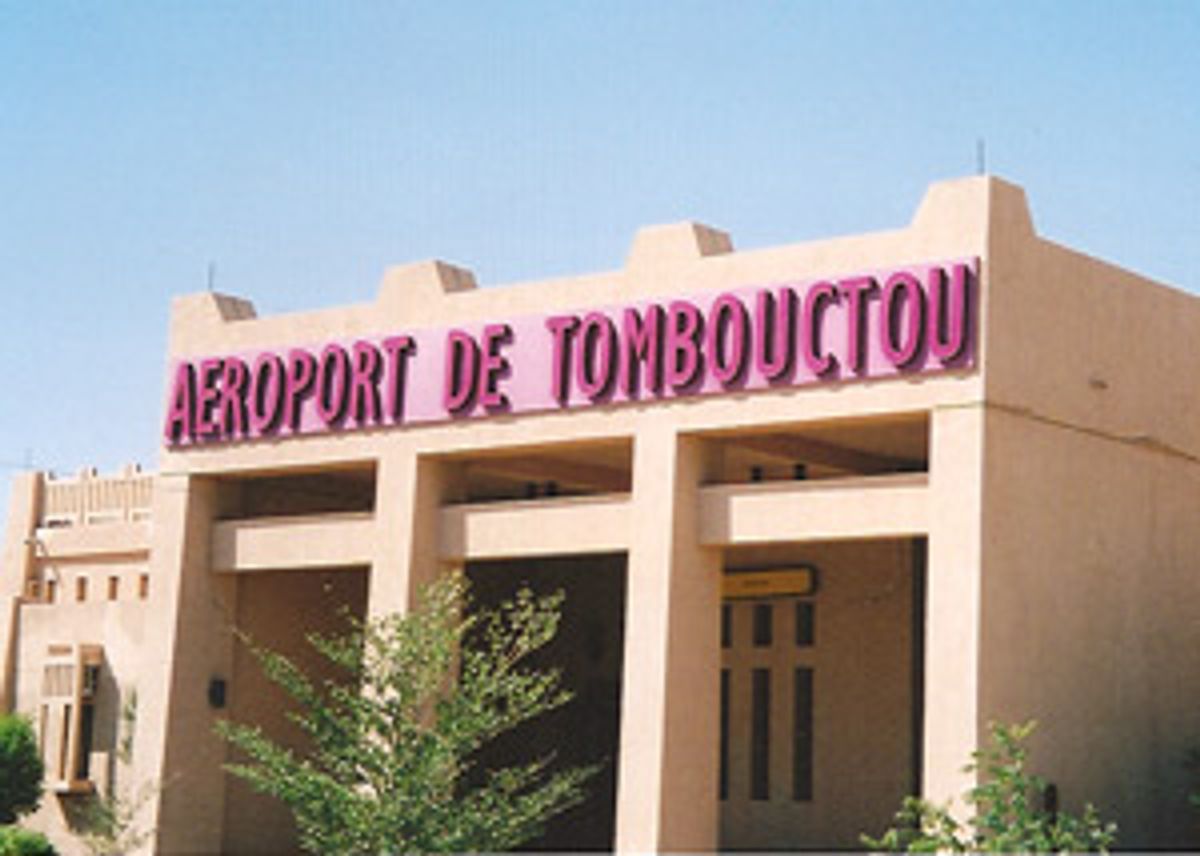
It's much the same with airports. It's not uncommon to find remote airports with long, well-appointed runways and outstanding services. Although passenger-handling facilities aren't always an indicator of more important things, one of the most impressive little airports I've ever seen is the one in Timbuktu, Mali. I expected nothing more than a thatch-covered shack -- maybe with a few of those ubiquitous Malian goats pulling a sand-encrusted luggage cart. I was startled to discover a handsome terminal, designed by the international firm of Dar Al-Handasah. It's a Sudanese-style building emulating the mud-built mosques found all over Mali. The interior, if a bit drab, is spacious and immaculate. Nearby is the "old" terminal -- a low, flat structure that isn't unlike many of the small terminals you'll find in the American Midwest. It would be the envy of many third-world airports, but in Timbuktu it's not even the nicest. Along the smoothly paved apron's north side is a 6,900-foot runway -- long enough for the occasional charter from Europe.
(What this says about the Malian government's priorities is debatable, but for better or worse you find these incongruous showcase airports in various corners of the globe. The oversize complex in Mandalay, Myanmar, is perhaps the most obscene example.)
Some of the world's most prestigious airlines fly regularly throughout Africa, and believe me, they would not be doing so if their destination airports were inadequate. Carriers cannot, on a whim, begin flying to a foreign city. Airports must meet Federal Aviation Administration approval, taking in runway length and condition, crash-and-rescue capabilities, approach and navigational equipment, and security measures. Even alternate and diversionary airports are evaluated for approval.
Delta is currently the only U.S. major with service to Africa, flying into Accra, Lagos, Johannesburg and Dakar (Cairo, Nairobi and Cape Town begin soon). Before inaugurating flights to these cities, teams of company auditors and inspectors were sent ahead, to ensure not only adequate passenger facilities but safety and security standards.
I once described Dakar's Léopold Sédar Senghor International as nothing short of the "the world's worst airport," but, trust me, it is not a dangerous place -- except possibly to your wallet when, like me, you're stuck there at midnight waiting for a predawn departure.
All of this can be extrapolated elsewhere, be it South America, India, China or Southeast Asia -- regions where commercial aviation is often, and unfairly, maligned as categorically hazardous.
A list of airlines from developing countries that have been fatality-free for at least the past 25 years.
Air Jamaica
Air Malta
Air Mauritius
Air Niugini (Papua New Guinea)
Air Seychelles
Air Tanzania
Air Zimbabwe
Bahamasair
Caribbean Airways (formerly BWIA)
Cayman Airways
Ghana Airways (ceased operations)
Lacsa (Costa Rica)
Pluna (Uruguay)
Royal Brunei
Royal Jordanian
Syrianair
TACA
Tunisair
I am flying soon to Tegucigalpa, Honduras, which I'm told is one of the most dangerous/difficult landing strips in the world. Should I be nervous?
I would never describe any approach as "dangerous." Even "difficult" is misleading. Flying is no different from any other profession: Some tasks are more challenging and work-intensive than others. In no way does that make them unsafe. Although some airports -- particularly those with short runways and surrounded by high terrain -- present less margin for error, crews will stay out of trouble so long as they fly by the book and maintain situational awareness.
Airport-specific training is required for some destinations, often designated as "special qualification airports." At my own airline, captains flying to certain Latin American cities for the first time must, in addition to reviewing the various takeoff, landing and emergency procedures, be accompanied by a training pilot. Unusual approaches like those into Quito, Ecuador, are frequently practiced in simulators.
I've been told that due to "noise restrictions" planes taking off from Long Beach, Calif., actually have to cut their engines for a short period of time during the climb. The plane levels off and coasts for a bit, then the engines are restarted. Is this true?
This is not the first time I have encountered this ridiculous legend. The answer is no. Indeed there are noise restriction rules when departing from Long Beach, just as there are from many other airports. In most cases this entails a delay in the flap/slat retraction schedule and an adjustment to thrust. By climbing at a steeper angle, the plane rises above noise-sensitive areas more quickly. This procedure might be combined with a turn or other pattern to avoid dense neighborhoods. In Boston, jets departing on Runway 22R make an immediate left turn after liftoff to stay clear of South Boston.
Noise restrictions or not, you will commonly hear the engines throttle back slightly and feel the plane shallow out moments after takeoff. The thrust used for takeoff is, in the interests of safety and performance, more than enough, so it's lessened once aloft to save wear on the engines and to keep the plane from exceeding reasonable speed. The plane is still climbing and is not decelerating nearly as much as it may feel. (Despite the impressive roar of the engines and spine-straightening acceleration, airliners usually do not take off at full bore. Maximum thrust is used when conditions dictate -- weight, runway length and weather -- but normally they don't, instead allowing a preordained thrust setting some degree below the available output. This helps preserve engine life.)
I was on board a flight that broke off its approach and diverted to another airport. We were told that it was "too foggy to land." How could this be true? Aren't modern, sophisticated airplanes -- it was an Airbus A320 -- certified for all weather conditions?
First, let's review how a plane lands in bad weather: Pilots navigate to the runway using something called ILS, or instrument landing system. They track a pair of radio signals -- one horizontal, the other vertical, transmitted from antennae on the ground. (The horizontal signal is known as a "localizer," while the vertical is called a "glide slope.") With the two beams centered in a kind of electronic cross hair, the plane is guided toward the runway with close to unfailing accuracy. The crew descends to a certain height at or near the threshold, at which point the runway must be visible for landing.
Not all ILS approaches are the same. Some allow for lower visibility "minimums" than others, dependent on ILS signal calibration, runway approach lighting, pavement markings, etc. The typical, Category I instrument runway permits approaches with a forward visibility down to about a quarter-mile. Others have so-called Category II approaches, allowing as little as 1,200 feet of visibility. Category III minimums drop to as low as zero visibility (a full-on auto-land is used for that one).
Cat I runways are common. Cats II and III are usually found at busier and/or fog-prone airports. Even there, however, not every runway is qualified. Here at Boston we have four main runways offering eight possible ILS approaches, only one of which is certified for Category III. During extreme low-visibility conditions, which fortunately don't happen very often, that's the only option. If, among other complications, the winds happen to be out of tolerance for that runway, everyone is out of luck and the airport effectively closes.
(Crews will often speak of "low ceilings" when making P.A. announcements during delays and whatnot, referring to the altitude of the base of the cloud cover. But technically, it's visibility that determines approach criteria, not ceiling.)
So, in other words, an airplane is only as capable as the runway it is landing on. Because a given jetliner is equipped and certified for zero-visibility Category III auto-land means nothing if the runway too is not similarly equipped and qualified. Most commercial runways are not.
I was flying out of Detroit. It was very foggy and we'd been sitting on a taxiway for several minutes. The captain announced that if the fog didn't lift within 10 minutes, he would taxi to the other side of the airfield "to use a longer runway." What's the advantage of a longer runway in the fog?
None, per se. It sounds to me like the captain didn't fully explain. Going back to the previous question and answer, just as not every runway can accommodate bad-weather landings, neither can they all accommodate bad-weather takeoffs. Normally, airline guidelines allow for takeoffs with as little as 600 feet of visibility, but only if the runway itself is appropriately outfitted. The lowest-visibility takeoffs require, among other things, a center-line lighting system and a minimum of three RVR readings (that's Runway Visual Range, a technology that measures precise forward visibility). As for the captain's announcement, above, the best-equipped runways tend also to be longer (though not always), which made for a simpler, if not exactly complete explanation.
Next week: The growing danger of runway collisions
Do you have questions for Salon's aviation expert? Contact Patrick Smith through his Web site and look for answers in a future column.
Shares