"The Matrix," last
summer's sci-fi box-office smash, envisions a future in which artificially intelligent computers take over. Instead of programming the computers, humans become the slave race, serving as living batteries that provide energy for their former desktop tools.
What a bummer. But hey, that's just Hollywood science fiction, right? Wrong, says Kevin Warwick, a professor at the department of cybernetics at the University of Reading in England -- the British equivalent of the M.I.T. Media Lab -- who has spent his career working on robotics, creating machine intelligence and, most controversially, building human-computer implants for use in his own body. Author of the recent computers-can-think book "March of the Machines: Why the New Race of Robots Will Rule the World," Warwick is the futurist
most likely to be quoted throughout British newspapers direly predicting that
computers may conquer the world within our lifetime. As he
himself describes his work, "It's like creating science fiction."
Last year, Warwick made headlines when he implanted an electronics-filled glass capsule under the skin of his arm in order to remotely control his computer. The experiment, more hypothetical in nature than practical in application, was simultaneously praised and derided in his native Great Britain: The Guardian called it "a stunt in cybernetics"; the Glasgow Herald described him as a "publicity-hungry scientist, out there on the funding stump, ready with his party tricks"; even his daughter called him crazy. He enjoys a nutty-professor reputation at his own University of Reading;
other observers point out that his work is frivolous compared with cutting-edge medical experiments with body-control implants.
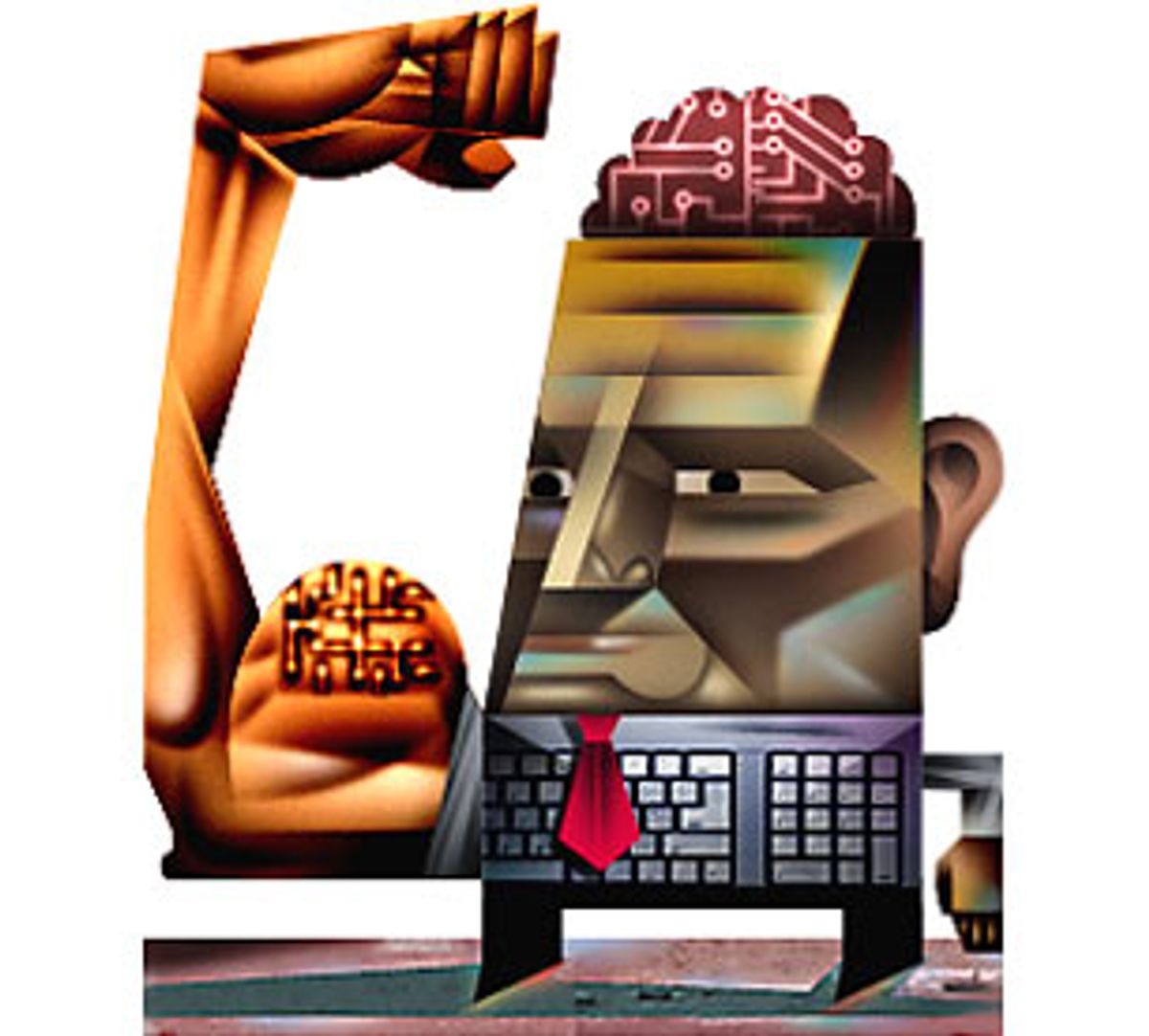
Warwick is now developing an even more complex implant project -- he is planning to hard-wire his brain directly to his computer. Call him "Professor Cyborg," if you will (it's just one of his media nicknames); but our ability to be cyborgs, he warns, may save the human race if the worst possible scenario -- the "Matrix" future -- comes true.
"Some computer scientists have their head in the sand in their thinking --
believing that things are programmed, and that we [humans] can always
determine what they are doing to do. It's a complete load of rubbish, that
is!" Warwick exclaims. "Sure, we've got implants for people with disabilities, like pacemakers, but we're not looking ahead as to how we might possibly increase human brainpower. So really that's the direction I've been going -- with a view to maybe save the world."
Warwick has spent the majority of his career at the University of Reading, where he landed 11 years ago following a stint at British Telecom and teaching jobs at various British universities. At the University of Reading, Warwick has been puzzling over cybernetics -- defined
by him as the topic of "communication and control in human and
machines." The "machine" part of his experimentation includes his
electronic pets, the "seven dwarves": a troupe of little wheeled robots
with white faces and ultrasonic eyes who have been teaching themselves
both individual and group behavior. He and his research assistants observe as
these robots figure out how to move around corrals, compete in robot soccer
matches, and perform other notable robot feats. Like ants (or humans, for
that matter), they'll follow each other around, mimicking a leader who has
already discovered the secret to not bumping into walls.
So far, Warwick's most notorious robotic accomplishment occurred last year,
when one of his fleet was the first robot to autonomously train another
robot. One of the dwarf robots learned how to zoom
around a corral in Reading; using an Internet link and radio signals, that
robot then remotely trained another robot in Buffalo, N.Y., to zoom
around in the exact same way. It may sound like a relatively modest
accomplishment, but the event went into the Guinness Book of World Records
as a robot first. ("Quite why I have no idea," laughs Warwick. "I think it
was printed somewhere between Pamela Anderson and the Spice Girls.")
"It was a fairly simple demonstration that robots do learn and adapt, and
that to me is quite critical -- that they aren't just programmed to do what
you want them to do," explains Warwick. In other words, in the future it is
quite possible that robots won't even need humans to program them in the
first place. Instead, they will reprogram and rebuild themselves. "Intelligent robots can come up with a large amount of independence and do creative and imaginative things that you never imagined they could do, and communicate with each other and create their own languages."
Warwick describes this not as a step towards artificial intelligence
but "machine intelligence" -- a new form of silicon-based smarts different from, and perhaps even superior to, our own carbon-based intelligence. As he matter-of-factly puts it, machine "brains" are going to be far superior to human brains. We already know that a computer can surpass a human, he quickly details, in "number crunching, how quickly it can operate, the mathematical capabilities, the memory, the logic. We know that machine intelligence has a lot of advantages already over the way the human brain works. Looking to the future, in what ways is the human brain going to remain ahead?"
Warwick argues that there aren't very many ways in which humans will
be superior to machines, despite the current advantages we boast. "Our
senses are restricted, they suit us as humans, but machines have the
capabilities of sensing the world in ultrasonics, ultraviolet, infrared,
X-ray, gamma ray," Warwick explains. "Machines can sense the world in all
sorts of ways that we can't hope to do, unless we start looking at implants.
The human body and the human brain are fine as far as being a human is
concerned; but they are very, very restricted and limited when we look into the future."
Warwick predicts that a future in which computer brains have roughly the same power, if not more, than human brains is only 20-30 years away. The possibility of a computer takeover is one reason why Warwick has been pursuing his implant projects -- he hopes that by tapping into machine intelligence he'll be able to enhance human brainpower.
In August 1998, Warwick played the part of guinea pig in what was then
touted as the first non-medical implant experiment. With a tiny glass
capsule full of transponders under the skin of his arm, Warwick essentially
became a human remote control: Every time he walked through the door of his
building at the University of Reading, sensors in the doorways would
immediately register the presence of the transponders in his implant. The
lights would come on, his computer would boot up and connect to his Web
site, doors would open, and his office would greet him with a "Hello,
Professor Warwick!" In a very Big Brother touch, his computer could also
track his comings and goings and his exact location within the building.
The experiment was simple, especially when compared with some of the more
complex medical implants that neurosurgeons are now working on, but it was evocative nonetheless. Warwick admits that he has been contacted by government officials interested in potential use of implants in prisons or for tracking pedophiles -- but Warwick himself breezily glosses over the Orwellian implications of widespread computer-implant use.
"I didn't feel like Big Brother was watching, probably because I benefited
from the implant: The doors opened and lights came on, rather than doors
closing and lights turning off," he says. "It does make me feel that Orwell
was probably right about the Big Brother issue -- we'll just go headlong
into it; it won't be something we'll see as a being negative because there
will be lots of positives in it for us."
Warwick only wore the implant for nine days -- he says he was worried about the possibility that the glass capsule might explode or migrate around his body. But Warwick believes that was long enough to get a sense of what effect a mind-machine interface might have on our relationships with computers. "After a few days I started to feel quite a closeness to the computer, which was very strange," he muses. "When you are linking your brain up like that, you change who you are. You do become a 'borg. You are not just a human linked with technology; you are something different and your values and judgment will change."
His next implant experiment will engineer an even closer link between
humans and computers. In 18 months, Warwick will again undergo surgery,
this time receiving not just a transponder implant in his arm but a
connection to his nervous core -- a tiny collar that encircles the bundle
of nerve fibers at the top of his arm, reading the signals from his nervous
system and transmitting those to his computer. Of course, just how his
nervous signals will translate into computer commands remains to be seen --
much of the experiment will involve testing to see if he can turn on lights
on his computer by waving his arm in certain ways.
Again, it's a simple experiment that has vast implications for the future of
mind-machine interfaces. "This is where you can start to speculate straight
away; in the very near future we should be able to operate computers
without the need for a keyboard or a computer mouse," he explains. "It should
be simply possible to type on your computer just by writing with your finger in the air."
This implant will not merely send signals to his computer, however; it will
also receive them. The computer should be able to record and store sets of
Warwick's nervous signals and transmit them back at a later time; if all
goes well, he'll be able to "play back" the motion of flexing his elbow or
wiggling his fingers. He could even "re-experience" the nervous signals
related to his emotions, "playing back" the signals his nervous core sent
when he was feeling happy or stressed. "Will I feel the emotion I felt
before, will I feel a different one, will it be better or will it be worse?
We have no idea," he speculates. "The big worry is that while we'll be able
to see what those transmissions will do to my fingers, they will also go
back to the brain. What will my brain will of those signals? That's a
smidgen dangerous. But it's extremely exciting."
In the most bizarre touch of all, Warwick's wife has agreed to receive
an identical implant. The two human lab rats, he hopes, should be capable of transmitting signals from nervous system to nervous system. Conceivably, Warwick's feelings of anger or amorousness could be transmitted to her, and vice versa -- an experiment that has the British tabloids raucously describing the implant as a "love chip." As he more benignly puts it, "We should be able to transmit a semaphore type of communication -- which is where the notion of telepathy comes in."
Perhaps the most peculiar aspect of Warwick's experimentation with robots
and implants is his own cheerful acceptance of the dark side of his own
research. "I think humans would be crazy and stupid to give machines the
power to affect how the world operates," he explains, before launching into
an explanation of his experiments enabling machine intelligence in the seven dwarves.
Warwick's implant systems -- which could be used to "enhance" humans with sensory information -- could also conceivably be employed to create races of superhumans or computer-controlled human slaves. While Warwick seems to have an eye on saving the world, it's a world that will partially be of his own making. He may even help change what it means to be a human.
That is, of course, if his predictions even come true. But even if they don't, he says it's best to be prepared anyway.
"Yes, I believe in the doom and gloom, unfortunately -- but that's
evolution. Something is going to come along and surpass us at some time,
and my feeling is that more than likely at some point it's going to be
machines, intelligent machines," he matter-of-factly postulates. "Can
anything be done about it? This type of implant should take us a long way
down the road; but realistically we've got to have machine intelligence
connected in some way to the human brain. It's a race against time."
Shares