

Something about Vivian Buck troubled a Red Cross aide, though the relief organization worker couldn't quite put her finger on it. All she could say about the 7-month-old Vivian was that there was a "look" about her that was "not quite normal." This observation was the missing piece in a puzzle officials at Cold Spring Harbor Laboratory's Eugenics Record Office were trying to solve: They wanted to prove that feeblemindedness was a trait passed from parent to offspring.
Already the laboratory had IQ test scores for Vivian's mother Carrie and her grandmother Emma which found the women to be "morons." Adding the "data" about Vivian's looks to the mix was enough to establish that three generations of the Buck family were of low intellect. These facts became the basis of a landmark 1927 Supreme Court decision that allowed states to forcibly sterilize people who carried "hereditary defects." Carrie Buck was forcibly sterilized, and by the mid-1930s, about 20,000 people in the United States met the same fate under similar laws.
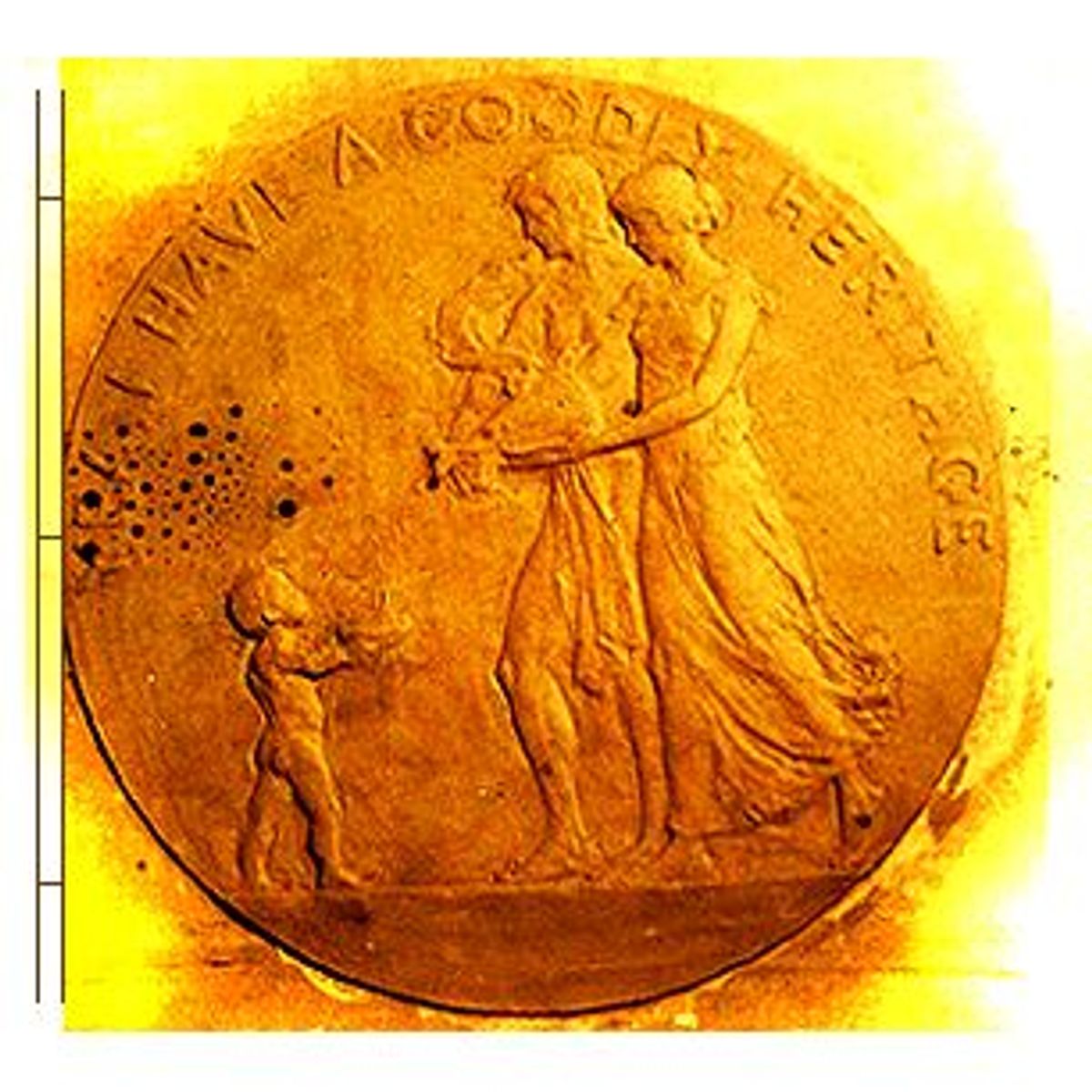
Vivian Buck's story, along with various state sterilization laws, are among the artifacts that will soon be on the Web as part of a digital image archive chronicling a dark chapter in U.S. history -- the American Eugenics Movement. The movement, which began in 1904, was a government-sponsored social engineering project which sought to improve the human species by encouraging "fit" people to marry and procreate while sterilizing and prohibiting unions between the "unfit."
The Image Archive on the American Eugenics Movement is expected to go online in January 2000. Judging from a preview, it's a pretty powerful site, featuring a collection of troubling documents and pictures. There are photos of men arranged as if in a police line-up, which purport to show correlations between the size and shape of one's head and one's intelligence; there is a photo of a young boy just out of diapers who was identified as a likely potential criminal -- a determination based on the shape of his face. There are family trees which track alcoholism and idiocy across the generations; and there are photos of the "fittest families" -- who apparently evidenced no undesirable traits.
Up to now, the materials of the eugenics archive, which had been dispersed among several institutions including the American Philosophical Society in Philadelphia, have remained an obscure body of research, accessible only to scholars. By granting broad access to the archive over the Internet, David Micklos, director of Cold Spring Harbor's DNA Learning Center and chief architect of the eugenics archive, hopes to encourage students and the general public to make a connection between what happened in the early 1900s and events in genetic research that are grabbing headlines today -- a connection that could provide an ethical context for some agonizing decisions we face in our personal lives and in society. Clicking through some of the shocking images and articles of the exhibit, I was struck by a disquieting common ground shared by eugenics and today's prenatal genetic testing: a belief that biology is destiny and that science alone can help us overcome it.
The goal of the eugenics movement was to create the best society possible. Eugenics relied on the state-of-the-art genetics of its day, although the vast body of information that became the basis for sterilization, marriage and immigration laws aimed at weeding out those with "bad heredity" was based largely on anecdotal information. Field researchers at places like the Eugenics Record Office collected hereditary data through house-to-house surveys and the study of records of prisons, hospitals and institutions for the deaf, blind, insane and the mentally disabled. Today we have a lot more accurate information -- scientific data about the structure of DNA and its proteins, which paints a detailed picture of how traits are inherited. And many of us -- believing that technologies like prenatal genetic screening yield results that are reliable enough for us to use as the basis for life-altering decisions -- are using this information to create the best children possible.
If you scoff at the notion that a child's future academic prowess was once thought to be determined by the fact that his or her grandfather was a drunkard, then consider that today we don't even flinch at the idea of controlling our own procreation. In fact, we expect to pay a lot of money to engineer the "perfect baby." Witness the advertisement placed in the student newspapers of Ivy League schools by an infertile San Diego couple last year. The ad offered $50,000 to college-aged women in exchange for their eggs. The couple, by selecting to advertise only to the Ivy League, was clearly looking for a particular kind of woman's eggs, and they were very specific: Potential donors had to be at least 5-foot-10, possess a combined SAT score of 1400 or higher, and show some athletic prowess.
Then there's the more recent case of Ron Harris, the Arabian horse breeder and fashion photographer who reportedly opened up a Web site for the purpose of auctioning off eggs and sperm of fashion models to the highest bidders. The price of admission to this little exercise is a fee of 20 percent of a the final bid on egg or sperm, and for that, you have the comfort of knowing that, "our striving reflects the determination to pass every advantage possible along to our descendants."
"I guess the question I ask about this is why buy such a specific egg," posits Paul Lombardo, professor at the Institute of Law, Psychiatry and Public Policy at the University of Virginia and a leading scholar of the Vivian Buck case. "I understand that couples are infertile, but [through ads like this], they're not just looking to have a baby, they're looking to have a special baby with special features they've picked out."
Why buy a specific egg? Don't we want the best for our children? Developments in reproductive and genetic science coupled with the age-old desire to give our children every advantage possible has led us to a point where we feel we are more responsible for our offspring at an earlier age -- even before we conceive them. Of course, it's common knowledge that smoking and drinking alcohol can harm a developing baby, and a lot of women are aware that taking folic acid before and during a pregnancy decreases the chances of birth defects; these are the eat-your-broccoli type measures that any woman can take. But where we begin to cross the line from common-sense health choices to scientific control comes with procedures like prenatal genetic tests.
Prenatal genetic screening is designed to look for specific diseases such as Down syndrome and is recommended to women whom doctors determine to be "at risk." Just who is "at risk" is a decision that is made on based on results of preliminary blood tests and anecdotal and demographic information a pregnant woman gives her doctor. A woman's race, age and the diseases that have existed in her family and that of her mate's are among the facts used to determine the risks of producing a baby with a disease or disability. For example, risks for certain inherited diseases like Tay Sachs or sickle-cell anemia vary depending upon the race of a woman and her mate. So if a woman or her mate are Jewish, then she is likely to be screened for Tay Sachs.
The discussion between doctor and patient regarding prenatal tests often start off with the open-ended question: How do you feel about genetic testing? In the abstract, who could quibble with having more information about her developing baby? But when you're pregnant, wearing nothing but a hospital gown, and lying with legs agape on an examination table, this question can stir panic. That panic comes from the implicit message delivered by doctors when they advise patients to have these tests: Should the baby turn out to carry a disease or defect, intervention -- in the form of in utero surgery or even abortion -- is often advised.
With prenatal genetic testing comes a small chance of triggering a miscarriage. At the same time, certain results, like tests for cystic fibrosis, can generate more questions than answers. Cystic fibrosis, a fatal, inherited illness where the body produces large amounts of abnormally thick mucus that accumulates in the lungs and intestines, is known to biologists as a single-gene disease. This means that having the gene would mean that someone would have the disease. But someone who carries the gene for the disease might never show signs of cystic fibrosis. That's because the genes themselves don't bring on the disease, says Garland Allen, a professor of biology at the Washington University St. Louis. The expression of the genes depend on other factors such as environmental triggers, Allen says.
Such ambiguities are not generally part of the discussion when doctors steer their patients toward having these tests. If you waver when asked the general, "How do you feel about testing?" question, then the doctor might ask, "What if," as in, "What if the baby has Down syndrome?" And if you're still waffling, and if you happen to have a child already, you might be asked, "What about your child? How will a Down baby affect your family?" This conversation hits a pregnant woman in her most vulnerable spot -- her heartfelt concern for the health of her developing baby and the overall well-being of her family. And some doctors make their opinions about this clear: To undergo the tests is to fulfill a duty to do all that is possible to ensure a baby is healthy; to refuse the tests is to shirk responsibility.
What may feel like a coercive atmosphere to some pregnant women certainly doesn't compare to the collusive agenda of the eugenics movement, but it has similarly insidious consequences. The pressure to rely on science today is brought to bear on one patient at a time, and with the intent of ensuring the health of both mother and child, while the eugenics era was marked by a country-wide belief that everyone had a responsibility to do all that was possible to improve society, says Cold Spring Harbor's Micklos.
Groups like the American Eugenics Society cropped up all over the country after 1910, developing campaigns and sponsoring state fair exhibits to raise awareness of the importance of eugenics. The archive shows photos of billboard-type advisories in which flashing lights called attention to "facts" such as: Every 15 seconds $100 of public money goes to the care of "persons with bad heredity," and that every seven and a half minutes, "a high-grade person is born in the United States ... with the ability to do creative work and be fit for leadership. About four percent of all Americans come within this class."
One irony today is that technology like genetic screening is being sold to us as a way of making our lives easier by reducing our chances of having to care for disabled children. Yet one need only to look at the subject lines of postings to chat boards such as Parentsoup.com's Genetic Tests and Complications to understand the stress that these tests can cause. "One in 31 [spina bifida or other neural tube defect test] result and scared," posts one woman. "Low [spina bifida] at 17 weeks and scared to death -- help!" writes another. Those yet to take tests or receive results, often ask "What if it's bad news?"
And this begs the question, how reliable are these technologies and what are the risks involved? There's the recent story of Nancy Seeger, the Chicago-based writer and artist who found through genetic tests that she was at increased risk for developing breast and ovarian cancer. Seeger looked at her family history with cancer -- her mother and aunt died of breast cancer -- and, with the advice of doctors, opted to have her ovaries removed. At the time of the surgery, Seeger donated some of her blood for study at a university hospital. Eight months later, doctors studying Seeger's blood found that she did not carry mutation of the gene for breast and ovarian cancer. The company that administered her genetic tests made a mistake.
The truth about modern genetic science is that the very information used as the basis for life-altering decisions like having your ovaries removed or life-ending decisions like aborting a cystic-fibrosis-carrying baby is not always conclusive. This is not to say that all genetic testing is bad. Despite the confusion and stress they cause, these tests and the medical interventions they enable have helped countless parents have healthy babies and others to avert a cruel illness. Instead, the stories of Nancy Seeger and the women on Parentsoup.com serve as cautionary tales of what we can lose in relying on science alone to make crucial decisions.
And therein lies the biggest lesson of the eugenics archive. The movement reached its zenith during the years that Cold Spring Harbor Laboratory operated the Eugenics Record Office, between 1910 and 1940. But by 1940, the laboratory shut down the Eugenics Record Office because the science that was used to make the various laws was discredited. For evidence of these shortcomings, one need look no further than the extensive records of the case of Vivian Buck. Among the images of the IQ tests and the observations of 7-month-old Vivian is an artifact that came a few years after the 1927 Supreme Court decision: Vivian's grade school report card. This record shows that Vivian's teachers found her to be bright. She had a solid B average, which proves that she was far from the imbecile that the high court found her to be.
Certainly, science and technology have ways of making our lives better. But they also make our lives harder, simply by giving us more options -- which sometimes lead to hard choices. So it's inspiring to see the Internet come to the rescue with something like the eugenics archive -- to put us in touch with history and force us to think about where science has taken us and where we need to go next.
Shares