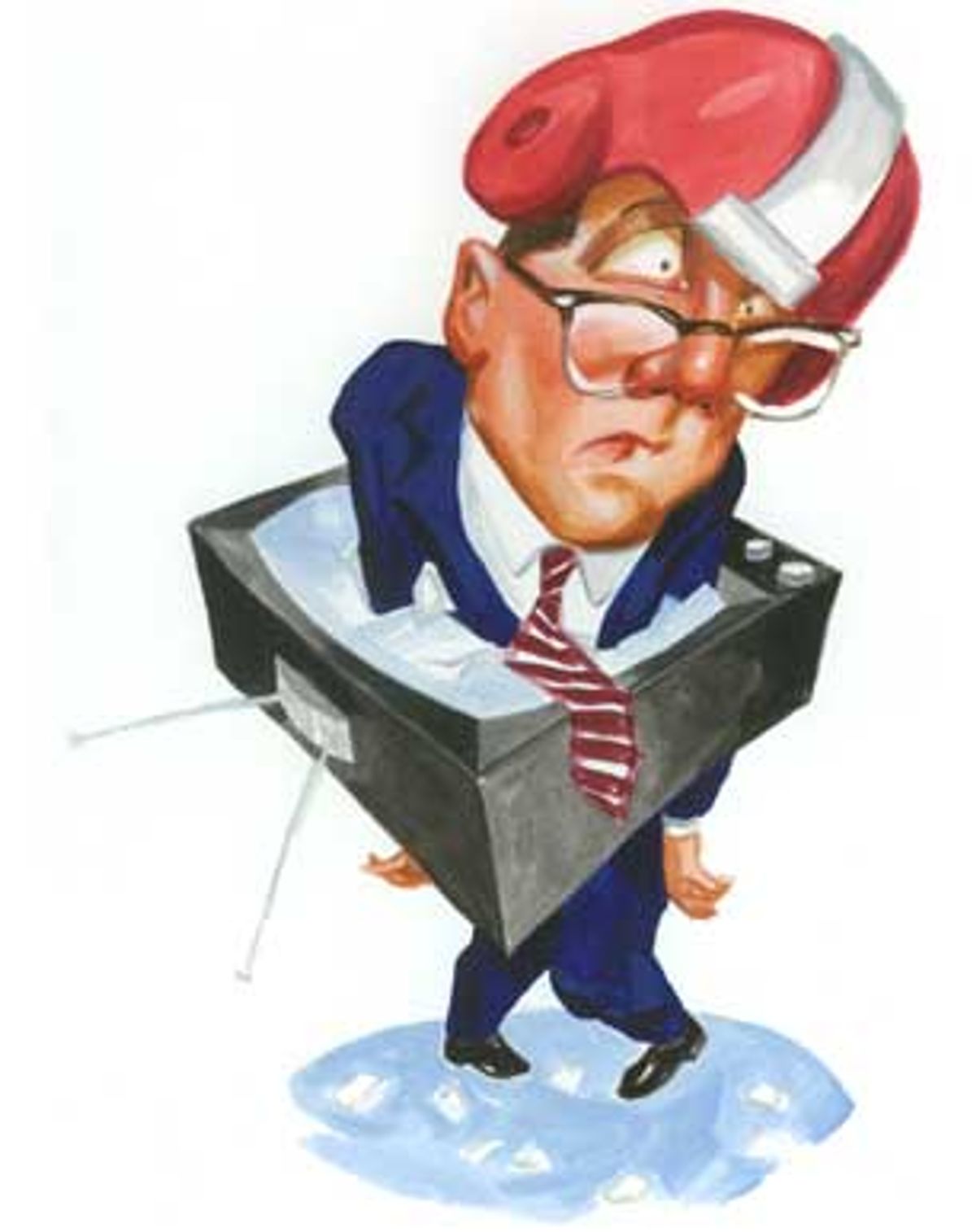
Just suppose you blew a cool $3.5 million in a mere 90 seconds on three television ads starring yourself and hyping your little known dot-com. What's impressive isn't just how much you spent to launch your company and see your own smiling face during the Super Bowl. It's how much of your total capital went into those three fleeting bathroom breaks.
Having started with just $5.8 million in seed financing, you squandered more than half of your capital in less time than it takes to soft-boil an egg. Congratulations! That fancy caper puts your little start-up in the running for the hotly contested title of Fastest Dot-Com to Piss Away the Greatest Percentage of Its Funding. And now it's time to -- what else? -- dust off your pitch and raise more money! How excruciating it must be to meet with potential investors, when the one thing your company is known for -- if it's known for anything at all -- is having the genius (or stupidity) to spend money at the rate of just under $38,889 a second.
Or not. Computer.com, a hand-holding help site for novice computer users, did actually run through 60 percent of its funding in 90 Super Bowl seconds. But Michael J. Ford, the co-founder and president of the Maynard, Mass., company, is still sporting that smile. I quizzed him about the red-faced reactions he must surely get from investors as he seeks more funding. Doesn't cartoon steam shoot out of the ears of the blustering moneybags as they roar: "Kid, you just spent $3.5 million in less than two minutes. Why should I give you, of all people, any of my money!?"
Ford assured me that he's met with no such open indignation: "They probably wouldn't say it to my face," he says.
Besides, Computer.com is hardly alone in this. It's the morning after for the 17 dot-coms, both early stage start-ups and publicly traded companies, that shot their multimillion-dollar wads at the Super Bowl last quarter -- driving the price of a 30-second spot up to a record $2.2 million. Just three months later, with the NASDAQ seesawing wildly, the public markets' once-rabid desire for anything dot-com has chilled, and even the public dot-coms that snuck their calling cards into investors' psyches during that great haze of beer, snack food and a St. Louis Rams victory are now trading below their late January price. Few of the sites have enjoyed a demonstrable growth in traffic, or can point to any big deals that were nudged into the end zone by Super Bowl advertising.
It can't be pretty for the big spenders who've got to justify their Super Bowl blowouts to shareholders and investors. They're certainly not getting a warm reception from the likes of Donna Novitsky, a partner at Mohr, Davidow Ventures in Silicon Valley: "Advertising in the Super Bowl was kind of a ludicrous thing to begin with," she says dismissively. "It's a very untargeted way of reaching consumers." So, why did this horde of mostly fledgling and unprofitable dot-coms do it? Novitsky's theory: "I think it's an ego thing ... It was really a sign of excess."
January's Super Bowl strut left Neil Weintraut of 21st Century Internet Venture Partners similarly unimpressed. "This year, advertising on the Super Bowl amounted to keeping up with the Joneses," he says. He fantasizes about all the more "heretical" things a company could have done to squeeze more buzz out of the same budget, like give away 100 Volkswagen Bugs. "The key thing is to do something that someone hasn't done before. The key thing you want to say to consumers when you're launching a company is, 'I'm an innovator,' and you're not going to do that with the Super Bowl."
In 1999, only three dot-coms advertised nationally in the Super Bowl -- and got tons of media attention for doing so. But this year Net companies packed the game like sardines: AutoTrader.com, Britannica.com, Computer.com, Epidemic.com, E-Trade.com, Hotjobs.com, kforce.com, LastMinuteTravel.com, LifeMinders.com, Monster.com, Netpliance.com, OnMoney.com, Oxygen.com, OurBeginning.com, Pets.com, Webex.com and WebMD.com. Even ad aficionados would have trouble remembering all the companies that warred for extravagantly priced air time.
Mitch Davis, senior vice president of marketing for Britannica.com, is amazed by the "irrational marketing" expenditures exhibited by the wet-behind-the-ears dot-coms. "In two or three years, we're going to look back and wonder how the hell did a company with $6 million in capital spend half of it in less than two minutes," he says. But when he admits, "I have the luxury of saying that because we have a brand" -- implying that Britannica is justified in spending millions on ads just because it has a long history of doing so -- he sounds just as delusional as the unknown start-up founders who continue to argue that the Super Bowl was a fabulous investment.
So, what exactly did those dot-commers get for the money? It may be all Monday-morning quarterbacking, but in retrospect, the bottom line looks like a bit of gawking press coverage and a temporary uptick in site traffic, but nothing so lasting that it could be called "brand building," and nothing so irrefutably valuable -- except for maybe that priceless ego-gratification -- that it could possibly justify the huge expense for a whole batch of unprofitable companies.
"They would have been better off had they taken the money that they spent on Super Bowl advertising and gone to Vegas," says David Stewart, professor of marketing at the University of Southern California's business school. "I think the odds of a positive outcome of spending those dollars would have been higher in Vegas than in a one-time ad on the Super Bowl."
For those gamblers who prefer the stock market to Las Vegas, a good Super Bowl tip would have been to short all the publicly traded dot-coms who advertised on it. None of the dot-coms that advertised in the big bowl are trading at or above their game-day price, and many are down by as much as 60 percent. Ego-gratifying Super Bowl ads are one thing if you're a privately held company and your investors -- for whatever reason -- will let you get away with it, but the shareholders of these publicly traded stocks seem to have cause to wonder what exactly these companies thought they were doing with investors' nest eggs.
At the close of trading Tuesday, Hotjobs stock was down 60 percent from its Jan. 31 trading price (the first trading day after the Super Bowl) -- from almost $28 to just above $11. Netpliance was down 65 percent from the $22 it commanded three months ago, to less than $8; and its Internet appliance product, the I-Opener, is selling at a remarkable discount -- "Now only $99 (regular price $199)" chirps the Web site. And Healtheon/WebMD was feeling the pain, down 69 percent from $65 to $20. Not even a $220 million shot in the company's arm at the beginning of April from the company's founder, Silicon Valley pioneer Jim Clark, and famed venture capitalist John Doerr could give the stock more than a few days' bounce.
But the saddest whimpering stock of the bunch is Pets.com, which was down 73 percent from $11 on Jan. 31 to $3 after the dot-crash. The wags on the company's Yahoo message board last week drubbed the company in messages with subject lines like "THIS DEAD PET."
Though Pets.com's big ad spending has done little to pump up the company's stock, it has made that irrepressible sock puppet something of a household image. So Pets.com is now pursuing a new strategy to recoup some of the $20 million it has reportedly spent on ads starring the floppy-eared mascot, a puppet which may prove to be its most valuable asset. Last week, Pets.com announced its intention to sell merchandise featuring the sock puppet in brick-and-mortar stores. Perhaps selling its mascot's image offline will be more immediately profitable than its core business of hawking Meow Mix over the Net. Maybe all that "brand building" will pay off yet! As if to defend this important revenue stream for the company, Pets.com is suing a former writer for "Late Night with Conan O'Brien," for defamation and trade libel of its "spokespuppet."
The recent trading history of the public dot-coms that joined the Super Bowl binge might give pause to a company like WebEx, the online meeting company that brought a hyper-glam RuPaul before millions of beer-swilling Super Bowl viewers, spending $1.2 million to secure a 30-second spot just in major markets. In December, the company announced it had closed a $25 million round of financing and had "committed a majority of the new funds to marketing efforts." In April WebEx filed to go public, so it shouldn't be too long before we see just how much market buzz $25 million and a celebrity drag queen can buy you.
We know stock prices can be fickle, especially lately. "That's just the market talking, not our customers," the dot-coms exclaim. But the only other quantifiable index of a site's branding success is traffic. And, excepting a temporary bounce in the days following the game, all that money spent on the Super Bowl has shown few signs of broadening these companies' audience.
Take the case of OurBeginning.com, an online stationery store in Orlando, Fla., with essentially no name recognition before the game. According to Media Metrix (whose numbers remain the industry standard, despite their apparent flaws), the site had 362,000 unique visitors in January; 547,000 in February; and "no reportable traffic" in March, meaning that by Media Metrix's count, fewer than 250,000 individuals visited the site.
Still, Michael Budowski, CEO of OurBeginning.com, defends his decision to run the ad, which featured cheesy brides viciously cat-fighting over stationery: "The Super Bowl bought our company credibility," he says, deadly serious. He says the ad gets the company in the door with some big corporate clients -- "Oh, yes. You guys did the Super Bowl." -- and has helped reel in at least one $3 million customer. He thinks they'll do another ad next year.
For sites like E-Trade, Monster.com or Pets.com, which have done extensive ad campaigns, the effect of the Super Bowl traffic is harder to measure. But Monster.com's attempt to use Robert Frost's "The Road Not Taken" poem to induce job-seekers to check out their classified-ad job site hasn't been evidently persuasive. While PC Data Online, which tracks Web usage statistics, reported that the site got an immediate 80 percent increase in traffic from the ad on the day of the game, there was no apparent longer term benefit -- Media Metrix clocked the site's traffic at 3.6 million unique visitors in January, 3.5 million in February and 3.4 million in March.
So, if a Super Bowl ad didn't intrigue investors enough to drive up your stock price and didn't excite consumers enough to drive sustainable traffic to your site, what exactly was the point of the big outlay? Just a wacky once-a-year stunt?
Certainly, blasting more than 100 million consumers with your brand name is a weird way to win corporate clients. Stewart of USC dryly says: "The typical business manager doesn't watch the Super Bowl for purposes of finding his next vendor." So what were companies like WebEx and Healtheon/WebMD, doing there in the first place? Perhaps trying to get their name out in front of investors (read: day traders) and well, yes, customers.
David Thompson, vice president of marketing for WebEx, says the venue made sense for the company's "hyper-branding" initiative since WebEx is a "B2E" play. (Um, "business-to-employee," I'm told.) "The Web turns old advertising rules on its head," he enthuses. (Wait, isn't this TV advertising?) "The best way to reach that man or woman may be through a Super Bowl ad. They're human beings first and customers second. Hit them where they live!"
Ford of Computer.com calculates media coverage his company got for doing the ad was worth $10 million, not the $3.5 million paid. Surely, the value of Diane Sawyer on ABC's "Good Morning America" cooing "I liked the Computer.com ads" cannot be quantified in mere digits. And Ford reminds me that I, too, am contributing to the return on his investment in the Super Bowl by writing about it: "I don't know if you're aware, but you're doing a story, so you're a part of it!" he says triumphantly.
As far as the highest goal of such advertising, the ever-elusive building of brand, it's not clear that those ads really "hit" anyone. The people who care about this stuff for a living, like the ad execs at D'Arcy Masius Benton & Bowles (DMBB) in St. Louis, which handles clients like Coca-Cola, Milky Way and TWA, were left scratching their heads about all those dot-com ads the day after the Super Bowl.
"We got together to look at all the Super Bowl advertising. We watched it as a group the next day, and we were pretty much unimpressed," says Mike Flynn, a senior account planner.
A month after the game, DMBB St. Louis surveyed 1,000 adults, and found 357 who'd watched at least three-quarters of the Super Bowl. Only 17 percent of those could name a single dot-com that had advertised during the game without any prompting. Not a single person remembered seeing ads from AutoTrader.com, Britannica.com, Computer.com, DowJones.com, Epidemic.com, kforce.com, LifeMinders, Netpliance, OnMoney.com. OurBeginning.com or Healtheon/WebMD without prompting.
Some of the companies that had done a lot of commercials before the game like Pets.com, Monster.com and E-Trade fared better. A whopping 6 percent of those surveyed remembered seeing an E-Trade ad. That was the big winner. Even with prompting, only 4 percent could recall Epidemic.com's creepy ad, which employed a sickening germ metaphor to invite viewers to send spam to friends.
The problem may not have been entirely with the somewhat loopy creativity in the ads themselves, which have been endlessly critiqued, rated and dissected.
Nigel Carr, the general manager of Kirshenbaum Bond & Partners West, an ad agency, says that in this year's Super Bowl the flood of dot-coms basically succeeded in drowning out each other. "Like everything in advertising, someone does something differently, and it works incredibly well because no one else is doing it, and then everyone rushes to copy it, and it stops working because everyone is doing it. That's basically the history of advertising in a nutshell."
USC's Stewart says that the dot-com ad rush -- Net companies spent $3.1 billion on offline advertising last year alone, according to Competitive Media Reporting -- parallels what happened historically in other "overcapitalized industries" like railroads, the telegraph, radio and TV, where new innovations caused a surge of money, and then of promotion to flood the markets with competing messages. "It's not really a unique phenomenon," he says. "It just happens to be the one that's happening today."
Mantra number one: Cut through the clutter
Still, the companies most of us had never heard of before, and may never hear from again, defend the Super Bowl as just the thing for them. "It's probably the only event where people turn on the game, not just to see the game but to see the advertising. We knew that we could rise above a lot of the clutter out there," says David Miranda, CEO of LastMinuteTravel.com.
Jim Blumenfeld, the CEO of OnMoney.com, a site designed to help you manage your money, says the same thing: "We feel we've broken through a lot of the clutter."
And the gyrations in the market don't phase any of these fearless entrepreneurs either. "There are a lot of companies that are probably thinking about it, if they haven't already pulled out of their marketing spends," says a pleased Blumenfeld. "It reduces the clutter out there and it could ultimately be a huge opportunity for us."
Mantra number two: Look under the hood
Budowski of OurBeginning.com is equally enthusiastic about the market drop. "It actually helps us," says Budowski, who plans to have a public offering by the end of this year. "People are going to become more selective and start looking under the hood and saying -- 'Hey, what's in there?' We think we have a real company."
The funny thing is that so does everyone else -- about their own company, that is. Ford of Computer.com says: "There are a lot of quasi-business models, marketing plans masquerading as companies out there, and we're scaling up to be a long-term company." This, from a site that is a computer news and shopping site for newbies.
Miranda of LastMinuteTravel.com, who also plans on an IPO before year's end, says that a shakeout is inevitable, and "I'm happy to see it happen. What's happening in the dot-com world, if you look under the hood of some of these companies, what you see are some business models that are very suspect. You can't just put a dot-com on the end of everything. You have to separate the good ideas from the hype."
Did someone gives these guys a script with the words "under the hood" in it? Maybe it also had stage directions sending them all to advertise in the Super Bowl. Hmm, will it be picked up by entrepreneurs next year -- giving us cause to rename Super Bowl XXXV as SuperBowl.com?
"That's anybody's guess. Look at the stock market -- you don't know how many dot-coms are going to be around next year," says Flynn of DMBB.
Such talk certainly doesn't rankle this year's Super Bowl cast. Ever the unflappable entrepreneur, Computer.com's Ford forges down the IPO road with no regrets about the one-day multimillion-dollar ad orgy. Though he has nothing to show for his flash of cash, except the free press (yes, including this article!) -- he says: "We were very pleased with the results. The Super Bowl was a huge success for us. No one had heard of us before. Now, we have not only a national brand, but an international brand."
Media Metrix be damned. Maybe tens of millions of football fanatics the world over do have that generic URL, Computer.com, inextricably commingled with their misty memories of Super Bowl XXXIV.
They'd better. Ford, who's busily raising his next pile of dough, admits that he won't be doing a "huge marketing campaign" anytime soon. "Based on what happened with the stock market in the last couple of weeks, we're looking to do more targeted marketing."
Shares