

On Nov. 10, a 19-year-old woman named Sheyla Morrison was fired from her position as a volunteer "guide" for the Everquest online role playing game. As an active member of the gaming community, Sheyla was widely known as an unemployed and depressed young mother whose entire life had revolved around the endless hours she spent hanging out in the virtual lands of Everquest. Losing her coveted position as a game guide devastated her.
The day after she lost her job, she committed suicide.
This, at least, was the story according to Sheyla's friend "Kinudin," who posted the tragic news to the popular "Lum the Mad" Everquest fan site. "Sheyla took her own life this past Saturday morning," Kinudin wrote Nov 14. "It seems that being fired as a guide was the final straw. She had a hard life, losing her mother at age 15 and hav[ing] a child at age 16 which was seized by the state because her father had her declared an unfit mother. At the time of her death, she had been trying unsuccessfully for a year to try and get custody of her daughter ... It is obvious that Sheyla took the Everquest world a little too seriously."
The tight-knit community of Everquest fans was shocked. Across the many bulletin boards populated by game players, Sheyla's friends and total strangers alike expressed their sorrow and disbelief, discussing how a tragedy like this could have been prevented and angrily blaming Verant, the company behind Everquest, for mishandling the dismissal of an emotionally unbalanced young woman.
A week later, however, it's beginning to appear that there was, in fact, no suicide -- and that there may not even have been a real Sheyla. Since Verant has refused to discuss the situation, Everquest community members have initiated their own investigation of the "suicide," turning up some perplexing information. Their research has unearthed a hidden drama behind a character that many Everquest players thought they knew well, but apparently didn't know at all.
The hoax has rocked the Everquest fans -- and set in motion yet another wave of doubt and concern over the "addictiveness" of virtual life. Fans of the game jokingly call it "Evercrack" for good reason. While fantasy games dating back at least as far as the paper-and-dice versions of Dungeons & Dragons have often been criticized for encouraging obsessive behavior, the current state of the art of online gaming has taken the quality and depth of virtual experience to new heights. Regardless of whether a young woman truly died, the dialogue sparked by the controversy is forcing a community-wide reassessment of the potential drawbacks to online life.
"It's bringing an underlying problem that had been there to light, and making a lot of people take a step back and take a look at themselves," says Chris Skinner, a two-year game veteran who has been inspired by the Sheyla situation to start a support group called Everquest Escape. "Even if it was a hoax, it was good for the community because people can see how serious this issue is and step forward and get help if they need it."
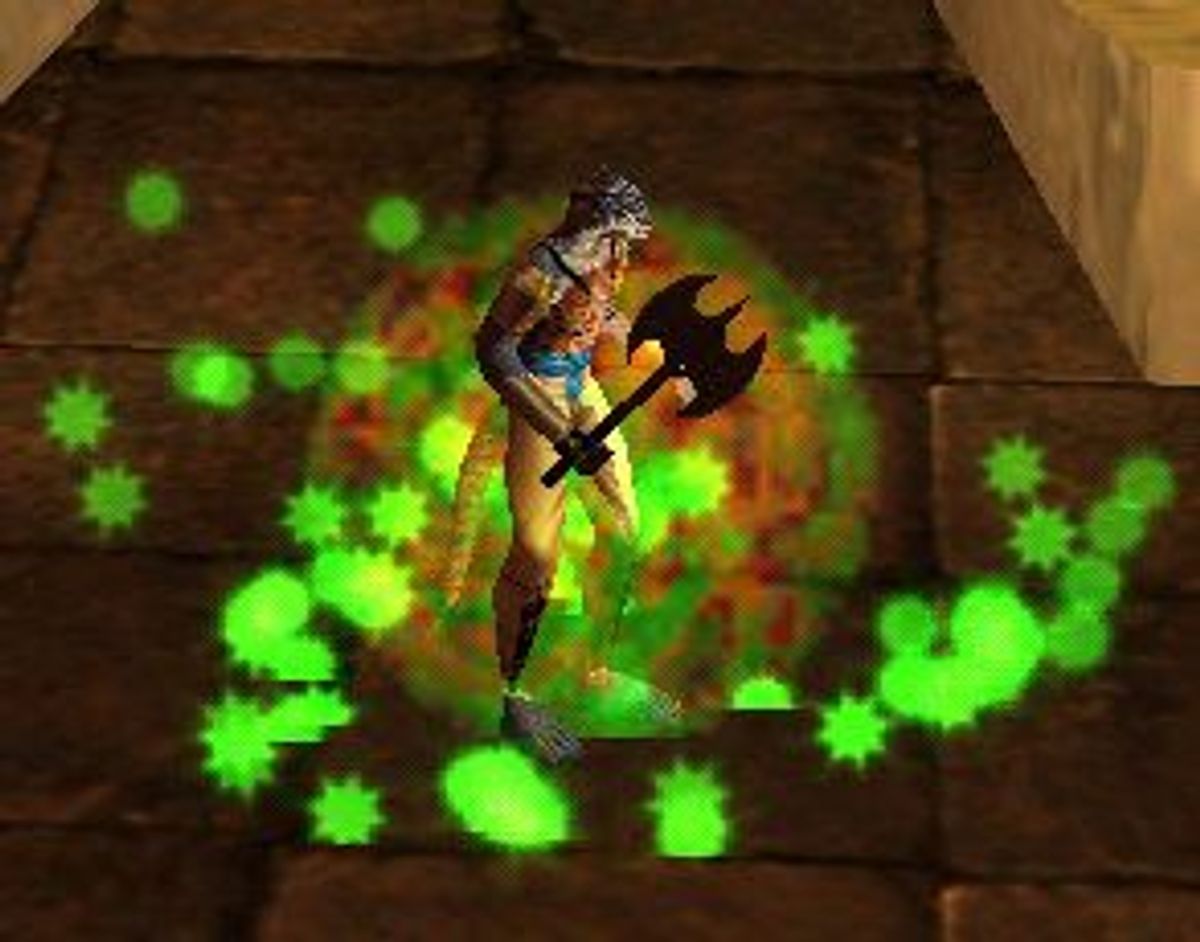
Stepping into the land of Everquest is like entering a three-dimensional fairy tale kingdom, a world of epic tales, grand quests and dangerous dragons in which you are the main storyteller. Like other popular role playing games (such as Asheron's Call or Ultima Online), this massively multiplayer online realm invites you to re-create yourself as a half-elf, dwarf, gnome or enchantress and embark on a never-ending series of adventures with over 300,000 fellow players. Beautifully rendered to be as realistic-looking as possible, it's much like stepping into the pages of a Tolkien novel.
There is no particular point to the game except, possibly, to move up in levels of character "expertise" -- learning how to become, say, a master warrior, jeweler or hunter. Making it all the way to level 50 and beyond will take you months of playing. In order to grow as a character you'll need to befriend other players, possibly joining a larger group called a "guild," which will join you on your quests, help you hunt gnolls and fire beetles and simply keep you company during some of the more tedious hours of recovering from battle.
With role playing you aren't simply following along someone else's linear storytelling narrative -- you and your newfound friends are the story. "The Everquest world is very real," says Jennifer Powell, a longtime player who often plays with her husband and other friends from the Well. "If you're a sane person, that doesn't affect you too much, but it's kind of stunning how much it's really very real. When I step in I feel like I'm going to another place -- I may see my husband there, but he's another persona inside the game."
By most accounts, the average Everquest player logs in for 15 to 20 hours a week; but more avid players, like Sheyla, will often play for many, many more -- clocking in months of playing time in a year. They'll often log into one of Everquest's many servers every day (in Sheyla's case, this was usually a server called "Quellious") and spend endless hours chatting, instant-message style, with pals from their guilds. Especially close Everquest friendships are often cemented by an online "marriage," an actual wedding ceremony after which the two characters' game assets -- gold, armor, weaponry and the like -- can even be combined into one bank account, if they so desire.
And then there are the fan sites, countless community bulletin boards (for guilds, servers, news sites, plus the "official" Verant boards) and virtual parties that guilds sometimes sponsor. The most avid players often become "guides," unpaid volunteers who on top of playing the game spend up to 10 hours every week offering advice to newbies and assisting players who are struggling.
All said, this makes for some pretty compelling game-playing; the more you play, the better you get, the closer you'll become to your online friends and the more you'll want to play. For the vast majority of players who spend time in Everquest, this is a terrific way to make new friends and use their creative powers to build an alternative world for themselves. But for others, it becomes an obsession; and the bickering, fighting and nastiness often seen in the online communities is a testament to this. Flame wars and feuds erupt, and guilds spontaneously fall apart from the infighting.
"It's such an addictive environment; it's like rats in an overcrowded maze -- they start attacking each other," says Scott Jennings, who manages the popular Lum the Mad gaming news site. "Once you get to a certain high level of player you've got people who have spent literally months of time sitting in front of their machines. And it becomes a really big deal to them, it becomes their life, they become obsessed by it. Anything that threatens them -- someone who threatens their guild standing or something as trivial as someone killing a monster they have their eyes on -- that's the kind of thing that spawns this vitriol and rage. It's tunnel vision, really frightening."
Which is where the story of Sheyla really begins.
By most accounts, Sheyla first appeared in the lands of Everquest in March or April of this year, introducing herself as a 19-year-old woman from Colorado (sometimes Oklahoma) who loved to draw. She joined the "Companions of Light" guild, along with someone who was introduced as her sister Jolena, and quickly made a name for herself as a sensitive but depressed young woman with a quick temper and a tendency to lie. Within a few months, she had logged in so many hours that Verant allowed her to become a guide.
But Sheyla's tenure as a guide was controversial, and she was chided for her occasionally unpleasant interactions with players. Her status as a guide was already endangered when, on Nov. 10, someone using her guide name ("Leza") posted a greeting on an online bulletin board. Verant has very strict rules about "official" communications with the Everquest playing population, and guides are forbidden to post to bulletin boards under their guide names. Soon after "guide Leza's" post, Verant terminated Sheyla's guide account. (The ensuing drama in the bulletin boards led many people to question whether the offending post was actually written by Sheyla herself, especially since it was later amended to include the line "HAHAHAHAHAHA SuXoRs I got her fired!!!!")
The following Monday, people who identified themselves as Sheyla's husband and her foster mother posted to several bulletin boards and mailing lists with the news that Sheyla had taken her own life. They offered few details except the fact that she was a sad young girl who had loved her Everquest friends. The mourning began. "We have our squabbles from time to time but for the most part the players stand together," says one member of the Quellious Quarters community, where Sheyla spent much of her time. "The message boards went quiet for about two days after the first post about Leza's death was posted. I know all of us were in shock and totally stunned by this news."
But as stories about Sheyla came out, the community at large began to doubt whether a suicide had actually taken place -- or if, indeed, the people they had known as Sheyla and her sister Jolena even existed.
Early on, Sheyla's stories often seemed wild, but since no one had ever met her in the flesh the community simply shrugged and took them at face value. William Joseph Seemer, a fellow guild member who eventually became close friends with Sheyla, describes an incident in the spring when Sheyla announced that she had cancer of the aorta. Her guild rallied around her and showered her with support and sympathy as she prepared for medical treatment; but many became suspicious when a mere 12 hours after her supposed open-heart surgery, Sheyla was already back at her computer playing the game.
The "Companions of Light" guild eventually collapsed, but Seemer kept in touch with her -- sending instant messages and the occasional written letter -- on and off until last week, when he came across the bulletin board posts describing Sheyla's suicide. When he heard the news, he was shocked -- and not just by the disturbing news. "I was told by Sheyla that she was pregnant at one time and had a miscarriage and wasn't able to have children; which blatantly contradicted what I read on boards that said she had a 2-year-old child and a husband," he says.
Seemer knew, from the letters they'd exchanged, that Sheyla lived near Oklahoma City; he began scanning the obituaries for the area but found no reports of suicides. He dug up the phone number for Sheyla's sister Jolena, and called -- but when he spoke to Jolena's roommate, the roommate told him that not only had Jolena moved out months earlier, but she didn't even have a sister. "I don't know what to think," he says.
Seemer wasn't the only person investigating. Verant refused to talk to the community about what had happened to Sheyla. The company also refused to comment or speculate to Salon. Instead, Verant began deleting posts regarding Sheyla from the official bulletin boards. The community decided to take matters into its own hands. Administrators from the Quellious Quarters bulletin boards, Scott Jennings of Lum the Mad, and gaming reporters from news and fan sites such as Adrenaline Vault and Gamers.com, as well as several concerned friends, spread out across Oklahoma and Colorado. They called coroners' offices, tracked down IP numbers and e-mail addresses, compared chat logs and account names and talked to Sheyla's ISP.
By Monday, the collective discovery was that Sheyla had, in fact, been a hoax. According to the report by Sandy Brundage of Gamers.com, Sheyla and her "family" -- her sister, husband and foster mother -- were all constructions of one couple who shared an e-mail account and lived in Oklahoma City. Not only did Sheyla not exist, but she was decidedly not dead. While the wife played "Jolena," the husband played "Sheyla."
But the couple had recently broken up. According to Gamers.com, the husband faked the Sheyla suicide as part of an elaborate plan to gain custody of their child. The plan, according to Brundage's report, was to claim that his wife had staged the suicide in order to "bring the story into court as proof of her instability and to gain custody of their daughter."
Not surprisingly, the community that last week was singing eulogies to the sensitive Sheyla -- "She sang. She painted. She cried. She was very attractive, and probably found herself very ugly when she looked at herself in the mirror," wrote one poetic mourner at the time -- is now licking its wounds and remembering the old adage that virtual appearances can often be deceiving.
"If she wanted attention, she certainly got it," notes Jennings wryly.
The Sheyla incident isn't the first time some of the more troubled role-playing-game enthusiasts have resorted to extreme behavior in order to get some kind of attention. Jennings recalls a similar situation in Ultima Online several years ago when another player suicide was faked in order to engender sympathy; other posters to the Lum the Mad bulletin boards have since recollected other suicide hoaxes. Richard Garriot, the creator of Ultima Online, was once visited by a naked fan who pulled out a gun and took a shot at him.
Such incidents involved clearly troubled fans teetering on the edge of sanity and in need of some kind of real psychological help, but such people certainly don't make up the majority of the players of online role playing games. "The large majority of people aren't that eaten up with [gaming], but you get that with everything. The word 'fan' comes from 'fanatic'; you've got this in politics or people who chase rock bands around the country," says Jennings. "But with online gaming it's easier to track because you have an electronic trail."
Regardless of what the man behind "Sheyla" was trying to achieve with his hoax, the controversy has stirred up a strong debate about depressed or otherwise unstable players, and whether immersive role playing games actually encourage troubled people to become "addicted" to the game. Over the course of thousands of posts across myriad gaming bulletin boards in the last week, countless Everquest players have come forth with concerns about how obsessed they are with the game, how it's damaging to their offline relationships and how it's causing them to withdraw from the real world into the virtual one.
Chris Skinner is one player who felt that the Sheyla controversy hit too close to home. A two-year veteran of the game, he came close to dropping out of college and losing his girlfriend because he was spending every waking hour playing the game; he estimates that at least 70 percent of the people he's befriended through Everquest have at one time or another developed an unhealthy obsession with playing the game. "To an outsider it's just like looking at a crack addict -- you don't understand how it is until you've been there," he says. "It really is an addiction." Skinner believes that players who spend all their time in the game lose touch with the real world -- replacing it with a virtual one -- only to discover that when they are having problems their "virtual friends" aren't as supportive as a real-world network might be. In response, he is now organizing an online support group called Everquest Escape -- which he hopes will include chat rooms, bulletin boards, a Web site and perhaps even in-game advisors -- to provide support for players who are feeling alone, depressed or otherwise obsessed with the game. As he puts it, "We can provide a forum for these people to know that there are others out there, we care about them and they are important, and maybe together we can help them work through their situation."
It is clear that role-playing games appeal to people who are otherwise limited in their real lives -- where else in the world could a handicapped man get to live the life of a fleet-footed warrior, or a shy woman become a witty and desirable enchantress, or a minimum-wage grunt play the role of a wealthy king? You can be as good or as evil or as popular as you've always dreamed. It would seem to make sense that troubled or unhappy people would find the worlds of Everquest, Asheron's Call or Ultima Online a welcome escape from the woes of everyday life; and, in turn, escape just a bit too much.
"It's an escape that has these friendships encoded into the game, a kind of companionship is enforced by this game," says one anonymous systems analyst who watched his already failing relationship fall apart as his girlfriend spent all of her spare time developing a virtual boyfriend on Everquest. "You have to be social and interact with people [to succeed in the game] -- for some people, they become surrogates for real life. They've got more 'EQ' friends than 'RL' [real life] friends."
Bulletin boards across Everquest are currently hopping with posts from self-confessed "Evercrack addicts" and spouses who worry that their partners are more involved with their gaming lives -- sometimes even including a virtual wife or husband -- than they are with their real-life families. Carly Staehlin, the producer of Ultima Online, estimates that there are 5,000 "married" couples inside that game, and says, "Players invest an average of 12 hours per week in Ultima Online, and [there are] lots of people who spend a lot more than that. Let's say two hours a day, your evening is going to be spent in the virtual world. If you are married in real life you are not spending that time interacting with your real-life spouse but your virtual spouse." No wonder so many jealous husbands, wives, girlfriends and boyfriends look with consternation at the phenomenon of role-playing marriages.
But that doesn't mean that the game is addicting, and many would disagree vehemently with Skinner's use of the term. The builders of Ultima Online and Everquest, for example, say that their games are no more compelling or addicting than any other pastime. Says Cindy Archuleta, community relations manager for Verant and Everquest, "Our average player plays about 20 hours a week; most of it is just a good sense of community when they are there. You can always find disturbing stories here or there when you do look for them. I have hosted three real-life events where people come to meet each other, and it's been extremely positive."
And it's true that any community or game, online or off, is going to have its more extreme enthusiasts as well as a much larger population of perfectly happy, well-adjusted participants. For every Sheyla, there is probably someone who has used Everquest as a way to reach out to the world and make friends, to learn something about themselves and gain a new perspective on life.
"It doesn't create a void, but it does help fill it," says Ron Hayden, an Everquest enthusiast and founder of the Well Guild. "For some people it's a bad thing because they avoid dealing with their life; for others it's a bridge to self-confidence. It really lets shy people who have a lot of self-confidence issues put on a personality and learn to overcome that in an environment where it's safe." After all, the whole idea of a role-playing game is to re-create reality, to create a world as immersive and entertaining as life itself, that allows players to live out their fullest fantasies -- to be better version of themselves -- in real time. This can be both wonderful, and dangerous, as the "Evercrack" confessions show. And thanks to ever-more-powerful gaming platforms like the Playstation 2 that can render shockingly realistic graphics, games are just going to continue to become more immersive. Jeff Brown, a spokesman for Electronic Arts (the publishers of Ultima Online) brags that "as immersive as these games are today, we are about six months away from them taking a quantum leap in the level of immersion that people will experience."
A dialogue about how to deal with gamers who enjoy the virtual world more than the physical world is an important one to have now -- rather than waiting until more players have resorted to faked suicides or real ones as a cry for help. And for that small epiphany, the Sheyla hoax was probably good for the role-playing community. "This was an important event for the community, it's just something that always needs to be discussed," says "Tweety," who runs an Everquest fan site, and ruminated publicly about the suicide. "She did us a service in some way. I prefer to think of it as Sheyla the idea, rather than Sheyla the person."
Shares