

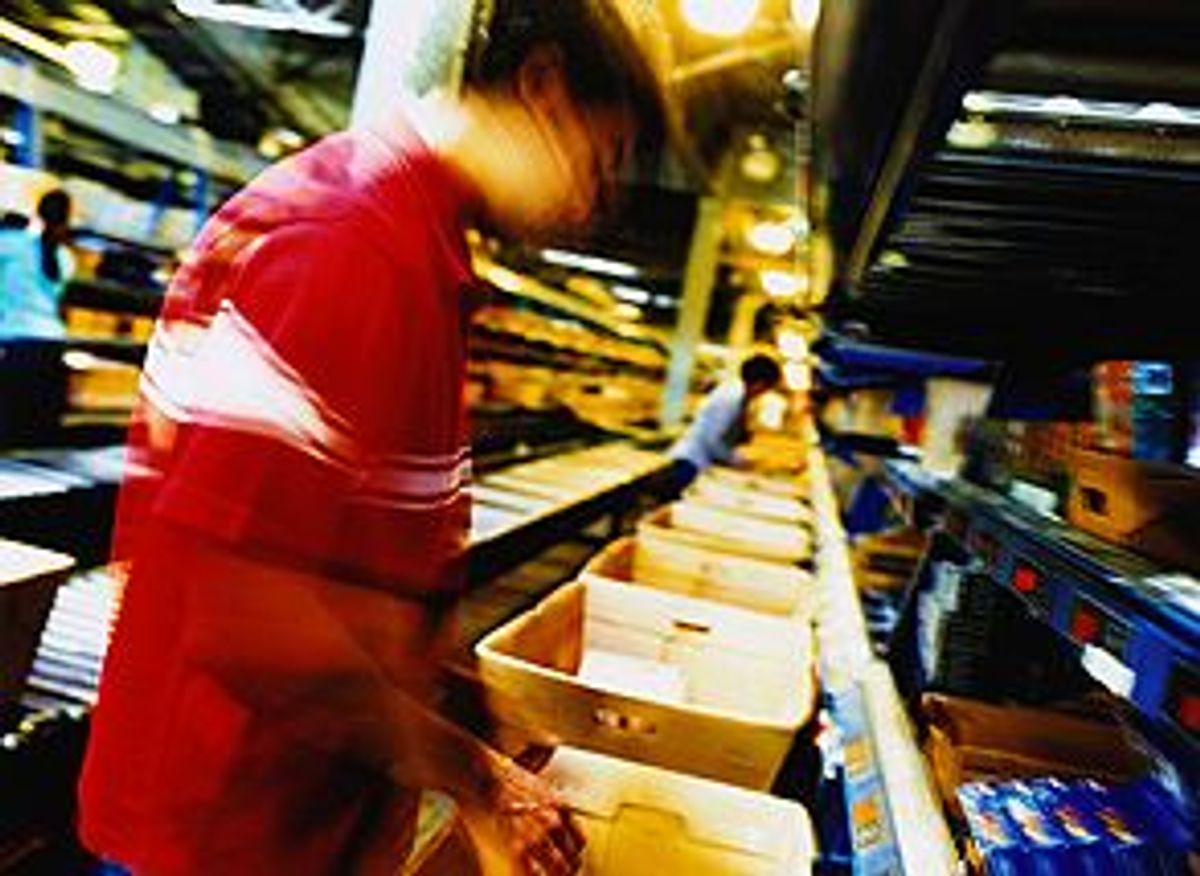
There was a rhythm to it at times, slapping labels on boxes and heaving them down the line. Some nights I would zone out in a throwing frenzy, look down to check my watch and find I had missed break. But more often I would discover that the 44 boxes of Hefty Cinch Sacks I had just put on the belt were supposed to be 44 boxes of Tide.
Huggies diapers, halogen floor lamps, Depend undergarments, I launched their journeys to the Kmart store near you. Some nights I moved so much Quilted Northern that I felt personally responsible for the collective ass wiping of the Mountain time zone. To Kmart, I was Associate No. 22699 at its Denver distribution center, the guy from Boulder who didn't smoke or eat meat. To the AFL-CIO, I was a "salt" or a "colonizer," a spy in the service of the American labor movement.
"This is not 'Norma Rae,'" Mark, the organizing director, told me. "You're not there to rile people up. Stay quiet, blend in as best you can and keep your ears open. If someone mentions anything about a union, don't say anything. If the campaign is a go, we might put you on management's anti-union committee. Anything can happen. Be prepared to be bored; pretty soon you'll forget that you're anything but a Kmart worker."
The consensus among seasoned union organizers is that the best of them are born out of the shop floor struggle for union representation. Those who have lived through management's often dirty and always divisive anti-union campaigns are best suited to lead workers through them. I had come through the AFL-CIO's Organizing Institute, which trains both rank-and-file union members and young, socially conscious college graduates in the fundamentals of organizing. I was a hybrid of the two, having been a member of a craft union in the film industry, but still young and naive enough to delight in an undercover assignment of non-union shitwork.
I harbored doubts about my capacity to be an organizer. I'm soft-spoken, frequently mistaken for gay and, according to my cousin, dress like a librarian -- in other words, not a likely stand-in for the macho, chain-smoking, coffee-swilling, fast food-inhaling stereotype of the male union organizer (a generalization, incidentally, that I found to be quite accurate). Salting was my personal litmus test for my future as an organizer. Coming through alive would bestow me with the labor-movement street credibility I so needed, along with an intimate understanding of what the struggle looks like from the inside. It would, I hoped, light the fire necessary to fuel an often-thankless itinerant lifestyle of economy motels, strained personal relationships and hard work.
I was ready for the challenge of organizing Kmart; what I didn't know is that I'd end up fighting a very different battle than the one I'd chosen.
My last name is Dicker. With the possible exception of films featuring men disguised as nuns, it is, quite simply, the funniest thing in the world. "Dickhead," "Dickchip" and "John Dicker the pricker licker" are only a few of the amusing nicknames I enjoyed in my youth. But in my 26 years, I had never encountered anyone so thoroughly enchanted by it as Jim, the college football player, summertime Kmart casepack associate and, as luck would have it, the architect of my mission's demise.
The second shift casepack department comprised 20 associates. Rob was a "reach truck" driver who had worked at the Kmart distribution center for four years. When our shift let out at 12:30 a.m., he left to deliver papers for the Denver Post. He then rose at 6 to start his other job at the carpet upholstery business he hoped would become his mainstay. He saw his two kids for a few hours on the weekends and rarely got five hours of sleep.
Amanda was 19 and perpetually indignant. She lived with her parents and 4-year-old son. The start of each shift found her sprinting through the plant to punch in on time. John was a retired college recruiter whose dreams of raising cattle were dashed when a hailstorm decimated his hay crop and forced him to sell most of his herd. He worked part time for the health benefits. We talked about baseball and the merits of beer vs. whiskey, the latter of which he was a great proponent of. Two weeks into the job, he confided to me: "This place sucks."
Charles was our shift manager, a veteran, a family man and a platitudinous bore. On my first day as a Kmart associate, he gave me his standard new hire speech: "I believe we're here to do the job we're paid to do and go home. It's not complicated. As it says in the associate handbook, your production goal is to throw 360 boxes an hour. That's six boxes a minute. Achieve that and you're a success. I am here to make you a success." He was well-suited for Kmart -- the plant was littered with block-lettered posters: "AIM FOR QUALITY!" "YOU CAN MAKE A DIFFERENCE!" and the ever-menacing "THINK LIKE YOUR CUSTOMER!"
I told my fellow associates an assortment of embellished truths and outright lies, dressing down my past and changing the subject when I had to. My friends at home, in my other life, were convinced that I would stand out, that my middle-class demeanor would expose me as the impostor proletarian I was. But I learned early on that my Kmart coworkers couldn't care less about where I came from. If I was suspected of anything, it was of not being smart enough to find another job. Why, they wondered, would a single guy like me -- a kid, practically, with no family to support -- drive 25 miles from Boulder every day to a job that had little to offer apart from the health coverage? Still, no one gave it much thought.
Work at the Kmart distribution center was a series of aggravations. Conveyor belts jammed; there were vicious splinters and cardboard cuts. Boxes fell on our heads from second-tier slots; a case of cat litter left Amanda's face black and blue. Pallets, cheap and splintery with protruding nails, were the bane of the casepack associate. It was our responsibility to throw them into designated pallet slots after we cleared the boxes on top. Some weighed 60 pounds and it was not uncommon to throw 100 during the course of a shift. Since we were constantly peeling labels, wearing gloves would have significantly reduced our production rate. My hands quickly grew chapped and calloused.
Speed was paramount at Kmart -- our goal was to maintain a 48-hour turnaround in stocking store merchandise, a demanding standard that still looked lazy compared to that of Walmart, the undisputed master of distribution, which boasts of a 24-hour turnaround. If a package of Bounty paper towels was purchased from a Kmart store on Wednesday, by Friday that item had been ordered, pulled from the distribution center by someone like me and restocked on the shelves.
Casepack associates worked from stacks of computer generated labels that we carried in tin pouches hooked onto our thick leather belts. Matching the numbers on our labels with the numbered storage slots in the warehouse, we peeled off the adhesive backing, placed the labels on the boxes in the storage slots and then hurled those boxes onto the conveyor belt -- over and over and over again until cleanup. Once they'd been sorted according to their destination, the boxes were loaded onto trucks bound for one of 116 Kmart stores throughout the Rocky Mountain states.
Distribution centers, or D.C.s, are big, airplane-hangar big. The walk from the parking lot to the time clock took nearly 10 minutes. The P.A. system was essential; it regularly chimed in the status of outgoing batches, alerted associates to jammed lines and paged supervisors and managers. Everyone had a reason to use it.
"John DICKer, please dial 389. John DICKer, dial 389."
Including Jim.
Many liberals are dismayed to learn that workers do not instinctively gather under the union banner like extras in an Eisenstein film. During an organizing campaign, employees are a captive audience for managers who have eight hours a day to drill in the anti-union message. Businesses hire expensive union busters, sometimes known as "labor consultants" who screen propaganda videos and hold meetings to convince workers that the union is only interested in their membership dues, or that if the union wins, the plant might shut down. Meanwhile, union organizers are barred from entering the plant, and consequently have only a few hours at the beginning and end of the workday to make the union case.
The union needed to know what kinds of work people did, when their shifts were and how long they'd worked for Kmart. That's where I came in. Much of my work as a salt involved compiling an employee roster that would help the union talk with workers once the campaign began.
My union sponsors weren't sure whether the Denver distribution center was ripe for organization. Kmart was the big leagues, a national chain with the best union busters money could buy. If there wasn't any heat from the shop floor to begin with -- if workers weren't already trying to unionize -- a campaign would be a waste of union resources and a loss of face for both the union and the workers. And, in fact, workers at the Denver Kmart D.C. weren't as bad off as they might have been. Denver's unemployment rate was less than 2 percent; wages were high, $10 per hour to start. The only unionized Kmart D.C. paid less than $7 an hour at the start of the campaign.
Mark, the union organizer who had sent me to Kmart, decided to come out at the end of the month to talk to some workers and make a decision. I was well into my second month. I was becoming friends with my shift, giving people rides home. Amanda had made a pass at me. I was fitting in.
There was just one problem.
"Hey DICKer!" Jim yelled from the top of a storage module.
"Hey fucko, how's your mom's side of the street corner?" I replied.
There is a power struggle between men that, to various degrees, occurs everywhere from a U.N. summit to a "Star Trek" seminar. It plays itself out through repartee, the implied violence of gestures and stares. It is nothing more or less than the establishment of hierarchy, a penis war for every milieu. It can be deconstructed, dismissed and ridiculed, but when you're in the thick of it, there's nothing to do but fight back. Nothing I read in the Nation offered any useful methodology for dealing with Jim. It was just me and my own collection of eighth-grade vintage comebacks. Sometimes, the personal is just plain personal.
With Jim at 6-foot-2 and at least 230 pounds, any thought of physical confrontation was little more than a request for a beating, and turning to management was no better than running to daddy. I briefly entertained the idea of initiating an earnest discussion, but Jim seemed an unlikely candidate for a heart-to-heart. I could only conjure up the scene from "In the Name of the Father" where the IRA prisoner explains the necessity of armed struggle to Daniel Day-Lewis: "It's the only language they [the British] understand."
The stakes were high. I'd been working hard and was nearly on par with the 360 boxes per hour production goal. Kmart wasn't my first salting assignment; several months earlier I'd had a brief stint at an industrial laundry outside Detroit, folding pants and coveralls. I lasted nine days. I wish I could say that I'd been followed, found out, that security had seen me sneaking around on break, pilfering employee rosters and talking into the recorder in my breast pocket. The real reason for my dismissal was a bit less sexy: I could not fold pants fast enough. Kmart might well have been my last chance.
But Jim had me against the wall. He was a Samsonite showroom of my emotional baggage. I could give back to him verbally but he was like a dog, trained to sniff out fear. And I reeked of it. Jim was the embodiment of every adolescent bully, every unavenged humiliation I could remember. I spent too many years with my tail between my legs. As David Mamet's Donny says in "American Buffalo": "Action talks and bullshit walks." I was ready.
Most nights, Jim's pages came in the last hour of the shift. One particular Tuesday, the first one chimed in before first break. "John DICKer, you are needed in the casepack office, John DICKer." It was summer and most associates smoked around the picnic tables. Jim stayed in the break room watching TV with a few other guys on our shift. The room had a dozen microwaves and numerous vending machines. The logos of Denver's sports teams were painted on the walls. Go Broncos. One of the vending machines served fountain soda in 18-ounce paper cups. I put in my 50 cents for a Dr. Pepper.
"Paging Jim Allen, paging Jim Allen."
I poured with confidence from high above his head, until the stream of brown liquid matted down his hair. As he jerked around, I let it all out, until his face, shoulders and T-shirt were drenched. I stood stonefaced above him. With the soda gone, so was the fear. I was dangerous. Calmly, with every ounce of dignity I could muster, I put my face in his, pointed my finger and spoke my farewell: "Quit paging me, bitch."
A security officer took my badge and back brace. I cleared out a beaten-up paperback copy of "The Hotel New Hampshire" from my locker. That afternoon, there was a thunderstorm on the plains, and as I drove west toward Boulder, the Rockies peeked through the clouds. I slept well that night.
When I broke the news to Mark, he remained surprisingly calm. He came out to the D.C. as planned, met with several workers and decided to bag the campaign. Most workers recognized that Kmart paid better than other unskilled positions. They had no security without a union contract, but it's hard to argue with what people perceive as a good arrangement. "Where's the oppression when you need it?" Mark lamented.
I would never be a rank-and-file militant. I would never be spoken of in the same breath as Elizabeth Gurley Flynn, Big Bill Haywood or César Chávez. I was John Dicker, ex-associate No. 22699. Without the responsibility of children, a mortgage or car payments, returning to New York was my privilege. But sometimes, worse than the arrogance of not recognizing privilege is failing to take advantage of it.
Every union video I've ever seen ends with Aretha Franklin's "Respect" playing over images of rallying workers. I expected to struggle collectively and achieve respect by voting "yes" in a union election. Instead, I voted with 18 icy ounces of carbonated beverage. No recount was necessary, and if I contest anything, it is only my failure to find a bigger cup.
Shares