There are moments, these days, when I sit at my desk, watching the spam pour into my in box, and think, Well, we did it! We built the Internet and created the most efficient means in human history for delivering penis enlargement pitches and come-ons from Nigerian scam artists.
As spam keeps multiplying, it reminds us of the persistence of the original nightmare of the Net as a borderless, centerless anarchy -- a medium in which anyone is free to tell outrageous lies or steal collective resources because, hey, who can stop them? Each new spam is an irritating reminder: This network is out of control.
Except. A couple of weeks ago, in between the spammed "Become your own boss!" and "herbal Viagra" offers, I received a cluster of real e-mail from friends and colleagues, all pointing to the same news blip: "Four Web sites," the headlines read, "control half of surfing time."
My God! Talk about media concentration! Has the entire Web really come down to America Online, Microsoft, Yahoo and Napster?
Of course, look a little more closely at that report and you find all sorts of holes. For starters, there's the notoriously inaccurate methodology of the survey takers at Jupiter Media Metrix. Then there's the definitions of all these terms -- "site," "surfing," "control." Does AOL "control" the time that its users are sending e-mail? Are Napster users "surfing" when they're trading music files? Who assembled this ludicrous data, anyway?
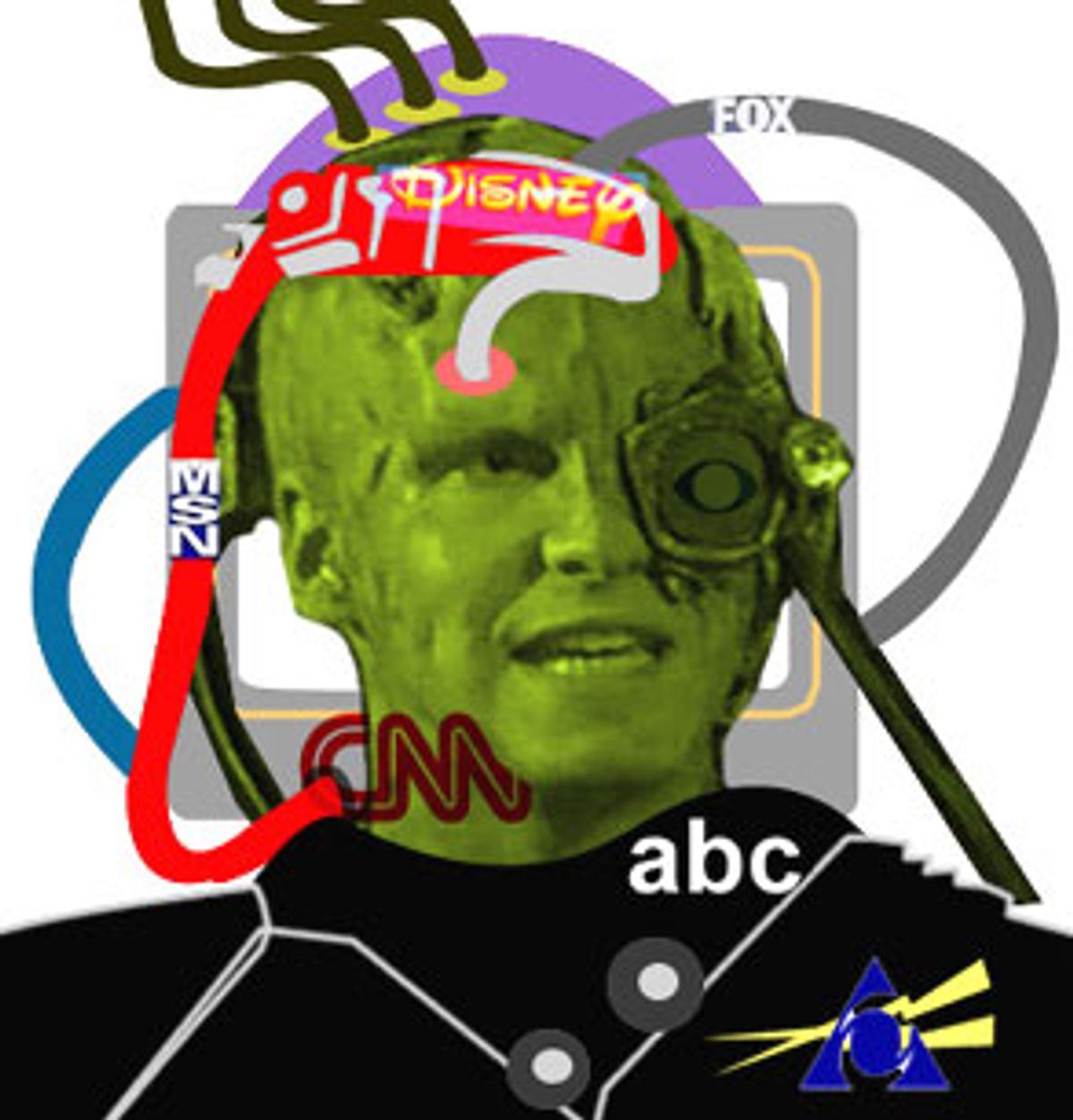
Still, the sound bite touched a nerve because -- whatever the flaws in Jupiter's study -- we know in our guts that control of the Web is concentrating at an alarming rate. Sure, it's still possible for anyone to put up a Web site. But as the carcasses of independent Web start-ups litter the landscape, the once-wild online free-for-all is rapidly devolving into a showdown between AOL and Microsoft. AOL controls the subscriber lists and a huge chunk of the content; Microsoft controls the consumer operating system and browser. Anarchy? No way -- this is a bipolar Cold War, waged with software standards and lawsuits and marketing blitzes.
In fact, the Web today, in this grim summer of 2001 -- seven long years after its first flush of popularity -- faces a paradoxical and perplexing impasse. It's still too anarchic to be made a completely smooth, convenient, ready-for-prime-time experience; but it's also losing the vital ferment of its "let a hundred flowers bloom" youth to the gray monotony of corporate control.
We're reaping the worst of both worlds, networked chaos and monopolistic consolidation. The least common denominator of individual behavior multiplies, while the least common denominator of mass taste prevails.
In other words, we're screwed.
How did we -- the users of the Internet, promised untold new vistas of individual empowerment and a renaissance of political and cultural expression -- wind up in such straits? To answer that, we have to look back to the roots of today's commercial Internet, the heady days of 1994 and 1995.
What made that time so exciting? For the first time in our experience, the spread of the Web had, momentarily at least, leveled the playing field of media distribution. The Web's open design and standards meant that publishers of all stripes could stop worrying about getting their products to people; all you had to do was plug your content into the Web, and anyone who had access to the Web could get it. You didn't have to pay for shelf space or rack space or airtime, or pay off regulators to reserve spectrum for you, or worry about delivery truck drivers going on strike. The Web didn't eliminate distribution costs (there are still servers to buy and bandwidth charges to pay), but it dramatically reduced them, and gave the notion that "everyone's a publisher" some credence beyond hype.
"Publisher" covers a vast spectrum, though, from AOL Time Warner to your local HTML whiz kid. As commercial publishers colonized the Web and private individuals flexed their new publishing muscles, two vastly different visions of the Web's purpose and value emerged. Old-line media corporations that viewed the Web as a threat and commercial start-ups that saw it as an opportunity shared one perspective: The Web had to be made a safe place for profits, whatever it took in the way of advertising, subscriptions, privacy invasions and other increasingly desperate measures. Meanwhile, the do-it-yourself Web publishers -- from the "build your own page" homesteaders of 1995 to the more recent explosion of weblogs -- reveled in the new ease with which they could post information, from personal trivia to headline-making revelations, to the entire world, and didn't worry much about money.
In no other medium have "pro" and amateur, commercial and "just for fun" found themselves so inseparably intertwined. But along the way each camp tended to conveniently forget some facts: The amateurs lost sight of how heavily their "free" publishing was subsidized by venture-capital investments in Net infrastructure -- investments that, having proved largely unprofitable, are no longer flowing. The pros, meanwhile, talked up projections of vast growth for Internet usage, without acknowledging how much of that use went to e-mail or Britney Spears fan pages, neither of which was likely to boost a media company's bottom line.
Thanks to this dynamic, the Web we know today evolved. The medium became a laboratory for big corporate media and technology companies to test new software and new business models at relatively low risk and cost. Much of the Web's seven-year history is a chronicle of these failures: The e-commerce missteps of 1996 (remember Marketplace MCI?), the city-site wars of 1997, the me-too portal mania of 1998 and 1999, the dot-com dollar palooza that peaked and then cratered in 2000. At the same time, the Web became an enormous global water cooler and party line, a gossip-amplifying, hobby-driven cornucopia of trivial pursuits -- ham radio on speed, only you didn't have to learn Morse code.
A lot of predictions made with great idealism didn't pan out. After a brief first wave of innovative new sites -- Hotwired, Feed, Word, Suck, Salon and Slate -- the notion that the Web would foster a renaissance of independent publishing quickly withered in the face of some hard truths about Web media: Yes, it's easier and cheaper to put up a site than to print a newspaper or magazine or start a TV station, but journalism and information still cost money. And once you hang out your Web shingle you still have to figure out a way for people to find out that it's there.
So of that first wave of high-profile "indies," Hotwired and Word are long gone, Feed and Suck have just gone into deepfreeze and Salon's financial difficulties have become a long-running soap opera in the financial press. (Slate may belong to this group in its target audience, but it is now so deeply intertwined with the Microsoft Network that its Web address has become a mere redirect from "www.slate.com" to "slate.msn.com," and its editor, Michael Kinsley, says he doesn't even have a separate balance sheet.)
There's no reason the Web can't support a flourishing field of independent professional publishers in the middle ground between Big Media and feisty amateur -- no reason, that is, as long as you give this still-fledgling business time to sort itself out. Web users will, eventually, accept the necessity of paying subscription fees for the content they really want. Advertisers will, eventually, stop holding the Web to standards of guaranteed effectiveness that their bloated print and broadcast budgets could never meet. Sustainable businesses will evolve out of the carnage of the dot-com downturn, or grow off the corpses of failed start-ups. Broadband connections and software improvements will, across a decade-long vista, reduce users' frustration and impatience. Anyone, anywhere, will still be able to put up a Web site and reach anyone else online with news, gossip, truth or lies.
One big "but" hangs in the way of this rosy scenario, however. As Microsoft and AOL play out their corporate duel, each will inevitably seek to lock in customers and lock out competitors. I think a significant number of Web users, myself included, would be happy to see these two giants cripple each other in the process. The trouble is, their moves are more likely to injure bystanders -- and could wreck the Net itself.
While no one company may "control" the Web, Microsoft and AOL each have it within their power to wreak a lot of damage on the network and its users. At the moment, the pressure is on Microsoft to whittle down AOL's overwhelming lead in the subscriber rolls, so it's Microsoft that's causing the most trouble. Since Microsoft controls the operating system and Web browser that most consumers use, Microsoft looks to bend its software in directions that will help drive users to its Web sites and other businesses. This is what Microsoft calls "innovation" and "integration" -- and what the U.S. legal system, depending on which court's ruling is currently in force, calls "monopolistic behavior" and "antitrust violation."
As Microsoft readies the next mass-market version of Windows, XP (which supposedly stands, in some bizarre tip of the hat to Jimi Hendrix, for "Experience"), provocative tidbits of its "integrations" have surfaced. The most outrageous gambit is a little innovation known as Smart Tags -- a tool already built into the Office XP software package that automatically adds new links to documents. You don't choose where on the Internet these links point to; Microsoft does. In Windows XP, Microsoft intends to extend Smart Tags to the Web browser, usurping the heretofore-unchallenged right of a Web site operator to decide where links point.
This sets off very loud alarm bells: Site editors rightly fear the hijacking of their content; site proprietors rightly foresee the hijacking of their businesses. (In my previous paragraph, imagine a link from "Hendrix" to a Microsoft-owned or -partnered music shop -- or, more outrageously, from "antitrust violation" to a Microsoft-slanted definition of that term.) Microsoft, feebly, murmurs that XP remains an unfinished product, and Smart Tags don't look like other links, and maybe they will be turned off by default, and maybe it will be easy for sites to override them. The bottom line remains: Microsoft will choose new directions for its technology, and the very directions the company insists its users are clamoring for will -- by sheer coincidence -- move power over content and commerce into its own hands.
The Smart Tags tool isn't the only trick up Microsoft's XP sleeve. The new Windows will also herd users toward Windows Media Player for multimedia content. It will "integrate" its instant-messaging service to take on AOL's dominance in this arena. And it will aggressively push its Passport service for storing personal information.
Passport is Microsoft's scheme for getting your credit card number and personal information on file; sure, it will offer one-click convenience at many Microsoft-affiliated sites, but it also puts Microsoft in an ideal position to finally make good on its long-held dream of cutting itself a slice of online transactions. (In memos and interviews a few years ago, the company's then chief technology officer, Nathan Myhrvold, referred to this tollbooth charge as a "vig" -- a term from the patois of bookies, which gives you an idea of the direction from which Microsoft has been drawing its inspiration.) Once we all need to register for Passport to pay the subscription fees Microsoft intends to charge for use of its operating system, Passport will be ubiquitous and unavoidable -- except by those who opt out of the Windows world completely, fleeing for the high ground of Apple's newly reinvigorated operating system or the freehold of Linux, as more and more adventurous souls will do.
Microsoft's role in the ecology of the Internet business has long been to "cut off the air supply" of competitors. Microsoft execs deny coining that memorable phrase, which emerged during the antitrust trial -- but whether they used it or not, it accurately describes the company's tactics. Today, AOL -- with its tens of millions of subscribers -- has the luxury of, in essence, being the atmosphere of the online world. Where Microsoft needs to subsidize its online efforts with the obscene profits generated by its desktop-software monopoly, AOL controls the world's largest stream of direct revenue from online services. This is thanks to the company's unique position in serving as the country's biggest Internet service provider and its largest producer of content (since the merger with Time Warner).
AOL won this position by offering new users a genuinely easy method of getting online, and by locking those users into AOL buddy lists and instant-messaging services. Users pay AOL their monthly connection fee (which seems to creep up a couple of dollars every year or two) and then AOL tries to leverage the relationship through advertising and promotions. Smart business? Sure -- but one that relies on users' lack of smarts.
It's not yet clear how AOL will respond to Microsoft's offensive, but you can be sure it will give up no ground without a battle -- in the courts or the consumer market or the software arena or everywhere at once. AOL will do everything in its power, as it always has, to keep users' eyes and dollars from roaming beyond AOL turf -- and now that AOL's turf is so vast, that's an easier task.
Before asking whether either of these companies could control the Web or the Net, you have to pin down what you mean by "control." There's control of speech -- of individual users' ability to say what they want. There's control of access -- of whether and how we're able to find and reach others across the network. And of course there's control of the ability to make money online.
As long as AOL's and Microsoft's struggle is fought primarily in that final realm, the fight won't be one that most Net users will care about; one mega-corporation's money grab looks pretty much like another's. Things will get far more interesting, however, if the conflict spills over into the other two categories. The Smart Tag controversy is a glimpse of what corporate speech control on the Net looks like -- that's why it has so much of the active Net up in arms. Meanwhile, the more AOL and Microsoft "leverage" their advantages in, respectively, subscribership and software, the more likely they are to start closing off entrances and exits and transforming their fiefdoms into private networks. In the world of instant messaging, each company's users are unable to connect with the other's -- a preview of what corporate control of access on the Net looks like. Think of how it would feel if e-mail worked that way!
In fact, it's not hard to imagine this at all -- because it's exactly how the commercial online world worked before 1994. The smoke of today's AOL/Microsoft war obscures a secret agenda the two companies will never admit to publicly: They don't like the Internet -- and never have.
Microsoft's MSN and AOL were both closed, proprietary networks when the Web exploded and upended their business plans, forcing each to change course radically: Microsoft turned its battleship around to sink Netscape in the browser wars, while AOL dropped its hourly charges. Both companies hooked up their networks to the open Net, while conniving to keep their users just a little fuzzy about where the "branded" AOL or Microsoft turf ended and the rest of the Net began.
Both companies, you can bet, would be far more comfortable in a world without the Internet -- a world in which they governed who could post content on their networks and taxed anyone who made money from it. Seven years ago, only one thing made them accept and embrace the strange new notion of a network that nobody owned or controlled: the overwhelming enthusiasm for the Net on the part of masses of users and developers.
A kind of online "people power" forced open Microsoft's and AOL's doors seven years ago. Today both companies are itching to turn back the clock. Can they do it? They'll certainly try. But if these companies push too hard, those who care about the survival of an independent Web may simply vote with their feet and wallets, as they did once before. If they don't -- and only if they don't -- it will be time to sing a requiem for the Net.
This article has been changed.
Shares