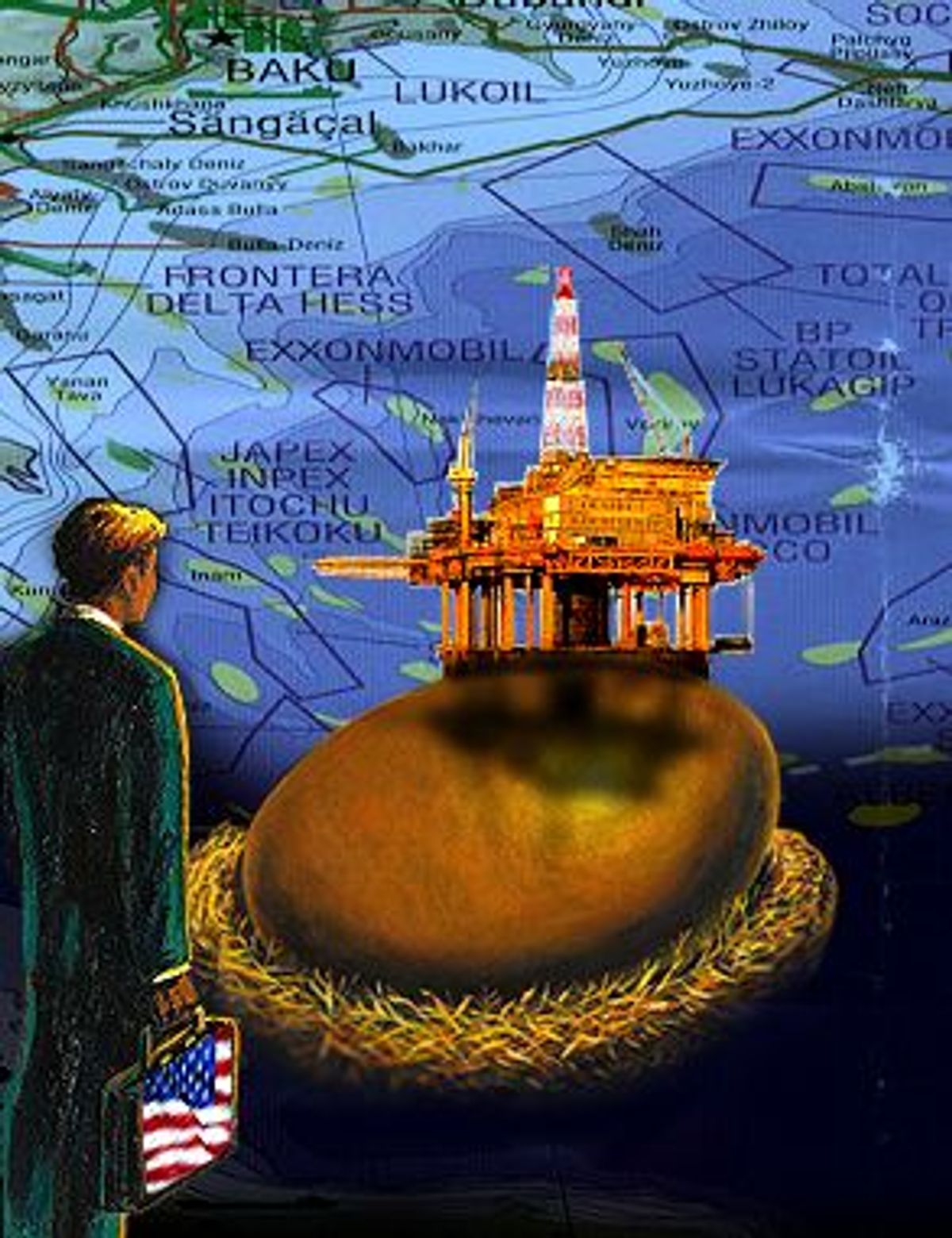
Any war worth its salt deserves a nifty conspiracy theory, and the war on terrorism is no exception. Here's how it goes: the U.S. bombing of Afghanistan is not really aimed at toppling the Taliban and nabbing Osama bin Laden, it's about gaining access to Central Asian oil and natural gas. Just as in the Gulf War, American troops are fighting to keep gasoline prices low and factories humming, led by a commander-in-chief with intimate ties to the oil industry.
There are some clear differences between the war on terrorism and the Gulf War -- namely, the thousands of casualties the U.S. has already faced. But as the conspiracy theorists suggest, there's also little doubt that overthrowing the Taliban could be economically advantageous to the U.S. At least one U.S. oil company, Unocal, spent much of the 1990s striving to start work on a pipeline that would cross Afghanistan and connect Central Asia to Pakistan and India -- without having to pass through Iran. The continuing civil war between the Taliban and the Northern Alliance made any such plans impossible to realize, but the possibility remains.
The Caspian Basin -- a region that includes Azerbaijan, Kazakhstan, Uzbekistan, Turkmenistan, Tajikistan and Khirgistan -- does have largely untapped oil and gas reserves. If the U.S.-led coalition succeeded in stabilizing Afghanistan, new pipelines could finally be constructed. Access to Central Asian oil and gas might well decrease the Western world's dependence on the Middle East.
And it's that last possibility that has most longtime followers of the oil biz and Mideast politics intrigued. Never mind the conspiracy muttering -- anything that offers a chance of eliminating the chokehold that the Mideast has over the world's oil supplies demands serious attention. As Michael Klare, author of "Resource Wars: The New Landscape of Global Conflict," notes, the idea that the war in Afghanistan isn't just about terrorism, but also about securing a replacement for Persian Gulf oil "keeps circulating in the netherworld of opinion."
The stakes seem to be huge. A replacement for Persian Gulf oil would allow the U.S. to extricate itself from its intimate embrace of repressive regimes in countries like Saudi Arabia. It might even present the possibility that the seemingly inevitable showdown between the West and the Muslim world could be averted.
Unfortunately for conspiracy theorists and assorted dreamers, Central Asian oil is unlikely to be the "ace in the hole" freeing the West from its oil shackles. The role that Central Asia might play in the story of worldwide energy "has been substantially overestimated," says Klare. "It's not another Persian Gulf."
Even if ways were found to get oil and gas out of Central Asia -- a task that will be expensive and difficult -- the unhappy truth is that there just isn't enough fuel there to make a significant difference. The most wildly optimistic estimates, coming from U.S. government analysts, theorize that the region has only 200 billion barrels of oil, which means that Caspian oil supplies are decidedly second-tier -- far smaller than what's known to exist in Saudi Arabia alone and about as substantial as oil fields now being developed off the coast of Mexico, Argentina and Brazil. Natural gas deposits in the region are more substantial but still not enough to remove the need for Persian Gulf supplies.
Barring a radical shift in technology or worldwide demand, the oil and gas of the Caspian Basin will remain only marginal in importance for at least the next 20 years. And as long as oil-producing countries outside the Persian Gulf can't supply all the world's needs, Arab countries like Saudi Arabia -- the world's largest producer of oil -- will have the power to set the all-important price of oil on world markets. Which means that, barring the unlikely prospect of a direct Western takeover of Mideast oil fields -- or the even unlikelier prospect of a concerted American effort to curb its voracious hunger for fossil fuels -- the U.S. and its allies will still have to kowtow to Gulf countries, no matter how corrupt or repressive their rulers are.
"Even if the United States got 100 percent of the output from the Caspian over the next couple of decades -- about 7 to 10 million barrels per day -- it wouldn't be enough," says Daniel Butler, an energy analyst with the U.S. Department of Energy. "The Persian Gulf will still have a huge amount of leverage."
One of the first questions to grapple with when trying to understand the interdependencies between Western nations and Middle Eastern oil producers is devilishly difficult: Just how much oil is out there? And the immediate answer is confusing, because a close look reveals that there is an awful lot yet to be pumped up.
Ever since the oil industry got its start in Pennsylvania in the late 19th century, people have wondered when the world would run out of "black gold." Doomsday predictions have been commonplace. The earliest U.S. government estimates believed that oil would be gone by 1925; updated predictions from the Department of the Interior in both the 1940s and 1950s argued that oil supplies would run out before 1970. The 1980s, 1990s, and early 21st century have all also been pinpointed, by both environmentalists and geologists, as periods in which the wells would finally peter out.
Each of these predictions might have been proven correct, if only the supply of oil was a static figure. But instead, like oil itself, the amount of oil remaining in the world, according to one analyst, is "totally fluid." Even as the world consumes more than 73 million barrels of oil per day, according to U.S. Department of Energy figures, the total available supply continues to grow.
The standing figure for proven and easily accessible oil reserves remains what it was in the 1980s -- 1 trillion barrels. That's more than double estimates from the 1940s, and the number doesn't even reflect improvements in technology that will let oil companies pull even more oil out the ground.
"When you drill you expect to get 30 percent of the oil [under the ground]," Butler says. "That's what the trillion barrels is based on; the 30-35 percent of what's available. But because technology has made great strides, you can now get 50 percent and in some cases -- in places such as the North Sea -- 70 percent."
In other words, there are actually more than 1 trillion barrels of proven reserves. "If you look at the series of estimates, it's an increasing series." says Butler. When they do it again in a few more years, I guarantee that they'll even find more."
In fact, the most recent U.S. Geological Survey estimates declare that the world holds 3 trillion barrels -- enough to satisfy world demand at the present level for about 100 years. These surveys could be overstating the potential, but there are also other sources of oil that remain untapped. Tar sands and shale rock formations hold substantial quantities of oil. Some experts estimate -- according to Bjorn Lomborg, author of "The Skeptical Environmentalist" -- that shale rock alone contains 242 times more oil than conventional petroleum resources.
As Saudi Arabia's former oil minister Sheik Yamani pointed out, the Stone Age came to an end not for lack of stones and the Oil Age will end, but not for a lack of oil."
With such an abundance of oil yet to be extracted, why can't the world wean itself from the Persian Gulf? At the very least, why couldn't the 506 million barrels of Saudi Arabian oil imported last year -- about 15 percent of total U.S. oil imports -- be found somewhere else, specifically the Caspian Basin?
The answer to both questions, as always with oil, comes down to price. With the current price of oil hovering around $22 per barrel, it is not yet economical to develop sources of oil that would reduce dependence on Mideast oil. And right now Mideast oil is cheap to produce, and production of it can easily be ramped up to keep prices down. Central Asian oil, for a variety of reasons, can't compete.
Most Central Asian oil is believed to reside in the Kashagan field, under the Caspian Sea itself, a body of water bordered by Azerbaijan, Iran, Turkmenistan, Kazakhstan, and Russia. The Soviet Union controlled the sea from the 1920s on, but there has never been any treaty dividing up ownership -- today, all five countries surrounding the sea have staked competing claims on the water and to what lies beneath. In the decade following the dissolution of the USSR, the sea went from an "international footnote," in the words of one law review article, to "a tangled international dispute with a multi-billion dollar stake."
Ironing out the dispute won't just be difficult; it could be impossible, says John Voll, an Islamic history and international affairs professor at Georgetown University.
"Caspian oil can cause a lot of problems," he says, noting that a war between Azerbaijan and Iran could easily erupt over the Caspian, since both countries have been on bad terms since the 19th century. "It's not the amount that matters; it's the fact that it's being pulled in so many directions."
"People once thought the Caspian would be a more stable region than the Middle East, but that hasn't proven to be the case," says Amy Jaffe, senior energy advisor at Rice University's Baker Institute for Public Policy.
And even if jurisdictional issues were settled, getting oil rigs and other supplies into the sea would be challenging, says Jaffe. "You can't just build the rigs and pull them in with tugboats, because the sea is landlocked," she says. Getting the oil out will also be tough. Even if pipelines are built, it would still cost more to get oil out of Uzbekistan than out of Saudi Arabia.
The politics and geography of the region are not the only obstacles. Even if the region reverses its long history of societal entropy; even if Central Asia quickly stabilizes, oil barons and seekers of energy security may end up disappointed. Estimates of what is underground in Kazakhstan, Azerbaijan, Uzbekistan and other countries in the area range wildly.
Butler and other U.S. analysts argue that the region holds between 150 and 200 billion barrels, about as much as what's found in the large fields off the Atlantic coast of South America. But Rice University geologists peg the region's proven reserves at between 15 and 31 billion barrels -- and say there may not be more than 50 billion barrels total.
"Since the late '90s, more and more oil companies drilled in this region and had disappointing results," Jaffe says. "People are more pessimistic than they were a few years ago."
The Caspian will likely never become one of world's top oil-producing regions, Jaffe says. "It's not going to happen. The region will only supply 3 to 4 million barrels of oil a day to the world by 2010," she speculates. And even if the region produces double that -- the vision of optimists like Butler -- Caspian yields will still lag far behind the Persian Gulf countries, which exported 17.5 million barrels of oil per day in 2000. The gap widens even further when one takes into account that countries like Saudi Arabia could be producing millions more, but have so far chosen to hold back, as part of an ongoing struggle to stabilize prices.
If we accept that Central Asian oil will not replace Persian Gulf oil, is there still a possibility that it could play an important role? Michael Klare suggests that the U.S. strategy in the region aims not to replace Persian Gulf oil, but rather to "multiply the possible sources of supply so if there's a cutoff in one, they can boost supply elsewhere."
Development outside OPEC -- the consortium of 11 oil-producing countries, seven of which are in the Mideast plus Venezuela, Indonesia, Nigeria and Algeria -- has been growing since 1988 at a rate of about 1 to 1.5 percent per year, according to Department of Energy figures. Should this trend continue, non-OPEC production would likely reach 54 million barrels per day by 2005. But even with an additional 10 million barrels a day from the Caspian basin, there still wouldn't be enough oil to satisfy present worldwide demand (73 million barrels per day), not to mention future demand, which is estimated to grow about 2 percent a year.
A combination of Caspian and other non-OPEC oil could keep the United States and Europe free from dependence on Persian Gulf oil. But add into the equation a larger set of U.S. allies -- in particular, Japan, which is the world's second-largest consumer of oil -- and reliance on the Gulf begins to look inevitable.
If oil prices spiked to $30 per barrel, solar power would be a viable alternative, says Dan Kammen, director of the Renewable and Appropriate Energy Laboratory at UC-Berkeley. At $50 it becomes economical to extract shale oil, says Lomborg. But the bottom line is that the Gulf states, with their ability to ramp up production to meet growing demand, will still control the market. If any other country, such as Mexico, for example, tried to cut production that would boost prices to the point that exploration of new sources of oil, or development of new sources of energy became economical, Saudi Arabia alone could make up the difference.
And if the U.S. were to withdraw from the Gulf entirely, the prospects could be disastrous in the short term, suggests Paul Krugman, the Princeton economist and New York Times columnist. "Suppose that it just so happened that all U.S. oil came from Russia and Venezuela, but that Japan got its oil from Saudi Arabia. Now suppose Osama bin Laden takes control of Saudi oil, reduces the supply, and drives prices in the Japanese market to $144. Do you really think Venezuela and Russia would keep selling us oil at $25, and not divert their supplies to the more lucrative market?" The long-term implications of such a move might make solar power more attractive, but the short term hit would be huge.
Klare puts it more directly: "The Persian Gulf sits on top of two-thirds of the world's known oil reserves," he says. "[The world] just can't do without it."
Is it possible to alter this relationship? Can the Persian Gulf stranglehold ever be broken?
Radical cuts in demand, technology breakthroughs or the discovery of another Persian Gulf could rearrange the energy chessboard. But the amount of oil still untapped in the world -- and, more to the point, still remaining in the Persian Gulf -- makes it difficult to envision a scenario in which prices will rise enough to force the development of alternatives. No one with power over the matter -- not governments that import, oil companies, or the oil exporters -- wants to see prices go too high. Politicians gain from cheap oil because expensive energy leads to recession. Oil companies and exporters fear that high prices would encourage a shift away from their underground cash crop, and since the most expensive oil to produce costs about $15 -- which is about what it would cost to extract and transport Caspian oil, according to Jaffe -- a $20 barrel of oil is still a profitable barrel.
Meanwhile, the best place to make a profit remains the Persian Gulf. It costs $15 to extract a barrel of oil in the U.S., but it costs less than $2 in Saudi Arabia.
"No one in the oil industry is talking about avoiding OPEC, because it's cheaper to get oil from the Persian Gulf," says Martha Brill Olcott, a senior analyst and Central Asian scholar at the Carnegie Endowment for International Peace.
"The Middle East has been central to U.S. strategy since the end of World War II," adds Yahya Sadowski, an energy analyst and professor at American University in Beirut. "Whoever controls the oil there, which is not just available in larger quantities but at much lower costs of production, holds the global economy by the throat."
Getting out of the Persian Gulf will ultimately take years and possibly decades, says Butler at the Energy Department. "It's considerably difficult," he says. "From the oil standpoint, our stance toward Saudi Arabia will not change because it can't."
So would we still have to engage with Saudi Arabia even if the country continues to fund and support radical movements -- like the Taliban -- that are directly opposed to the United States?
"Yes," he says. "Even then, we still have to deal with them."
Shares