

On a gray, snowy day last year in Wichita, Kan., where vast wheat plains stretch for miles out and exude an almost unbearable mood of desolation in the winter months, Sami Hammad, a 36-year-old airplane mechanic, finally hit rock bottom.
Walking into the hangar that brittle February morning, where he worked for the Montreal-based aircraft manufacturer Bombardier, Hammad encountered a picture of a Taliban figure plastered to his locker. It shouldn't have come as much of a surprise. He'd endured ridicule for his Muslim faith for years from co-workers. But for some reason it was different that morning. It broke him. With a mix of sadness and defeat, he froze and just stared at the image, while half a dozen workers looked on and laughed. No one would take credit. He says that day he felt like the loneliest man on earth. "I have to tell you," he confesses, "it depressed me so bad seeing that picture. It just really hit me -- that no matter what I do, no matter how hard I work, no matter how much time I put in, I would never be accepted here. I would always be the hated Muslim my co-workers want out."
In complaints to the Equal Employment Opportunity Commission (EEOC), Hammad, a sturdy, boyish-looking Muslim man from Sudan, describes years of alienation, sadness, and emotional turmoil at the hands of co-workers who relentlessly tormented him about the black color of his skin, his choice in music, the food he ate and -- mostly -- his religion. Hammad says that the abuse started shortly after he arrived in the fall of 1995 and didn't let up for the six years he worked at Bombardier. According to the EEOC, the aircraft manufacturer had 20 similar complaints filed against it in 2001 and 2002.
Bombardier is not the only company where such incidents occur. Religious intolerance in the workplace is threatening to create massive rifts between workers in factories and offices across America. According to the EEOC, worker complaints of religious discrimination jumped 85 percent in the last decade. In 2002, complaints grew 21 percent compared to the year before. And although such cases make up less than 10 percent of overall workplace discrimination complaints across the nation, religious harassment suits are rising at the fastest rate.
A nationwide survey of personnel executives last year conducted by the New York-based Tanenbaum Center for Interreligious Understanding found that 36 percent of respondents said there are more religions represented in their offices than five years ago. Sixty percent of those surveyed said religious harassment occurs in the workplace. Of those, 50 percent believe that religious bias affects performance.
Indeed, the American workplace is undergoing a metamorphosis. Why? A shift in office demographics, for starters, from an influx of immigrants and an aging population. Add to that a workforce profoundly affected by recent world events and tragedies, and the more recent politicization of religious issues.
"This was an emerging issue that has now emerged," said Georgette Bennett, president of the New York-based Tanenbaum Center for Interreligious Understanding, a nonsectarian organization for the prevention of religious conflict in the workplace. "These conflicts are bad," says Bennett, "bad for morale, bad for productivity, bad for business." And she warns that the situation is only getting worse. "What we're seeing here is just the tip of the iceberg."
- - - - - - - - - - - -
War was not what Hammad wanted with his colleagues. But it came in fits and starts anyway. He claims that he was turned away from training programs because of his religion and race. Many times, workers declined to team up with him. For years, he was denied requests to leave for two hours of weekly Friday prayers even though he promised to make up the work at a time of the manager's choosing. He tells of coming into the hangar one morning to find chemical solvent slathered on his toolbox and graffiti concerning sexual acts with camels written about him on the bathroom wall. Frequently, he was urged "to go back to his Muslim country." When Egypt Air Flight 990 crashed in 1999, he recalls an angered co-worker saying, "What is this damn Muslim religion that supports suicide?"
Leaving the company was perpetually on his mind. But he fretted about having to start over again at the bottom, which would have entailed taking on the overnight shift and getting a smaller paycheck. It also concerned him that there was no guarantee that workers would be more receptive to him at one of the other aircraft manufacturers sprinkled throughout Kansas and Arkansas. Even at home he couldn't escape his problems. He constantly worried. He lost sleep and agonized about being tired on the job and getting injured. He sought the help of a psychiatrist to battle stress-related sicknesses. Increasingly, he grew distant from his wife. "Some people are just so evil. And it was killing me every day in so many different ways," Hammad recalls. "I was falling apart, really unraveling. I was backed up against the wall and didn't know what to do."
Hammad didn't force his theological ideas onto others, he says. He stuck to himself, spending his time working solitarily on the technical aspects of airplanes, piecing together landing gear, and making certain that the power systems were functioning properly -- a demandingly exact job that he compares to surgery and that earned him high marks from supervisors. At lunch, when the other 87 men on the floor were talking sports, women and home improvements, Hammad tells of how he used to sneak away to pray in a dimly lit closet stocked with mops and brooms that reeked of disinfectant.
"I tried to be as quiet as possible when it came to my religion, because I knew they had problems with it," he says. "For me it was a non-issue. I was there to work, not to talk about God."
Like the 300,000-plus population of Wichita, dubbed "the air capital city of the world" and a base for industry heavyweights like Boeing and Cessna, a vast majority of the 4,000-plus men at Bombardier are white and natives of the state, or at least the Midwest. According to Greg Harper, the union representative at Bombardier, there are a handful of other foreigners at the company besides Hammad and none of them is in a decision-making position. "That's the reality of these aircraft companies out here," he says. Harper describes Bombardier as a tough and brutish world, where management focuses more on production and profits than on strained relationships between workers.
That's a motivational disaster waiting to happen, says Todd Campbell, manager of diversity at the Society for Human Resource Management (SHRM) in Arlington, Va. Campbell says that some companies suffer from a kind of myopia about the issue. "You might be able to suppress religious expression and race in the short term, but in the long haul, the companies that don't educate and work on policies of integration and respect will lose out. With a changing workforce and a global economy, even companies in the most remote U.S. cities and towns will have to adjust.
"What you have to remember," Campbell adds, "is that when employees feel respected and valued in the workplace, they generally do better work. Managing them properly sends a message that the company respects individual differences."
In the six years Hammad worked for Bombardier, he filed 15 grievances and sought out the aid of numerous supervisors. However, management shrugged him off, he claims, advising him not to stir the pot. One man told him that complaining would only "get him hurt." In the end, what came of his protests was a demotion to the production department, where he pieced together the monstrous jets -- a job that required less skill and provided fewer options for advancement. To make matters worse, his wife left him, complaining that he'd become a bitter man. "I didn't ask for this," Hammad groans. "I went to work just like everyone else. I was Muslim. I didn't push it. I didn't talk about it. So why did they?"
Harper offers an unsettling answer. "You should realize that if you're different here, you're going to lose." It was Harper who signed off on all of Hammad's complaints and spoke out unsuccessfully against the demotion. "The good ol' boys always win in this company," Harper says. "You can't prove that, of course. But it's their world. They make the decisions."
The old adage that religion is left at the office door is just not feasible in today's environment, says Martin Rutte, president of a consultancy in Santa Fe, N.M., that addresses religion in the workplace. "Religion is a critical part of one's identity more and more these days," he asserts. "By saying categorically 'no' to religion in the workplace, you end up taking away what's most important to people, what drives them. And that's hugely demoralizing."
Generally, employers are obligated to reasonably accommodate employees with religious needs, just as they are required to do for the disabled, as long as it doesn't cause undue hardship to the company. Under federal law, Title VII of the Civil Rights Act of 1964, workers are entitled to practice, exercise and discuss religion in the workplace without the threat of retribution.
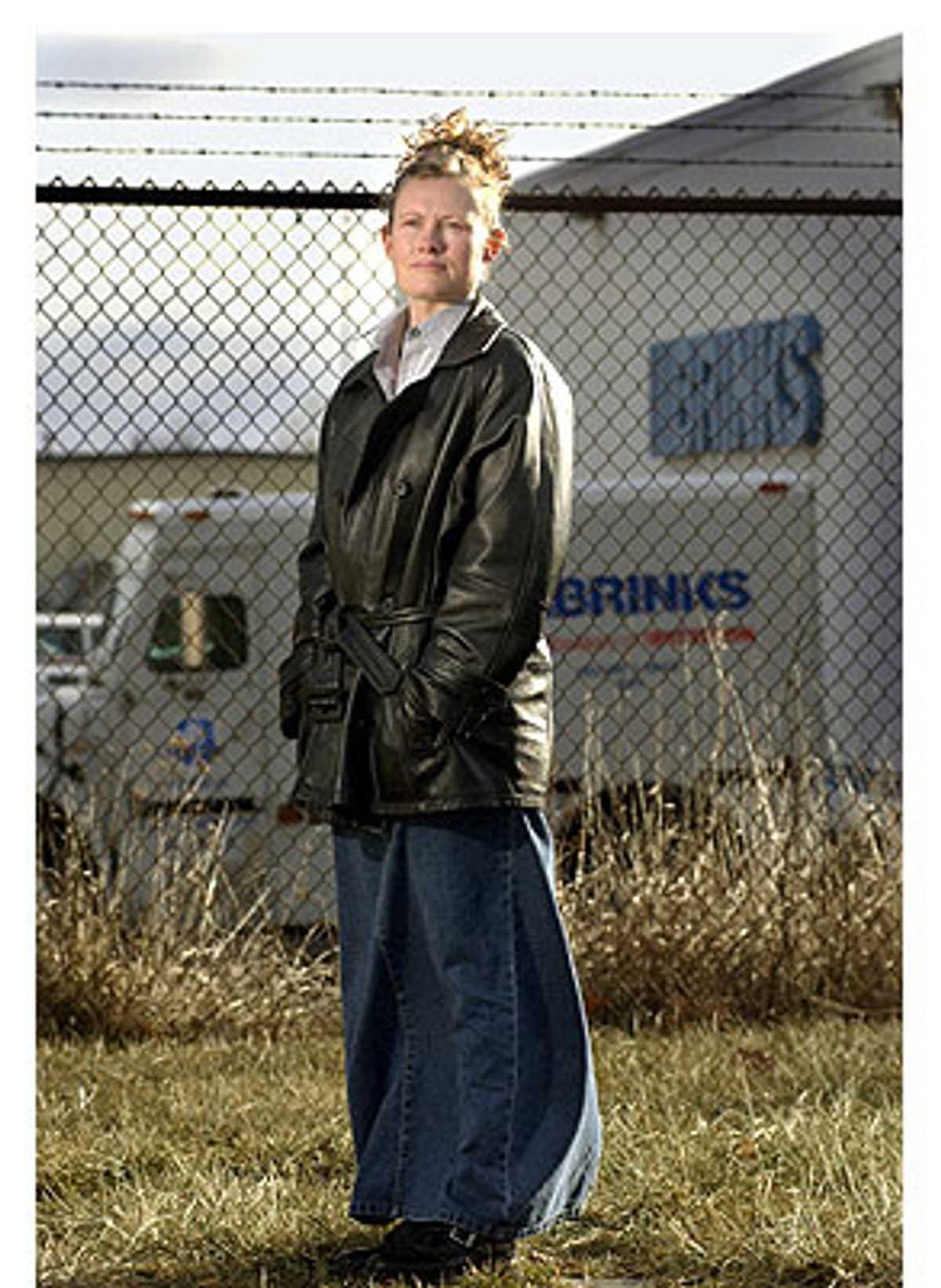
That wasn't the case at Brink's Inc., the armored truck and security services company based in Darien, Conn. When a guard there, Carol Grotts, refused to wear the company's required gray pants uniform because her Pentecostal religion forbids it, managers turned her away. "After I told them about my uniform problem, they were shocked," says Grotts, who worked in the company's Bartonville, Ill., office. "They said they wouldn't have hired me if they'd known." To placate the company, Grotts offered to buy a skirt or culottes (flared pants that resemble a skirt) made out of the same material as the company's uniform, but Brink's refused and fired her. "I knew this was discrimination and I knew this was wrong," says Grotts, a soft-spoken 47-year-old. "It wasn't like my wearing culottes would have hurt their business. They just didn't want it. End of story."
According to the Tanenbaum survey, requests like Grotts' are becoming increasingly common. Twenty percent of the respondents said that they experienced an increase in worker requests for religious accommodation in the past five years.
"The reality is that managers have to balance their business with the values of their employees," says Jessica Collins, an SHRM research associate. "There's no definitive answer to what dress is OK and what's not. Policies have to be in place that are flexible enough to make the workplace productive and progressive."
The EEOC intervened on Grotts' behalf and forced Brink's to hire her back two years later, in 1999. She was desperate for a job. Though Brink's managers allowed Grotts to wear culottes, the atmosphere was heated. From the start, managers told her in a written missive to stay away from discussing "anything about God." Grotts says that directive was a staggering blow. "I go to work to make a living just like everybody else. I work just as hard. I never go to work to push religion on people. Yes, religion is who I am, and if someone wants to know more about me, I'll open up. Am I just supposed to deny what's made the largest impact on my life?"
Late last year, Grotts was fired again, the company citing financial reasons. But Grotts, who remains unemployed, lives across the street from the company and saw that new guards had been hired shortly after she was let go, a point the EEOC used to argue the discrimination suit in court. In January, Brink's settled the case, paying Grotts $30,000 and pledging to train all managers in their Illinois offices in religious accommodation requirements. Brink's did not return phone calls about the case.
In a similar case in January, the EEOC sued Fort Lauderdale, Fla.-based Alamo Rent-A-Car on behalf of a Muslim woman, Bilan Nur, who worked as a customer service representative at the company's Phoenix airport location. The suit charges that Nur was told that she couldn't wear a headscarf for the holy month of Ramadan, although she'd been allowed to wear one for the past two years. She claims the change in policy was a response to the Sept. 11 tragedy, which had occurred two months earlier. In court documents, Nur alleges that even though she offered to make a scarf out of the company's fabric, and plaster an Alamo patch on the front of it, the company, which had no policy in place concerning headscarves, refused the request and fired her. The suit is pending; Alamo did not return phone calls.
There are examples, no doubt, of employees taking religious expression too far. In a 1995 Nebraska case, a federal appeals court ruled against Christine Wilson, an employee who claimed the right to wear an antiabortion pin showing a particularly disturbing color photo of an aborted fetus. It upset co-workers, including some who shared Wilson's views on abortion. In court, Wilson conceded that the pin caused a serious disruption at work. The court told her that the pin was unacceptable.
What these cases make clear is the tenuous line between what a company should accommodate and what it has the legal right to deny. Granted, employers' concerns about the divisiveness of sectarian rituals are not unfounded. David Grinburg, a senior spokesperson at the EEOC, points out that a general rule of thumb for companies might be: "If the religious expression, whether it be different clothing, displaying some sort of religious paraphernalia, or praying at lunchtime, isn't hurting the business and not disrupting the office culture, it should be allowed."
- - - - - - - - - - - -
Victoria Leyva remembers waiting in her office for the new director of human resources to visit her for the first time. The woman, Joan Shaw, had been hired by the University of Chicago Hospital to improve the department. For nearly a year before, Leyva had recruited entry-level personnel for the hospital, and had earned exemplary marks on her employee reviews. Leyva was a Pentecostal Baptist. And Shaw was a Catholic. But Leyva didn't consider that an issue at the time. In fact, with her high review marks, she didn't think she had any reason to worry about the first meeting. Held in the midmorning, it was a straightforward introduction with no more than five minutes of small talk. But, as she found out shortly after, that day she had unknowingly become the target of a campaign to force her out because of her religious beliefs.
What Leyva describes as a concerted battle against her by one woman started out slowly, and perhaps even cautiously. "It was about making me uncomfortable," says Leyva, a stout woman with wire-rimmed glasses and a restrained smile. Shaw asked that she remove two fairly innocuous items from her office -- one was a calendar titled "Treasures of Inspiration: A Woman's Guide to Daily Living" and the other was a clock inscribed "Armitage Baptist Church." According to court documents, Shaw claimed they were "too religious and too denominational."
Leyva charges that Shaw also demanded that she not recruit from local churches, which she'd been doing without resistance since being hired. The complaint states that Shaw indicated she "had a problem with Leyva bringing religion into the workplace." And though Leyva stopped, Shaw continued to accuse her of disobeying orders. Official papers charge that she so much disliked Leyva's beliefs that she not only referred regularly to her as a "Bible thumper" and a "religious fanatic," she also instructed a colleague to gather complaints and "do whatever he could to get her fired."
Like the others in this emerging workplace drama, Leyva, 43, now the director of human resources at Lawndale Christian Health Center in Chicago, isn't an overtly religious person. She doesn't wear crosses. She doesn't carry a Bible. She dresses like anyone else on the streets of Chicago and talks in a calm, whispery voice a lot like running water. She says she only spoke of her beliefs if someone asked. For instance, she describes a female co-worker coming to her once who'd been going through a very hard divorce. "I sat her down and we had just a very open conversation, like any other two women might have. She asked me what I did when I had problems, and I ended up telling her about my church. She came once and that was the end of it. Was that wrong to help? Was I pushing religion? No, I don't think so. I call it being human."
Court documents portray Shaw as a bold, verbally direct woman who had become reckless and obsessed. In May 1992, a year after coming on board, she told a supervisor to fire Leyva, court documents allege, but the man refused, saying "there was no reason." A week later, he was terminated. On his way out, the suit claims, he told Leyva to "watch her back." Fearing her end, she confronted Shaw. "I went to her to try to work things out," she says. "I told her that I worried about what I'd been hearing. But she just sort of blew it off. Told me I was just being defensive."
As it turned out, her fears materialized anyway. Shaw hired a new supervisor, who, after a week on the job, gave Leyva a negative review. Distraught, Leyva took a vacation to collect herself and figure out her next move. Midweek, however, the new supervisor called to say that he couldn't find some test results from Leyva's recruits. He told her that this was the last straw. When she came in the following Monday, her office was completely boxed up and being used for storage. The message was clear: She'd been clipped. "I remember being very sad," she says. She remembers the new supervisor following her into the office. "I wanted to cry, but I was just completely overwhelmed," she says. "It was just very, very sad."
A year later, EEOC brought her case to court. The hospital denied any wrongdoing and called Leyva's story false, but settled for $110,000. Not long after, Shaw left the hospital for good, according to the hospital.
In the spring of 2000, Frederick Bock (whose name was changed at his own request), thought he was coming into the job of his dreams when he scored a prized post at an international architecture company in Orlando. In a lawsuit he filed, Bock, who has blond hair and blue eyes, claims that the owner and a supervisor harassed him for being Jewish and turned his life upside down in the nearly two years he worked there. The owner, Bock charges, asked him a number of times if he "was really Jewish." Jokes and slanderous comments were made about his religion. For instance, the owner once said, "Jewish people since biblical times were bankers. We all know that bankers have money and suck owners' pockets, and we all hate bankers." This was the same man who drew a swastika on one of Bock's architectural plans, says Bock.
The defining moment came one day when Bock's supervisor was critiquing his work and segued into a description of an old boss, whom he labeled a "money-hungry Jew." Unabashedly, the supervisor, according to the lawsuit filed by Bock, went on to say that he could "understand the reasons behind the Nazi Holocaust." Bock complained to human resources, and was fired the next day, the company saying that his work wasn't up to snuff even though he'd scored top marks on a recent performance evaluation. A year later, a U.S. District Court found that Bock had a reasonable basis for a religious harassment claim and ordered that the case go to trial. But it was settled out of court for $100,000 without any admission of guilt. Bock is now a senior-level architect at another firm in the Miami area.
Such blatant harassment sends overwhelmingly negative messages to other employees in the office, says Rachel Shonfield, a senior lawyer at the Miami office of the EEOC who is familiar with Bock's suit.
Worse, Shonfield adds, that kind of unchecked behavior shoots a rippling wave of fear through the office. "When one person gets fired for expressing grievances, employees feel that they shouldn't talk about problems," Shonfield says. "They fear retaliation, and you have this unproductive culture of fear that permeates the workspace."
Many managers, bent on keeping morale high and conflict low, think the best way to eliminate religious harassment is to eliminate allusions to the subject altogether -- from minor expressions like religious computer screen savers to more significant actions, such as religious conversation and prayer.
But ignoring or sweeping religious interests under the rug is not only callous, but also unrealistic, experts warn. Consider the numbers: A recent Gallup poll reports that 95 percent of Americans believe in God or some type of universal spirit, while 48 percent say they talk about their religion at work daily. What's more, there are more than 1,500 distinct religious denominations and faith groups nationwide, a number that is growing every year, according to the American Civil Liberties Union. Outlawing religious discussions can kill morale, spur resentment, and ultimately hurt productivity.
"Managers who shut religion off will only inspire more confusion and clashing," says Ian Mirtoff, professor of business management at Stanford University. "It's self-destructive for a company to ignore the facts that we are more than just a Christian nation, that everything has changed since 9/11, and we're more religiously diverse than ever."
Besides, ignoring worker conflict has colossal financial penalties. Last year alone, the EEOC settled over $310 million in workplace-related lawsuits. That's not even accounting for the massive attorney fees and the inestimable damage any sort of employee conflict or dissension does to the productivity and well-being of a company. Turnover is costly, too. When employees, especially top performers, are unhappy they'll go elsewhere. According to Nextera Enterprise, a management consulting firm in Cambridge, Mass., nearly 6.5 million workers left their jobs last year, costing companies an estimated $75 billion to replace them.
Companies would save money and create a more balanced and industrious work environment if they just educated their workforce a little more about religious diversity, says Bennett of the Tanenbaum Center. She advocates education methods, from recognizing religion in company handbooks to internal spirituality seminars; she even suggests creating a "meditation room" at the office where people can explore more personal issues. "There is such a pent-up need to deal with these issues, that when an opportunity arises, it is a positive experience for both the business and the employees."
Shonfield says preventing problems begins with education. "The process is interactive," she says. "It's incumbent on the employer to make employees aware about free speech in the workplace."
Boiled down, living with religion in the workplace is really just about fostering a culture of openness and respect, experts say. It also means putting a premium on self-expression while eschewing the practice of proselytizing. And finally, it means balancing the bedrock principles of business with the spiritual and religious needs of employees, impulses that move and inspire the business to be better, stronger, and more competitive.
- - - - - - - - - - - -
Sami Hammad's story didn't end happily. Eventually, he took his case to the EEOC, which is the last resort for most. In 2002, the EEOC fielded 2,572 such complaints, up from 1,388 10 years ago. Hammad's case went to jury trial and he lost. With all the evidence that had been collected, he ultimately failed to convince the jury that the harassment was either severe or hostile. "I don't know if they would have ruled for me even if I had been cut into pieces." Hammad blames the loss on the fact that he is Muslim and the trial was held on the first anniversary of Sept. 11.
Nevertheless, Hammad returned to work at Bombardier for another month before he was finally laid off because of, according to the company, financial reasons. A company spokesperson, Dave Franson, wouldn't comment except to say, "The verdict pretty much speaks the truth."
Since then, Hammad has been a migrant worker of sorts, looking for airplane jobs, writing a book about what happened, and trying to straighten out his life. The last time Hammad calls he is headed down to a temporary job in Rogers, Ark., where he'll be living in a dingy roadside motel with three other men and servicing airplanes at a local factory from 6 p.m. to 6:30 a.m. almost every day.
He's on the side of the road in the middle of a snowstorm that will leave 2 feet in its swirling trail by the next day. The wind growls violently in the background. He says it feels like 20 below, but he wants to talk.
"I just wanted to make one last thing clear," he says, his voice shivering. "I didn't ask for any of this. I didn't want to go to court. I didn't want to have problems. I just wanted to come here and do my work and live a quiet life like everyone else."
Shares