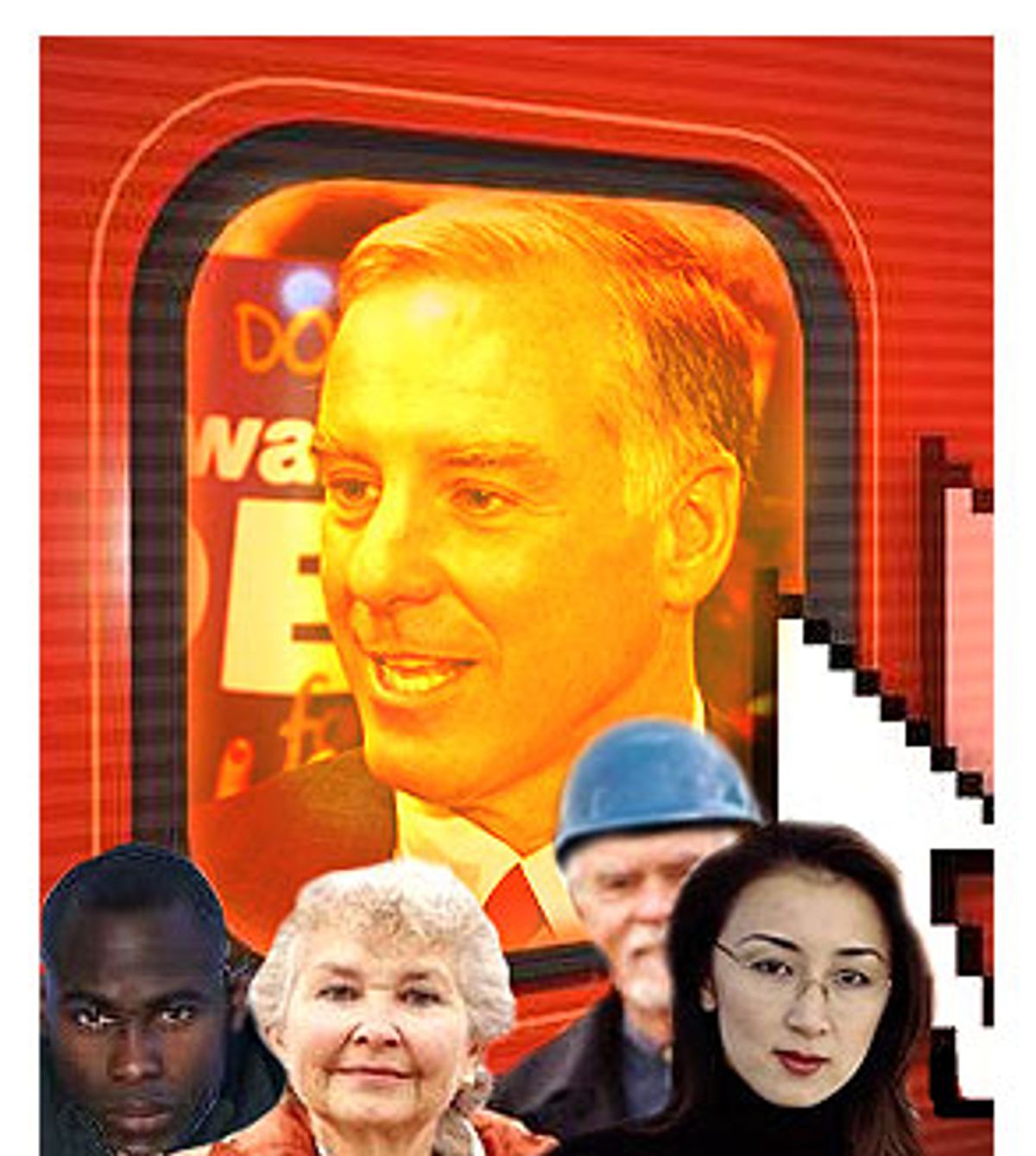
Steve Chaffin, an attorney who is the unofficial coordinator of presidential candidate Howard Dean's campaign in Ohio, has been working in Democratic politics for about 20 years. He doesn't remember ever seeing a candidate attract the kind of people who come to Dean. "They're all intellectuals," Chaffin says. "They're lawyers, doctors, engineers, very creative people."
Chaffin considers this a generally positive thing, but he worries that because Dean has relied greatly on the Web as a campaign tool, the candidate's message has not been widely received by "blue-collar people" and minorities. This concern, which has popped up repeatedly in the media, is shared by many other Dean supporters, including Richard Hoefer, a San Francisco filmmaker who believes that the campaign has been too "blog-centric." Asked if he thinks there's a homogeneity to Dean's base, Hoefer responds, "You mean whitey?"
In June, when Howard Deam surprised commentators by beating his opponents in the second-quarter fundraising race, it became clear he was using the Internet like no other presidential candidate in history. By building connections with the Web's leading bloggers, the campaign created an online movement around Dean's bid -- and it used the movement to get cash, mainstream media attention, and dominance in the polls. Since then, the Web has been nothing but kind to Dean: The cash has come in faster (the campaign reportedly expects to collect more than $10 million in the third quarter, which ends on Sept. 30), the media has become much more interested, and Dean's poll numbers have skyrocketed.
But is Howard Dean's campaign too wired? Is Dean attracting too many people who hang out on the Web all day -- wealthy, Internet-savvy, mostly white people, including a healthy dose of what the New York Times recently called "the tongue-studded next generation" -- while failing to win over more traditional Democratic constituencies?
Some Dean supporters are starting to think that's the case. But what's remarkable about Dean's grass-roots organizers is that many already seem to realize that it's time to do something about minority outreach; the connected hive of Dean supporters, held together by blogs and hundreds of Yahoo groups, is, in a sense, self-aware, and capable of reacting to the shifting winds of a political campaign.
Online, there's a healthy debate over whether Dean's base really is less diverse than that of the other candidates, or if that's simply a view being advanced by the news media. "In case you haven't noticed, we've entered the 'they're all white' phase of the campaign," Rick Klau, a software executive who runs a blog devoted to the Dean campaign, wrote in response to the Times story. Reporters are eager to find a new angle on Dean, Klau suggested, and "many of them are observing that many of the throngs showing up to hear Dean speak are Caucasian. Uh, ok. Point taken. But as everyone else points out, we've got some time before the primaries. If the articles were pointing out that the missing minorities were attending rallies by one of the other top-tier candidates, I'd be worried."
The campaign itself does seem to think that Dean's lack of support among minorities is a problem, and it says it's trying to address it. In a live chat with readers of Washingtonpost.com on Aug. 27, Joe Trippi, Dean's campaign manager, wrote that the campaign originally had few resources to make a special effort to attract minorities. "We determined that we had to focus on four things -- Iowa, New Hampshire, the Internet and fundraising," he wrote. "For the first six months of this year, that is all we had the resources to do. With the June 30th quarter surge, we have now been able to hire outreach coordinators in the African-American, Hispanic and Asian-America communities as well as others ... We expect you will be able to see significant progress in the next 60 days."
But many Dean supporters aren't waiting for Trippi to start a specific push for minorities -- they're doing it themselves. For their September Meetup -- the monthly, revival-like gatherings Dean fans hold in groups all across the country -- supporters voted to put outreach to minorities and senior citizens at the top of their agenda. At the meetings, they were given Howard Dean informational postcards to hand out to people in local communities; the cards, which include prepaid postage, can be mailed in by people who want to know more about Howard Dean but don't have access to the Internet. Online voting for the October Meetup is open right now, and it appears that minority outreach will again be one of the main topics discussed.
Some Dean supporters are planning an even greater push for minorities. Richard Hoefer, the filmmaker in San Francisco, is part of a small band of "creative professionals" called the Dean Media Team, and he says it's his goal to expand Dean's base beyond people who read and write blogs. Folks in the DMT intend to create slick ads and short videos aimed at attracting people who are being missed by the Dean campaign. The videos will be streamed over the Web, but members of another grass-roots group, DVDs for Dean, will also produce "tons" of physical copies to hand out to anyone who wants them. The campaign "only has so many resources and they have to focus their resources in Iowa and New Hampshire," says Bart Myers, another member of the DMT. "We can help them go beyond the Web and get the message out in other areas."
If Howard Dean's apparent failure to attract minorities indicates a shortcoming of the Web as a tool for creating a winning political campaign, the way his supporters are dealing with the failure points out one of the Web's great strengths: When you've created an online movement, thousands of people who are supporting your goal, it's easy to have them quickly adjust to the needs of the moment. Grass-roots movements are not unusual in presidential politics, but Dean's supporters seem to have a level of organizational, technological and media sophistication that is probably unprecedented; when they discover a problem, they're remarkably nimble in addressing it. Their devotion to Dean ought to scare many of his Democratic opponents -- and it should keep Karl Rove up at night, too.
Howard Dean's Meetups are held on the first Wednesday of every month, and in the run-up to September's meeting, the campaign saw a surge in registrations; more than 108,000 people are now signed up for Dean. (Dennis Kucinich and Wesley Clark, vying for second place, each have about 12,000 Meetup supporters.) It's hard to tell how many people actually attended the September meetings, but afterward several hundred people related their experiences on the Dean campaign's blog.
Many said that their meetings were wonderful -- but there were more than a few comments like this one, posted by "Donald from Austin": "There's something wrong here," he wrote. "We had a warm and welcoming meet-up here in Austin last night. It was fun to see friends show up that I didn't know were for Dean. I wasn't surprised to see them. I knew we all shared the same values -- so it made sense they'd be there. Out of a few hundred people, I saw one black. The homogeneous Internet culture (of which I am a part) seriously lacks the diversity we need to win. 'WE' don't all have e-mail or broadband connections to the campaign. What to do?"
Another supporter who attended a meeting in Washington, D.C., wrote, "There was not a single Asian American in the room despite hundreds of them being enrolled 3 blocks away at a local college. There is a huge African American population in DC which was certainly not reflected in the room -- not a single one present ... There is a large population of Hispanics in the metropolitan area -- only one in the room. More needs to be done ..."
On the blog, some Dean fans put forward ideas for how to attract minorities. "Josh in Austin" scolded supporters, "PLEASE stop having Meetups at cute white middle-class cafes where everyone looks like you! Each meetup should be scheduled in a place where the people walking by and wondering what's going on are from demographic groups that are harder to reach -- namely, either minorities or the elderly. EVERY retirement home has a meeting room. Have your meetups THERE. Is it sexy? No, but it will reach a group that is eager to be a part of the process. Have your meetups in restaurants in the Hispanic part of town or whatever other group you need to reach. Make the Meetup ITSELF work for you, instead of going there and THEN talking about what to do ...!"
Josh's post illustrates how astute many of Dean's supporters are about what it will take to get their man into the White House next year. Even though Dean is now thought of as the Democratic front-runner, many in his online community are constantly chiding each other not to become complacent about the task ahead. The danger that supporters appear most wary of is "preaching to the choir" -- bringing the pro-Dean message only to folks who are already inclined to accept it. Indeed, Richard Hoefer calls this the biggest pitfall of Dean's blog strategy. "I've been at odds with Dean for America because I criticize them for being too blog-centric," he says. "I think they preach to the converted, and it bugs me because I think they're missing the boat. I think Dean has incredible appeal to blacks, Latinos, minorities -- but the message hasn't gotten out there yet because they have been too focused on the blog."
The self-awareness of the potential shortcomings of Dean's campaign is exactly the kind of thing you might expect from people as well-educated and affluent as Dean supporters tend to be. And while right now none of the other campaigns can legitimately claim to be any more diverse -- in terms of either race or class background -- than Dean's, it is worth wondering whether a campaign organization such as Richard Gephardt's or John Kerry's will eventually be able to mobilize the traditional Democratic sources of support -- unions, teachers and minorities -- that will lead to primary victories and an eventual nomination.
Hoefer himself has some experience building Web campaigns -- last year, he created G4Noise.com, a Web site at the center of an effort to convince Apple that its high-end Macs were unacceptably noisy. Hundreds of people from all over the world joined the campaign, and in February, Apple relented, agreeing to replace noisy PowerMac G4 cooling fans with new, quieter versions. So Hoefer is not by any means opposed to campaigning online, but he says that Dean's blog, which puts the inner workings of the Dean campaign on public display, can sometimes seem closed off to folks not well-versed in its culture.
As an example, Hoefer pointed to one of the Dean supporters' catchphrases: "Bring back the bat!" Whenever Dick Cheney holds one of his quarter-million-dollar lunches, or when George W. Bush raises a million dollars in an evening, the Dean campaign puts up a baseball bat logo on its site and challenges supporters to raise just as much money for Dean. "We're bringing back the bat!" they say -- and shortly after they put up the bat, the money rolls in. Now, says Hoefer, the "hangers-on that are always on the blog" constantly ask for the campaign to bring out the bat. For the initiated, the phrase inspires action, but for people who aren't familiar with Dean, could it seem a little clubby?
There are many who disagree with Hoefer's view that the Dean blog is not as welcoming as it could be. Michael Cornfield, the research director of George Washington University's Institute for Politics, Democracy & the Internet, says that Dean's online campaign can be called "historic" precisely because it gives supporters unprecedented access. "It's the energy and emotion," he says. "You feel like you're in a campaign headquarters when you read that stuff." Most presidential campaigns are "very anal about controlling their message. The Dean campaign has adopted the opposite message, which is that we'll let anybody talk about us" -- and it's this attitude, he says, that makes people want to join the effort.
Matthew Gross, the campaign's Internet chief, says that even though Dean is getting more press these days, his Web site remains one of the main ways for new people to come to the campaign. "As he appears on television more often, you see a reaction," Gross says. "More people come online to find out about Howard Dean. It's kind of always been that way. They say, 'Gee, I've never heard of this guy,' and they go online." The numbers support Gross' point: So far, more than 360,000 people have signed up to support Dean, and the campaign is trying to reach 450,000 by the end of September.
But Hoefer's view might still have merit. In any social movement, whether it's centered around a rock group or a baseball team or a political candidate, you're bound to find varying levels of orthodoxy -- the insiders vs. the outsiders, the early devotees and the Johnny-come-latelies, the true believers and the folks who are doing it just because everyone else is. Howard Dean has built a political movement based on e-mail and Web discussion groups and blogging, and for the most part, his most devout supporters live by these technologies; but if he is to broaden his appeal, he'll have to find people who have no use for the Internet, and who won't be scared off by the portion of his base that is tech-savvy. Can he?
In April, Richard Hoefer attended his first Dean Meetup at Kelly's Mission Rock, a restaurant overlooking the San Francisco Bay, and he was immediately "blown away" by the candidate. Fewer than 150 people attended that night, and Dean was widely considered a long shot, but when he saw a videotape of Dean speaking, Hoefer says he thought, My God, that's him! At the time, Hoefer says, he'd been disappointed in most other Democrats -- but Dean's willingness to attack Bush attracted him. "I knew then that I was going to bring every single talent that I have to get this guy elected," he says.
Not long after that, Hoefer decided to start a collective of creative people devoted to Dean -- he called it the Dean Media Team, and he says he wanted the plan to work like a decentralized advertising firm, with professionals from all over the country volunteering their services to create, shoot, edit and otherwise help on video ad campaigns touting Howard Dean. The plan was ambitious, and a few months passed before "a critical mass" of people signed up to help. But by the late summer, things seemed to come together, and the DMT began to work on its first campaign.
The group's first project isn't especially original -- they created a series of 30-second spots based on Apple Computer's "switch" ad campaign, in which real people tell short, quirky stories about how frustrated they are with their Windows computers and why they decided, instead, to use Macs. Kevin Murray, a Dean supporter who is a professional editor of corporate videos in San Francisco, thought it would be a good idea to make the same kind of ads for the former Vermont governor -- real people giving their real thoughts on Howard Dean.
"There's a surprising and very elegant crossover from Apple's campaign to Dean," Murray says. Apple is an underdog in the computer industry, a firm that's constantly fighting a well-financed opponent that seems to rule the world, which is not unlike Howard Dean's fight. "And for me it feels very pure, because of course Apple is just selling computers," while Dean, Murray says, is selling a new vision for America.
At the August Meetup in San Francisco, held at the Unitarian Universalist Church, Murray polled the crowd for Dean fans willing to participate in his ads. He set up a white backdrop in a side room, and there he filmed several supporters as they spilled their guts about Dean. It didn't take him long to edit the films down to 30-second spots, and he and others in the DMT added music and graphics; they also set up a companion Web site, Switch2Dean.com, to distribute the films and to collect stories from others who'd switched.
Everyone associated with the Switch2Dean ads insists that this campaign is just a proof of concept, a small project intended to show that creative people, working together, can do a pretty good job of promoting Dean. But the ads are still rather remarkable. They're smart, funny and authentic -- the kind of thing you never see in real political ads. The people in them are obviously in love with Howard Dean, and because they're real, their adoration is not easy to dismiss: If you're not a Dean supporter and you see one of these ads, there's a good chance they'd prompt you to find out more about him.
But who, besides people with broadband access to the Web, will see them? "Of course we would love to get them on TV," Bart Myers says. "If that's something that Dean for America is interested in, we are not going to limit their distribution at all." (Myers notes, though, that because of campaign finance restrictions, the campaign has to be very careful about encouraging his effort; the Dean Media Team has received no support from Dean for America.) But if the Switch2Dean videos don't get on TV, Myers says there are other ways to get the ads out to Dean supporters. He encourages people who do have fast Internet connections and DVD burners to download the videos and make copies for everyone they know.
But how will people who don't have DVD players access them? Members of the DMT intend to hold Dean meetings at community centers, and they encourage other supporters to show their videos at the monthly Meetups.
If all of this sounds a bit complicated, that's because it is. It's always difficult, members of the DMT say, to get to the least-connected people in society, and it's far from certain that anyone on the lonely side of the digital divide will get to see the work produced by the group. But many in the DMT appear willing to do the work anyway. During the past few months, Hoefer has spent time traveling through San Francisco talking to homeless people about what they want from their government, and he intends to cut his film into a short piece aimed at getting homeless people to support Dean. J. DeLoach, who runs Scenic Verve, a film production company in San Francisco that produces "documentary films on progressive subjects," is working on a series of videos in which she'll profile members of various minority communities who are supporting Howard Dean -- "the Latino community, the African-American community, the queer community."
And the DMT's video are certainly not the only way that Dean supporters intend to appeal to minorities. Steve Chaffin, the Ohio coordinator, says that almost every day, people send him new ideas for ways to expand the campaign beyond the Web. Chaffin recently received an e-mail from a supporter who suggested that Dean fans should purchase toothpaste, shampoo and other necessities that can't be bought on food stamps, and then give away those items at local charity centers. The Dean supporters will tell the poor that "We feel we can heal America with Dr. Dean's programs," Chaffin said.
Will any of these plans to recruit minorities work? And, if they don't, will Howard Dean suffer? Markos Moulitsas Zuniga, the proprietor of the popular lefty blog Daily Kos and a consultant to the Dean campaign's Web efforts, says that even if Dean is failing to appeal to minorities now, they will come to him if he wins the nomination. Meanwhile, Moulitsas says, polls show that Dean is currently attracting a crowd that the Democratic Party has had trouble with in recent elections -- white males. This is partly because of Dean's use of the Web, Moulitsas says, but mainly because "he's a very aggressive candidate in his speaking style, and the anger. Nobody wants a president that's a wimp, and Dean sounds tough, he sounds like he's ready to kick some ass, and I think that really fires men up."
Jonathan Kreiss-Tomkins, a Dean supporter who lives in Sitka, Alaska, a city of 9,000 people that sits on an island off the state's southeastern coast and is accessible only by boat and airplane, agrees with this notion. Kreiss-Tomkins, a white male, has heard almost everything he knows about Howard Dean through the Internet. "And I definitely think Dean appeals to the typical Internet geek," he says -- and he knows, because he is himself something of an example.
Kreiss-Tomkins maintains a database of the more than 500 online discussion groups focused on Dean, and manages a private online discussion of the leaders of all these groups. He has emerged as a key grass-roots organizer for Dean. He says he was motivated to work for Dean because "I believe our country is in a dire state. The economy is in the dumps, we're attacking countries, I believe healthcare needs to be improved, the environment is horrible horrible horrible."
But Kreiss-Tomkins keeps his love for Dean mostly secret from his friends, and he won't be voting for Dean anytime soon. That's because he's 14 years old -- a high-school freshman who, when not busying himself with politics, spends much of his time practicing oboe, cello, acoustic bass and piano. "My social image is quite a bit different," he says. But Dean's campaign allows him to contribute a lot of effort from the privacy of his own room. "Online you can work out for him to your heart's content," he says.
Shares