There aren't many people in the United States who have as much experience with rock-and-earth dams and coal slurry impoundments as Jack Spadaro, a distinguished mining engineer who's been working in federal regulatory agencies for almost 30 years. That's why he was selected to be one of eight members of an accident investigation team to determine the causes of the nation's largest coal slurry spill at the Martin County Coal Company in Inez, Kt., on Oct. 11, 2000.
A coal slurry impoundment is a reservoir of thick liquid waste from coal processing that is constructed by damming the mouth of a valley with rock and earth. To residents living near these impoundments, they are disasters waiting to happen. The EPA called the Inez spill the worst environmental catastrophe in the history of the Eastern United States. Far more extensive in damage than the widely known 1989 Exxon Valdez oil spill off the coast of Alaska, the Martin County Coal slurry spill dumped an estimated 306 million gallons of toxic sludge down 100 miles of waterways.
Jack Spadaro has made it his life's work to figure out why these spills happen and how to stop them. But right now he is awaiting final word from officials at the U.S. Mine Safety and Health Administration (MSHA), a wing of the U.S. Department of Labor that is a lead regulatory agency for the coal industry, as to whether he will retain his job as the superintendent of the National Mine Safety and Health Academy, MSHA's training facility. His superiors are accusing him of a raft of misbehaviors -- including "abusing his authority" and "failing to follow instructions." But as far as he's concerned, the reason he's facing dismissal is very simple: He's been in hot water since January 2001 -- when Bush administration officials took control of the Martin County Coal investigation.
Before the change in political administration, Spadaro and his teammates had been uncovering information that had far-reaching implications for both Massey Energy (the parent company of Martin County Coal and a major contributor to the Republican Party) and the coal industry as a whole. Testimony and documents revealed that executives at Martin County Coal and federal regulators were aware that there was potential for a catastrophic failure at the slurry impoundment but didn't take proper actions to avoid it. In particular, an MSHA engineer had made a list of specific safety recommendations to Martin County Coal and MSHA district officials following a 100-million gallon spill in May 1994. But MSHA and Martin not only largely ignored the recommendations, MSHA actually allowed Martin to add coal waste to its impoundment.
By the end of 2000, Spadaro and other investigation team members felt they were beginning to collect enough evidence to issue Massey Energy citations for willful and criminal negligence. In addition, it looked as though their own agency, MSHA, was going to be held accountable as well. But that all changed when George W. Bush moved into the White House. Within days of Bush's inauguration a new team leader was brought in to head the Martin County Coal investigation. The scope of the investigation was dramatically narrowed -- offering yet another dramatic example of how the wholesale takeover of the White House by the energy industry is having a real impact on real lives, not just on the whistle-blowers like Jack Spadaro but on the people he's trying to protect.
On April 3, 2001, Spadaro tendered his resignation from the accident investigation team and filed a complaint with the Department of Labor's Office of the Inspector General, alleging that Bush administration officials were obstructing the team's work. Spadaro also spoke out publicly when MSHA released its final accident investigation report in October 2002, which cited Martin County Coal for two minor violations with fines totaling $110,000, and left MSHA district officials completely off the hook.
Spadaro was placed on administrative leave -- often a bureaucratic precursor to job termination -- on June 4, 2003. He was called away on business to Washington, D.C., that day and federal officials took the opportunity to raid his Beckley, W.V. office. They searched through his personal belongings, dismantled the frame of a family portrait to look behind the photograph, and changed the locks. Officials in D.C. questioned him about providing free academy housing to an instructor who had multiple sclerosis. Spadaro says he was dumbfounded by the questions since MSHA officials, including some of his questioners, were aware of the arrangement, which was, in any case, within Spadaro's authority to grant.
Spadaro could be terminated any day. The apparent vendetta against him, and a mass of other evidence including damning off-the-record comments by officials involved in the investigation and a heavily-redacted report, raise serious questions as to whether Bush administration officials, ranging from mining safety officials all the way to Labor Secretary Elaine Chao, orchestrated a coverup to whitewash Martin County Coal of any serious responsibility for the coal slurry disaster.
There are about 700 slurry impoundments in the United States. Nearly 200 of them are built over underground mines, as is the Martin County Coal impoundment. Plans for building one of the biggest slurry impoundments ever constructed are also under way.
These waste facilities, though little known, have one of the greatest potentials for catastrophic environmental disaster in the country.
On Feb. 26, 1972, a slurry dam gave way at the Buffalo Mining Company in Logan County, W.V., releasing a giant wave of thick, murky water, choked with chemicals, coal refuse, rocks and dirt. According to the official accident report, 132 million gallons of slurry suddenly flooded the Buffalo Creek Valley floor, destroying or partially destroying 17 communities. 125 people were killed. 4,000 people were left homeless.
Jack Spadaro was only 23 years old in 1972, but had already accumulated enough coal mining expertise that he was asked to be the staff engineer for the governor's commission that investigated the Buffalo Creek disaster.
"That was a terrible tragedy that could have been avoided," he says. "There had been plenty of warnings that something [of this nature] would occur. There were a series of dams at Buffalo Creek and there had been failures on all of them."
The tragedy profoundly affected Spadaro. He spent the next 30 years studying rock and earth structures and working as a government regulator to try and protect miners and communities from faulty dams and negligent coal companies.
The Martin County Coal slurry impoundment is 70 acres in size and has a capacity of more than 2 billion gallons. Part of the lagoon is situated above underground mines. In the early morning hours of Oct. 11, 2000, the bottom of the slurry impoundment broke into one of the mines. A torrent of sludge and water blasted through about two miles of underground mines until the flood punched out of a mine opening in the side of a mountain and began flooding Coldwater Creek.
Residents described the flood as a black lava flow. Janice Maynard remembers seeing five big turtles, supine in their shells on top of the slurry, which had enough density to raise bridges as it crested the creek banks.
"It smelled like hydraulic fluid," she said. "Nothing smells worse than hydraulic fluid."
Eventually, the thick sludge stopped flowing, but the less viscous slurry at the top of the impoundment was still rushing into the mine. This caused a pressure build up, which resulted in a second flood that punched through mines on the Wolf Creek side of the impoundment.
There was no loss of human life, but aquatic life was annihilated, and animals that came in contact with the sludge got stuck and perished, or died because they were unable to get uncontaminated drinking water. Many residents exhibited severe rashes and suffered from respiratory problems. No one in the area dares drink tap water for fear that a number of hazardous substances found in slurry, such as arsenic and mercury, have permanently poisoned the municipal water systems.
It's a stroke of luck that no miners were killed. A conveyer belt that hauls coal to the preparation plant runs through the area where the breakthrough occurred. A miner had just vacated that section of the mine minutes before the catastrophe. Officials say that if all of the slurry had come down the Coldwater side, hundreds of homes would have been submerged and the loss of life would have easily surpassed the death toll at Buffalo Creek.
Within two days of the disaster, Davitt McAteer, then assistant secretary of labor for mine safety and health (a 1994 Clinton appointee), assembled an accident investigation team. Tony Oppegard, now general counsel for the Kentucky Department of Mines and Minerals, was the team leader.
Jack Spadaro was the No. 2 man. "Jack was highly qualified for the job," said Oppegard. "I knew he'd be a diligent member of the team. He knew a lot about impoundments, and I knew that he had investigated the Buffalo Creek disaster. McAteer told me that if I wasn't there, Jack was in charge."
Spadaro immediately set out to find the root causes of the Martin County Coal accident: "I was concerned that we were having a failure of this magnitude 30 years after Buffalo Creek. There had been a lot of safeguards implemented over time. But all that was related to the dams and the earth structures. Not a whole lot of attention had been given to the reservoir areas. I was interested from a technical standpoint and a personal standpoint because I had been involved with these things for so long, and I knew what kind of tragedy could result if we didn't do a good job of investigating."
Oppegard started his investigation by wading through slurry-filled mines at Martin County Coal to try and get a close-up look at the diaster. The details of the May 1994 spill, six years earlier, in which about 100 million gallons of slurry were dumped, didn't come to light until later in the investigation. But when they did, certain documents read like smoking guns.
Of particular interest is a June 13, 1994 memorandum obtained by Salon through a Freedom of Information Act request. In that memo an MSHA engineer made a series of nine critical recommendations that Martin County Coal and MSHA regulators needed to address before the company could resume using the impoundment. The engineer, Larry Wilson, also observed rising bubbles in the slurry impoundment, indicating that there was still a breech. "[Martin County Coal] should not be allowed to let the [slurry] level rise until a complete evaluation by the Company's consultant has been completed [sic]," wrote Wilson.
The Wilson memo caught the attention of Mark Skiles, head of MSHA's engineering division, which is known as Technical Support. Skiles was ordered by McAteer in October 2000 to do a complete review of MSHA's files on the May 1994 accident.
Skiles' investigation resulted in a memorandum to his boss that stated: "I would conclude from this investigation that after the 1994 failure the [local MSHA district office] did not follow [Larry Wilson's] recommendations. Technical Support in light of the 1994 failure did not follow up on the recommendations."
What's more, Martin County Coal's own engineering firm was aware that another breakthrough after the May 1994 accident was "virtually inevitable," according to testimony given to the accident investigation team. (The Lexington Herald-Leader newspaper obtained transcripts.) In his testimony an engineer for Geo/Environmental Associates, Scott Ballard, said that there was only 15 feet of rock and dirt between the bottom of the slurry impoundment and the location of the 1994 breakthrough into the underground mine. (The MSHA recommended amount is 150 feet.)
Plans to seal the rupture and minimize leakage were "never intended to prevent a breakthrough in any form or fashion," Ballard told MSHA investigators. "In fact, the question was asked during the MSHA review process: Will this prevent it? And the answer was emphatically 'no.' There's no guarantees. There's nothing here that will prevent a breakthrough."
According to Jack Spadaro, Ballard testified that at least five Martin County Coal executives were aware of the risks their impoundment posed to miners and the surrounding communities. Massey Energy declined to comment.
Two months into the Martin County Coal accident investigation, evidence started coming to light that the Massey subsidiary could be charged with criminal negligence, which could have severe financial and legal implications. MSHA was also in the hot seat: Its own district managers, who were vested with holding Martin County Coal accountable to the law, appeared to have given the company a pass. Despite the warnings inherent in another impoundment rupture, MSHA let Martin County Coal increase the volume and height of its slurry impoundment after the 1994 accident.
But the direction of the investigation abruptly changed when Bush was sworn in as the nation's 43rd president. In late January 2001 Bush administration officials installed a new team leader to take charge of the Martin County Coal investigation, a switch that was neither required by law nor politically necessary. In fact, MSHA's lead investigator, Tony Oppegard, had gotten indications that he was going to be put on contract so he could finish the investigation. But, with no explanation, he received word that the Bush administration had not approved his contract.
Instead, Tim Thompson, the district manager from MSHA's Morgantown, W.V., office, was brought in. According to some members of the accident investigation team, Thompson made it clear that investigators were expected to immediately start wrapping up their work and write the final report. There were as many as 30 interviews that the team had left to conduct, but Thompson whittled that number down to about six. Spadaro says that Thompson explicitly said, "We're not going to let any fingers point at MSHA." Thompson did not respond to a request for an interview.
According to investigation team members who spoke with Salon on condition of anonymity, Thompson was in frequent communication with the new assistant secretary of labor for mine safety and health, David Lauriski, who was appointed by Bush in March 2001. These communications took place particularly when Thompson was at odds with the rest of the team over critical issues, the sources said.
Bush's top leadership at MSHA is stacked with former mining executives. Lauriski, MSHA's chief, was an executive with Energy West Mining. Deputy assistant secretary John Caylor worked for Cyprus Minerals, Amax Mining and Magma Copper. MSHA's other deputy assistant secretary, John Correll, worked for Amax Mining and Peabody Coal.
In Kentucky there's a high degree of suspicion that MSHA officials were getting their orders from higher-ups in the administration, and from Sen. Mitch McConnell, R-Ky., who, like the Bush-Cheney ticket, is heavily backed by campaign contributions from the coal industry, including Massey Energy. In a full-page editorial in the Lexington Herald-Leader, the newspaper's opinion writer put it this way: "When President Bush took office in January 2001, Elaine Chao, Senator Mitch McConnell's wife, became Secretary of Labor with responsibility for MSHA. David Lauriski, a Utah coal operator, became MSHA's director. Lauriski hired a McConnell staffer, Andrew Rajec, who attended the MSHA investigator's meetings and now works in Chao's office."
Coal has been king in these parts for more than a century. As an example of how coal companies wield political influence these days, consider this excerpt from a meeting in 2002 between coal magnate Bob Murray and MSHA inspectors. West Virginia Public Radio managed to obtain notes from the meeting. Said Murray: "Senator Mitch McConnell calls me one of the five finest men in America, and last time I checked he was sleeping with your boss."
On Jan. 10, 2003, the inspector general's office in the Labor Department completed its findings on Spadaro's allegations that the Bush administration was obstructing the accident investigation into the Martin County Coal slurry spill. Salon obtained a copy of the 25-page report by filing a Freedom of Information Act request. It's heavily redacted. Whole pages are blanked out, leaving the public to wonder how the Inspector General was able to exonerate MSHA. The report's final sentence: "No evidence was uncovered to substantiate any allegations relating to MSHA's Martin County Coal accident investigation."
The Courier Journal newspaper in Louisville, Ky., wrote on its editorial page: "The message a Labor Department Inspector General's report has sent, not only to those in charge of the U.S. Mine Safety and Health Administration but to all the friends of business whom George W. Bush has planted in the federal bureaucracy, is clear: Complaints about business-friendly regulation will be given short shrift."
Ellen Smith, an award-winning investigative journalist who publishes Mine Safety and Health News, had this to say about the IG report: "I have been reporting on mining issues since 1987, and I can tell you that in all of these years of reporting on mining issues we have never seen a government report with redactions like this one. They might redact people's names. They might redact dates. But in this case, it was literally half the report, and there are pages and pages of redactions. How they reached their conclusions, we will never know, because they have taken all of that out of the report."
The inspector general's office justified the redactions by citing the need to protect personnel privacy and internal matters. But according to MSHA officials familiar with the IG investigation, what's more likely is that the inspector general had an interest in not revealing details of sensitive discussions and documents that could have implicated Labor Secretary Chao and top MSHA officials in a coverup.
As an example, the report notes that the accident investigation team leader, Tim Thompson, called four of the investigators into his office to sign the final report. When they were handed just the signature page, not the completed report, they objected and refused to sign. The report says, "Thompson made a conference call to Assistant Secretary [for Mine Safety and Health] Dave Lauriski." Several lines are redacted, then the report continues: "Thompson provided a copy [of the report] ... a few typographical errors were identified and corrected. The four members willingly signed the final report without reservation."
What did Lauriski say? And what did he or the inspector general make of the fact that Thompson wanted the investigators to sign a report they hadn't read? The public may never know.
The IG report also addresses the Mark Skiles memo of October 2000 noting that the local office of the MSHA had not followed the recommendations of the report written by the engineer who had analyzed the 1994 spill. But the only information that's imparted is that the memo exists. The entire next page has been redacted.
What follows the redactions is a brief description of a so-called District Response Memo to the Skiles memo, a sort of tit-for-tat dueling memo in the bureaucratic blame game that purports that all the recommendations made by MSHA engineer Larry Wilson after the May 1994 slurry spill had been followed up on. Again, no pertinent information is imparted, and the next two and a half pages are completely blanked out. This is significant because these documents go to the core of culpability and charges of criminal negligence.
According to some members of the accident investigation team, who provided testimony to the inspector general, there are two revealing details that the IG most likely redacted: 1) MSHA investigators had alleged that top management at MSHA put pressure on Mark Skiles to alter his memo in order to water down his conclusion that "after the 1994 failure the [MSHA district office] did not follow [Larry Wilson's] recommendations;" and, 2) MSHA investigators had alleged that the district response memo was fabricated, back-dated and surreptitiously made available to the investigation team after the Skiles memo was leaked to reporters and appeared in regional newspapers. If proven, either one of these allegations would have been grounds for obstruction of justice.
One investigator said he had doubts about the district response memo when it first appeared, late into the investigation. For one thing, it was dated Oct. 31, 2000. The Skiles memo was undated, but it was later said to have been written on the same day, Oct. 31. The Skiles memo, which is a detailed two-and-one-half-page report with more than 20 pages of attachments, had to make its way through at least two offices before the local district office could draft its response, which is four pages in length and disputes, point-by-point, all of the allegations that MSHA and Martin County Coal did not follow through on nine safety recommendations.
What's more, according to members of the investigation team, the district response memo contains "flat-out lies." For example, the initial engineering recommendations in 1994 called upon Martin County Coal to install weirs at its impoundment to monitor for outflow. Skiles noted in his memo that this recommendation had not been followed up on. The district response memo rebuts that "weirs were installed at all outflow locations." But at least two MSHA investigators say they saw no evidence of the weirs when they inspected the site after the October 2000 disaster.
Investigators on the accident investigation team wanted to cite Martin County Coal for eight violations, including at least one for willful negligence. Instead, the number was whittled down to two with a total fine of $110,000. Massey Energy appealed those citations; one was removed. The only federal violation Massey is cited with is for failing to properly notify MSHA about changes in water flow from the impoundment; fine: $55,000.
A fine by the state of Kentucky was much stiffer. Martin County Coal agreed in the summer of 2002 to pay $3.25 million in penalties and damages, the largest mining-related fine in the state's history.
Massey Energy says it has spent over $40 million in cleanup costs. But Massey's CEO, Don Blankenship, also announced during a conference call with investment bankers on July 31, 2003, that the company had just won a $21 million insurance settlement for property damage and business interruptions that resulted from the October 2000 slurry spill.
The January 2003 finding by the inspector general that there was no evidence to support Spadaro's allegations that Bush administration officials were obstructing the investigation may have cleared the way for putting Spadaro on administrative leave. But it was never a secret at MSHA that Spadaro was a marked man. He'd acquired a well-deserved reputation as a whistle-blower, a "calls-them-as-he-sees-them" type of government employee, often with the public's interest at heart.
Spadaro has worked with Republican and Democratic administrations over the years. But he never seemed to get on track with the administration of George W. Bush. In addition to the Martin County Coal matter, Spadaro clashed with top officials at MSHA over allegations that lucrative contracts were being handed out to friends and former associates. Earlier this year, Spadaro blew the whistle on Lauriski and MSHA's two deputies, Correll and Caylor, for their connections to not-for-bid contracts that went to longtime friends and associates Gerry Silver and Ben Sheppard. Sheppard obtained a series of contracts worth about $190,000. Silver received more than $100,000 from MSHA.
In October 2003, MSHA charged that the superintendent had abused his authority at the academy, made unauthorized cash advances on a government credit card, and failed to follow supervisory instructions and appropriate accident procedures. The most serious of MSHA's charges against Jack Spadaro revolve around the superintendent's granting of free room and board to two instructors who were disabled. MSHA also says that Spadaro violated government rules by providing free room and board at the academy to participants in a mine rescue competition.
Spadaro's attorney, Jason Huber, says the charges are specious. "There were at least two individuals who required disability accommodations, and Jack provided for them," says Huber. "Everything that Jack did as superintendent was according to either directives that were handed down to him from superiors in accord with policies that existed prior to Jack's arrival, or that were required under the law."
MSHA spokesperson Rodney Brown said that the agency cannot comment on an ongoing personnel matter.
The unauthorized cash advances were a series of transactions in the amount of $200 or less, totalling about $1,800. According to Huber, Spadaro promptly paid his credit card bill each month and that the advances were for MSHA-related activities, including a dinner with Chinese businessmen at a restaurant that didn't accept credit cards, requiring Spadaro to get a cash advance at an ATM. MSHA also cites labor grievances from several years ago: a delayed promotion, reprimanding an employee, and two complaints about relocating employees to different offices in the building.
Spadaro says that given the nature of the charges against him, the June raid on his Beckley office is particularly alarming. "There's no justification for the raid that was done on my office," he says. "Even if I was guilty of all the crimes they accuse me of, there was no justification for attacking me and my office in the way that was done. We can't find any precedent for what they did, and we think it was extreme. That's going to be part of our complaint to the Merit Systems Protection Board [a federal agency that protects civil servants' rights] and later in federal court."

Freda Williams of Coal River Mountain Watch stands in front of the Independence Coal Company, near Whitesville, West Virginia.
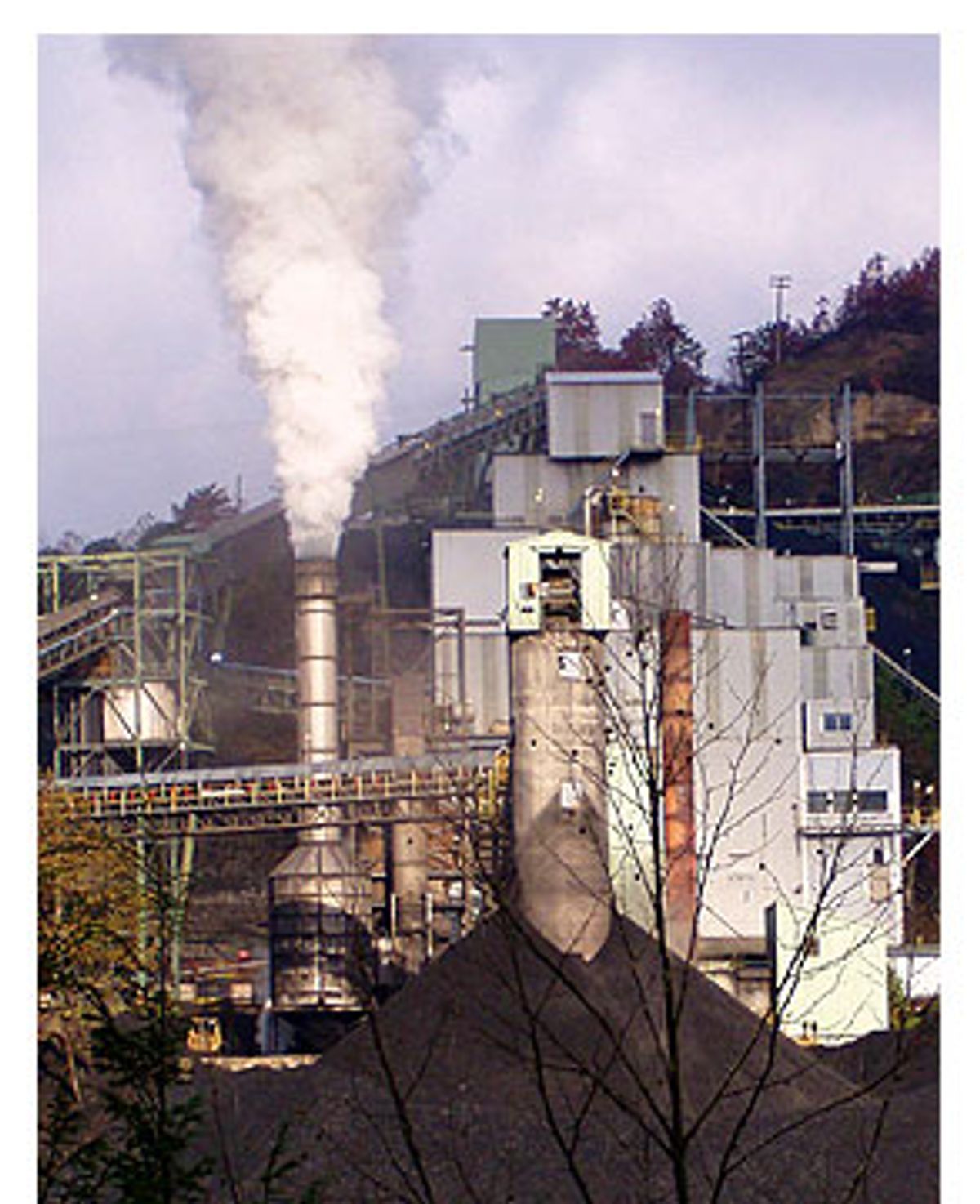
If you don't live in a state that produces coal it may be easy not to notice that fully 50 percent of all electricity generated in the United States comes from coal-fired power plants. But if you're in coal country the presence of the black rock is unmistakable. Take northeastern Kentucky as an example. Drive down Route 23 -- the Country Music Highway with signs that pay tribute to the likes of Loretta Lynn, Dwight Yoakam and other hometown stars -- and not a minute goes by without seeing a big rig hauling what miners call a "coal bucket," a long, gray-stained trailer covered with a tarp to hold in its payload. Flecks of coal click and crack against car windshields as fleets of these trucks make their way to railroad lines, shipping docks and power plants. Thick white exhaust, like a cumulonimbus cloud, billows into the sky at the American Electrical Power plant; a mountain of coal, as big as a professional football stadium, charging the network of electric cables and transformers.
If you live in the coal fields, your life is intimately linked to the coal industry. For decades there was almost a symbiotic relationship between coal field residents and coal companies. Jobs glued them together. Nowadays the coal industry is less dependent on vast numbers of workers. It's highly mechanized. Instead, the relationship, as one coal field resident put it, is more like that of a husband and his battered wife who keeps coming back for more. Large-scale mining operations have literally flattened whole mountains, filled entire valleys with rubble, and rattled homes with high-powered explosives. In some areas, piles of rubble as high as a modest skyscraper entomb whole valleys from mouth to crest. Many valleys, or what are called hollows in the Appalachians, have been filled with coal slurry.
Machines aren't as selective as human hands with picks, so when coal is stripped out of the ground a lot of rock and dirt comes with it. That extra material needs to be separated from the coal. Mine operators have what's called a preparation plant where the raw coal goes through a series of chemical processes. When it's through, the coal is as fine as baby powder -- no more lumps. The excess liquid, dirt, rock and chemicals -- the slurry -- is then pumped into an impoundment.
In the aftermath of the Martin County Coal accident investigation, the big question lingering in Kentucky is this: If there was obstruction of justice and a subsequent coverup, why would Bush administration officials get behind it? The new team in Washington could have let the previous administration take the blame. Both Martin County Coal slurry accidents in 1994 and 2000 occurred on Davitt McAteer's watch. The newly anointed Bush administration could have easily made the case that Clinton and his team fell asleep at the stick, scoring a few easy points with environmentalists.
But those familiar with the coal industry and federal politics say there's a much larger picture. One MSHA investigator told Salon, "The investigation didn't have to do with just Martin County Coal. The bigger question is 'Should slurry impoundments be allowed over old mines?' That would have been addressed in our report." With an estimated 200 such impoundments, the coal industry had a lot riding on MSHA's report.
Hundreds of coal field communities near slurry impoundments had a lot riding on the report as well.
The fear of catastrophic slurry spills animates the dark recesses of mountain life for many a coal field resident. On one chilly fall evening, Abraham Lincoln Chapman -- his friends call him Link -- and his 13-year-old daughter Paige stand outside their home on the edge of Coldwater Creek, one of the waterways most severely affected by the October 2000 slurry spill. They hear something splash in the water. It's a welcomed sound. Paige is pretty sure it's a muskrat, a creature they haven't seen much since the accident three years ago. Link says the water used to be crystal clear. Now it's murky brown, and if you poke a stick into the bottom, black clouds of fine slurry rise to the surface.
"It used to be full of fish, full of ducks, turtles, muskrats," Link laments. "We basically have nothing now. I've seen some minnows in it lately. I don't know if they've been released in it, or if they're minnows from up in the hollow that have come down from where it wasn't directly affected."
"We used to catch sand dabs, bass, creek chubs, anything," says Paige. "It was really full. When the sludge came, it washed away the bank we used to stand on. Everything is gone." She really misses walking up the creek and catching bullfrogs; their legs are a local delicacy. Now, the bullfrogs are all gone, and Paige says she wouldn't get in the creek even if she had to.
Her father worked in the coal industry most of his life. His jobs included being a safety director and a purchasing agent. From those vantage points he's seen the types of chemicals used to process coal. There are conflicting reports on how toxic the slurry is. A study from Eastern Kentucky University found that there are reasons for residents to be concerned. But a government study says there's no need for alarm. Link doesn't buy it. He says dryly, "According to what we've been told [by the government] as of lately, the slurry's probably good for you, if you'd eat you a handful of it every day. You ain't going to grow horns or nothing."
His children aren't assured that there won't be another catastrophe. Link spent his life savings to add a top floor to his house so he could get their bedrooms off the ground level because they were so scared the slurry would come down through the hollow again. "That's the kind of mental thing it's done to the residents that live here," said Link. "I know what's in the old mines up there and when my little girl would get ready to go to bed at night and she'd say, 'Dad, the slurry won't come out tonight will it?' And, I had to look her in the eye and say, 'No, it won't come out. You sleep.' It was really, really hard to do that, knowing what was still up there."
People familiar with the mines say there could be anywhere between 50 and 100 miles of abandoned mines near the tops of the mountains filled with water and slurry.
The question of safety seems very real when you stand below a slurry dam. A typical rock and earth structure, about 250 feet tall, stretches to the top of a valley mouth to hold back slurry in the Sun Dial impoundment at Independence Coal, another Massey subsidiary based near Whitesville, W.V. A truck driving across the top of the dam looks the size of a toy Hot Wheels vehicle. Below the slurry dam, which is grown over with grass, is the preparation plant, a series of buildings and conveyer belts painted baby blue. Vertical white lines accent the bigger buildings at regular intervals, like yard lines. The plant is situated next to Marfork Creek and draws water from it to process the coal. There's a coal silo, and piles of coal around the property.
Directly across the creek from Independence Coal is the Marsh Fork Elementary School where 200 students are enrolled. There's a green-and-yellow play structure with slides, a small bridge and a cupola amidst a grassy play yard. There's a sports field behind the school with a scoreboard adorned with a Pepsi logo. Night lights are available for evening games. Freda Williams, an organizer with the advocacy group Coal River Mountain Watch, shudders at the thought of a slurry accident here. "I would really hesitate to say what would happen to all those school children," she says.
It's hard for her to come out and say that if anything like what happened at Buffalo Creek in 1972 or Martin County Coal in 2000 occurred here, the school would be buried within seconds. It's late in the afternoon, and no one's at the school now. But I ask Williams what school officials think about being so close to an impoundment.
"The coal companies can come into the school and distribute their T-shirts and literature, but those of us who are trying to educate the people on the conditions that surround the school and the area, we're not welcome," she replies. It's then that I notice a chain link fence topped with barbed wire that goes around the perimeter of the school grounds, an out-of-place security precaution for a small mountain town where most people leave their homes and cars unlocked.
The Independence Coal impoundment is just one concern for communities in and around Whitesville. What looms most ominously for them are plans to make the largest impoundment in the country at Brushy Fork. It now holds 5 billion gallons of slurry, and, according to Coal River Mountain Watch, it's scheduled to hold up to 9 billion gallons. Its dam is 950 feet tall. The Brushy Fork impoundment sits on top of underground mines, and it's engineered by the same firm that designed the 2 billion-gallon Martin County Coal slurry impoundment.
Williams is the daughter of a coal miner, a union man who was run out of so many coal companies that by the time Freda was 16 she'd attended 16 different schools. At her home in Whitesville, she proudly displays a picture of her father with a group of determined, hardworking men in suits. It was 1921, and they were the victorious defendants in the historic trial of the Blair Mountain Mine War, a labor struggle that pitted thousands of miners against federal troops. Freda sadly notes in the picture that four black men are segregated to the background, also in suits, allowed to partially share the historic moment with their white counterparts. Coal has always been a part of her life.
The mountainside near her home is one side of the hollow that makes up the natural basin of the Brushy Fork impoundment. She noticed the other day that mud was trickling down the slope. It could mean that slurry is pushing on an underground mine. Earlier in the day, as we drove down a two-lane road, she noticed gray water coming down a hillside, a telltale sign that slurry is leaking. She reported both sightings to MSHA.
Her perspective on the coal industry is very clear: "We're not against coal mining. We just want the coal mining to be done legally and responsibly."
Meanwhile, Jack Spadaro's fate sits in the hands of MSHA's deputy assistant secretary Correll, who's weighing the superintendent's appeal of his termination notice. Spadaro doesn't expect any sympathy from Correll, the target of one of his whistle-blowing activities.
Spadaro is just a few years from retirement and he stands to lose his pension. "I've been in federal government for 27 years, and this is the most lawless administration I have ever seen," he said. "They care nothing for the rights of their employees. They certainly care nothing about enforcing the laws they are charged with enforcing, and they run roughshod over anyone who might try to get them to obey the laws."
Shares