

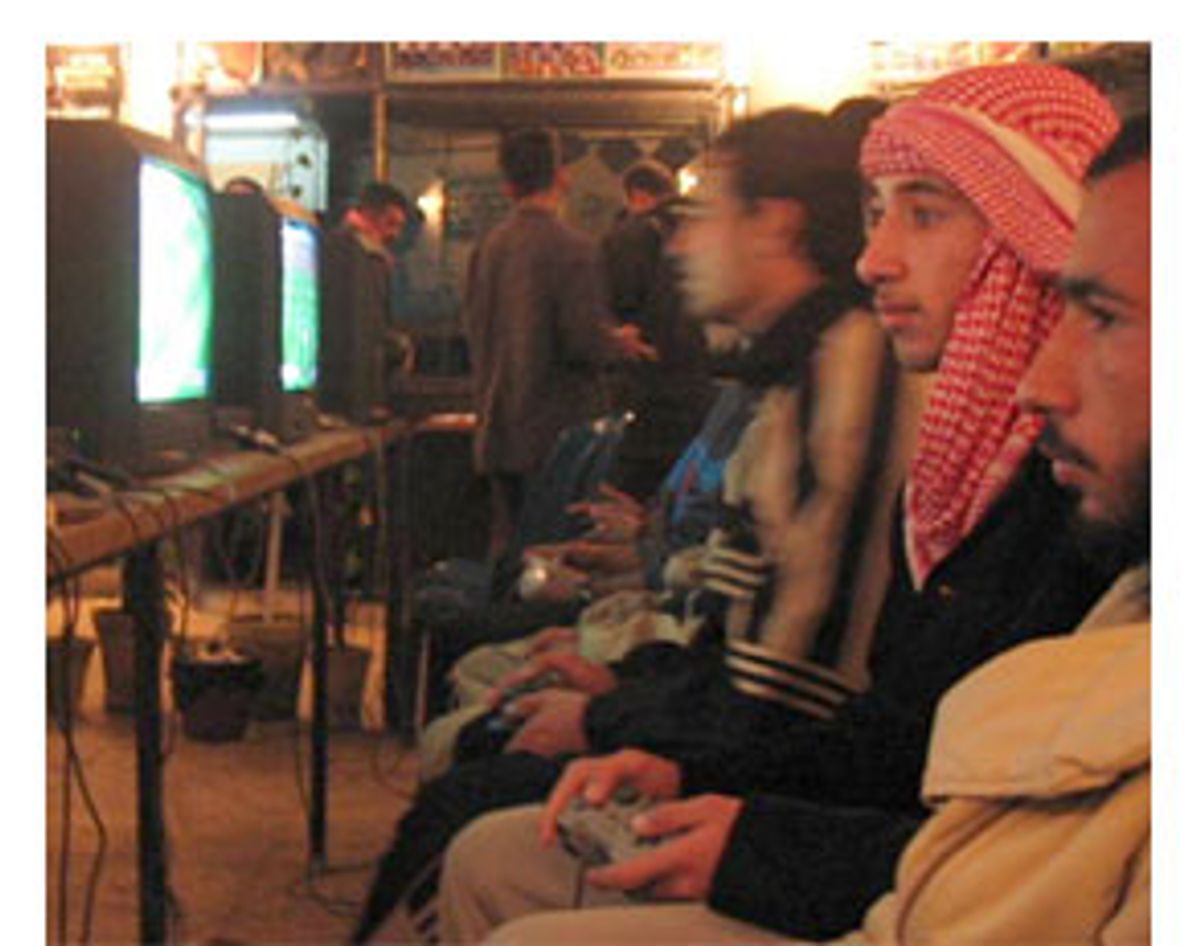
While the shock-and-awe bombing raged outside, Zeyad spent a lot of time playing "Crash Bandicoot" on his Playstation. Bandicoot is a humanoid fox who must escape the dangers coming at him from all sides (polar bears, lethal blowfish and so on), and as the walls of Zeyad's family home in Baghdad trembled from the precision-guided aftershocks, the dental student kept putting the agile mammal through his paces.
"It was really strange," Zeyad tells me now by e-mail. "But it was better than having to listen to the bombings." So he played it with the volume blasting. In his hands, Bandicoot died and was reborn, then died again. Meanwhile, outside, airstrikes kept ripping the sky. And so, as he recently wrote of "Crash Bandicoot" on his blog Healing Iraq, "I experience dèjá vu whenever I play it now."
While millions of gamers have their own associations with the game, Zeyad is surely among the first to couple "Crash" to a massive military campaign. But he's likely not the only one -- during the invasion of Iraq, reporters observed American soldiers hunched in the steel wombs of Bradleys and M1s, engrossed in their own portable game consoles, as they rumbled by night toward Zeyad's hometown.
The invasion has been a boon to the country's high-tech consumer market, according to Zeyad. "After the war," he says, "computer and console prices dropped drastically and became available for a larger section of Iraqis. You can get the fastest Pentium IV PC with the best components and accessories at $500, whereas it usually cost $800 before the war ... As to consoles, the cheapest are the Dreamcast at around $80 (or less) and the Playstation at an average of $100. Playstation 2's are more expensive and therefore less common (around $200-$250)."
That the PS2 is openly sold at all is actually another benefit of the war's aftermath, for under U.N. sanctions, units of the Sony console were apparently classified "dual use" devices which Saddam's scientists might bundle up to create a supercomputer, for use in long-range missile guidance. But Zeyad says the PS2 was still available under the dictator's regime, despite that interdiction: "They were smuggled through Jordan and Turkey. Most of these came from Southeast Asia and the United Arab Emirates."
Despite postwar price drops, he continues, "Computers and consoles are not affordable for the majority of Iraqis, and that is why there are so many Internet, LAN, and console cafes opening all over Iraq for people who can't afford them." For as he recently wrote on Healing Iraq, "Iraqis are hardcore gamers. Almost every neighborhood in Baghdad has what you might call a 'videogame cafe' with several consoles where people can play for about a dollar an hour ... . We have a special gamers' district at Bab Al-Sharj at the heart of the city, where you can find hundreds of videogame vendors." (Maybe that's where Hans Blix should have sent his weapon inspectors, since they could have verified evidence of dual use violations by digging up copies of "Grand Theft Auto III.")
Zeyad describes a Baghdad that few in the West know -- certainly not from reports that seem only to depict a Third World city beset on all sides by anarchy, ethnic and religious conflict, and terrorist attack. When the world media reports on Iraqi anger over the Coalition Provisional Authority's failure to restore the electric grid, for example, little is written about what Iraqis are using the power for. There is a difference between reporting that Iraqis are angry at a neighborhood power outage and reporting, say, that a lot of them are irked because the blackout interrupted a killer session of "Counter Strike" at their local LAN cafe.
So Zeyad's insights into his country's burgeoning digital culture provide a missing piece in the American dialog on Iraq's reconstruction, and Iraqis' own perception of Americans. And in his account of that subculture -- and by his own efforts as a wired blogger -- one perceives an Iraq that is ready and essentially equipped, despite temporary appearances, to join the interconnected tapestry of modern democracy.
Zeyad (he prefers not to publicize his family name) was born in Baghdad in 1979, and as a boy he moved to the West for a time with his Sunni parents (though Zeyad describes himself as atheist). They pursued graduate degrees in England, and voluntarily returned in 1987 to Saddam's Iraq.
"My parents weren't planning to stay in the U.K.," he tells me. "They were there for study on the [Iraqi] government's expense and they still had jobs back in Baghdad. Moreover, the situation in Iraq during the '80s wasn't so bad as compared to the '90s." (At the time, Saddam was still seen by many as a harsh but relatively progressive autocrat -- certainly compared to the hostage-taking mullahs in Iran he was then waging war against.)
Zeyad's family had a P.C., and computer games became both a hobby and a cross-cultural conduit out of a rapidly closing society. "When I was 11 or 12," he says, "I started playing Sierra adventure games. I was a huge fan of 'Leisure Suit Larry' and 'Police Quest.' I learned a lot about American culture from these games, and I started to understand some American expressions and their usage of the English language. These games were very educational to me."
(In "Police Quest: In Pursuit Of The Death Angel", you're a by-the-book cop who must track down a powerful drug dealer, and in "Leisure Suit Larry: In the Land of the Lounge Lizards," you're a virginal would-be swinger who must sex up three EGA babes with '80s hair. (So as an education in Americana, perfect.) Then came the first Gulf War, and suddenly Iraq itself became a setting for U.S.-made P.C. games. "There was a game called 'F-15 Flight Simulator' which was about the first Gulf War," says Zeyad. "I spent a lot of time playing that game and specifically missions in Iraq."
Saddam's security apparatus eventually took notice of games like this as well. "At one time we even had Mukhabarat agents rummaging through gaming stores looking for these games. As far as I know, when someone brought a military game from Jordan, it would have to stay for a few days at the Ministry of Information for checking. When we were still playing 'Mortal Kombat' on the Sega Megadrive, we heard rumors that there was a specific code or combo that would spawn Saddam Hussein and his bodyguards to finish the opponent, but these were just rumors."
The Mukhabarat created what must be the strangest assignment in the history of secret police, anywhere.
"They had people," says Zeyad, "whose jobs were to play and finish these games to find out if there was any mention of Iraq or Saddam."
In other words, they employed totalitarian play testers.
When the country went online in the late '90s, all Internet traffic was monitored by the Mukhabarat, who kept a watchful eye on political dissent. But Zeyad was still able to access apparently apolitical gaming sites, and these became a kind of backdoor for a limited form of self-expression. For the last three years, "I hanged around gamefaqs.com message boards and in Yahoo groups and chatted with gamers from many countries. Normally we just discuss favorite games, ask questions about plot theories, gameplay tips, puzzle solutions and similar stuff."
But as rumors of war loomed, conversations shifted away from virtual combat to the real, imminent thing. "We had some discussions about the war," says Zeyad. "Many people expressed incredulity or astonishment to the fact that Iraqis played P.C. or console games, or had access to the Internet. They used to ask me many embarrassing questions about the situation or about the regime, which I was a bit hesitant to respond to, given the fact that all Internet use in Iraq was under surveillance by the Mukhabarat. At one point I stopped participating in these discussions altogether, just to avoid the trouble."
Last year, he returned to the global discourse on his country in a big way, when he joined a second wave of Iraqi bloggers. They were following the path laid by Salam Pax, the original "Baghdad blogger" who has since leveraged his notoriety into a book deal and a U.K. Guardian column. Inspired and then assisted by New York blogger Jeff Jarvis, Zeyad's Healing Iraq blog went online shortly after the debut of Baghdad Burning, the acerbically pessimistic blog from Riverbend (who didn't even seem very happy to see Saddam captured).
In the main, though, the Iraqi bloggers tend to be tentatively optimistic advocates of the U.S.-led invasion and the Coalition Provisional Authority. Omar's Iraq the Model (with contributions from Ali and Mohammed) shines with blistering takedowns of the Western antiwar movement, while the dignified ruminations by Alaa of The Mesopotamian are interspersed by florid bursts of Arabic-tinged prose. ("The bones in the mass graves salute you, Avenger of the Bones," wrote Alaa, greeting Bush after his brief Thanksgiving visit. "Hail, Friend and Ally, Hail, Sheikh of Sheikhs, GWB; Descendant of the Noble Ancient Celt.")
But then there is Zeyad's teenage brother Nabil, who launched his own blog last November, and even here there is something stirring, in the kid's gusto to get his opinion out to the world, Baathist holdouts or fractured English be damned. ("This man is an American man," writes Nabil, rudely dismissing Pentagon-backed CPA council member Ahmed Chalabi, "he gets out of Iraq when he was a kid and now he comes to Iraq and wants to be the president of the new Iraq, his age about 50-60, he is a thieve he steal a bank in JORDAN and the Jordanian police want him now.")
While Zeyad is also a supporter of the American-led occupation, he is not, however, occupation's apologist. In fact, his most recent entries have advocated the pleas of a relative who believes her son died after being abused by U.S. patrolmen, a claim hotly disputed in the blog's forum by his mostly American readers. (Zeyad sought assistance for an investigation into these allegations by contacting "Chief Wiggles," another Iraq-based blogger -- who also happens to be an American Army intelligence officer and a freelance humanitarian. It may be the first instance in which blogging has aided a wartime misconduct claim.)
To his own surprise, Zeyad's ambivalence on the occupation extended even to Saddam's capture. "I felt humiliated," he wrote. "I sank into an overwhelming depression and sadness, and I had a desperate need to get terribly drunk. I should have felt joy but I didn't. And I'm still disappointed with myself." (His brother Nabil was a lot less ambivalent: "Mr. Poll Bremer goes on TV and he said we got him," he posted. "What a great thing the American forces arrest Saddam in a spider hole that he was hidden in, he is so loser because of why he didn't kill him self when he heard the soldiers near him.")
Zeyad's forthright reflections on contemporary Iraqi politics have earned him an international following, but his accounts of the Baghdad gaming scene have perhaps garnered him about as much attention. "I should have made this a gaming blog instead of a political one!" he wrote, after his first entry on the topic was swamped by reader response. Both it and his photo log of game cafes were linked to by Slashdot.org (the ultimate URL in techie cachet) and thus disseminated throughout the global geek consortium.
None of this should come as a surprise. Computer and video games are the universal cultural referent for the young, in a way that Hollywood films were the catalyst of an earlier generation, as soldiers greeted each other across the battle lines. Nabil employs them as an icebreaker when talking with U.S. soldiers he meets (and sometimes plays basketball with): "At first the Americans were shocked to know that Iraqis had access to games and consoles and knew so much about it," says Zeyad, "but after a while they started to discuss game strategies, exchange tips and so [on]."
The kind of games they talk about may also provide insight into the way this new generation perceives Americans. Among the most popular titles in Iraq is 2002's "Medal of Honor: Allied Assault."
"It's a very popular game here," says Zeyad. "Iraqi gamers love first-person shooter games, and this one was a hit for some time and is still being played at LAN cafes." A painstakingly realistic depiction of the American GI during World War II, its key level is a brutal re-creation of the D-Day assault on Omaha Beach, based on the same scene from "Saving Private Ryan." As in "Ryan," the level is so punishing (you must die dozens of times to even reach the beachhead) it almost plays like a simulated self-flagellator, which you endure as a way of honoring the resolve of America's soldiers, even in the face of grinding death.
"I'm not really sure if the game story itself had any effect on opinion [of Americans]," Zeyad says. "Since most Iraqi gamers don't really pay much attention to plot or story line, and usually focus on gameplay." Still, in the game's Allied vs. Axis multiplayer mode, he says, "most of the gamers I notice play as Allied." And you have to think something so vivid would work its way into the subconscious of the Iraqis who play it. (Then again, another hit game with Iraqis is the P.C. game adaptation of "Black Hawk Down.")
Zeyad also sees gaming potential in a more recent American conflict -- or rather, the one that is still playing out. "I think the operations in Iraq deserve their own game," he says. "I would like the game to be accurate and represent the existing terrain and conditions in Iraq. Other games like 'Conflict: Desert Storm' are poor in this area, for example, the terrain and buildings don't look the same as the real thing, and the voice acting was terrible -- the Iraqi soldiers talked in an Egyptian accent. Also, the player should be able to choose either side, for example a Republican Guard soldier, or a foreign terrorist, in addition to coalition soldiers."
But more than the theme of any particular title, it's the pervasiveness of gaming itself, even well before Saddam's fall, that strikes one as the most telling pointer of the country's future.
Gamers know the digital age in their body. They grasp a game's farrago of diverse stimuli, the onscreen rush of icons, meters, text, 3D visuals and audio cues, and make a cascade of split-second decisions that become, after a time, second nature, like a limbic response. Interfaces are intuitively understood, complex systems are quickly comprehended without the need of predigested orientation. For gamers, understanding other computer applications (the Internet, digital cameras, etc.) becomes a trivial effort, and this is where the growing constellation of game cafes throughout the cities of Iraq becomes so crucial. If computer literacy is a prerequisite for reaching the height of globally connected pluralism (and it is) then consoles are the stepladder, and PC games, the escalator.
For now, though, Iraqis as gamers are still trapped behind disconnected borders. "LAN cafes don't have Internet connections," says Zeyad. "Internet cafes don't allow software and games to be installed on their computers." But when the connection comes, he'll enter the lobbies of the world's multiplayer combat zones. "I'm looking forward to play mainly 'Unreal Tournament' and 'Empire Earth,' but it would be fun to try other games like 'Battlefield 1942,' 'Quake III,' 'Medal of Honor,' and 'Counter Strike.'"
I sometimes play the odd Unreal Tournament match online myself, and so I tell Zeyad to look for a player with the username "Coriolanus," when he can come on via the Internet.
"At local LAN cafes," Zeyad e-mails me, "I go by the handle 'Soul Reaper,' so I think I'll use the same."
Inshallah, the Soul Reaper will hunt down Coriolanus with a rocket launcher, and kill him again and again, as a way of announcing Iraq's arrival to the free world at play.
In my work as a journalist of the medium, I interviewed a fellow gamer who is also a Green Beret who once called down airstrikes on the Taliban in Kandahar. For an entirely unrelated assignment, a year later, I happened to meet another fellow gamer who is also an Air Force bomber pilot, and it turned out he unleashed some of those very bombs on Kandahar's Taliban -- and then last year, dropped more munitions on Saddam's forces in Iraq. That pilot flies an F15e -- the same jet that Zeyad of Iraq is more than familiar with, from his days of playing the Gulf War-era flight simulator of the same name. (Though Zeyad was more preoccupied with controlling Crash Bandicoot, when the real F15s returned over his family's house last year.) As a gamer, I have myself played with peers living throughout the E.U., from Japan, Singapore, New Zealand and Australia. (Unsurprisingly, given the prominence of its high-tech economy, Israel is the only Middle Eastern country with a sizable gaming community; but that, it seems, will change soon.)
The brotherhood of gamers crosses all borders, ignores all cultural, political and economic distinctions, and brings together some of the most technologically savvy of every nation into the same creative commons.
I think about the play-testers of the Mukhabarat, the men who once had to play through video games in search of potential anti-regime content. (In "Conflict: Desert Storm", for example, the end mission involves killing a general who looks suspiciously like the recently de-spider-holed leader.) I picture a middle-aged Baathist with a Playstation controller teetering on a voluminous gut, trying without success to maneuver his British commando into Saddam's lair before the Republican Guard can get a bead on him. Instead he's the one who keeps getting mercilessly snuffed. Maybe before this he manned Qusay's plastic shredders, or worked shifts at what his résumé tactfully describes as "despoiler of women's virtue." Now here he is, fumbling with a medium where cruelty counts for nothing, and the game kids of the Bab al-Sharj can own his ass with their eyes closed. (Down the halls of the Ministry of Information, he bellows, "How do I use this 'God mode'?!") Because he can't beat the game fairly, because it demands a proficiency he could never earn, and there are no means with which to torture its hard-edged causal logic into submission. In the very near future, he will be dead, or retired to the indignity of hawking diesel fuel to passing farmers and truckers outside town.
But even in the electrified neighborhoods of the Sunni Triangle, the game kids will be busy inside, applying their skills. And they will be in the game rooms and the Internet cafes springing up with just as much frequency, opening up new avenues of possibility. We will benefit from them as well, for in between death-match sessions, some of them will let us in on the news of an emerging Iraq that our own media cannot be troubled to keep pace with -- clicking through to new windows of opportunity which open up slowly, but with progress meters that steadily move in the right direction.
Shares