

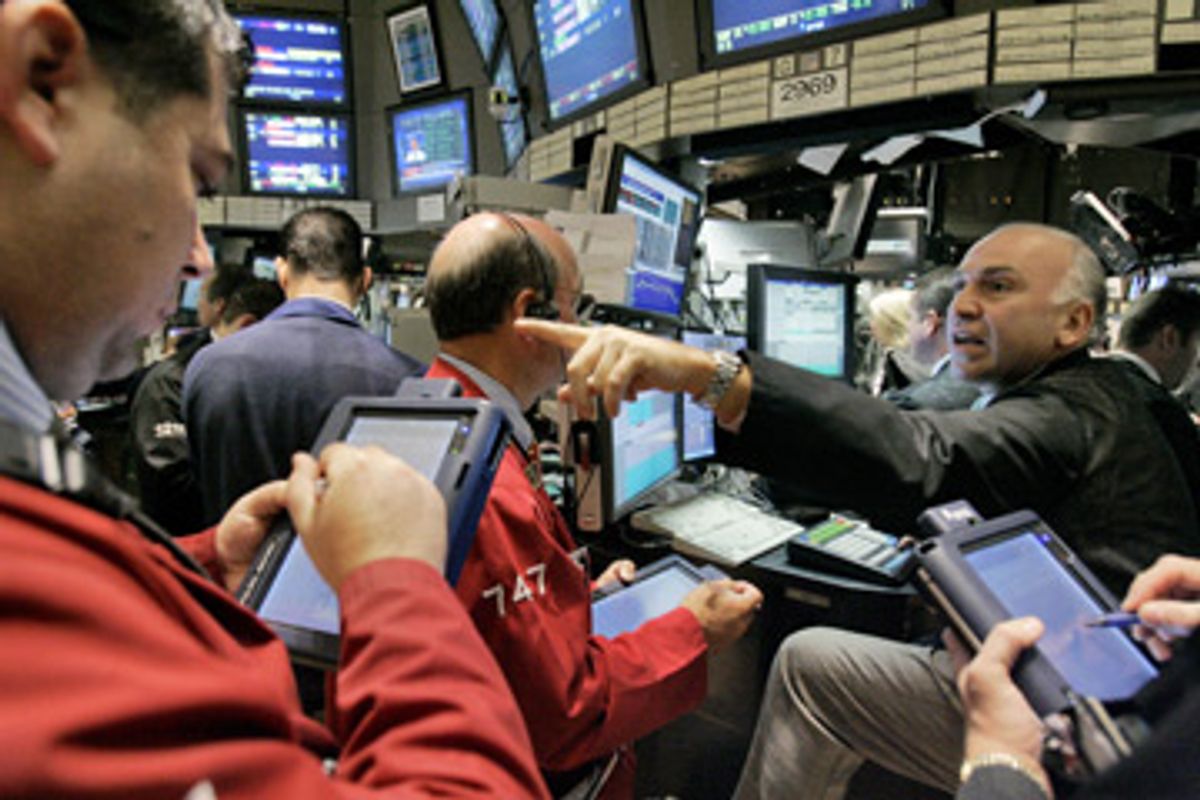
From New York to Hong Kong and everywhere in between, alarm bells are ringing. Central bankers are on 24/7 alert, ready to perform life support on catatonic markets. Stock traders are panicking -- the Dow's wild ride on Wednesday, down 350 points and then almost all the way back, is just the latest declaration of confusion and fear.
If you had been paying only casual attention to the financial markets as summer rolled along, you could be excused for glancing at the headlines and wondering, what the hell is going on? By many measures the global economy is growing faster than it has for decades. But in our globalized world, anxiety is everywhere. Soon after the markets close in New York, Asia's traders start running for cover. By the time they're exhausted, Europe is picking up the relay. And then back to the United States it comes.
People who devote their entire lives to studying the intricacies of high finance are confused right now. But the basic story line isn't that complicated once you break it down into simple building blocks. And that's what Salon is going to do. Here are some simple questions and, we hope, some simple answers.
How did this happen? How did we get here? What does it all mean?
There is a standard explanation included as a paragraph in almost every story attempting to explain the current turmoil. It goes like this: Anxious to goose the U.S. economy out of its dot-com-bust doldrums, Alan Greenspan and the Federal Reserve Bank lowered interest rates to rock bottom in 2001. The resulting flood of cheap money encouraged an orgy of borrowing at every level of the U.S. and world economies. Whether you wanted to buy a house or a multibillion-dollar conglomerate, lenders were your best friends, falling over themselves to offer you whatever amount of capital you desired -- and charging low, low rates of interest. Cheap money led to a growing complacency about risk. If you ran into trouble, you could just refinance your house, or borrow a few billion more dollars today to pay off the billions you might owe tomorrow.
Greenspan's policies are being blamed for inciting the greatest housing bubble in U.S. history. The collapse of that bubble set off a wave of defaults by homeowners no longer able to make the payments on their mortgages. Mortgage lenders were the next link of the chain to break, followed by the investors who were trading in bonds and securities whose value was tied to these loans. Suddenly, risk was back!
So that's that? It's Greenspan's fault?
Partially, but interest rate tinkering is not the whole story. It may not even be the most important part of the story. There's another reason so many homeowners are in trouble and stock markets are imploding: Wall Street rigged the system so something like this was inevitable.
One could make a case that the biggest economic story of the last 10 years -- bigger than the dot-com or housing booms, bigger than their busts, perhaps even bigger than the extraordinary growth of the Chinese and Indian economies -- has been the astonishing growth of what is obscurely referred to as "structured finance," a crazy quilt of arcane derivatives and other "financial instruments" that have become the lifeblood of markets everywhere.
Whoa. Stop right there. What is a derivative?
Strictly speaking, a derivative is a financial doohickey whose value derives from some underlying asset. A mortgage loan is an asset. A pool of mortgage loans grouped together into a security that can be traded on markets is a derivative.
We often hear about the "real economy," that place where real people buy and sell real things, or go to work at real jobs where they make real stuff or deliver real services. Derivatives belong to what should be called -- but never is -- the unreal economy, a place where speculators make bets about what will happen in the real economy. Derivatives are vehicles for making such bets. If you think the borrowers whose loans are pooled together are going to make their payments, then buying a share in a group of such investments might be a good idea. That would be your bet.
A metaphor might be useful here. The real economy is like the Super Bowl. Real men on a real field push each other around and play with a real ball for a set period of time, and the team with the most points at the end wins. But while all this is going on, millions of outsiders who are not physically involved in the game bet on its outcome. Only they don't bet just on the outcome. They also bet on the spread -- how badly one team might beat the other. Or they can get more creative and bet on what the combined score of the teams might be, or which team's quarterback will be the first to be injured. There's absolutely no limit to the things that you can bet on, as long as you can find someone to take your bet.
The betting economy is the unreal economy. All those sports bets, no matter how kooky, are financial exercises whose value and meaning are derived from what happens on the field. Theoretically speaking, the betting economy exists in a separate dimension from the actual game, but we all know that's not true. There's so much money involved in gambling that the temptation to fix the results becomes irresistible. Players and referees, for instance, can be bribed.
We can call a bribed NBA official an example of "spillover" from the betting economy into the sports economy. The very same thing happens in the real and unreal economies. So much money is riding on all the derivative bets connected to the housing sector that Wall Street speculators essentially rigged the housing sector to make their bets pay off.
To understand exactly what happened, we must take a closer look at a particular kind of derivative: the infamous "collateralized debt obligation," or CDO.
Say what? Collateralized who which how?
Don't worry about the name. Call it an extra-special funky doohickey if you like. It's not important. What is important is its function, which is to make things that should be considered risky take on the appearance of less riskiness.
After a mortgage lender makes a loan to a homebuyer, that loan is packaged up with a bunch of other loans into a security -- a financial instrument that can be traded. Securities are rated by rating agencies according to the chances that the underlying assets will be defaulted upon. U.S. Treasury bonds, for example, get stellar AAA+ ratings because the U.S. government is considered likely to meet its obligations.
A security based on a pool of subprime mortgage loans would normally not deserve an AAA+ rating. Subprime, by definition, means "not so good." Subprime loans are made to people who can't put together a down payment or have bad credit, or can't prove they have a job. Subprime loans are risky!
Many investors -- particularly in pension funds and municipalities -- are prohibited from investing in securities that are not high-rated. Let the hedge funds and the investment banks play around with the risky BBB stuff, the "junk." The rest of us should be more prudent.
But investment bankers are clever fellows. In cahoots with the ratings agencies, they came up with a way to magically transform a low-rated security to a high-rated security. (The culpability of the ratings agencies -- Fitch, Standard & Poor's, Moody's -- should be not underestimated. It might be helpful to think of them as the bribed referees in this game.)
Enter the collateralized debt obligation. The CDO takes a pool of risky mortgage loans and divides it into slices. (Wall Street calls these slices "tranches," but that seems to be a word that makes the brains of normal people freeze up, so we'll ignore it.) For simplicity's sake, let's say that a mortgage-backed security gets divided into two slices when it is transformed into a CDO -- a senior slice and a junior slice. Let's say that the senior slice gets rated AAA+ and the junior slice gets rated BBB-. But if anything goes wrong -- if the homeowners whose loans are part of this security start missing their payments -- the investors in the junior slice have to lose all of their money before the investors in the senior slice start feeling any pain. That's the beauty of the scheme. You take a bunch of bad loans and turn some of them into high-rated gold and some into lower-rated bronze. You sell the gold to the cautious and the bronze to the bold. If a few loans go kaput, the bronze investors suffer. If all the loans go kaput, everybody gets hurt. Unless there's a total financial meltdown, everyone is happily making money.
We keep hearing in the financial news about risk being "sliced and diced." Is that what you're talking about?
Yes. After the transformation, we now have an instrument that satisfies the desires of both conservative investors, who can just buy the AAA+ rated slice, and investors who have a taste for risk, who can buy the BBB- slice. It's a brilliant work of alchemy.
And very popular. CDOs tied to subprime mortgages became hot commodities, snapped up with gusto by traders all over the world -- even the riskiest, most likely to self-immolate, lowest-rated slices of those CDOs. Especially those slices.
Why? Why was there such an appetite for risk?
No risk, no reward. In the securities world, financial vehicles whose underlying assets are risky yield higher rates of return. Subprime loans ultimately charge higher rates of interest than prime loans. That means that as long as homeowners don't take advantage of introductory low rates and pay off their loans early, pools of such loans will throw off a higher stream of income than pools of less risky loans. Traders who want to get a piece of that higher stream of income will take the chance of default.
This is where we approach the crucial turning point. Many different parties have been blamed for the housing mess. Homeowners are told that they should have read the fine print on their loans and should have avoided taking on financial obligations that they couldn't meet. Mortgage lenders are blamed for pushing the risky loans in the first place. And of course, there's the maestro, Alan Greenspan. But these attributions of guilt all miss the mark. The incentive for everyone to behave this way came from Wall Street, where the demand for subprime CDOs simply couldn't be satisfied. Wall Street was begging the mortgage industry to reach out to the riskiest borrowers it could find, because it thought it had figured out a way to make any level of risk palatable.
So Wall Street wanted mortgage lenders to make bad loans?
Let's return to our Super Bowl metaphor. The gamblers aren't satisfied with their odds of winning, so they bribe a player to fumble at the one-yard line and alter their bets accordingly. Wall Street traders, hungry for more risk, fixed the real economy to deliver more risk, by essentially bribing the mortgage originators and ratings agencies to fumble the ball or make bad loans on purpose. That supplied CDO speculators the raw material they needed for their bets, but as a consequence threw the integrity of the whole housing sector into question.
But hang on. Isn't the total amount of subprime loans outstanding just a fraction of the overall home-lending market? And isn't the U.S. economy still growing? Why has just one small sector of one country's economy caused so much trouble?
Two main reasons: a lack of transparency and an overabundance of leverage.
What's been described here so far is just the simplest possible model of how things work. The truth of what is really going is far more complex. So complex that no one has a good handle on exactly what will happen if things go awry. Not regulators, not traders, not even pessimistic journalists. Try reading an SEC filing from a New York investment bank -- it is one of the most difficult-to-comprehend documents ever created by the human mind.
It is not, in a word, transparent. It serves the opposite purpose: It is an instrument of obfuscation. Because of failures of regulatory oversight, we have very little idea who owns what, or what risks hedge funds and pension funds and municipalities and mutual funds are really exposed to. This is all fine and dandy if your goal is to prevent your competitors from understanding what kinds of bets you are making. But it becomes a much more severe problem when you're trying to figure what is going wrong when the trains start derailing.
(By the way, if you're looking for something that government could do that might address this problem, calling for greater transparency carries the double whammy of being both the right thing to do and, rhetorically speaking, something that free markets are supposed to depend on for their proper functioning.)
Next up: leverage. Archimedes told us that if he had a lever long enough and a place to put it, he could move the world. Speculators in the world's financial markets also like leverage; but they don't use crowbars to move objects -- they use borrowed money to make bigger bets. This is fine as long as your bets pay off. But when your bets go bad, the people whose money you borrowed want it back.
Right now, a great many people want their money back.
The people who say that subprime is just a small part of the economy are correct. What they fail to note, however, is that the same games that Wall Street played with subprime are likely being played in every sector of the economy. It's not just a Super Bowl whose results can be fixed. The NBA, and Major League Baseball, and the Tour de France and the Olympics are all under the same pressures.
Subprime ripped a window open into the way business as usual is being conducted.
Now everyone wonders, what's next?
Shares