

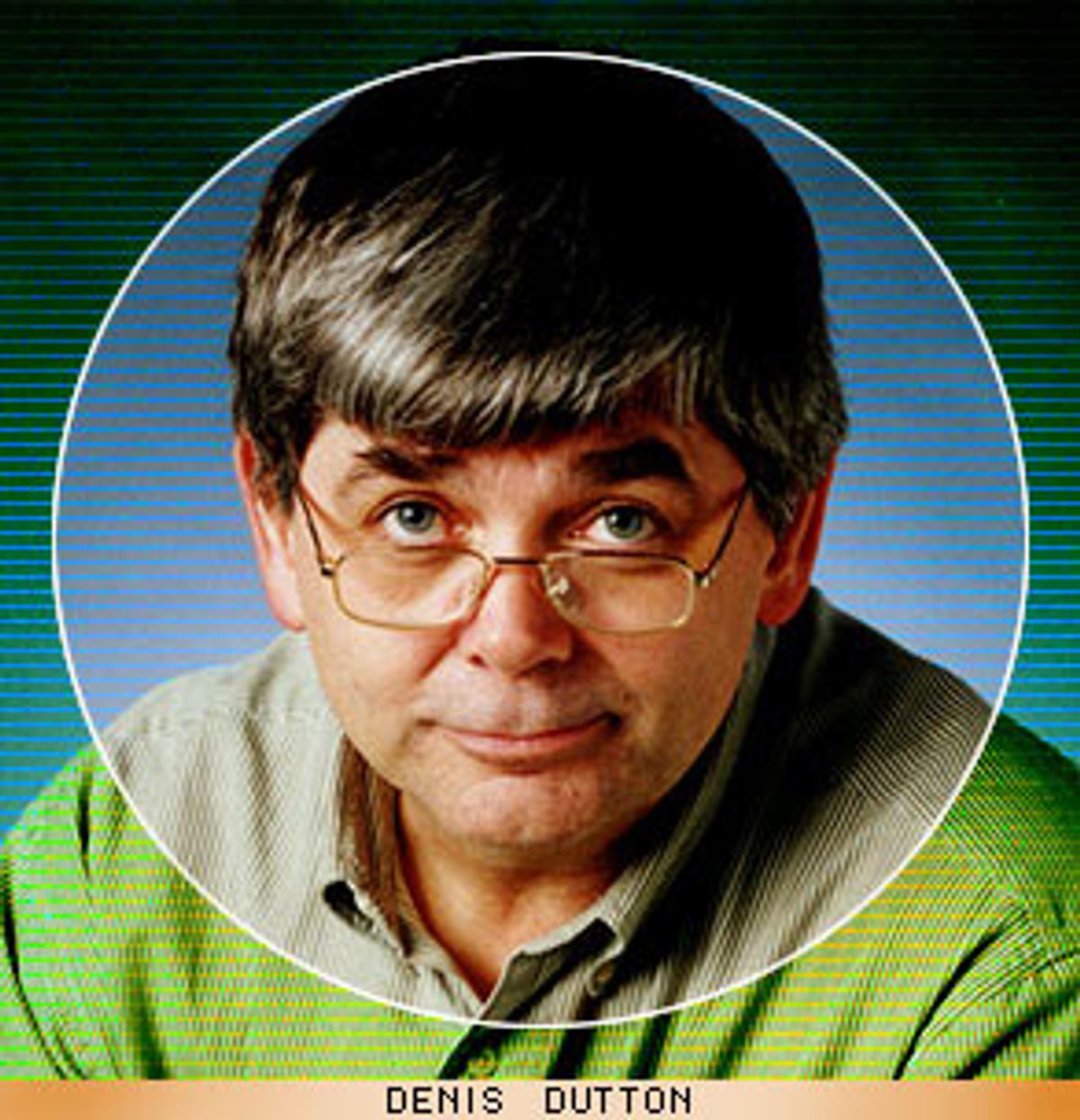
Denis Dutton, editor of the popular Web site Arts & Letters Daily, has the kind of damn-the-torpedoes, strapping intellectuality that figures like Camille Paglia, Robert Hughes and John Searle do. Over dinner with him, trying to keep up with his knowledge and ideas about wine, Glenn Gould, Kant and evolutionary psychology, you can feel like Boswell invigorated by the company of Dr. Johnson.
Dutton, 56, grew up in Los Angeles, got his Ph.D. from the University of California at Santa Barbara, spent time in India with the Peace Corps (he still twangs away at his sitar on occasion) and eventually accepted an appointment to the University of Canterbury in Christchurch, New Zealand. A gleeful contrarian, he edits the academic journal Philosophy and Literature, and in 1996 founded the Bad Writing Award. A thinker who prefers to measure his thoughts against what actually exists, he once took time out to live with the wood carvers of the Sepik River region of New Guinea to learn what art, craft and beauty mean to them.
Arts & Letters Daily has been one of the Web's surprise hits, a text-heavy site that consists of little but one long scrolling page -- technologically, it's about as un-cutting-edge as can be. On it are found no animations or applets, just links to articles and essays published elsewhere, with teaser paragraphs describing the highlighted articles. The site caught on quickly as a kind of unofficial "best of the Web." (Full disclosure: A few of my Salon pieces have been highlighted by ALD.) For readers interested in ideas and the arts, the site, which was purchased by the journal Lingua Franca in November 1999, is like a daily digest assembled by brainy, freewheeling grad students.
Now Dutton -- the scholar as Internet impresario -- has struck again, founding the online publishing house Cybereditions, dedicated to making available worthwhile scholarly books that had fallen out of print. Cybereditions offers them up as e-books, HTML downloads and print-on-demand paperbacks. Salon caught up with Dutton by phone, as he took a break between a meeting of the American Society for Aesthetics and an e-book conference in New York. As always, the conversation hit the ground running.
You just attended a conference of estheticians. How is the concept of beauty doing these days?
I think the idea of the social construction of beauty -- this idea that beauty is simply whatever culture or society says it is -- is on the run. Of course, beauty does arise in a cultural context. No one ever denies that. But there's also a natural response people have to it.
But wouldn't it be fair to say that an enjoyment of haute cuisine and Bach generally comes only with an education?
Sure. It's clear on the one hand that an education enriches and informs a response to beauty, even makes it possible in esoteric cases. On the other hand, there's no question that someone with no musical education whatsoever might wander into a concert hall and be overwhelmed by the Beethoven Pastoral Symphony. Any theory of esthetics that ignores these two sides of the appreciation of beauty is missing something important. I feel that as a young person in the Peace Corps I was too impressed by cultural differences and didn't look closely enough at similarities. Evolutionary psychology is a terrific corrective to the idea that we're all purely products of culture.
When did you start Arts & Letters Daily?
I designed it in July of 1998. It first went live on Sept. 28 of that year. The design of the page is based on an 18th century broadsheet.
Why?
The 18th century broadsheet tries to pack the maximum content on the minimum amount of paper. So I took that classically simple idea and turned it into a Web page.
I imagined it had something to do with your enjoyment of clashing points of view.
I do like the idea that there's a range of views on the page, and all sorts of competing voices.
How quickly did people discover the page?
It took off very fast. These days, we're often above 20,000 visitors per day. As with most Internet sites, weekends have smaller numbers, and Friday isn't as big as Monday.
What do you know about your readers?
They're the kinds of people who subscribe to the New York Review of Books, who read Salon and Slate and the New Republic -- people interested in ideas. One of the things that pleases me about the Internet is that people have for a long time idealized the '50s and 1960s as some kind of golden age of journalism. With three networks and every city having a monopoly morning daily -- as if that were a golden age! For diverse points of view and open, robust criticism, things have never been better than they are today.
What has been the most controversial piece you've linked to?
A couple of times when we had some pieces that were excellent, sober, scholarly articles from the magazine Christianity Today, these seemed to get up some readers' noses. People who wouldn't think twice about something out of Commentary were objecting that we were publishing out of Christianity Today. They seemed to think we were somehow forcing religion down people's throats.
What have you learned from your readers?
One thing that surprises me is that people are not necessarily looking for short pieces. Many of our most popular items have actually been quite long. This challenges the idea that everything on the Internet ought to be short and sharp. People are also looking for longer, meditative pieces that provide an occasion for thinking.
There is an audience out there for high-end material. You don't hear much about them.
It's all supposed to be shallow glitz.
In the media biz it's taken for granted that magazines have to work a niche market. Yet if your site has a theme, it's variety.
We're very conscious of that. The site is intended to expand the reader's sphere of interest. It's a grave mistake in publishing, whether you're talking about Internet or print publication, to try to play to a limited repertoire of established reader interests. A few years ago Bill Gates was boasting that we'll soon have sensors which will turn on the music that we like or show on the walls the paintings we like when we walk into a room. How boring! The hell with our preexisting likes; let's expand ourselves intellectually.
I know people who love your site but scratch their chins, because they can't figure out your point of view. They want to know your agenda.
[laughs heartily] I heard recently about a British Marxist who finds that the site enrages him. But he can't help but look at it every day. We're reacting against cant and clichés wherever we find them. Whatever's prevalent in the universities and among the chattering classes is sometimes something that needs exploding. And we're willing to throw the dynamite. On the other hand, there are certainly many items on Arts & Letters Daily that present a fairly standard line that educated people take on many issues. A vegetarian gun-control advocate who opposes capital punishment is fine. But what pricks my interest more is the vegetarian anti-capital punishment cowboy who carries three shotguns displayed in the back window of the cab of his truck.
Let's talk about Cybereditions. Book publishing is such a nutty field. Why would a professor of philosophy want to get involved?
My parents were in the book business, my brothers still run the Dutton bookstores in Los Angeles and I've been interested in editing books and journals all of my life.
When did Cybereditions go up?
It's been selling books off its site since the middle of this year. We have about 30 titles in process right now, and we're hoping to raise that number to over 100 in a couple of months. Books have been going out of print at the rate of 30-40,000 a year for the last 40 years. So Cybereditions takes high-quality, out-of-print books that the authors have the rights to and does a new edition where possible. Some of our books are unchanged from the original edition, but most are in some way updated.
What are your bestsellers?
Frederick Crews' book "Skeptical Engagements" has been selling, Norman Holland's book "Poems in Persons" has been selling. And Mark Turner's "Death Is the Mother of Beauty" has been popular. We recently acquired Ihad Hassan's "The Postmodern Turn," and Brian Boyd's first book on Nabokov's "Ada."
As successful computer people are beginning to kick back a little, are they becoming more interested in the cultural applications of the technology and the money?
A couple of years ago it was impossible to interest people in the computer world in anything that used the dreaded word "content." If it wasn't a switch that made something go faster or some kind of whizbang program, they weren't interested. Cybereditions is an application of computer technologies to a very traditional business. Book publishing is and always was, as Jason Epstein has said, a cottage industry. It's a matter of authors working with editors to produce books that are useful to readers. There's no way to mass-produce good editorial work. And good books are no more going out of fashion than good stories or good food. We have found backing in Silicon Valley, though it's very modest.
Authors tell me that, now that publishing houses are aware of electronic publishing, they won't let rights revert to authors anymore. The publishers are refusing to admit that books have gone out of print.
That's exactly right. This is going to enrich a lot of lawyers. Ask the publishers for the rights, and they'll dawdle and claim a book is simply out of stock. At the same time, there are thousands of authors who, before all this, when they were told their books were out of print, simply took the rights back. So there's a huge field that Cybereditions can work with even if the current publishing scene is not entirely friendly to a new entrant.
What rate do you pay?
We pay up to 40 percent of what we net, and with electronic downloads that can be done.
Does Cybereditions have a physical location somewhere?
The server's in Santa Clara, Calif. The company doing the editing is in Christchurch, New Zealand. The technical people are there too. We'll be using contract editors all over the world. Our authors will certainly come from everywhere. It is a New Zealand corporation, but with international investment. And the print-on-demand books will be done, mostly, in the U.S.
How do you react to the new Gemstar e-book readers?
The quality of the devices is excellent. But Gemstar is intent on controlling and licensing what the devices can actually be used for. Rather than using an open format, which allows you to use any file of your own, you can only read what you download either through their site, or what is licensed by them.
A lot of commercial publishers are high on Gemstar's approach.
If this is the future of electronic publishing, I think you can count most readers out. Who would have bought a television set in 1955 if it turned out that the television-set manufacturer controlled what programs you could watch?
What kinds of opportunities does electronic publishing offer someone interested in scholarly publishing?
For one thing, it changes the concept of the book. Normally a book comes out in a final finished edition. Perhaps years later a second edition follows. But an electronic book can be continually revised, more like a computer program than a printed book. You can have an initial edition, then make some corrections -- that's edition 1.01. Some more and you have edition 1.02. Right up to a really new edition, and that's version 2.0.
Everything becomes software.
We can continually update. Another thing: Traditionally, the book is published and sits out there alone and undefended while the critics pick it apart. With e-publishing, a scholar who's worked for years on a book can now come out with a revised edition answering critics. We think that the idea that writers can now answer their critics is very important. That's why we've registered the domain name booksthatbiteback.com.
So much of what gets said about electronic publishing is about how the floodgates will finally be opened and the native genius of the people will finally be released.
I sing the praises of the many contrary points of view that are available on the Web. The downside is that much of the material that's available on the Web is unedited and self-indulgent. More than ever, the Web demands good editors who can knock writing into line and make it serve readers rather than the egos of writers.
Internet utopians tend to use the term "gatekeeper" as a synonym for "devil." As a publisher, what's your view of the role of gatekeepers in the Internet world?
The old libertarian paranoia about gatekeepers is passé. Gatekeeping is impossible on the Internet anyway. What we do need, as much today as ever in the past, are intelligent editors and publishers who can be relied on to select the best material.
We need guidance.
And guidance of that sort isn't manipulation. It's entirely rational, and an economic use of time.
In a way that's what the canon is -- guidance.
The classical canon is a great way to begin an open-ended reading list. It was never intended as a straitjacket, nor should it be.
You're an egghead who has created an intriguing business. What have you learned about the business world?
Many of the people I've encountered, particularly in the computer industry in California, are some of the smartest and most imaginative people I've ever met. And one has to laugh a bit sadly at academics who look down their noses at people who happen to have done well in the computer industry.
I've always been amazed by the way some academics seem to think that they're smarter than everyone else.
I once read that people with Ph.D.s in fact have slightly lower IQs than people with M.A.s. Apparently, a lot of really smart people feel, once they've got the M.A., enough of this, I'm out of here. And some people who go on to get the Ph.D. have a kind of stupid doggedness. As a Ph.D. myself, I suppose I might admit it takes one to know one! Even so, you also find some of the best minds in the world in academia.
Are there assumptions academics make about businesspeople you'd like to shake them out of?
The usual leftoid malarkey -- that the business people are only interested in profit, really, while we academics worry about the good of the world, and whether our four-month vacations might be reduced to three and a half.
I left academia in the late '70s. Bring me up to date.
There's a very serious divide that's developed in the academic community. The science departments have remained strong. And those departments such as psychology or economics that have tried to give an empirical base to their research and teachings have remained lively and productive. The sad story is over in the English department. English as a discipline has been reduced to a laughingstock by its adoption of cultural studies as its central focus. In a sense you can see how it happened. The students don't want to read long, hard, old books. And many faculty members find it unrewarding to teach classic literature to recalcitrant students. But to rescue the situation by turning to politicized readings of comic books, soap operas and the media has been a big mistake. Of course, there are still holdouts for real quality -- Bard College is a notable example. But increasingly they're an embattled minority.
The radicalism of the cult-studies approach seems to go hand in hand with a complete caving-in to commercialism.
Yes. There's an odd way in the which the left, by trying to remain avant-garde, has gleefully adopted commercialism as the only reality -- playing perfectly into the hands of the philistine right. Realistically, we have to understand that there's always a considerable percentage of students who are not given to independent thought, and who rather enjoy being told how to talk about their favorite soap operas in deconstuctionist jargon. In any society there are people who are easily led.
I've run into a syndrome among some younger people recently. At about the age of 30, they start to realize they were brainwashed instead of given an education. And only then do they start to wake up from it.
So long as you have contrarian sources of news and information, hope is not lost for intellectual independence. And we'd love Arts & Letters Daily to be the meeting place for critical thinkers from all over the map.
A novelist who has also taught at colleges told me that the people who are really interested in reading and writing are leaving English departments and going into creative-writing departments instead.
So the abiding classical interest in great prose and how it gets made will persist. It will just be reborn in another department.
You aren't a pundit bemoaning the end of culture!
All of these interests can go only temporarily into eclipse, because they're permanent human concerns. I'm a democratic optimist -- I live in the belief that the more information people have, the more they can be trusted to make the right choices.
Shares