Jonathan Lethem

Jonathan Lethem’s “perfect” album

The "Motherless Brooklyn" and "Fortress of Solitude" author's new book explains his fixation with the Talking Heads

Jonathan Lethem

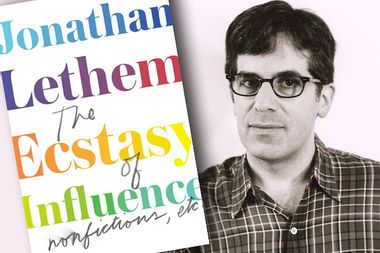
In essay collections like “The Disappointment Artist” and last year’s acclaimed “The Ecstasy of Influence,” best-selling novelist Jonathan Lethem brought his sharp critical lens and personal passion to bear on Marvel Comics, Roberto Bolaño, Bob Dylan and the John Carpenter movie “They Live.” Add to that diverse list of cultural artifacts the Talking Heads album “Fear of Music,” the subject of Lethem’s latest book, and published as part of Continuum’s 33 1/3 series of music writing.

The collision of Lethem and Talking Heads makes perfect sense. Both can’t escape being identified with New York – or, in Lethem’s case, Brooklyn – and despite working in disparate modes, each brings the formalism and precision of the high arts to popular forms. Lethem fans already know of his love of the band – composed of David Byrne (vocals and guitar), Tina Weymouth (bass), Chris Frantz (drums) and Jerry Harrison (keyboards, guitar) –  from his essay “The Beards.” There, he connected his love of  “Fear of Music” to the aftermath of his mother’s death from a brain tumor. “I have an obvious predisposition to handling the material of 1978 and ’79 with an exaggerated, personal intensity,” he told me. We spoke via Skype, Lethem from his office at Pomona College where he is the Roy E. Disney Professor in Creative Writing.

What drew you to Talking Heads’ music as a youth?

In 1978 I launched myself out of a very difficult Brooklyn public school and got into the High School of Music and Art, in Manhattan. It was like crossing the threshold. Suddenly I was hanging out in Harlem, trying to figure out who the cool kids were and how I could become one of them, or whether I somehow already qualified. Everyone had their band; it was pretty much like a menu: You could be into the Ramones or Cheap Trick or the Dictators. U.K. punk was this attractive signal coming in, but we had a special affinity for the New York bands. I had a friend that semester who was into Television — he was a little hipper than I was.

I was just at the right conjugation of nerdy, alienated and hyper-alert that I identified instantly with Talking Heads. They sang songs about books! I got it immediately.

In the book you call “Fear of Music” a paranoid album, and other works of art you’ve written about – some Stanley Kubrick films, and Philip K. Dick’s novels, for instance – have this bent as well. Are you a paranoid person?

Paranoia is closely related to a subject that’s right at the heart of the album: fear. Paranoia is an intellectual shading on a somatic experience, a physical reality that is fear. I experienced a lot of fear — not only my mother’s death, but I lived through a rather desperate chapter of New York’s urban history  —and it shaped me. Paranoia is a kind of utilization of fear, like “Let’s pick this fear up and shine it around like a flashlight and see what I can see with it.” As it invests itself in certain kinds of artworks, like in Philip K. Dick’s novels, paranoia tends to be a mode of inquiry and exploration — a philosophical mode, really. In that sense, it was attractive to me, because it was a lot less passive than just lying there and trembling.

But I try to disentwine my inclination for conspiracy and paranoia in artwork from its general lack of not only usefulness but interest in everyday life, where it’s actually a way of shutting possibilities down.

Do you have a favorite song on “Fear of Music”? From your description of “Heaven” – “If heaven’s impossible to know, ‘Heaven’s’ hard to recollect” – that seems to be your least favorite.

I received, in a very specific way, skepticism about “Heaven.” I have a friend, John Hilgart, who was a sounding board while I worked on this book. Hilgart said, quite passingly, “I always felt on Side 2, after ‘Air,’ there’s a three-song lull. I like ‘Heaven’ in principle, but to listen to it is kind of boring.” And then he felt, and I think this would be a much more common remark, that “Animals” and “Electric Guitar” are buried on Side 2 because they’re less inspired melodically or fully realized, and bear less relistening.

I had always held the whole album on this pedestal, where, in a way, it was all exactly as good as itself. I saw it as fractal, “This album is perfect, therefore everything on it is perfect.” Besides, I had always taken “Heaven” as a sacred object — everyone knows this is one of the masterpiece songs. But when Hilgart said that it was like – click! – “Heaven” is one of those things that I listen to and tell myself I’m loving it, but it’s actually boring. I started focusing on the idea of tedium, because the song’s self-referential; it wants to be boring.

In fact, I like “Heaven” a lot. The only song I’m uncomfortable with is “Electric Guitar.” The song is crippled by its disorganized quality, and it doesn’t seem as pure conceptually, because how do you put an electric guitar up there with air, heaven, animals, mind? It doesn’t belong on that stage. Also, it’s been played live barely ever. It’s a sitting duck if you need there to be a worst song on the album, though, really, I don’t know if “Fear of Music” needs to have one.

I do know that my favorites are the two side closers. I wouldn’t want to have to choose between “Drugs” and “Memories Can’t Wait.” Those became the most rewarding songs to write about; they just got richer and richer for me. I actually made myself like them even more, which I didn’t think was possible. Of course, “Life During Wartime”  is pretty good too. [laughs]

Did you find yourself liking the album more in general as a result of writing about it?

It was like having any subject before you when you’re writing a book — your own characters, your childhood, some stupid idea you made up about Tourette’s syndrome, whatever it might be that you’ve committed years of your life to — you love it and hate it a lot along the way. There were days when I felt utterly under its hobnailed boot, and there were days when I did not want to listen to “Fear of Music” again. I wrote through those feelings, of course, as you do with your contempt for all the different assignments life has given you, and I was enraptured by the end.

What’s weird is that I put it on for pleasure now. Your iTunes counts listenings, and my entire top 25 most-listened-to tracks on iTunes is all “Fear of Music” and different live versions of the songs. It was ceaseless, to the point where my wife would force me to switch to the headphones.

How did you start?

I rarely delay — and certainly proportionate to how many pages the piece was, I don’t think I’ve ever delayed starting a project as long. There are novels that I had in mind for three or four years, or even more than that before I began writing them, but those were very long novels. I took three years circling around this.

I kick-started myself in a really specific way. I accepted an invitation to the Experience Music Project Conference to be on a panel about urbanism. I said I would talk about Talking Heads’ relationship to urbanism and the evolution of their vanity as urban dwellers, starting with the “More Songs About Buildings and Food” song “Big Country,” which goes “I wouldn’t live there if you paid me,” to “Fear of Music’s” “Cities,” “I’m finding a city I’m going to check out,” and ending with “True Stories’” “People Like Us,” where they’re pretending to be hicks from Texas. I saw this as a topic I could make an interesting presentation on, but of course I was thinking, I’ll start writing about “Cities” and then I’ll have myself on the page about “Fear of Music.”

There are small traces of that presentation in the chapter on “Cities” in the book. A lot of it had to get thrown out, but at least it got me thinking about how to make something actually occur. I knew that I would write about each song directly and that I wanted to intersperse those chapters with provocative side questions about the album as a whole — I had that structure sitting there. I wrote about the commercial, the radio spot advertising “Fear of Music,” and then I wrote about the album jacket, and then I started writing about “I Zimbra.” Except that I had this weird chunk of thinking about “Cities,” which I incorporated, I wrote the book straight through as it reads.

Were there critical works or other texts that influenced your approach?

I was very conscious of the 33 1/3 books. I’ve been an eager customer, so I was thinking of some of the ones I loved best, like Franklin Bruno’s “Armed Forces,” Douglas Wolk’s James Brown book, “Live at the Apollo,” and Carl Wilson’s book on Celine Dion, “Let’s Talk About Love.” Not that I was going to ape their approaches, which are quite divergent anyway, but I write to enter into a conversation that books on shelves are having. I wanted to be a really exciting member of the 33 1/3 team, I wanted to come in with something that only I could do, but that also was recognizably a contribution to this recent but very interesting tradition.

In terms of critical writing, I followed less a specific example and more the general idea of close reading. I had written a book on the John Carpenter movie “They Live,” where I had just stared at the movie and free-associated. I wanted to do that but more so. “They Live” had a relatively high number of outside comparative texts brought in — other films, artworks and some theoretical things. With “Fear of Music” I thought, let me bring in fewer, and let me sometimes bring in none at all, let me just be with the sound of the songs and say what I’m hearing.

You write that it’s never unimportant asking what was going on in the artist’s life at the moment of creation. Let me turn that on you. Why write this book now?

How can I reconstruct or account for such a sprawling intention? I began fantasizing that I might do a 33 1/3 book before I had even agreed to do one, and “Fear of Music” was always the record that I knew I would write about. Then three years elapsed between agreeing to do it and actually starting.

I have been amazed to find myself doing so much critical and cultural writing, a lot of it being a weird mix of criticism and memoir, or covert memoir pieces pretending to be critical pieces. There’s a long evolution for me, thinking I would write fiction that was all going to be invented, and that I like to read criticism but I would never want to write it, then having it invest in the fiction itself. “Fortress of Solitude” is where that really starts, but “Chronic City” extends it. I incorporated a lot of critical impulses, cultural commentary — even things like liner notes crept into the voice of the book.

Having come into this hyper-developed critical voice without ever meaning to, I wanted to both do it service and quarantine it by writing this book. Like, you go over here and write a whole book about “Fear of Music,” then shut up. This and the “They Live” book would be both a summit and a farewell, which has to do with an intention for what I want to have happen in my fiction next, which is that I want to stop incorporating the critical voice into it in the same way.

Simultaneously, I think I’m also done with the tokens of my 14- or 15-year-old self. I can’t really imagine anything after this climax of “Fear of Music.” It’s like I finally came out of hiding, like once you show yourself you can slam the door, because the internal paparazzi are satisfied, they got their shot.

In the liner notes of “Sand in the Vaseline,” Jerry Harrison said, “There is a shared sensibility [with Talking Heads fans] that would make friendships immediate.” What’s that sensibility?

They’re pretty bookish. One of the things I thought interesting was how underwritten the songs are. They’re not wordy, really, but the sensibility is so fundamentally literary. Usually people think about Leonard Cohen or Bob Dylan or somebody recent like Craig Finn, who have these cascades of descriptions and evocations. Byrne never did that and it doesn’t seem like there was ever a phase in his songwriting career where he was even thinking to do it. But in another way I think Talking Heads are a very literary band in their fundamental stance, their ambivalence and sense of inquiry. I think even when he’s switched to nonsense lyrics there’s a spirit of inquiry that pervades all of Byrne’s best work, and “Fear of Music” is dominated by it.

Brian Gresko has contributed to The Huffington Post, The Atlantic, The Daily Beast, The Paris Review Daily and The Millions. He lives in Brooklyn.

Jonathan Lethem: The literary world is like high school

In a Salon exclusive, the "major author" reveals the downside of getting into the cool kids club

Jonathan Lethem(Credit: Mara Faye Lethem)

The novelist Jonathan Lethem began trying his hand at nonfiction back in the 1990s, for this very publication. He’s since proven himself a modern master of the form, having just published his second collection of criticism, essays and autobiography, “The Ecstasy of Influence.” The new book includes the now-famous title essay — a defense of collage and appropriation that’s revealed at the end to be patched together from rewritten snippets of other writers’ work — originally published in Harper’s magazine. It also features a new and currently much-discussed response to a mixed review of Lethem’s novel “The Fortress of Solitude,” written by James Wood for the New Yorker.

“The Ecstasy of Influence” is in part an attempt to discuss the things artists and writers rarely talk about — how much of their work is borrowed from other artists and how much they care about their critical reputations, among other things. So I called Lethem (who is, full disclosure, a friend), to find out what on earth he was thinking.

For someone who once vowed never to write nonfiction, you’ve developed something distinctive: a very memoiristic, even confessional approach to criticism.

My fourth novel, “Girl in Landscape,” was catalyzed by my ferocious interest in this film “The Searchers,” and yet the book itself couldn’t say that. So in the aftermath, I started writing an essay that was a very personal, tormented, structurally crazy piece. It was the first place I confessed how much not going to college affected me, how powerfully quitting an institution affected my life’s course. Then I was asked by Glenn Kenny to contribute to his undersung, marvelous anthology of writers on “Star Wars,” which contains the most outrageously brilliant piece by Lydia Millet on Darth Vader.

Yes! That essay is tremendous.

An incredible piece of writing. I realized that I had a method and I wanted to write a series of essays to complete the sequence. That ended up becoming the collection “The Disappointment Artist,” which was about the problem of cultural obsessions, how if you tried to make the artwork explain you to yourself, you were destined to feel betrayed by it. “The Fortress of Solitude,” too, was about exploring the strengths and weakness of making yourself through readings of culture: the culture of street life, your parents’ bohemianism, the beginnings of hip-hop culture, arcana like experimental film.

Which leads to the question of influence and this new book. There’s an consistent argument here that the pristine and heroic originality that many people expect from artists is an illusion.

Yes. Of course, the flip side is that the book is also about the permanent power of my fannish reverence for things. I don’t want to be cast in some debunker role, where I’m saying all art, even if you sit alone in a room to do it, is accidentally crowd-sourced or that every heroic image of creativity is a pathetic windsock.

No, no, but that’s not the same thing as refusing to make a fetish of perfect originality.

Which is a great fetish except when it causes us to feel unnecessarily betrayed if we see the little man behind the curtain. It’s a mistake to ask our cultural creations to be immaculate, perfect and greater than our human selves because actually they’re made by our human selves, which are wonderful without being immaculate, and without a Promethean independence from anything else. People are social animals and our artworks are social animals, too. In a conversation. That’s actually what gives them their life.

Another running theme in this book is how novelists — especially novelists who have had some success, as you have — are expected to behave in public. What bothers you about that role?

This goes back to when I was in art school. I watched prep school boys get there, and within months of arriving, they’d switched from being cheeky, Lacoste-wearing guys who liked to drink beer to being mumbling, dungaree-and-scuffed-workboot guys who liked to drink beer. I realized that there really is a set of scripts around being a painter or sculptor. I’d already seen it in the grown-ups around my father, who is a painter. Watching an 18-year-old invent this self made me see how constructed the personas of the painters and sculptors mumbling around the scene had been.

There was a way to be an artist, and it was kind of comical to me. It meant you had to be inarticulate in a specific way. You were supposed to say, “I don’t know, I just made the thing,” in this Cro-Magnon style. That meant you were a real artist.

What is the novelist’s script?

There are variations. I had the strange benefit of moving through the first decade of my writing life in a chameleon way — I was alternately a Bay Area writer, a New York writer, a science-fiction writer and a crime writer — so I got to see those different scripts.

It wasn’t until I published “The Fortress of Solitude” that suddenly it became possible that I was “major.” That’s a very specific script, although one we like to pretend doesn’t exist. Our major novelists are simply our major novelists, right? They’re free! They can do whatever they like.

Well, actually, I saw all kinds of weird constraints attached to this. There were enormous privileges, and I always want to rush to say that. What an incredible journey for me, especially for someone who came to writing in an eccentric way and still wanted to do eccentric things. Sometimes someone would name the five or six “promising young men,” and I’d be one of them. Cool, great! I should say that I’m really honored that people think I could be important in the way they want me to be important. It affects me and changes me to be in that position. This book acknowledges that it’s a two-way street.

But I could also see certain structural injunctions. Those fascinated me.

What were some of those constraints?

One of the most obvious was not to do minor or silly books. That’s a really strange injunction if you look at literary history because most every novelist we accord major prestige did all sorts of things. The only way for me to obey, “OK, now you’re major: Stay major!” was to only write books as long, sorrowful and widescreen as “The Fortress of Solitude.”

It was a really meaningless injunction for me, but it was certainly there. I guess I frivolously — and some would say hopelessly — tried to negotiate with that by doing other kinds of books.

Someone like Jonathan Franzen would be the embodiment of that idea of a major novelist; he publishes big, serious books, infrequently. What are the other things a major novelist is supposed to do?

Ignore critics is obviously one of them. I came to see it as a strange, very Kabuki kind of thing, very performative. Your job is to have a lot to say up to a point. We want our novelists to be voluble and strong-minded and have opinions and impress us with their command of cultural matters. Then they publish a novel and are supposed to fall silent and become a bulletin board upon which things are tacked.

Perhaps people want to believe that serious novelists only engage in a higher discourse. To talk about critics or discuss how other people see your work is stooping.

I’m sure that’s right, but my confession is that I’m already stooped. I’m a fan, I’m a reader, I’m in the culture.

Talking about the the script is also something that you’re not supposed to do, because it’s talking about success and failure and the limitations of the things that people fantasize about happening to them. Norman Mailer talked about his career as if it were a work, a project, and people felt angry and betrayed by that. It’s crossing a line to raise these issues at all.

I like the idea of the arts as Lewis Hyde describes them, a gift economy in which there’s a transference of value outside the commercial realm. I believe in that deeply, but I don’t believe that the power of it rests on not saying what’s happening around us. It’s part of the world, and part of my world. I do think that I have a job, and that is honesty. People do ask me about this stuff. Sometimes I just want to answer them.

The novelist is supposed to be visible, but also to be above any desire to be visible.

I’m crappy at being above things. I keep wanting to deflate the platform underneath me and point out that it’s only an air mattress.

Many readers also come to literature with a longing to get beyond the pettiness of the world. There’s a dream that you can finally escape small-p politics, competition, envy — all the things that are evoked by the label “high school.”

You would think that the more I rose into this status called “major,” the more privileges I appeared to enjoy, the more free I would feel, the more I would have left “high school” behind. I would have graduated. In fact, in many ways it was the opposite.

When I was a marginal, dark horse operator, I felt very out of “high school.” I could talk about all the different things I was excited about, talk about out-of-print writers and my love of vernacular cultural things — pop music, science fiction, Hollywood film. I could do high/low at once and no one was patrolling that. That, to me, felt like graduation.

But after taking on more importance in my publisher’s view and some critical frameworks, I felt handed a script that was a lot more like “high school.” There were things it wasn’t cool to say. There were people you weren’t supposed to mention anymore. When I got to be one of the cool kids, all I was supposed to do was answer questions about the cool kids and act like there were no other kids around.

When it came to influences, I was never to be asked about any other writer than Jonathan Franzen, Jeffrey Eugenides, Rick Moody, David Foster Wallace or Michael Chabon. And I guess they were asking those guys about me. I kept trying to break out of this weird little cage, saying, “Those guys are fine, they’re nice guys and I like reading them, but for me the energy happens to be coming from all these other places.” So if you want to ask me about this book, stop asking if I wrote it as my version of “The Corrections.” I started writing it three years before I even knew of the existence of “The Corrections.” I couldn’t break out of that conversation.

It was so silly, but it spoke to the desire for there to be a literary [Mount] Rushmore, to replace Updike, Roth and Mailer — or whoever it might have been in their mind’s eye, the great writers who are always battling each other in Valhalla. “We need a young group to be doing that!” So I couldn’t enjoy any of the polymorphous freedom that I’d had before. I was basically being asked over and over, “Well, are you afraid your backup quarterback is going to take your job?” It was totally high school!

Probably the biggest transgression you make in this book, though, is the essay about James Wood’s review of “The Fortress of Solitude” in the New Yorker. What response have you gotten? Has anyone said, “You shouldn’t have done that.”

Yes, of course. Concerned friends have heard about it and got anxious that I was in some kind of distress.

You mean, they thought that you were so upset that you couldn’t restrain yourself?

Yes. I can’t fix that impression because it’s so basic, so large a part of the script. I have no interest in treating this as a crisis because that wasn’t how I experienced it. It matters enormously that I wrote that piece so many years after the review ran.

If not pique, then what inspired it?

My piece is a memoir. It’s a reflective piece on a strange aspect of my experience as a working novelist, one that tends to go unnamed. It’s really about my own surprise at being disappointable by James Wood. While thinking that he and I probably disagree about a lot of things, and therefore thinking that he might not like my work, I discovered that I’d still been thinking that he conveyed a tremendous power of insight and it would be very striking to me how much he would see, even if he disliked my work. This was a piece of innocence I was carrying around with me, not knowing that it was innocence.

To be clear, it’s not so much that you were expecting a more positive review as that you’d expected the review, positive or negative, to address the book for what it was.

Actually, what I really wanted to talk about was something that was still very interesting to me years later: How much I’d wanted to experience even a negative review from James Wood and how much that desire had gone off the rails for me and what that suggested.

What I hadn’t anticipated was that I could be disappointed in a stranger way by his efforts because with that review they became evident as cursory in a way that I don’t want the leading literary critic of the moment to be cursory. It disappointed my sense of the quality of the conversation that we all hoped we were in. I wanted to feel that the kind of critic he was, writing at that kind of length would account for the book itself. It could be rejected, but first I wanted it to be accounted for.

Yet reviews are not really written for the author.

If you think of a review as a kind of Consumer Reports, offering a thumbs up or down, then, fair enough: Who cares what the author thinks? But, implicitly, when someone weighs in in a certain measure, with a certain tone, and when they publish books called “How Fiction Works,” there’s a proposition they’re entering into that they’re doing more than that. They’re becoming part of the development of the art in a public space. So by implication, they should be wanting the authors to meditate seriously on what they said.

Is there a particular critical ethos you favor?

Too many different kinds to pick just one. Updike had a good list of things to do when reviewing. There’s a great essay by Randall Jarrell, “Poets, Critics and Readers,” where he says that we demand Keatsian negative capability — the willingness to step out of your self — in our artists, so why don’t we ask the same of our critics? It’s not that there are very few ways for art to be done right, but that there are so many ways.

And it’s important to note that you can ignore me completely. I don’t have the power to change the nature of things, only to remark on them. I’m not in charge of James Wood. It’s also important to say that most people don’t care about novels in the least, and in the larger scheme of human affairs, James Wood and I are not only deep allies, but practically the same person. He and I are passionately devoted to 99.9 percent of the same things

Have you had reviews that you felt did account for the book, even if they were also partly negative?

Sure. I’ve been mixed up, exalted, exasperated and fascinated by some long, committed pieces that weren’t just raves. The John Leonard piece [in the New York Review of Books], for sure. He said some things I’d dreamed of hearing anyone — let alone John Leonard, who I revered — saying about me. And in the same breath he said things that seem willfully obtuse and hostile and then things that I puzzled over and that changed me and my writing because they seemed to really look into it.

So that would not be a disappointing review?

Well, it was not easy to undergo, but it left my sense of excitement at being in that kind of conversation undisappointed.

Continue Reading Close
Laura Miller

Laura Miller is a senior writer for Salon. She is the author of "The Magician's Book: A Skeptic's Adventures in Narnia" and has a Web site, magiciansbook.com.

How a podiatrist sign became a literary icon

Happy Foot/Sad Foot has captured the imagination of David Foster Wallace, Jonathan Lethem and others

F. Scott Fitzgerald’s generation had its green light at the end of the dock in “The Great Gatsby,” that symbol of unattainable dreams, and today’s young literati have — a podiatrist’s sign?

The sign for the Sunset Foot Clinic on West Sunset Boulevard in Los Angeles is known to some locals as a kind of fortuneteller. On one side is depicted a foot with a woeful face, a bandaged big toe and crutches, while the other side shows an ecstatic foot in gloves and sneakers giving the thumbs-up sign. (Yes, these feet have both arms and legs.) When the sign is working, it rotates, and several residents of the nearby Silver Lake and Echo Park neighborhoods believe that whichever side they see first indicates what sort of day awaits them. Others use the sign as a guide: If they see the Happy Foot, they get to do something fun, while the Sad Foot condemns them to an afternoon of chores.

The Happy Foot/Sad Foot sign became better known to readers outside the Los Angeles area when it appeared in Jonathan Lethem’s 2007 novel, “You Don’t Love Me Yet.” In that book, the main character, a musician named Lucinda, can see the sign from the window of her apartment: “The two images presented not so much a one-or-the-other choice as an eternal marriage of opposites, the emblem of some ancient foot-based philosophical system. This was Lucinda’s oracle: one glance to pick out the sad or happy foot, and a coin was flipped, to legislate any decision she’d delegated to the foot god.”

The sign also appears to have inspired a passage in “The Pale King,” the final, unfinished novel by the late David Foster Wallace, published last month. Wallace relocates the sign to Chicago and changes its appearance somewhat, so that one side depicts the name and telephone number of the podiatry clinic while the other features “a huge colored outline of a human foot.” As in “You Don’t Love Me Yet,” aimless young people — in this case, college students who can see the sign from their dorm room — use the rotation as a “wheel-of-fortune” to determine the evening ahead, depending on which side is facing them when the sign is turned off at the end of the day. “If it stopped with the foot facing our windows,” the narrator explains, “we would take it as a ‘sign’ (with the incredibly obvious double-entendre) and immediately blow off any homework or supposed responsibility we had.”

In an eerie coincidence, Lethem, formerly of Brooklyn, N.Y, is now the Roy E. Disney Professor of Creative Writing and Professor of English at Pomona College in Claremont, Calif. — the same position Wallace held when he died in 2008. He doubts that Wallace ever read “You Don’t Love Me Yet,” given the major depression his predecessor was wrestling with when it was published. Instead, he believes that they were both inspired by local legend.

“When I was researching my novel,” he said, “I visited L.A., and at one point I was driving down Sunset Boulevard with someone who’d agreed to be a source on the area. I laid eyes on the sign, and asked about it, and that’s when the Happy Foot/Sad Foot lore was unfolded for me. I was aware when I used it that I was keying into a Silver Lake meme — a non-Internet meme, that is. Later, a friend met a guy who had a Happy Foot tattoo, and got a photo of that for me.”

The sign has also been immortalized in a song by the Eels, “Sad Foot Sign” (bemoaning one of the increasingly frequent occasions when the sign is broken and therefore no longer rotating), and in a short animated video, “Happy Foot vs. Sad Foot.” The musician Beck is also rumored to believe in its divinatory powers, and locals have been known to dress up in foot costumes for Halloween.

The sign’s literary legacy would appear to be rather more exalted, however, and — who knows? — it could even achieve the cult, in-joke status of the “Wilhelm scream,” a sound effect that has been inserted into hundreds of movies by puckish sound editors since it was first recorded in 1951. Of course, it’s a lot easier to slip a brief yell into a cacophonous soundtrack without calling undue attention to the thing; casually introducing a rotating podiatry sign into any novel set in L.A. is a taller order. Lethem, when asked if he would like to see other Angeleno writers rise to the challenge and find a way to work the bipolar anthropomorphized feet into their fiction, said, “It would be nice to see it become universal.”

Further reading

An article about the Happy Foot/Sad Foot sign in Boing Boing

“Happy Foot vs. Sad Foot” animated video

“Sad Foot Sign” by the Eels

A (highly recommended) transcript and audio recording of a segment on the Wilhelm scream from the radio program “On the Media”

Continue Reading Close
Laura Miller

Laura Miller is a senior writer for Salon. She is the author of "The Magician's Book: A Skeptic's Adventures in Narnia" and has a Web site, magiciansbook.com.

“Chronic” overachiever: Interview with Jonathan Lethem

The writer talks about his new novel's ambivalent take on New York, and how cultural obsession can lead to madness

Jonathan Lethem

As Jonathan Lethem grew into what critics like to call one of our most important novelists, he became increasingly difficult to pigeonhole; fluid across genres, Lethem’s biggest books (“Motherless Brooklyn,” “Fortress of Solitude”) can feel like sparkling new works from a new author rather than someone you’ve enjoyed before. His latest, “Chronic City,” with its flashes of pot-fueled magic realism and ripped-from-the-tabloid-headline riffs again reads as something completely different from Lethem, but no less enthralling.

“Chronic City” features one hapless Chase Insteadman, a former child actor adrift in New York as his fiancée, an astronaut, hovers above, prevented from returning to Earth by an orbital minefield. He soon falls under the mad spell of Perkus Tooth, a writer and inveterate cultural critic-obsessive, who becomes friend and Svengali, sharing with him his love of all things Brando and an increasing paranoia.

Lethem stopped by the Salon New York office to discuss his new novel, his Brooklynite  critique of Manhattan, his MacArthur “genius” grant and the dark side of cultural obsession.

Most anyone with a deep love of film, books, movies has had a Perkus Tooth in their lives at some point, sort of tutoring them on the good stuff. I read that Paul Nelson was an inspiration.

Sure, Paul Nelson was part of that image for me. I mean, Paul Nelson was not frantic, actually. And he wasn’t a dandy, and he wasn’t a pot smoker, so there’s a lot of ways in which if you knew Paul Nelson you’d never associate the two. But something about Chase’s innocence meeting Perkus’ cultural worldliness comes from the fact that as a 20-something — 21, 22 — I kind of fell into Paul’s sphere for a little while and he gave me this instant education in his version of American vernacular culture. Ross Macdonald, Orson Welles, Howard Hawks, Chet Baker. And it was this flood of references for me to sort out and absorb and he became very important. A lot of the things that Paul taught me to value are still really the center of my sensibility.

But there was also something poignant about the amount that Paul depended on the power of his cultural searches and what they unearthed for his sustenance. It was like they were his oxygen, and I adored it and I think I identified with it at the same time as it can’t help but serve as a kind of warning … just so many people I know who have at some point become voracious about cultural collecting, cultural searching — their identification tips over. I’ve done it. And it’s, to me, so human and so poignant and so compelling and also terrifying to go into that place. And you know, at the same time it’s just finally a metaphor for what anyone does, which is search for meaning, constantly trying to ask yourself if you can find in the environment somewhere, the natural world, your family tree, some version of politics or culture or in this case pop culture, a description that makes you understand why you’re here. So in that sense it’s not culturally specific at all.

What do you mean by a “warning”?

Well, just as critical theory, critique, tips into paranoia — finding patterns that don’t exist — collecting can cross that line from being the quest for value into being the quest for the subterranean, impossible artifact that will somehow validate all of your existence … You know, I used to know, I still do know, a lot of [Bob] Dylan collectors, and he’s begun demystifying a lot of the secrets by issuing them himself, but these things used to circulate as talismanic objects. And there was always the myth of the song that was even better, the musician who’d come out of some session and say, “Well, yeah sure, you heard ‘Blind Willie McTell’ because you’ve got a tape of it, but there was another song that he debuted in the studio that day that was never written down and we all begged him to play it again and he never did.” And it’s sort of like, “Well, if that song’s even better than ‘Blind Willie McTell,’ then what about the song that Dylan wrote but didn’t play that day, or what about the song that Dylan never even wrote! That might be the best one!” It’s a path of madness, and certainly I wanted to portray that terrifying descent to some extent.

What’s fascinating about a character like Perkus is there’s no echo chamber, it’s all in his head. He’s coming up with his own fictions, really, without any enablers.

In that way it relates really strongly to a book like “The Fortress of Solitude,” which is overtly nostalgic. I mean, Perkus is his own fortress of solitude. He’s trying to keep a diorama of the version of New York City that means the most to him alive. And for him the Tompkins Square riots are still fresh news and Tom Verlaine breaking up Television is like a fresh tragedy. It’s all at the edge of his nerves, the world that means the most to him, and he’s trying to bring other people into that system of values.

Chase Insteadman is such an unformed thinker about culture, the world. Do you think you were like that at 21?

I probably wasn’t very like Chase Insteadman when I was 20 — I might be more like him now in a funny way. Or let’s say that the ways in which I identify with Chase as a character have to do with the peculiar fate of being slightly known, and an author is by definition not a famous person. In our culture, where fame is a currency and we see it awarded on television in all sorts of strange ways, authors never register, they’re not even a blip. But in a tiny kind of weird, subjective version of my own experience, the world I wander through, in a bookstore or just now going into the offices of the New York Times Book Review, people are like [looking over his shoulder in surprise ] — and I’m about to be on tour and play this part inevitably. Ian McEwan has a great line where he says, “Book touring is like being an employee of your former self.” But it’s an acting role, you have to authenticate — yes, I’m the writer who wrote that book — nightly for people, and it’s kind of silly and I’m not an actor, I’m no good in any sense except that I have backed into by necessity the ability to play myself. And the moment you do that, you develop this very obscure, uncomfortable double sense of self and that can be very haunting. And that’s what I wanted to capture when I wrote about Chase’s sort of mediocre celebrity. The way he’s still remembered for something he himself can barely remember doing is something I feel a strange degree of identification with.

You feel like you’re acting?

There are times when someone wants to talk to me about Tourette’s syndrome — well, “Motherless Brooklyn” was published 10 years ago. It means I wrote it 12, 13 years ago, I conceived it longer ago. The person who got excited about that isn’t very close to the surface for me anymore. So I have to do this strange, polite kind of acting bit where I reinhabit the role of the author of “Motherless Brooklyn.”

You’ve said “Chronic City” came from your distinctly Brooklyn point of view. What kind of critique, do you think, is it of Manhattan?

Of course I shudder if I think I made a deliberate social critique, because it’s not mostly a great path for a storyteller to take. But rather than a social critique or especially one of any particular present moment, I felt what I was doing was exploring some of the ambivalent power of Manhattan. And I think it’s always resided there, as long as I’ve been alive and lived next door to Manhattan — it is a kind of virtual reality. There’s something unreal about Manhattan, it’s a creation of will and aspiration and money. And unlike most places on earth it’s not rooted in its past, it’s rooted in its possibilities and its future, and it’s always being remade and revamped.

Now, having said that, what makes Manhattan, what makes NYC, what makes the world more complicated than any description, than the one I’ve just offered, is that it’s also real — people go on living their lives in buildings, eating food, wearing clothes, trying to pay the rent. And I wanted to find a way to put this doubleness into the book. This fact that a place can be a virtual reality and still be so stuck in our world, our real world, that’s what I really cared to say about Manhattan.

When I first moved to Manhattan “Motherless Brooklyn” had just come out. In that book, Brooklyn is grounded in this kind of firmament, whereas Manhattan is much more sketchy, changing, fast-paced …

The compression you’ve made, I’ve offered a similar description a few times, and I always look from the Brooklyn point of view that what I find so nourishing of Brooklyn is that it wants to be the big city, but it falls short — it’s always half-renovated, and half-gentrified. So you see these lumps of the future lying alongside the past, the recalcitrant chunks of the past that won’t go. And they’re just side by side and everyone has to just live with this kind of awkwardness. And whereas Manhattan often tries to remake itself and succeeds, startlingly this crazy new building will come up or crazy new neighborhood will exist and everyone seems to believe in it and move in right away, and it’s like, OK, now TriBeCa is a good place to go for food. What? Yes? Really? OK.

Back to Perkus, I kept thinking that, especially in the current climate, what a dying breed that sort of cultural critic is.

You’re right, it’s always a dying breed. One of the things I’m very devoted to in Perkus is the joke, seems like just a running joke, “I am not a rock critic.” In the end he kind of makes this tormented confession: “I am a rock critic!” I feel like there’s something very moving to me about the pioneer generation — [Robert] Christgau, Lester Bangs, Greil Marcus, Paul Nelson, Greg Shaw — who by force of will said, “We’re going to write seriously about this thing that everyone thinks is a joke.” It was like founding a school of criticism on bubblegum wrappers. The culture did not believe that rock ‘n’ roll could sustain analysis. The records were supposed to blow away and disappear after they fell off the charts, no one was even supposed to care who made them after awhile. They were just pop. And they located the connection between this material and American culture at large, between this material and art. And by doing so they created a language for themselves — that was an act of bravery. I really think it was as bold a gesture as a lot of art making itself. They made something that now of course can be quite complacent and automatic.

We all feel almost that there’s a wearisome familiarity with the inside language of music criticism, at least when it’s used in a received way. But that didn’t exist, so I think of Perkus as — of course the dates are off, he couldn’t have been one of the founders — but he conveys some of that spirit of trying to say something that no one thinks you’re even allowed to try to say. This book is partly about the emotion that accompanies trying to name unnamable things that you see in sets around you. Whether it’s conspiracies or facts about the city that somehow are inexpressible facts. It’s tormenting not to have the language to put it across and Perkus is tormented by that. But he’s also very dedicated. To look at him very generously he’s very dedicated to the idea of secret knowledge, to the mastery of secret knowledge. And the Internet and the reissue age is one that is very humbling to masters of secret knowledge — everyone’s a master of secret knowledge now.

You know, when I met Paul Nelson, this can be very hard I think for someone younger than me to understand anymore — if you get curious about Howard Hawks, if you hear someone saying “Oh, god, you don’t know what you’re missing,” you can go and see “Red River” tomorrow. You can see 30 Howard Hawks movies tomorrow. When Paul Nelson said to me, “You need to know about this,” what he then did was pull out of his apartment, which was an archive, these VHS tapes with his hand-lettered labels on them all recorded off PBS or “The Million Dollar Movie,” commercials intact, with him fixing the vertical hold in the middle of the big scene — all recorded for posterity — that was how this meaning was transmitted to me. It was something rarefied and almost impossible to explore. He wanted me to see obscure Orson Welles movies — “F for Fake” or “Mr. Arkadin.” There’s no Criterion Collection, there’s no way to get from here to there unless Paul Nelson was up that night recording it with his television. But that’s all gone. We’re drowning in archival culture.

Are we richer or poorer for that?

I think it’s OK. I’d rather have it around.

Have everything available rather than relying on these kind of guides …

Yeah, I guess in a way there is that sense in which Perkus Tooth is a commemorative character. I had to make these guys naive about the Internet — you know, the joke about them not even knowing how to bid on eBay, and still having a dial-up computer — because a lot of the meaning that is so precious and so fragile for them evaporates in the instantaneity of Internet communication.

So what was it like creating after you got the genius grant?

Well, the first thing to say is that I’ve been a very lucky writer, a very lucky artist, and the luck began before the MacArthur. The MacArthur didn’t arrive in the hands of someone sleeping on couches. I found my way mercifully to very, very — I have a very, very good editor at a very strong publishing house who supports me brilliantly and has now for more than a decade. So, that’s something — forget the MacArthur — that’s something any writer should dream of. I had a lot of opportunities that came with being capably published, brilliantly published. The MacArthur did free me, especially given that it came at a moment when I was — you know, I’m 45 now, I’m married now, I have a 2-year-old — I was starting to not want to live the scrappy, year-to-year, no health insurance kind of life. I needed to outfit myself with a few more middle-class amenities just to be able to look my wife in the eye. So it was kind of a perfect time.

But also I saw it as a kind of vote that I should do more of what I’d already been doing, but do it even better, do it more passionately, do it more deeply. I really do feel that this book is connected to the MacArthur in the sense that it’s an ambitious book and a big book, but it’s also, I’m not trying to please anyone but myself. It’s a very willful, very personal, I would agree if you said very eccentric book in a lot of ways. And that was what the MacArthur told me I should do. I believe I was right to take it as that kind of message.

The book dropped this week, reviews are coming up, the book tour’s going to start. Does the money free you from really having to worry about the stuff –

Let’s not exaggerate the good fortune. My MacArthur runs out in a year, and the really tragic thing about getting the MacArthur award is that the only person in the entire universe who will never get a MacArthur is someone who already got one. I’m on my own. It made the last few years so much easier, and it’s hard to know how I could have gotten this book done without it.

Continue Reading Close
Kerry Lauerman

Kerry Lauerman is Salon's Editor in Chief. Follow him on Twitter: @kerrylauerman.

Writing in the free world

Jonathan Lethem explains why copyright laws stifle creativity and why he's giving away the film option to his new novel.

Jonathan Lethem‘s seventh novel, “You Don’t Love Me Yet,” is a parable of sorts about the ways in which art is created and commodified by a process of borrowing, stealing and transformation. Set in Los Angeles, the novel concerns four indie rock musicians closer to their 30th birthdays than they are to success. The fetching bass player, Lucinda, strikes up a friendship with an anonymous caller to her day job, a complaint line funded by an art gallery. The man, appropriately dubbed the Complainer, happens to have a genius for words. Lucinda passes the Complainer’s musings on to Bedwin, the band’s lyricist, who transforms them into songs that finally get the band some attention. Things get tricky when the Complainer demands a different sort of compensation for his work: Rather than cash payment, he wants to join the band.

Last week, Lethem, author of the best-selling “Motherless Brooklyn” and “The Fortress of Solitude,” proposed an equally inventive, though much more generous, approach to releasing the film rights to his novel. On his Web site, he offered an option on the film rights free to the filmmaker who presents him with the best proposal by May 15. In return, the filmmaker will agree to pay Lethem 2 percent of the film’s budget when the film receives a distribution deal, and allow the rights to the novel to return to the public domain — for the free use of anyone, including other filmmakers — within five years of the film’s release.

Lethem also wrote an essay for the February issue of Harper’s called “The Ecstasy of Influence,” in which he argues for a new approach to copyright law, based on the recognition that “appropriation, mimicry, quotation, allusion and sublimated collaboration consist of a kind of sine qua non of the creative act.” It’s based on the recognition that all works of art are, in a sense, a collaboration between artists and the culture at large. I spoke to Lethem about the copyright theme in his new novel and essay at his home in Brooklyn, N.Y.

“You Don’t Love Me Yet” is about low-rent indie musicians with day jobs. Musicians like that often have little or no label support behind them and find themselves on a perpetual tour wagon, earning most of their cash through selling T-shirts — that is, selling the byproducts of their lovely songs. When I jump on my pro-copyright horse, I have to say these musicians may be wrecking their personal relationships by touring all the time, and then when they enter their elderly years, which for an indie band may be their 30s…

Yes, yes, they have no intellectual property to help them out in the old age home. The first thing I want to say is that it’s entirely a fiction of what I’ll call, for the sake of this argument, the opposition — corporate, copyright absolutists — that to question the present privatization craze in any way is to vote for some anarchic abolition of copyright.

I make my living by licensing my copyright. Everything I’ve tried to say, in the Harper’s essay and elsewhere, is that there is an enormous middle ground. It becomes one of those issues like, “If you don’t favor wiretapping in the U.S., you must be for the terrorists.” What I’m seeking to explore is that incredibly fertile middle ground where people control some rights and gain meaningful benefits from those controls, and yet contribute to a healthy public domain and systematically relinquish, or have relinquished for them, meaningless controls on culture that impoverish the public domain.

Having said that, there’s no simple description. There’s an enormously intricate series of judgments, given technological variations and the differences between different mediums. There’s no simple standard to apply. It’s a matter of understanding the needs of a healthy public domain and a healthy creative incentive in every field in deep and intricate specifics.

But I will say this: Problems of artists, musicians, writers, anyone getting paid for doing their most free and creative and independent kind of work, are not new ones. The present realm of corporate-instigated maximization of the intellectual property concept doesn’t seem to have kept indie bands from touring.

I’m a very lucky artist. I make my living from it. I didn’t know if I ever would. I’m very persuaded by the image that Lewis Hyde offers of an artist who is, by definition, in whatever medium, or whatever level of success or whatever culture, in the practice of culture-making; participating in culture by making stuff is inherently a gift transaction and a commodity transaction. And it always will be. The question is how do we affirm and clarify this relationship? Because it’s a very weird one — making commodities that are also gifts.

Presumably one is in a better position to make gifts of one’s work later in one’s career.

Ironically, yes! I’m in a better position than I was before. But the truth is, the agitation for it is mostly left to artists at the outset of their careers, or artists who have discovered the futility or frustration of hoping to make a living. It’s left to people who are mostly doing it as a kind of volunteer impulse from the margins.

We’ve seen in our recent lifetimes examples of people making some pretty commercially viable work who had the legs knocked out from under them, like Hank Shocklee of Public Enemy, almost the inventor of a new musical language, who saw it essentially outlawed — or made so impossible through the application of licensing laws that it might as well have become outlaw art. I feel that artists can’t stand by and watch that happen in good faith.

I do speak from a weirdly princely position. I don’t mean that in terms of my personal finances, which go up and down. I mean that in terms of a novelist being largely immune to these issues. I’ve expressed irritation when I’ve tried to quote a Brian Wilson lyric in a novel and it turned out that I couldn’t afford to do it. Or when some copy editor goes and systematically capitalizes the word “band-aid” in my pages, and it seems to me objectionable, because I’ve used it, and my characters have used it, as a noun. It just is. I’m sorry, but that word has become a noun.

But the truth is, I could write a whole book detailing the plot of a “Simpsons” episode, describing Homer’s yellow skin and protuberant eyes, and no one would ever be able to block my choice as an artist there, or make it too expensive for me to do it. But if a visual artist or a filmmaker or a digital montage maker tried to capture that image, which is just part of a visual language that is floating around, they don’t have my freedom.

What if you were to transcribe the script from the episode? Wouldn’t that be the equivalent of taking the language without alteration?

You’d probably reach an aesthetic point of diminishing returns before you’d get anyone excited about your copyright violation. But the point is: Are any of these things rivalrous with an episode of “The Simpsons” on television? Probably not. Why have we gotten so mystical about certain corporate holdings, which is what we are really talking about. Or certain business models? People speak of these rights as if they have this tangible moral power, comparable to the Ten Commandments. But they are very local and convenient corporate notions. All sorts of things can’t be moved from one location to another freely by people wanting to talk about them, or depict them, or make fun of them, or smash them together with other things.

This is high and low. Talk to scholars of James Joyce, who have seen themselves tied in horrific knots by excessively zealous literary executors who won’t let them quote from the works. There’s an epidemic of this kind of control. Everyone can get up in arms, saying Samuel Beckett shouldn’t have to see “Waiting for Godot” staged with Samurai costumes in his lifetime. It feels quite appropriate that he squashed things like that because he was such a severe and intense fellow. But for his heirs to make it seem as though there’s an eternal injunction against recontexualizing the things he offered into our culture, well, all we have to do is apply the same standard to Shakespeare to see how impoverishing that would be.

You received a $6,000 advance for three years of work on your first novel, which is, sadly, pretty typical. Clearly, if you were still making that kind of money, it would be pretty tough to continue making art at all, much less conduct this kind of social experiment.

Sure, but it wasn’t strengthening of copyright control that allowed me to make more money after that; it was because I found some readers. Even if my rights were Kryptonite and lasted 1,000 years, if no one read my books, they wouldn’t be worth a penny. The economy of human attention is a very precious one, much scarcer than any other. I’m lucky to be in the position of having anyone notice that I’ve given something away in the first place.

In your essay, you used the blues as a model of “open source” material. You mentioned Led Zeppelin copping from blues musicians. Or you could take Brian Eno and David Byrne, models of good behavior as they are, lifting from other musical cultures. Or Picasso lifting from “African primitives.” When you have a person or culture in power lifting from a person or culture with less power, especially when they make a crazy profit on the exchange, that’s when people get extremely uncomfortable.

I agree. That’s why I brought up those examples. I wanted to grant that there are an incredible array of relationships that artists can have to sources. Some of them make us uncomfortable; some of them even cross over into the deplorable and/or pathetic, like “Opal Mehta.” But I think there are innate standards that people are applying by instinct, whether they can articulate it or not.

One is the value-added question. David Byrne may have seemed like a bit of a tourist, but he applied a transformative genius to the works he glommed onto, as did Picasso. Carlos Mencia doesn’t seem to have added value to the jokes that other comics claim he has lifted from him. He just lifted them. So that’s one standard.

Another is deception. People don’t like to feel fooled. There’s some degree, if not of citation, then suggestion, that there are sources. The third is the Led Zeppelin issue: Oh wait, you just cashed in enormously on this. It was un-copyrighted blues and you just slapped a copyright on it? That’s the Disney/Led Zeppelin action. Those creators could both pass the value-added test quite nicely. But it still seems a little disproportionate, the amount of printing money that went on in relationship to sources that were relatively non-commodified before that time.

That’s what makes people afraid of making their material available without a copyright.

I think right now there’s a very lively culture of public shaming that would take care of those types. But sure, there are two sentiments that are not always completely in agreement. That’s one reason I didn’t call this an open-source project. Open-source projects require that any subsidiary use perpetuate the non-commodifiability. And I decided that was not a control that I wanted to impose. Part of what I wanted to celebrate was the non-controlled aspect of my gift transaction.

For example, I’ve put lyrics from my new novel on my Web site. And I’m not saying, “Don’t have a hit song and make money with these lyrics.” I don’t know if anyone could, but if someone did, I would just be happy for them. For me, just writing them and being engaged is more than enough. In that area, I’m not seeking reward and I’m not seeking to prohibit someone else from seeking reward. So that’s a little different from the open-source description.

That goes to the Samuel Beckett sentiment, or, perhaps better, the Margaret Mitchell estate [who sued for copyright infringement over "The Wind Done Gone"]. If you make stuff, it is not yours to command its destiny in the world. God help you, you should be grateful if it has one. It’s fantastic if anyone cares. Every artist should be constantly reminding themselves how lucky they are if people are even bothering in the first place. If people do something that is not as interesting as I’d hoped with my work, or if they go and make a lot of dough, that’s part of accepting that I’ve made a gesture whose conclusion is not mine to command.

But to be totally obvious, lyrics and even film projects are not novels. One thing I would always retain is the rights to my novels. With my new novel, I’m inviting some filmmaker to take a lover’s leap with me, saying that five years after the release of a film, we make it a stage play or a comic book or a musical or make a sequel. I wouldn’t probably choose to do that with every one of my novels. With some of them, some degree of control is still appealing to me. With this one I felt I would really enjoy giving that away. And it’s my choice. That’s the key. This proceeds from my choice. But I don’t think 50 or 100 years after my death, someone should still have say over what someone makes of this stuff. It certainly doesn’t follow. As Lawrence Lessig likes to point out, you can’t provide incentive to a dead creator to make more art by offering him a copyright.

I’m curious what happens when you reverse that value-added test. Let’s use the woman who claimed to have invented Muggles before J.K. Rowling, or the example you raised about the guy who wrote a bad version of “Lolita.” If making good art legitimizes borrowing, is the corollary true? If you make bad art, do you fail that value-added test and suddenly have your artistic failure become illegal too?

Bad art is never unethical. It’s desperately important to clarify that because every artist makes a lot of bad art before they make any good art, and often, at intervals, will make more bad art over the course of making good. It has to be as freely encouraged as the making of the good.

It seems very gutsy to invent a band in fiction.

Yeah, it often doesn’t work very well. I think I ducked the test in some ways by, first of all, inventing a half-assed band. They’re not meant to persuade you that they are going to take over the world. To make up a fictional artwork that seems that it will tip the world back on its heels always feels very fake.

If someone were to fictionalize the kinds of things that do succeed, they wouldn’t sound right either. Instead of doing that, I invented something like the avant-garde film in “Fortress of Solitude”; I made up art that no one cares about. That’s much easier to persuade people of, because there is so much of that.

The other thing I did that wasn’t a conscious strategy — though after I did it, I realized it was an unconscious strategy — is I didn’t actually commit to the full lyrics of the song. I always hate when there are fictional lyrics to the entirety of a song. It makes me cringe. I don’t think a lot of real lyrics are very persuasive on the page, even to songs you would like. So I always just gave a fragment or a line — even in the case of “Monster Eyes,” I just give a chorus. Even so, it still frees you to believe that the song is something you’d like if you heard the whole thing.

A lot of the Complainer’s lines could be ad slogans. It draws an interesting parallel between pop songs and advertising jingles.

It’s true. I was very interested in how so many great pop songs are made out of initially indifferent or seemingly ruined language. There are all these great soul songs that take popular advertising slogans of the day, or dumb witticisms, like “Don’t scratch where it don’t itch,” or “I’d rather fight than switch,” or Buddy Holly grabbing on to the line “That’ll be the day” from “The Searchers.” Even within the film, one of the embarrassing things about it is that John Wayne says that phrase too often. You feel like they are trying to brand it. So Buddy Holly catches on to this and makes this immortal song out of his excitement for that phrase.

These things are floating around and don’t quite belong to anyone, at least not the people who use them. They’re not just vernacular, but they feel like tawdry things, like someone has just picked up a chewing gum wrapper and put it into a painting. I wanted to get some of that bumper-sticker quality into this.

But the Complainer is this kind of idiot savant. He has this way of being irritating and impossible to dismiss that’s like the bad side of a catchy song; when pop succeeds and you wish it hadn’t. It has a viral quality. This is where advertising and a great pop hook converge — the noise in your brain that you can’t quite get away from.

This fall I interviewed Edward Norton and we talked some about his adaptation of “Motherless Brooklyn,” which he plans to write and star in. How’s that going now?

Well, you’ve probably got a much better idea of where that project stands than I do. I haven’t spoken to him about it in awhile and even then, it was in passing. So you tell me.

We also only spoke about it in passing. But what he did say is that he had decided to make it a noir — set it in an earlier time period.

That’s true. Although when people say “noir” you think 1948 to the mid-’50s. I think he’s interested in New York in the Robert Moses era, the very early ’60s. But it’s not a project I’m involved in. I am a well-compensated cheerleader for it, though, which suits me. I’ve broken that pattern recently. Amy [Barrett, a filmmaker and his wife] and I are working with the director, Josh Marston, who did “Maria Full of Grace,” on “Fortress of Solitude.” But even that feels like an exception to me. I’m so responsive to film. And my books incorporate that excitement in the work. I think that’s one of the reasons filmmakers have optioned my books. They can feel that I’m thinking in those terms. But on the other hand, I don’t have the temperament to make them myself.

The offer for the film rights to “You Don’t Love Me Yet” has been up for a week. Anything good come in thus far?

At the moment, I’ve seen six. I always assumed it would take at least some of the more credible or thoughtful offers time to figure out what the hell I was on about and what, if anything, they could envision themselves doing — not to cast any shade on the ones that have already come in, which I haven’t had a chance to look at yet.

You’ve already optioned films under traditional means. What do you hope will be different?

Well, I’m ready to be surprised. When I felt my way into this decision, one of the things I felt happiest about is that I could picture the material in this book being, well, not camera-ready, because you can never shoot the book. That’s always a big mistake when people read a book and say, “Oh! It’s a film!” You adapt it and it’s hopeless and it doesn’t work in a million ways.

But it’s contemporary. It’s a young ensemble cast. There’s no tour de force character that would require a star, like, say, Lionel Essrog in “Motherless Brooklyn” really wants to be Edward Norton. But you could see this thing being made in an early Richard Linklater in Austin, Texas, or Andrew Bujalski manner of work. It could be done with unknowns, and not so much money. I don’t mean to suggest that anyone shouldn’t call their friend Brad Pitt and make an expensive movie out of it.

Not to discount the Brad Pitts of the world who may be swooping in as we speak, but are you tempted to be biased toward first-time or small filmmakers, given that you have the potential to lure investors to people who couldn’t otherwise raise the cash on their own?

Oh, I guess it would be a bigger gift, not just to the person, but to the world at large, if this got someone to do something they wouldn’t have been in the position to do otherwise. If Steven Soderbergh comes calling, that would be hard to say no to, especially if he is very nice and says good things. But I wouldn’t be giving Steven Soderbergh any new opportunities.

I guess I’m in a similar position to those giving out grants or awards in the art world. It’s very pretentious to think of this as an award. But in the same way, if two equally interesting and charming proposals are made to me, and one is someone who could probably make their next movie easily anyway and the other is someone who might not otherwise get to make a film, you’re right. I should probably tip toward the latter. But this is all getting so ahead of myself.

Well, I bet whoever you choose will find it easier to raise money for the film than they would for a story by an unknown writer.

I have this weird little thing to lend out in a way. Even more peculiar is this episode has already gotten some attention. One of the weird things about being a novelist who has any relationship at all to the film industry is that what everyone says — consolingly almost, because they’re all envisioning hugely successful movies that are disastrous adaptations of your book, and already feeling sorry for you in advance for these nonexistent movies — they all say, “Well, at least it will sell some books.”

That’s true. And if someone made a very big movie, or even a medium-size movie, out of one of my books, whether it was good or bad, or whether I liked it or not — which is two different things — the one certainty is that it would sell books. But even the film options sell books. People talking about the idea of making a movie sells books. And here I’ve taken this situation to the ultimate absurdity: There isn’t even a deal, and yet here we are, talking about the movie.

You have a band covering your songs in New York in about a week. Have you heard any of these tunes yet?

Oh, yes, it’s a great version of “Monster Eyes.” The band is called Night Time. I wish you could hear it. It’s not on my site yet, but it will be soon. [But it's on Salon's site.]

And if they do blow up and making a killing on the song?

I’ll be Andy Warhol to their Velvet Underground. I’ll be their Complainer.

Continue Reading Close

Amy Benfer is a freelance writer in Brooklyn, N.Y.

Destination: Brooklyn

From Betty Smith to Jonathan Lethem to Truman Capote, the chroniclers of this brownstone-lined borough are as diverse as the millions of people who live there.

Because Brooklyn was once a populous, independent city, before being amalgamated in 1898 with the other four boroughs to make New York, it retains a poignant sense of lost, prelapsarian identity. Its touchy pride is tinged with the inferiority complex of the provincial living nearby, but not in, the metropolitan center. Because it became a bedroom borough for hundreds of thousands of workers commuting daily to Manhattan jobs, much of its literature inevitably came to dwell on the residential, domestic and familial. Brooklyn’s schools have spawned generations of bright little prodigies, such as Henry Miller, Norman Mailer, Arthur Miller and Woody Allen, who went on to become Americas literary lions, often moving across the river while periodically looking back with fondness or chagrin at their roots.

It is no accident, then, that childhood and adolescence should play such a major role in Brooklyn literature. The place to start reading is Betty Smith’s 1943 novel, “A Tree Grows in Brooklyn.” This story of young Francie Nolan, growing up with her family in Williamsburg, is saturated with the routines of daily life in an immigrant ghetto; it bridges the gap between bestseller and literary classic, largely because it is so affecting that it cannot help but win over readers of every age. Particularly moving is the relationship between Francie and her father, a charming Irish singing waiter too enamored of alcohol to support his family on a consistent basis.

Another superb novel about a young girl growing up in a poor, striving family, this time West Indian blacks, is Paule Marshall’s “Brown Girl, Brownstones.” Here, too, the father is a charming ne’er-do-well who dotes on his daughter, Selina. The mother, Silla, is an unforgettable character, a powerful, determined matriarch trying to preserve the traditions and ethics of an island culture in colder northern climes, while adapting to the new countrys governing principle of “how to make a dollar.” This semi-autobiographical novel, which first appeared in 1959, is actually set in an earlier period, the late ’30s to early ’40s, in the Fulton Street area of Fort Greene. It brims over with brilliant dialogue and subtle psychological descriptions. In this heated exchange about disciplining children, the cultural tension of “back home” and new world values become abundantly clear as Silla warns a friend:

“You best watch that heavy hand, ’cause this is New York and these is New York children and the authorities will dash you in jail for them.”

“Never mind that! They want licks!” Florrie shouted. “You got to wash their tail in licks. You remember what the old people home did tell us: hard ears you wun hear, own-ways you’ll feel.”

A much rawer Brooklyn may be glimpsed in Hubert Selby Jr.’s 1964 novel, “Last Exit to Brooklyn,” set in Red Hook’s waterfront district. Selby employs a combination of Joycean stream-of-consciousness and Beat lyricism to capture the violence and subjective confusion of these barflies, seamen, unemployed thugs and transvestite hustlers. In his cool, matter-of-fact prose Selby writes, “Tralala was 15 the first time she was laid. There was no real passion. Just diversion. She hungout in the Greeks with the other neighborhood kids. Nothin to do. Sit and talk. Listen to the jukebox. Drink coffee. Bum cigarettes. Everything a drag. She said yes. In the park. 3 or 4 couples finding their own tree and grass. Actually she didn’t say yes. She said nothing. Tony or Vinnie or whoever it was just continued. They all met later at the exit. They grinned at each other. The guys felt real sharp. The girls walked in front and talked about it. They giggled and alluded. Tralala shrugged her shoulders. Getting laid was getting laid. Why all the bullshit?” The figure of Tralala, a much-abused, promiscuous youth, is particularly memorable, as is the ensemble drama of a Brooklyn housing project in the final section, “Landsend.”

More recently, Jonathan Lethem has staked out the Boerum Hill section, not far from Red Hook, in a pair of vital, exciting novels, “Motherless Brooklyn” (1999) and “The Fortress of Solitude” (2003). The former is a tour-de-force murder mystery about a detective with Tourette’s syndrome, while the latter is a bildungsroman about a young man obsessed with rock music and comic books, growing up in a neighborhood undergoing transition from drug-infested blight to gentrification.

It is worth noting how many of the fine novels set in the borough contain the word “Brooklyn” in their titles: not just the aforementioned “A Tree Grows in Brooklyn,” “Last Exit to Brooklyn” and “Motherless Brooklyn,” but also Lynne Sharon Schwartz’s wry novella about an adolescent’s sexual exploration, “Leaving Brooklyn” (1989) and Michael Stephens’ harrowing tale of an Irish wake, “The Brooklyn Book of the Dead” (1994). These authors all seem to be saying that Brooklyn must be seen as a central character in their fictions. It’s as if Brooklyn is not just a place but a state of mind, or the shorthand for some very specific way of being, which readers, presumably from all over, would be able to decode. I can only hazard some guesses at what the word “Brooklyn” might connote as a literary sign: earthy, ethnic, lower-middle-class, underdog, Everyman, unpolished “dese and dose” diction, a kind of New York cockney? In the last 10 years, this set of associations has begun to feel dated, as money, glamour and chic have poured into the borough.

To get a clear picture of that more gilded Brooklyn, I would recommend reading Paula Fox’s sardonic short novel “Desperate Characters.” First published in 1970, it has since become something of a classic. The story revolves around a liberal, professional, highly educated married couple living in architecturally distinguished Brooklyn Heights, who seem anxious and uneasy for no particular reason, other than the old Peggy Lee refrain, “Is That All There Is?” They live in a cocoon of privilege, whose membrane against the have-nots is constantly in danger of wearing even thinner.

Brooklyn has long been celebrated in poetry, from Walt Whitman’s majestic “Crossing Brooklyn Ferry,” the archetypal commuting poem, to Marianne Moore’s fan letter to the Brooklyn Dodgers, “Hometown Piece for Messrs. Alston and Reese,” and her ode to a Prospect Park tree, “The Camperdown Elm,” to Harvey Shapiro’s wonderfully hard-bitten, gritty tributes to the borough’s spirit, such as “National Cold Storage Company,” “Brooklyn Heights” and “Meditation on a Brooklyn Bench.” Finally, those who fancy nonfiction prose should take a look at James Agee’s wacky inventory of an essay, “Brooklyn Is,” which has recently been published as a small chapbook, as has Truman Capote’s lovely, companionable essay-reflection on living in Brooklyn Heights in the ’50s and ’60s, “A House on the Heights.” And of course, I cannot omit Alfred Kazin’s eloquent “A Walker in the City” (1951), which is every bit as vivid about growing up in tenement Brownsville as Betty Smith’s novel was about Francie’s childhood in Williamsburg. Brooklyn has meant for many of its writers the Old Neighborhood. However much these precincts may be undergoing radical transformation in the coming years, from low-rise to skyline, the place we call Brooklyn remains a set of neighborhoods, and that in itself is a rarity and a kind of miracle.

Continue Reading Close

Phillip Lopate is an essayist ("Portrait of My Body"), film critic ("Totally Tenderly Tragically"), novelist ("The Rug Merchant") and anthologist ("The Art of the Personal Essay") who teaches at Hofstra University.

Page 1 of 4 in Jonathan Lethem