The Expendables

Rambo: The greatest deleted scene ever

A new Blu-ray collector's set reveals the super-soldier's bizarre, magical trip to a Saigon whorehouse

  • more
    • All Share Services

Rambo: The greatest deleted scene ever

During the weeks running up to today’s release of “The Expendables,” Lionsgate has flooded the market with Blu-ray editions of its brawny stars’ past glories. The centerpiece of this well-oiled onslaught is “Rambo: The Complete Collector’s Set,” which includes all the enhanced interrogations, decapitations and exploding helicopters of all four Rambo films. But even though Rambo kills 83 people in the fourth movie alone, this so-called complete set would be rendered an example of false advertising if it did not contain the Greatest Deleted Scene Ever.

From the moment that this big bundle of Stallone arrived on my front stoop, I had to immediately pop in Disc 1 of the “Rambo” set to make sure that this Holy Grail of extra features was there. I waded through several trailers and busybody intros, then found it almost hidden in a reel of other, far-lesser deleted scenes. Simply titled “Saigon Bar Flashback” on a disc that I scored at Target for seven bucks a few years ago, this deleted scene lays waste to all other cinematic outtakes like a shirtless Rambo squeezing limitless rounds out of an M-60 machine gun sans tripod.

The sequence begins with Rambo roasting a pig and then cutting off a hunk of meat with that famous knife of his. I know it’s hard to believe that it gets better than this, but stick with me here. As Rambo chomps down on a charred piece of pork, a Lucky Lager logo flickers on the screen with the sound of an electric crackle, followed by a heavy pentatonic riff that sounds like Cream’s “Sunshine of Your Love” played backward. A split second later, the magical Lucky Lager logo transports us to a Saigon whorehouse where hussies are rocking out by the jukebox and drunken GIs give us a big thumbs up in between gulps of some godawful Asian brew that’s likely cut with formaldehyde.

As the camera pans over the drunken revelry, it’s apparent that we are seeing things through Stallone-o-Vision. For a few seconds, you are Medal of Honor recipient John Rambo. Your gaze fixes on the hottest woman in the bar. It’s Miao Yin from “Big Trouble in Little China” (Suzee Pai) with her eyes of creamy jade. But your moment of being one with the Rambo is short-lived. The camera cuts to Rambo with a Fu Manchu mustache slow dancing with Miao Yin in front of a neon Schlitz sign. Neon beer signs are gateways to other, better worlds here, so we are then transported to Yin’s bamboo boudoir. A harmonized guitar solo joins the pounding drums and monster riffage. Soon Yin’s nipples are revealed, providing closure to anyone who watched “Big Trouble in Little China” countless times on cable in the late 1980s. Rambo’s nipples are also revealed. Rambo is shirtless — his most deadly state of undress. But instead of drenching half of the Asian continent in stage blood, this time Rambo opts to make love, not war.

Before we can hear Sly the Guy’s grunts of ecstasy, we find ourselves back in the present, or at least the early 1980s. Rambo’s Fu Manchu is gone, replaced by some Don Johnson-esque stubble. As Rambo is moved to tears by the thought of the glorious facial hair that was once his, we, the mere viewer, have no other choice but to go back and watch the scene four or five more times.

Also featured in the Rambo Blu-ray set are strange documentaries that combine your standard making-of feature with historical background on the real global conflicts that supplied these movies with their bloody source material. Disc 4 comes with a look at Burma’s closed dictatorship to go along with the most recent Rambo film. Disc 3 contains something called “Afghanistan: Land in Crisis,” where John Powers of the L.A. Weekly points out that “Rambo III” may be the only film about Islamic jihad shot in Israel. NYU professor Ella Shohat adds that it was “quite hilarious” to hear Hebrew-accented actors playing the mujahedeen. Also worth a look and listen is the Stallone commentary track that accompanies “First Blood,” where Sly tells us about breaking his lower rib, his desire to kill a wild boar with his bare hands, and drinking Campari with bitter unemployed loggers.

Bob Calhoun is a California freelance writer who specializes in rock 'n' roll, martial arts and Hollywood stuntmen.

“The Expendables”: Death of the old-school action hero

"The Expendables" proves just how much our ideas of heroism -- from Rambo to Bourne -- have changed since the 1980s

  • more
    • All Share Services

Sylvester Stallone

Waiting in line recently at the local multiplex, I witnessed a teenage boy point to the star-studded poster for Sylvester Stallone’s action-movie throwback “The Expendables.”

“I have to see this, just because it has everybody in it,” he told his mother.

Obviously he had heard of Stallone, Bruce Willis and Arnold Schwarzenegger — the three stars who form “The Expendables’” holy trinity of former gym-rat icons — but what did they mean to him? The kid probably wasn’t even born during the waning days of the Reagan and first Bush-era action movies, let alone the golden age of “Die Hard,” “Rambo: First Blood Part II” or “The Terminator.” Like others of his generation, he had grown up with a whole new kind of nuanced action hero, the Tom Cruises, Matt Damons and Angelina Jolies — stars with a subtlety and self-awareness that Stallone and company never fully mastered. By jumbling this era’s action stars with those of the past, “The Expendables” becomes an unintentional study in just how much the genre has changed in the past 30 years.

“The Expendables” assembles a cast half-comprised of ’80s action stars — this being the unofficial year of the ’80s movie revival (“Hot Tub Time Machine,” “MacGruber,” “The Karate Kid,” “The A-Team”). Alongside Stallone, Schwarzenegger and Willis are such luminaries as “Rocky IV” adversary Dolph Lundgren. It’s a cast that first shot to fame in the post-”Star Wars” universe of the ’80s, a blockbuster era in which spectacle, fantasy and escapism dominated the box office and a new film genre emerged: the body-worshiping, 120 rounds per minute, pro-military yet anti-authority action movie.

The popularity of these films made sense: Reagan’s post-Vietnam desire to restore U.S. global dominance spiked a resurgence of patriotism, peaking with the success of George H.W. Bush’s Operation Desert Storm; offerings like “Rambo” and “Predator” channeled those feelings by turning inexpressive Mr. Universes into symbols of American superiority and battlefield glory. Yes, Stallone’s John Rambo was haunted by Nam, but he was also a one-man army with God-like combat skills. “Die Hard’s” John McClane turned the average Joe into an anti-corporate, wife-saving, wisecracking populist daredevil. And as the Terminator, Schwarzenegger embodied the perfect male physique as a ruthless killer-turned-savior.

But soon arrived an unbeatable foe: camp. “Rambo” gave way to “Tango & Cash,” “Die Hard” begat “Hudson Hawk,” “Commando” became the appropriately titled “The Last Action Hero,” and compared to the self-aware hipness of Tarantino, action stars and their bloated vehicles appeared bombastic, arrogant and embarrassingly stupid. As brawny stars were pushed to the margins by increasingly effects-laden extravaganzas (“Independence Day”) and child-targeted blockbusters (the Pixar juggernaut), a new generation of action heroes — Vin Diesel, Jason Statham and “The Rock” — adjusted to the new cultural landscape by possessing a knowing irony and masculine vulnerability their predecessors had sorely fumbled.

In this sense Stallone’s career is exemplary. After mythologizing his own Horatio Alger working-class hero tale in “Rocky,” the Italian Stallion became the ultimate Reagan poster boy in the “Rambo” movies and went on to squander all remaining street cred with unintentionally derivative parodies (“Cobra,” “Over the Top”) and ill-conceived attempts to stretch his “talent” (screwball comedy in “Oscar,” dystopian sci- fi in “Judge Dredd”). The more he fought against his severe limitations as a performer, the more he made them glaringly conspicuous, and by the time Sly attempted to restore his reputation playing alongside Harvey Keitel and Robert De Niro as a humbled, tubby sheriff in 1997′s “Cop Land,” the world had moved on.

As Stallone went, so did his brethren. One-dimensional martial arts experts like Steven Seagal and Jean-Claude Van Damme (both of whom were originally given roles in “The Expendables”) disappeared into the straight-to-DVD abyss. Dolph Lundgren and Mickey Rourke — the only one on this list who transitioned from actor to jock instead of the other way around — all but vanished from the spotlight. Willis and Schwarzenegger’s action careers stalled, but they sustained themselves by focusing on reputable projects (“Pulp Fiction,” “The Sixth Sense”) and the governorship of California, respectively.

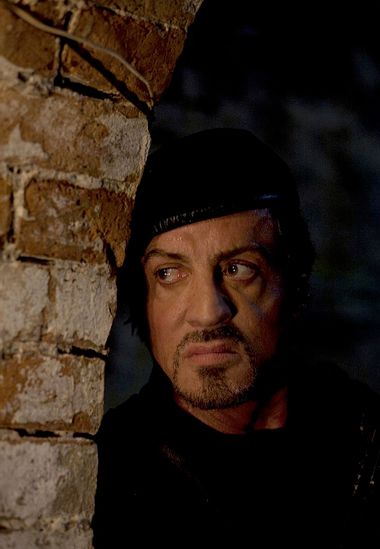
Rather than reviving the actors’ 80s heyday, “The Expendables” only demonstrates how much action films have changed in recent years. As directed and co-written by Stallone and centered around an ex-U.S. military mercenary team that runs a motorcycle club out of former member Rourke’s tattoo parlor, the film is supposed to be a back-to-basics actioner in the same sweaty vein as “Rocky Balboa” and the last “Rambo” film. Stallone leads the elite group, which features Statham as a knife specialist, Jet Li as a martial arts master, Lundgren as a hot-tempered sniper, and Terry Crews and Randy Couture as artillery and bomb experts. (For what it’s worth, the plot has them pursuing a band of Somalian pirates and then a Latin American dictatorship set up by rogue CIA man Eric Roberts.)

The obvious recent game changer in action filmmaking technique has been the “Bourne” series, which brought naturalism back into the action genre with shaky and blurred hand-held camerawork and borderline incomprehensible throw-it-against-a-wall-and-see-what-sticks editing. It’s a technique that Stallone, bizarrely, tries to ape in his new film, and in the process he manages to make a complete mess of action sequences while retaining the ludicrously violent tone of his signature ’80s work. When Stallone blew up a soldier with an exploding arrow in “Rambo: First Blood Part II,” the shocking image served as a climactic highlight; just three minutes into “The Expendables,” a bullet rips a machete-wielding pirate’s torso away from his waist, an opening salvo quickly eclipsed by wave after wave of deafening, inconsequential bloodshed. Though chaotic, “Bourne’s” cinematography is a visual statement that the world is a grittier and more complicated place than “Rambo” and its like ever acknowledged. The incongruity of “Bourne”-esque technical “realism” and outlandish, video game-style splatter in “The Expendables” is jarring: a mix of two styles signifying radically different politics.

The film’s biggest selling point — the Willis and Arnold cameos — also disappoints. The three appear in the same room when Willis, playing a CIA man, pitches the Latin American mission to both Stallone and rival mercenary Schwarzenegger. And that’s about it. “He wants to be president,” Stallone mutters as Arnold walks away. The joke is uncomfortable: It doesn’t just call attention to his real-life duties (discounting the fact that he’s technically barred from ever reaching the Oval Office), it highlights the fact that the Governator is now much more than a failed action hero. With Willis, and his legitimate acting chops, nearby, it only makes Stallone seem pathetic: a failed star hoping for a comeback and pulling favors from his cooler, more successful friends.

Which brings us to the elephant in the room: age. Most of the cast is old, featuring three 50-plusers and two near-senior citizens, including Stallone himself. But that’s one of the few sources of the film’s appeal. For all its blood and guts, the film’s rare enjoyable moments depend on the treehouse camaraderie among mostly over-the-hill, obsolete grown children, recapturing the blissful ignorance of the action movie’s youth or else staving off the entropy of its possible death. Ending with a knife flying from the hands of Statham and a motorcycle caravan scored to “The Boys Are Back in Town,” “The Expendables’” last-ditch effort to force viewers to care for its collection of butt-kicking G.I. Joe figures is almost endearing. Though the nostalgia permeating the film too often comes across as an opportunistic marketing gimmick, it’s here that one feels not a little sadness for these preening he-men and their once culturally relevant dreams of big-screen glory. The film might be disingenuous, but at least the melancholy is real.

Michael Joshua Rowin writes for the L Magazine, Reverse Shot, Artforum and Cineaste. He lives in New York City.

Continue Reading Close